Category Archives: Movie Reviews

Our reviews and thoughts on the latest releases, classics, and nostalgic favourites. Things we loved, things we hated, and worst of all, things we were ambivalent about.

The Town

Ben Affleck branded Charlestown the “bank robbery capital” of America in his movie about the neighbourhood, The Town. Neither cops nor statistics actually bear that statement out, but he certainly painted a picture of a rough neighbourhood where its inhabitants (“townies”) scowl at outsiders and steal everything that’s not nailed down. Sean and I have been to Boston a few times so I can’t quite recall which time we ventured out to “the town” for some dinner but I do recall deliberating whether we should. Sure the internet was calling this Moroccan restaurant one of Boston’s best, but did we feel safe?

hero_EB20100915REVIEWS100919991ARClearly things have changed since Ben Affleck last spent the night in Charlestown. When we visited, it was gentrified as hell, Beamers parked up and down the street. It’s also been a while since we last watched the film, so without the benefit of bellydancers or couscous, we gave it a re-watch.

Ben Affleck came on board as director only after someone else bowed out. His original cut of the movie was 4 hours long, and if you’re interested, it’s available to watch on the Blu-Ray. The studio convinced him to cut it down to 2 hours, 8 minutes for our sake, still a lengthy movie, but one that just flies by. Affleck’s character assembles a team of ruffians who brazenly rob banks and armoured trucks. He’s wanting to get out of this life, but neither his friends nor his enemies are willing to let him go. So that’s a complication. Another little wrinkle: the woman he’s currently in a relationship with is a former hostage of his, only she doesn’t know it. So that’s awkward.

You can tell Affleck is an actor-director; the action scenes are electric but the editing slows way down during character-driven scenes. He lingers over them. And he knows a great performance when he sees one. In The Town, the scene stealer was Jeremy Renner, who Casey Affleck recommended when Ben couldn’t get Mark Walhberg. Affleck has since said that Renner’s performance was so strong that he could literally save a scene by cutting to Renner looking down at a napkin.

Anyway, whether or not The Town is an accurate portrayal of the people and criminals who live there, it’s an excellent film, slick and well-paced, and it definitely benefits from great on-location shooting. The Boston on screen no longer exists, if it ever did, but it’s a great cinematic accomplishment for a hometown boy.

Shorts: Fantasia

Sleazy Pete: At less than 12 minutes long, Sleazy Pete still manages to go through 55 gallons of fake blood. That seems extraneous since Sleazy Pete is a priest who lives by the principle “Love thy neighbour” but the convenient loophole there is that the homeless aren’t neighbours to anyone so are therefore ripe for the killing. If you love B-movie gore, this one is wall-to-wall apocalyptic violence

Don’t Ever Change: Karen Hickman is newly paroled after spending her entire adulthood in DontEverChange-CyndiWilliamsprison for a crime she committed when she was 17. She’s in the midst of reconnecting with her biological daughter when a “fan” shows up with an inappropriate request. The productions values are great, the writing is fun; in less than 10 minutes director Don Swaynos gives us something truly satisfying…although I wouldn’t have minded even more!

The Story of 90 Coins: A man is much more serious about his relationship than his girlfriend is. As a compromise, she agrees to be wooed for 90 days. Every day he leaves her with a coin. At the end of 90 days, they’ll either have enough money for farewell drinks, or a marriage certificate. Sure it’s hella romantic but it also puts our poor heroine in the unfortunate position of having to choose between love and career. This short film is gorgeously shot, and if you’re in the mood to have your heart strings yanked upon fiercely, there are buckets of tears wept in the 9 minute running time.

The Madame In Black: A woman was burned for witchery, and centuries later, children still remember her with a game wherein the very brave call her name 3 times into a mirror. This short horror is perfectly edited for maximum tension.

Kong: (Bored Out of My) Skull Island

There are so many interesting components to this film that I find it unnatural and surprising how much it still sucked.

Basically: John Goodman convinces some government types that there’s this mysterious, vaguely-skull shaped island and the USA needs to LOCK THAT SHIT DOWN, like, be the first to “conquer” it and claim it as their own. So he hires crack photographer Brie Larson (for some reason), and master tracker Tom Hiddleston (for some reason) to accompany MV5BYzU4Y2VjN2ItZDA4Yy00MTBkLWI0ZGMtODcwZWY5ZDJlYTg1XkEyXkFqcGdeQXVyNjEwNTM2Mzc@._V1_SY1000_CR0,0,1500,1000_AL_him and the army led by Sam Jackson to the island that everyone knows is a no good, horrible, very bad idea. You may have noticed that the only thing more useless on this trip than the photographer is the tracker, except the little surprise that John Goodman has been keeping under his hat is: fuck surveying the island, he’s there to bring down the GIANT FUCKING BEAST, Y’ALL! Daaaaamn.
Except fuck you, John Goodman. King Kong is the least of your worries if you’re playing tourist on Skull Island. There’s much MUCH worse. But even though there’s a bevy of monsters and a bunch of a-list actors, none of them are remotely interesting. So that’s too bad. The movie is over-cast, and I’m not sure that I’ve ever said that before. But it’s just too crowded with famous faces and not one of them has a damn thing to do. And if any of them got any ideas about doing some acting or even just reciting a line that wasn’t entirely forgettable\unnecessary, Samuel L. Jackson was there to be a vacuum of talent, where his overacting is wildly disproportionate to the entire tone of the movie, thus hogging 110% of our energy, attention, and frankly, consternation, sucking up literally any sparks that anyone else was throwing off.

The only thing that I even wanted to like was Kong himself, but the movie couldn’t keep his size straight and that made me dizzy with rage (as did Brie Larson’s amazing, never ending roll of film). Kong is supposed to be big, and he is, but how big? Director Jordan Vogt-Roberts hopes you never ask that question, because he certain hasn’t. The answer is that it varies greatly from scene to scene and if you’re the kind of person who’s okay with glaring errors of continuity that don’t even take you seriously as a human being who can appreciate the difference between a station wagon, a sky-scraper, and a mid-range mountain.

Kong: Skull Island has an A-movie budget but a B-movie feel.


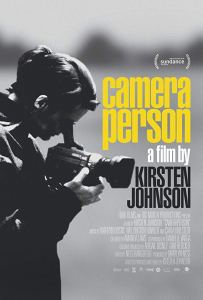
Cameraperson

“For the past 25 years I’ve worked as a documentary cinematographer. I originally shot the following footage for other films, but here I ask you to see it as my memoir. These are the images that have marked me and leave me wondering still.”   – Kirsten Johnson

MV5BMDRhMjUwYjUtYzU3OC00NTQ4LTk4MTktOGI0ODU4NmYzZWU0XkEyXkFqcGdeQXVyNDk4NTEzMTc@._V1_SY1000_SX676_AL_Capturing a thunderstorm, the camera shakes as the cameraperson sneezes.

A baby is born in Nigeria and seems to stare, and smile, directly into the camera.

A lawyer in Texas prepares nightmarish evidence for trial.

In Uganda, dancers and musicians ham it up for the camera.

That opening quote says it all. This is a series of very short clips, strung together they make up a scapbook or photo album, a collection of the places she’s been and things she’s seen and work she’s done. Some are very personal (her own twins appear) and some are political and some are funny and some are just beautiful, a magical moment caught on film. She catches more than most.

The way they’re woven together, it’s almost like we’re seeing a highlight reel from her own memory. There are patterns and there are insights. Micro-stories are told in just a few frames. And sometimes we get to know a little about what it’s like to live behind the camera, to observe something without intervening, the struggle between objectivity and responsibility and compassion.

If you’re narrative-needy, Cameraperson is not for you. It’s fresh and inventive and it tells a story in a different kind of way, but it’s worth it. Which is not to say in requires a lot of effort because for the most part, it’s a laid back, easy ride that may feel more familiar to a generation who will stream a series of unrelated clips for hours on Youtube. Except this one will feed your soul.


Personal Shopper

Kristen Stewart, I’m sorry honey, I didn’t really know you could act. You seemed up until now to have two settings: eyebrows and lip biting. Yet here you are, quietly impressing me.

Maureen (Stewart) is indeed a personal shopper. She picks up the glamourous clothes and accessories her celebrity client can’t be bothered to. Maureen despises Kyra but the MV5BOGFiY2U2ZTYtOTRmMS00MTY2LWE1OGEtZDUyNTI4N2I4YWUwXkEyXkFqcGdeQXVyNjcwNzI4MzE@._V1_money’s good enough to pay the rent in Paris, which is important to her. She’s in the city and won’t leave until she hears from her brother. Her dearly departed brother. Which is an obstacle of course. But she and her recently deceased twin brother are\were both mediums with a genetic heart defect, and they’d promised each other that whoever died first would signal the other from beyond, if such a thing existed.

But when contact IS made, how sure can Maureen really be that it’s her brother and not some creep? Or some other ghost? She wants SO badly for it to be him, but her skeptical nature can’t help but vacillate. This makes Personal Shopper a film that’s hard to pin down. It approaches grief in a way we’re unaccustomed to, but it’s also part ghost story, part coming of age, part mystery, part spiritual discovery.

Personal Shopper compels even though it’s largely about mournful solitude. Director Olivier Assayas, who previously got an excellent performance out of Stewart in Clouds of Sils Maria, creates an ambiance that pulls you in as much as it creeps you out. But he doesn’t overdose on the ghost story stuff, he knows it’s scarier and more effective to dole it out in small measures.

It probably helps that Assayas wrote Maureen specifically for Kristen Stewart; she’s actually meant to be taciturn and moody. But the character ultimately lacks depth, which is pure laziness since we spend pretty much the entire movie with her. It’s still a good movie though, with an atmosphere that won’t quit and a solution that begs to be found, even if we think we already know it.

Free and Easy

To be honest, it took me a while to adapt to the pace of this movie. It is slow, deliberate, and very measured. There’s no getting ahead of yourself. But the unusual story and glimmers of humour hooked me and I was glad I stuck it out. Free and Easy is genuinely something that feels new and unique.

It’s about a “soap salesman” who never sells a single bar but does encourage people to sniff his product (“a different scent on all 4 sides!”) because doing so induces loss of consciousness. Once his would-be customers are asleep on the ground, he frisks them for money and valuables. So he’s really a thief, posing as a salesman.

1_22_free-and-easy1-676x450Director Geng Jun shows us a side of China rarely seen: crumbling, bleak, all but abandoned. This cold, deserted, post-industrial town in northeastern China is dotted with rural characters, and they’re all as shady as the salesman.
It almost watches like loosely connected vignettes, a series of petty crimes where corruption and lawlessness is the new normal. But whenever these criminals encounter each other, you can’t help but laugh. The humour is deadpan but it landed surprisingly well for a movie that runs the risk of being lost in translation. There’s some slap stick, which I suppose is universal, but really it’s just the contrast between this totally depressing setting and the buffoons that populate it that just works.

The film is minimalist but that doesn’t mean there isn’t a lot of attention to detail poured into each shot. Out-of-focus details often sharpen into the butt of the joke. You have to stay alert to small gifts planted by the director along the way. Sure the subtext of the film is a little depressing, but it’s delivered in such an obliquely funny way, the message presented by sliding it in sideways, that you’ll laugh appreciatively at things that aren’t even overtly funny. In a film full of grifters, it’s the cops who are the dirtiest  of them all. That’s the lens through which contemporary, provincial China is explored in (ironically titled) Free and Easy, and the film stays remarkably on-brand.

Dunkirk

We shall fight on the beaches, we shall fight on the landing grounds, we shall fight in the fields and in the streets, we shall fight in the hills; we shall never surrender, and even if, which I do not for a moment believe, this island or a large part of it were subjugated and starving, then our Empire beyond the seas, armed and guarded by the British fleet, would carry on the struggle, until, in God’s good time, the New World, with all its power and might, steps forth to the rescue and the liberation of the old.

-Winston Churchill, June 1940

Has anyone ever been better than Winston Churchill at giving motivational speeches?  He had a way of rising to the occasion and here, the stakes had never been higher.   This speech was given immediately after the British and their Allies had been run out of France by the invading Germans.  Victory over the Nazis was not on the horizokinopoisk.run and must have seemed impossible at the time.  That’s more or less what Churchill said, after all: he is not describing a plan to win.  He is describing a last-ditch effort to survive when the Nazis try to conquer Britain after they finish in France, and a cry for help to the New World to save the day in that bleak scenario (Canada was, of course, already part of the Allied forces at the time, but the U.S. would not be until Pearl Harbor).

The devastating outcome of the Battle of Dunkirk gave good reason for Churchill’s pessimism.  It is a fascinating historical event because it was a loss that could well have broken the Allies, but instead, it galvanized them, particularly in the way that the British survived: hundreds of civilian vessels sailed from Britain to France to help rescue over 300,000 Allied soldiers from the Nazis.

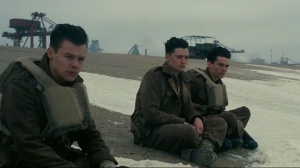
Time and time again, Christopher Nolan has proven himself to be as adept a director as Churchill was a speaker.  Tonally, Nolan’s Dunkirk captures what must have been the prevailing mood on the ground, at sea, and in the air as the Battle of Dunkirk was fought.  Nolan makes an inspired structural choice by intertwining three different stories over three different time periods, and as only Nolan can do, effectively explains a complex structure using only three small titlecards at the very beginning.  Dunkirk is reminiscent of The Prestige in that way – in both, Nolan always provides enough cues so the viewer knows exactly where a particular scene fits into the overall timeline and story, even as he tells the story in a complex, non-linear fashion.

With Dunkirk, Nolan has outdone himself.   Given how consistently great he has been throughout his career, it is incredible to think that he has gotten better, but that is clearly the case.  Dunkirk is absolutely masterful filmmaking from start to finish.  Above all else, Nolan’s film captures the essence of Dunkirk and gives us a true sense of the anguish of war, the desire to survive, and the fear of the unknown that soldiers must deal with constantly.  In particular, I am reminded of the scenes featuring Tom Hardy’s RAF pilot, all of which inserted me into the battle and truly made me feel how claustrophobic a Spitfire’s cramped cockpit would be, and how difficult it would be to spot, identify, and track an enemy fighter, let alone shoot it down.

For the viewer, this is a vital, visceral, and draining experience.  Dunkirk is a 106 minute movie that feels like it’s four hours long (which Nolan would take as a high praise, I think, if he ever read this review).  From start to finish, it is tense, it is devastating, it is awful and it is brilliant.  Dunkirk is filmmaking at its finest and a fitting tribute to one of the defining events of the 20th century.


Dead Shack

Dead Shack is that rare comedy-horror hybrid that actually works on both counts. It was yet another surprise from Fantasia’s lineup and I really have to stop being surprised because the truth is the programming is quite excellent even if the movies tend to do be a little wheelhouse-busting.

[I mean, what the hell is a wheelhouse anyway? Well, okay, I know what a wheel house is, it’s the little shack on a fishing boat where the wheel goes. If something’s in your wheel house, then you’re capable of doing it. And it’s not that I’m incompetent or unable MV5BZTgzODJjNDUtNGVhNC00NmUxLWJmYWUtMWU0ZTRiMGZmMzMxXkEyXkFqcGdeQXVyNjEwNTM2Mzc@._V1_SX1777_CR0,0,1777,743_AL_to watch genre films, it’s just that I’m rather chicken and often shy away. But here I am, grabbing the ole wheel by its…spokes? And I’m loving it.]

Dead Shack is about a family who goes on a budget camping trip to a rundown cabin in the middle of some bug-infested hellhole, and if I stopped writing right there, well, that’s horrific enough for me. But no. While on the trip, Dad and Dad’s new girlfriend immediately set to partying (euphemism for heavy drinking). His teenage Son and Daughter and their Ambiguous Friend knock about in the creepy surrounding woods and stumble upon a neighbour who looks like a Volvo-driving soccer Mom until she puts her armor on and brings home human prey for her undead family to feast upon.

For a movie about cannibalism, it’s actually quite funny. A lot of the fun comes from Dad, who is earnest and geeky and trying just a little too hard to be Cool Weekend Dad. But then it’s his kids who have to come to the rescue with their improvised armaments and slapped-together weapons. Death Shack kind of has the feel of an 80s movie – picture a Goonies-Evil Dead mashup. And there’s still plenty of gore and tense framing and a pretty heart-pounding soundtrack to satisfy the sickest of you souls. Bon appetit.


War For The Planet of the Apes

This review is late because it’s taken me all this time to decide how to tell you that Sean and I went to see this at the drive-in but I got so baked I have no idea what the movie is about or if I enjoyed it. After days and days of deliberation I think I’ll go with “Ehh, another movie about a talking monkey, who gives a shit” That’s pretty smooth camouflage, right?

I mean, those are probably my true honest feelings because I’ve never been into this franchise. I checked out the moment a trailer showed me an ape riding a horse and I am physically incapable of checking back in. But all my lovely review compatriots have been talking this one up like crazy, like it’s an actual, honest-to-Heston good movie. And I believe them, sort of.

Here’s what Sean and I were able to cobble together over lobster BLTs on the patio:

  1. Caesar, the leader of the apes, has decided to move his congregation to a nicer locale because presumably real estate just got too damn expensive in San Francisco.
  2. He sends the majority through the desert (?) toward ape shangri-la, but he and a few trusty sidekicks stay behind to confront the Evil Colonel and settle a personal vendetta.
  3. The Colonel (Woody Harrelson) really hates the apes, and is really afraid of turning into them. He’s gone rogue though.
  4. The real army hates the Colonel as much as the Colonel hates apes. The Colonel has enslaved some apes to build a wall that doesn’t help him all that much come Go Time.

Is that about it? I’ve got the gist, right? The story didn’t connect with me whatsoever but even in my distracted state I thought the CGI was crazy-good. I usually hate movies like The Jungle Book where I know I’m just watching a cartoon but I didn’t really feel that way in this movie. The motion-capture technology is pretty stellar and Andy Serkis is doing top-notch work. The Special Achievement Oscar was given out from 1973-1995 in recognition of achievements that made exceptional contributions to the motion picture for which they were created, but for which there was no annual award. The last year it was given it went to John Lasseter for his leadership of the Pixar team that birthed Toy Story. Maybe it’s time to dust that award off for the work that Serkis in particular has done with performance capture.

That’s all well and good but I think we can all agree that these pretty words are just frosting meant to cover up the fact that I forgot to bake the cake. If you really need to know more about War For the Planet of the Apes, please follow these links to people who paid better attention than I did:


The Film Blog calls it “a hugely satisfying round off to a superlative trilogy.”

Movie Man Jackson calls it “emotional-drama first, action-blockbuster second.”

The Craggus saw it and called it his “new favourite Apes movie and the benchmark by which I’ll be measuring the rest of 2017’s offerings.”

Jason called it a “sheer cinematic achievement in film.”

Bad Bloke Bob called it a “a tonal masterclass.”

Steve J Donahue reluctantly admits it’s “a crowd pleaser” but actually pleases me with his faint praise.

Polar Bears insist “this apes trilogy isn’t just a good blockbuster trilogy; it’s damn good filmmaking overall.”

Sarah finds “much to like about this film.”

Society Reviews called it “uninspiring” and had the same problem with the wall that I did. So ha!

Keith Loves Movies found influences from “The Revenant, Saving Private Ryan, The Shawshank Redemption, and Silence.”

Nerd Feed calls Caesar “one of the greatest cinematic characters we’ve ever seen.”

Andy gives it 5 “damn dirty apes!” out of 10.

Adam found it “wonderfully charming” but noted an “exaggerated runtime.”

The Honor Farm

I hadn’t seen my friend Josh in months and was eager to tell him all about the exciting new movie I saw at the Fantasia Film Festival. “I just saw The Honor Farm and I’m still trying to figure it out,” I told him while seated at a nearby Mexican restaurant.

I hadn’t seen the baby boomer somehow Honor farmstanding right over me until he chose this moment to cut me off. “I just saw that,” he complained. “It was terrible“.

I didn’t really want to get into it with this guy nor was I even confident that I had understood the film well enough to defend it so I just smiled politely as he told me that it wasn’t even scary. I bashfully admitted that I was the guy who jumped and cried out during the final act.

honor farm 2

The Honor Farm is exactly that kind of movie. It’s the kind of movie that you need to let sink in while you ignore those who will immediately and loudly dismiss it. Lucy (Olivia Grace Applegate) seems to feels like she’s just going through the motions as she prepares for her prom. After her drunk date embarasses her and tries to force himself on her, she reluctantly agrees to accompany her best friend Anne (Katie Folger) and a classmate she barely knows into the woods to take shrooms in an abandoned prison farm.

Other than that, the less you know about The Honor Farm the better. Although you should probably be warned that horror fans like the one described above may be disappointed. Because the set up seems bloody perfect. Eight teenagers, most of them seeming to fit a typical scary movie stereotype, entering a creepy prison on prom night might make you start placing bets on who will be first to die but this isn’t your typical scary movie. What follows is truly surreal and genre-bending and few of these character arcs play out like you’d expect.

I may have been a little lost during the closing credits but The Honor Farm keeps getting better the more I think about it. And I’ve been thinking about it a lot.