
Roma is the kind of movie that births film criticism. It will be used as the golden example in so many future texts I ache to think how many words will eventually be written about it and can’t quite fathom it.
Mexico City, 1971, a young family is having a rough time. Mom and Dad were fighting a lot, before he left, and now they do it on the phone, when he remembers to call. Four young kids are feeling vulnerable and acting out. Two young servants are trying to keep it all from falling apart. But one of them, Cleo (Yalitza Aparicio), is going through her own private crisis as well. She’s pregnant, and the father has run off. Fearing for her job but unable to return home to her religious family, her current situation is tenuous and her future uncertain.
This is the semi-autobiographical work by Alfonso Cuaron about that crazy time in his 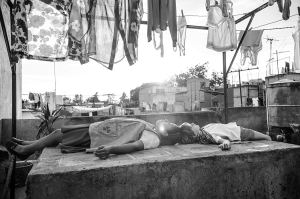 childhood when his beloved maid’s unexpected pregnancy collided with his parents’ bitter divorce. It marked him for life, and all these years later he’s strung together the haunting images from that period and used his memory to paint in the rest. He’s only a minor character in the film, it’s really an ode to the women who raised him: his mother, the two servants, and Mexico herself.
Cuaron immerses us in Mexico circa 1971. Filmed in starkly beautiful black and white, you can’t help but drink it all in, everything from the airplanes overhead, to the geese in flagrante delicto, the muddy markets and the local cinemas, the grassfires and New Year’s Eve traditions, rooftop laundry and candlelit chores, every scene is packed with loving details to a time and place Cuaron clearly treasures. His camera moves slowly, soaking up detail, lingering lovingly in quiet places. His trademark long takes emphasize time and space – the big house compared to the servant’s quarters, and the time Cleo devotes to undoing the naughty work of busy children. The sound design is incredible. At times I was overwhelmed by the layers of noise in the city – hawkers, vendors, tradespeople, cars, trucks, buses, dogs barking, children playing, marching bands tooting their various horns in seemingly random parades.
Roma is of course shot in Spanish and subtitled with care. It is obviously composed with great care as well, with so many interesting angles and viewpoints (a Christmas party filmed at child height, for example) and depths of field. Lensed by Cuaron himself (Emmanuel Lubezki was unavailable, but his collaboration in pre-production means his DNA’s all over it, Cuaron assures us), he often keeps his entire shot in crisp focus, with as much going on in the background as the foreground – but when the focus goes soft, it’s for good reason. Take note.
This film brims with the kind of personal detail that makes it truly unique. I especially liked seeing the young boys clearly obsessed with outer space – posters, toys, and astronaut costumes – you can’t fail to think that these are the origins of Gravity. Indeed, Cuaron has left a little piece of his heart on the screen. It is not sentimental, but it is affectionate, made with love. And I think it will be received, by audiences and the Academy, with nothing but.
 his kids, his little dog Olivia. Sure they’re criminals but they’re also doting dads, bill payers, lawn mowers, trash taker-outers. So you’ve got this brilliant back and forth of the two, somewhat disparate, halves of their lives. The hard and soft, the why and the how of tough jobs with lots of risk. We don’t spend much time with them, but we already know they are much than just their crimes, and when they meet their end, it’s not without sadness, a loss that is earned. And it’s also a highly effective way of introducing both theme and character. Brilliant, nimble work.
 crave it even more: a vicious cycle. It doesn’t always happen like this, but sometimes it’s a normal, happy, middle-class kid from a good and loving family who falls prey. Nic feels he’s disappointing his family. His parents feel they’ve somehow failed him. But now what? Do you support/enable him indefinitely, do you watch his teeth rot and his flesh waste and the life behind his eyes disappear? Do you allow his behaviour to tear your whole family apart, exposing younger siblings to it? Or do you cut him loose, not knowing where he is or if he’s safe, hoping every day that his rock bottom isn’t 6 feet deep?
 there. No, Dan Fogelman grows the concept to include generations that cross continents. The ensemble cast includes Antonio Banderas, Annette Bening, Olivia Cooke, Sergio Peris- Mencheta, Laia Costa, Alex Monner, Mandy Patinkin, and Jean Smart. Like his hit television show, Life Itself is not so much about the destination but the journey. Fogelman plays around with the chronology, as he does, and with an unreliable narrator and its delicious implications.
 Wales are quite enraged, so they’re only going to come at Robert (Chris Pine) harder – including declaring him an outlaw, and seizing his wife and daughter (which is poor gift-giving etiquette on their part). So Robert just gallops around raising hell and hopefully spirits until the two sides meet in an epic, EPIC, horse-murdering battle.
 The ever-evolving Predator crash lands on earth and interrupts a U.S. sniper’s top secret Mexican mission. After ejecting from its ship, the Predator kills the sniper’s support team but the sniper (Boyd Holbrook) manages to escape, mailing a few pieces of the Predator’s gear home as evidence of the encounter. The gear finds its way to the sniper’s son (
 Of course, ridiculousness is a Black staple and while Predator does not quite measure up to Black’s best (namely, the amazing Lethal Weapon), it is a wonderfully entertaining film thanks to Black and the extremely solid cast. The standouts of the teriffic ensemble are Tremblay as the protagonist’s code-cracking son and This Is Us’s Sterling K. Brown as a scenery-devouring special agent whose motives are never clear but always nefarious. The Predator keeps up a steady stream of action and laughs from start to finish, and as a result, I’m now waiting eagerly for the even-more-ridiculous sequel that the Predator blatantly and shamelessly promises.
 whole town’s on the brink of disaster. In 1960, the whole country’s on the brink of a sexual revolution, and women’s lib. But they’re not there yet. It’s shameful that Jeanette has to work instead of staying home with her son (who is 14 and never home). And they clearly don’t know how to do divorce; they forget the part about telling each other, and not committing adultery in front of the children. It’s a crazy time to be alive!
 composes poetry that is beautiful and eloquent beyond his years. Lisa feels an addictive high when she recites it as her own in poetry class, receiving praise by peers and teacher (Gael Garcia Bernal) alike. But mostly she just becomes obsessed with this kid, believing she’s the only one who can nurture his talent. Her behaviour becomes increasingly troublesome, though even on the mild end of the spectrum (depriving him of naps, luring him into bathrooms, alone, with candy bribes), I was uncomfortable.
 her family’s murder, she’s got a plan, and she’s got the skills and weapons to see it through. First, a trio of dead gang members are found hanging, execution-style, from the carnival ride where Riley spent her last moments with her daughter. It’s a message to the city, to the cops, and to the criminals she holds responsible. She’s coming for them.
