
Phineas Taylor Barnum was a showman first and foremost. His legacy includes a best-selling memoir, museums, philanthropy, and a circus who just closed its doors earlier this year, after something in the neighbourhood of 175 years of success. The Greatest Showman is the story of his life, only not: it’s the fictionalized, glamourized, told-in-an-entertaining-and-succinct-105-minutes version that somewhat resembles his life, or at least a rags-to-riches edition of it. It’s not historically or personally accurate but it IS beautiful and breath taking and fun. In fact, it’s the most excited I’ve felt at the movies all year.
Hugh Jackman has already established himself as a versatile actor: he makes Logan, a veritable man of steel, seem both tough and vulnerable. Here he straddles Barnum’s pursuit of fame, money, and success with his more modest but fulfilling 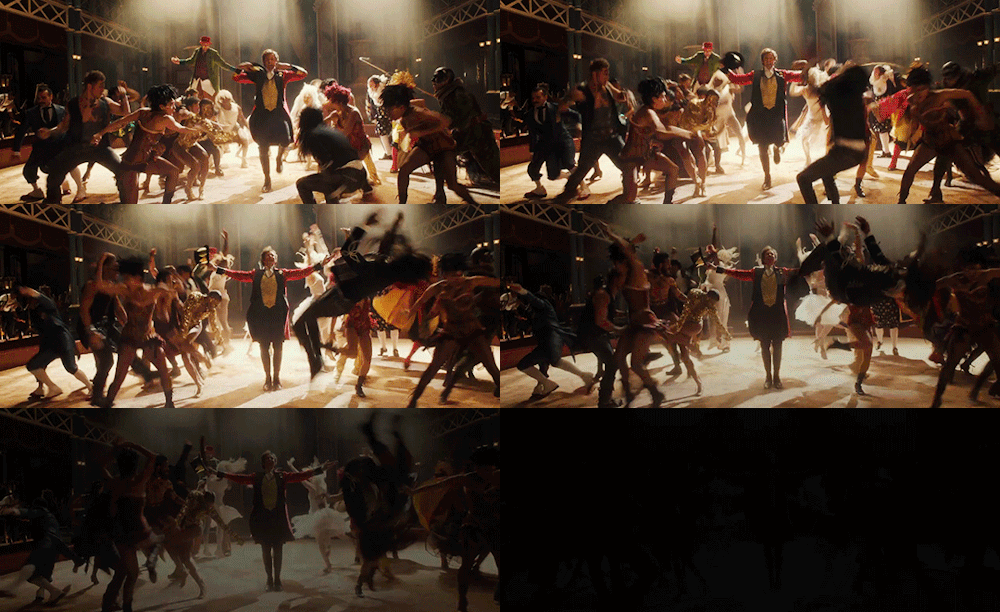 goals of happiness and family. Ultimately we see Barnum find both fame and family in the circus. He collects ‘freaks’ and ‘sideshows’ and gives them purpose and a platform. People pay the price of admission to look on in sensational horror.
The film is glossy, a glory to look at, and a wonder to hear. It’s a musical, with lyrics by Tony-winning (Dear Evan Hansen) and Oscar-winning (La La Land) duo, Benj Pasek and Justin Paul. A mashup of modern-sounding, toe-tapping, pop and hip hop, the music reflects an aesthetic that isn’t so much true to the time period, but more a tribute to Barnum’s constantly being ahead of his time. With dazzling, daring cinematography by Seamus McGarvey (Life, Nocturnal Animals, Atonement) and buoyant, irrepressible, vibrant production design by Nathan Crowley (Dunkirk, Interstellar, The Dark Knight trilogy), The Greatest Showman is a work of art by veteran professionals – except for its director. Michael Gracey had in fact never directed any movie at all before – why, then, did 20th Century Fox trust him with 80 million dollars and a promising script, co-written by Bill Condon, Oscar nominee for best adapted screenplay for Chicago, and winner for Gods and Monsters?
Hugh Jackman met Michael Gracey 8 years ago when Gracey directed him in a TV commercial in Rio de Janiero. The two hit it off creatively, and within months Jackman was suggesting him as the director a passion project of his, and with Jackman on board as star and producer, it only took about a hundred pitches or so before someone finally said yes. Yes! And true to the Barnum name, the movie wouldn’t just be a musical, it would be over the top, larger than life, bursting at the seems with spectacle.
In addition to Jackman, the cast boasts the likes of Michelle Williams as his long-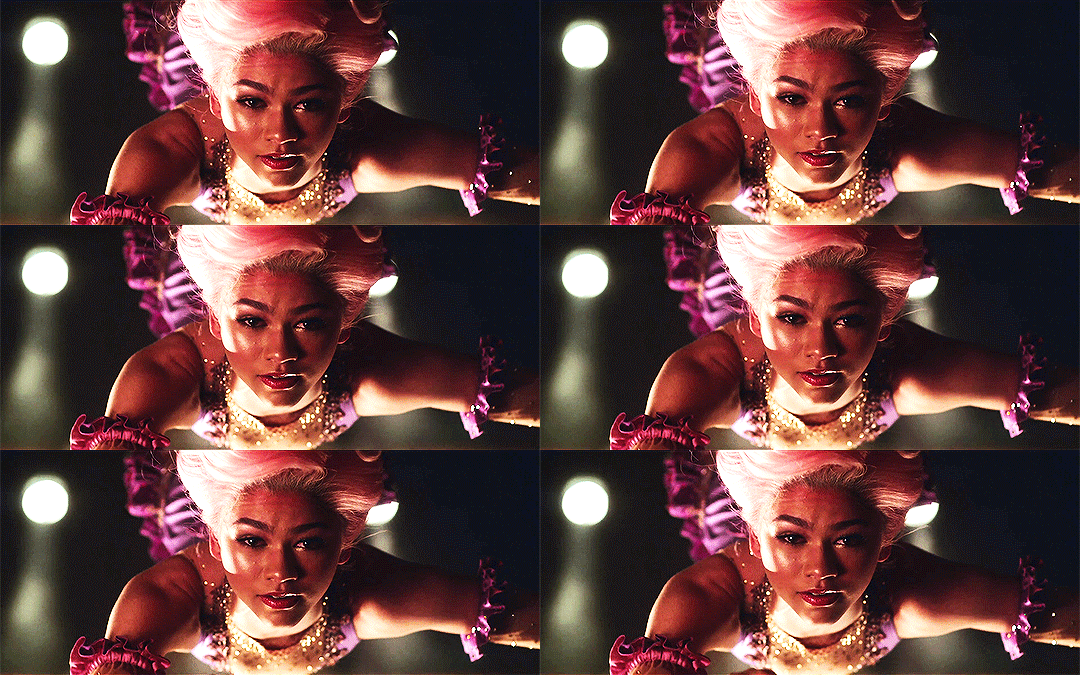 suffering wife, Charity, Zac Efron as his business partner, Zendaya as a talented trapeze artist, and Rebecca Ferguson as the songstress who legitimizes his success (though credit for her amazing voice goes to Loren Allred, who dubs her in the film).
The Greatest Showman is like the best parts of Big Fish and Moulin Rouge smooshed together. It lit my heart aglow. If you’re looking for a true account of PT Barnum’s life, read a book. What The Greatest Showman offers is a damn good time at the movies, so see it in theatres, on the big screen, the way it was meant to be seen. Hugh Jackman will thank you for it.
 modern effects and technology – and yes, it looks slick as hell. It’s basically Transformers fighting dinosaurs, which appeals to the little boy that exists surprisingly near the surface of nearly every man I know. This movie was released just before my dear sweet nephew Ben was born, but it strikes me now as made especially for him. I know one day we’ll watch it together, and my old bones will creak for the next six months as we painstakingly recreate every battle scene without the benefit of CGI.
 Vanessa has a nasty habit of trying to set her little brother up with patients, which could get ethically “sticky.”
 choice. Steven (Colin Ferrell) is a surgeon with a devoted wife Anna (Nicole Kidman), two talented children, and the devotion of a teenager of an ex-patient (Barry Keoghan). But you know that everything’s about to unravel. Maybe Steven isn’t such a great surgeon. And maybe his family are all a little more self-interested than we thought. And maybe Martin, the teenager, is hiding something sinister.
 much of a cum dumpster their mother was. The movie suffers an identity crisis very early on: is this a raunchy comedy? A movie full of surprise twists? Sentimental slop? Buddy stuff? A road trip movie? Or just an excuse to slut-shame sex-positive Glenn Close?

 Maynard is shocked and disturbed, and after a night of drinking, he finds his old hunting gear and an ape mask, though they bring him little consolation. Cut to: the next morning, the small town’s abuzz: big foot is on the loose. It doesn’t take long for Maynard to connect the dots and realize HE’S the one they’re looking for, but he keeps that embarrassing information to himself and the legend grows.
 in Toronto this weekend where the Art Gallery of Ontario is hosting a special exhibit on Guillermo del Toro called At Home With Monsters. Del Toro’s visual panache extends well outside the bounds of his film making. The themes that so often crop up in his movies appeal to him in his real life as well: religion, death, magic and alchemy, gods and monsters, insects and their symbolism, gothic detailing. He’s obsessed with Charles Dickens, Frankenstein, and macabre art – so much so that when his collection overwhelmed his home, he bought two more just to house the stuff. Adjoining the two houses, which he calls Bleak House, it has become a museum of sorts, stuffed to the gills with every crazy thing that’s ever inspired him. And now he’s curated from among his pieces and sent them out into the world for the rest of us to enjoy and think over. The exhibit comprises some 400 pieces – just 10% of his collection, but still more vast than I had anticipated, and it includes story boards, props, and costumes from his movies. It runs in Toronto until January 7th so you should really check it out if you can. If you can’t, you can try to console yourself with just a small sampling below.
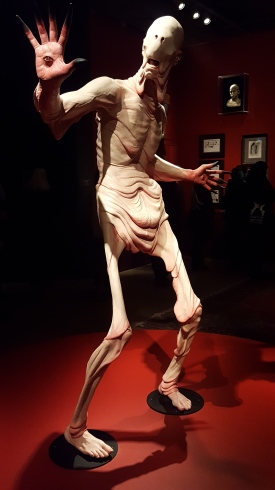 Del Toro based the Pale Man’s face on the underside of a manta ray – as a kid he found the fish’s tiny mouth and nostril slits frightening. In Pan’s Labyrinth, the Pale Man consumes fairies and children, but in today’s political climate del Toro sees his creation as an example of predatory white male supremacy. Just after the 2017 US Presidential inauguration, he tweeted “The Pale Man represents all institutional evil feeding on the helpless. It’s not accidental that he is a) Pale b) a Man He’s thriving now”


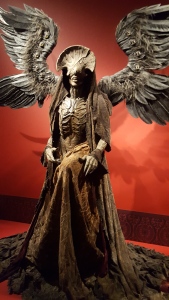 del Toro has simply moved the eyes to instantly create monstrosity. We learn as babies to expect two eyes, and when we don’t find them where they should be, it’s instantly disorienting. He drew inspiration from the archangels of medieval manuscripts, which had eyes on the feathers of their wings. The Angel of Death has a bony faceplate and misplaced eyes, making it literally blind to human suffering – the opposite of what we think a ‘guardian’ angel should be, which throws us off balance. Del Toro is really, really good at that. He defies and challenges our expectations.


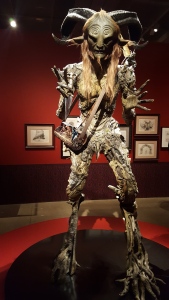 The Faun, from Pan’s Labyrinth, was inspired by del Toro’s recurring childhood dream (nightmare?) of a goat-faced figure who slowly emerged from behind his armoire. In the film, the Faun is intended as neither good nor evil, like nature, he is there to witness but has no agenda – he literally doesn’t care whether Ofelia lives or dies.


 ASSHOLES WATCHING MOVIES