Meg (Alicia Witt) loves giving voice and piano lessons out of the music store her family has run for generations. When she meets Nate (Andrew Walker), who’s just returned to Denver after years away, he’s surprised to learn that their store still exists. It’s one of many locally owned, mom and pop stores still somehow standing on Christmas Tree Lane in the city’s historic downtown. They’ve managed to withstand the pressure from suburbs and malls and online shopping, but the whole block has just received a collective eviction notice; all of these old buildings will be demolished to make room for new office buildings, and these guys have to be out by the end of the year.
Meg, of course, is determined to save Christmas Tree Lane, and organizes a vintage Christmas extravaganza – a tree decorating competition, a Santa photo booth, and of course, considering her proclivities, a Christmas concert to rally the whole community. Nate, who thinks she’s cute, is her new best customer, and now he’s also her best soldier in her little Christmas army. At least until they discover that Nate works for the evil development firm (run by his own father of course) that’s planning on tearing down Christmas Tree Lane. Boo!!
So what do you think? Will Nate develop sugar diabetes from his cocoa habit? Will Meg ever get to wear that slinky vintage dress? Will a concert possibly stop a wrecking ball? You can only find out by watching, so hurry on over to Hallmark.
Director Graham Kolbeins’s Queer Japan has a big, open heart. The documentary examines the multi-faceted queer community in Japan with a generous cross-section of its members. Tomato Hatakeno is a transgender activist and video game guide book author; Gengoroh Tagame is a gay erotic artist known internationally for his hardcore BDSM-themed manga; Vivienne Sato is a famed artist and drag queen. But despite the film’s depth of trailblazing artists and activists, it punches most heavily when it’s sitting with everyday people, people who are making compromises and taking risks just to live some part of their truth. One young person, a misfit, a gender outlaw, commented at a pride parade “I don’t give a shit about love, I need toilets” – a brutally honest reminder of a hierarchy of needs and rights that are not addressed equally within the community (or, I suppose, without).
Curating from over a hundred interviews conducted over 3 years in various locations across Japan, Kolbein has more than enough colour to paint a rainbow. We get a back stage pass to the glossy parties and the seedy underground, meeting people living boldly in all walks of life. It’s truly a prismatic view of Japan’s deliciously diverse queer culture, and a glossary of terms is helpfully provided so we enjoy as immersive an experience as possible.
Queer Japan is a celebration of non-conformity, of alternative thinking, of living life without apology. But this party is also well-informed by that same community’s hardships, struggles, and minority status. While much of it is still lived in the margins, the documentary’s hopeful, irrepressible tone makes it clear that change is coming, and this vibrant, resilient community is not just ready for it. They’re making it happen.
Queer Japan is available in virtual cinemas and on demand December 11.
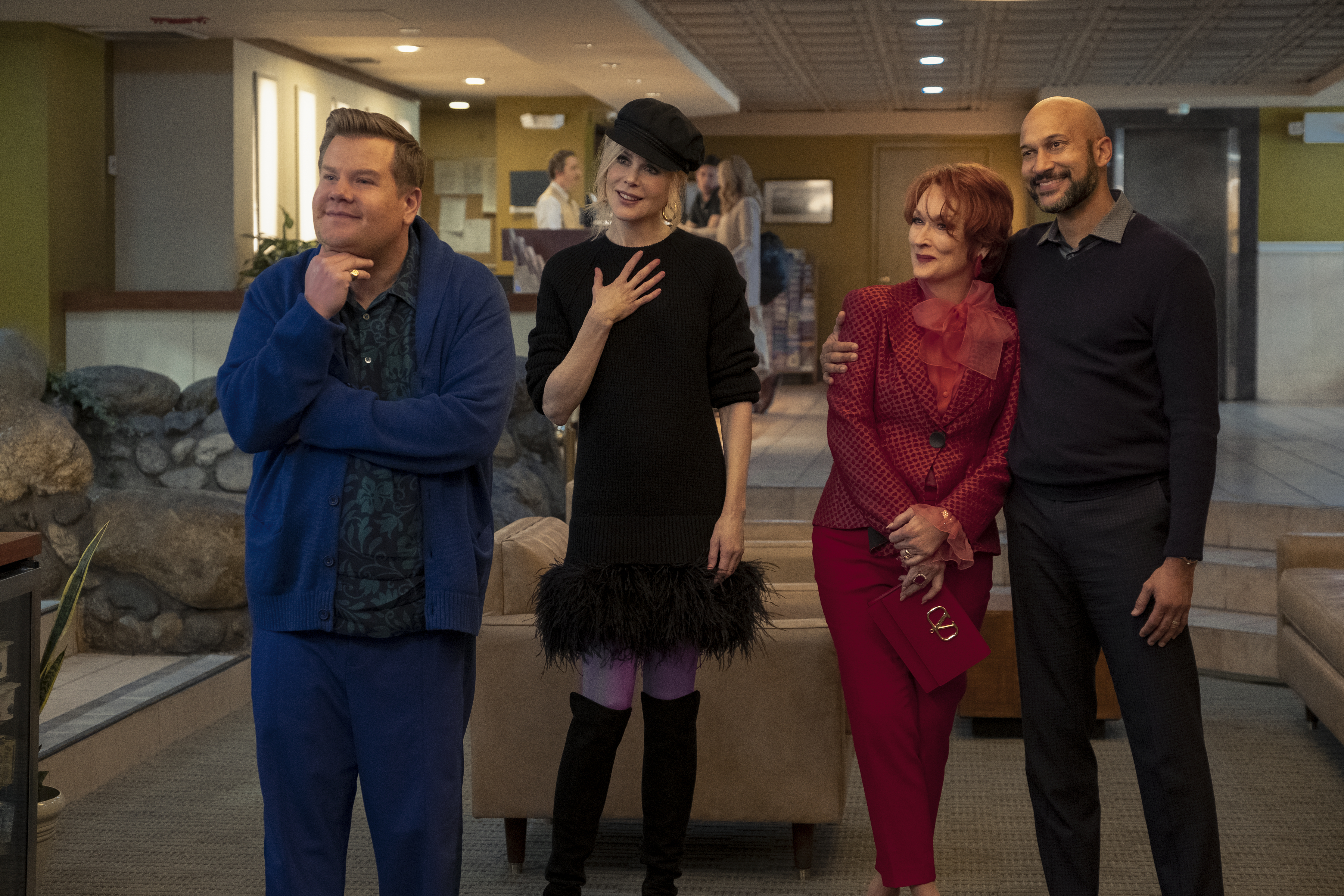
The Prom is a new movie on Netflix based on a Broadway musical of the same name about a handful of Broadway stars looking to clean up their image by taking on a random cause. The cause in question is a prom in Indiana that the PTA would rather cancel than allow a gay student to attend with her girlfriend. It’s a pretty gay musical that Ryan Murphy manages to make bigger, better, and gayer than ever, with boatloads of sequins and buckets of wigs, and the shiniest, sparkliest cast he could assemble.
Dee Dee (Meryl Streep) is a veteran stage actress, a Broadway phenom with a Tony in her purse and an outsized sense of entitlement. When we meet her, she’s starring in the opening night of Eleanor, a musical about Eleanor Roosevelt. Co-starring as FDR is Barry (James Corden), a Broadway mainstay who’s still chasing that first Tony, and hoping this might be it. Unfortunately, a bad review pretty much shuts them down on that first night, and someone has the temerity to point out that it’s not so much that the show is bad as that the two of them are so disliked. They’re narcissists, they’re told, though they’re not convinced that’s such a bad thing. But in the best interest of their careers, they decide to rehab their reputations by support a cause (a cause celebre, they specify) along with Broadway actor “between gigs” Trent (Andrew Rannells) and inveterate chorus girl Angie (Nicole Kidman), who ride the next bus out of town toward homophobic Indiana.
Emma (Jo Ellen Pellman) is the sweet teenage girl who just wants to take her girlfriend to prom. Alyssa (Ariana DeBose) is her closeted girlfriend and the daughter of Mrs. Greene (Kerry Washington), the “homosexual prom’s” #1 opponent. Principal Tom (Keegan-Michael Key) does what he can to mitigate the damage but he’s pretty powerless with so much opposition. Plus, now he’s start struck on top of everything else – he’s Dee Dee’s biggest fan.
As our Broadway do-gooders get to know Emma and her situation, what started out as a charitable act of self-interest turns into something a little more genuine, although the unironic, attention-hogging performance of It’s Not About Me had its charms. Both the songs and the film are uneven, but they’re also so much fun, who cares? I didn’t particularly buy Nicole Kidman as a mere chorus girl either, but do you hear me complaining? No. Because singing and dancing have put so much joy in my heart I should feel ashamed to ask for anything more.
The Prom is not a great movie, but it is boisterous, glittery good fun, full of beautiful costumes, beautiful voices, and a totally stacked cast. Ryan Murphy doesn’t do subtle, but he does have an eye for a fantastic musical number and this movie has north of a dozen. Though the feeling may be flitting, you can’t help but feel good while watching it, and what a perfect way to spend an evening near the holidays. The Prom is pure indulgence – tacky, campy, cheesy, and unforgivably feel-good. So feel it.
Kendra Adams (Nazneen Contractor) went to school for journalism but wound up writing listicles and personality quizzes at a Buzzfeed knock-off. She’s pretty good at getting readers wondering what kind of reindeer they are, but she’d like to do a little more so she keeps pitching her boss meatier pieces, which her boss summarily rejects.
One day, while browsing an antique store’s jewelry counter for her own mother’s lost engagement ring, she finds a similar one with a unique inscription, “My Christmas Love 1948.” The romance and mystery intrigue our intrepid reporter Kendra, whose subsequent pitch is again rejected but she decides to pursue the story anyway, on her own time. In New England she’s able to trace the ring back to the owner’s grandson, Michael (David Alpay), who was raised by his grandparents but has no memory of the ring. Together they discover the legacy his grandparents left behind, and the sacrifices they both made for what was most important – love.
Will it lead to a story? Or will it lead to something even more important: Kendra’s own romance? Watch and find out – the answer may surprise you!
I was in the right kind of mood to fall in love with a movie, and Mank was it for me.
Sean and I were at the cottage last weekend celebrating his birthday, and it was the first 48 hours I’d spent movie-free all year. Which is weird, considering 2020 will be known, among so many other things, as the year without movies. And yet, if you’re devoted to movie views and reviews, there were actually plenty of films to watch (this is my 428th review this year, not including some of Halloween and Christmas content that I backdate). Still, a lot (most) of the big releases have been delayed and there were perhaps fewer films to really get excited about – most markedly at this time of year, as Christmas is usually the big awards kick-off. So I was ripe to be swept away, ripe to appreciate something big and intentional, thoughtful and well-crafted. Mank was a cinematic gift under my tree this year, and the tag reads ‘With Love from David Fincher.’
Herman J. Mankiewicz (“call me Mank”), having just survived a car crash, is laid up in bed with a broken leg. Recovering in seclusion, and bedridden due to injury, he is perhaps in a wonderful position to do some serious writing, or that’s what Orson Welles is hoping. Orson Welles is a hot shot young director who’s just been given the Hollywood golden ticket, a rare opportunity to have complete creative control over his films. Welles has selected notorious drunk Mankiewicz as his screenwriter, leaving him with a stack of pristine white pages, a nurse, and a typist to get the work done in just a few weeks. What Mank eventually turns in will be a whirlwind, and long-winded, but beautifully written script for what will turn out to be the greatest film ever made: Citizen Kane. David Fincher’s movie takes a closer look at the duress under which that screenplay came to be written, and the Hollywood experiences that inspired it.
1930s Hollywood had a lot of stuff going on: a great depression, a looming war, rising anti-Semitism, the demonization of socialism…it was the Golden Age of Hollywood, but if you rubbed at the gold plating just a little, you could easily expose an awful lot of ugliness. Mank was a skeptic and a scathing social critic. Before he wrote for movies, he wrote for newspapers; he was the Berlin correspondent for the Chicago Tribune but really sharpened his wit as the drama critic for The New York Times and as the first regular drama critic at The New Yorker. When he made the move to Hollywood, Mank was often asked to fix the screenplays of other writers, with much of this work going uncredited. Ultimately he worked on The Wizard of Oz, Man of the World, Dinner at Eight, Pride of the Yankees, and The Pride of St. Louis, and dozens more. He became one of the highest-paid writers in the world, audiences gobbling up his new style of “fast” and “immoral” characters and plot. He wasn’t the most important man in Hollywood but he knew the ones that were – studio head Louis B. Mayer, for example, of whom Mank was not a fan.
David Fincher’s film sees Mank (Gary Oldman) laid up in bed, reflecting on his time in Hollywood, and digesting it into a movie that Welles (Tom Burke) would immortalize, critics would applaud, history would remember, and Hollywood insiders revile, for they knew the man Mank was referencing behind a veil so thin it left very little doubt. The man was of course frenemy and newspaper tycoon William Randolph Hearst (Charles Dance).
As typist Rita (Lily Collins) races to keep pace, turning his volumes of scrawls into something legible, Mank writes feverishly and drinks furiously. He has clearly been holding on to a lot of resentment as we flashback to specific events that are easily related to characters and scenes that we know and love from Citizen Kane. Hearst’s mistress, for example, Marion Davies (Amandy Seyfried), an actress for whom Hearst co-founded a movie studio, and to whose career he devoted many headlines throughout his vast media empire. And Mayer (Arliss Howard) at the studio, shamelessly churning out propaganda that would be mistaken for news (fake news, we’d call it in 2020) in order to sway elections. Mank has contempt for them all, and yet he’s able to turn into a script about spiritual corruption into, well, an enjoyable movie about spiritual corruption. It’s beautiful, in its way, in its insight and compassion.
Fincher’s film attracts my attention, my whimsy, and my admiration from the very first frame – from the opening credits, even. It looks and feels like a movie made during the period in which it’s set, and yet it also looks and feels as though it has every benefit that modern 21st century film making has to offer. With the help of cinematographer Erik Messerschmidt, Fincher straddles a line of his own making, and manages to lay down on film the very best of both worlds. Mank is textured and technically brilliant. It is a love letter to cinema, to the greatest movie ever made, and to film making itself, by brilliant film maker himself, an auteur, a highly skilled visual storyteller who eschewed film school and cut his teeth instead on Rick Springfield music videos (true story). After making his way through the very best (Madonna, Aerosmith, Iggy Pop, George Michael, Michael Jackson, the Stones), he made the leap to the big screen with 1992’s Alien³ (which also starred Charles Dance, fyi), which wasn’t a critical darling but did take some admirable risks with the franchise’s mythology. Ice broken, Fincher never looked back, and if you’re any kind of cinephile, chances are pretty good at least one of his films is in your top 10 (Se7en, Fight Club, Zodiac, The Social Network, Gone Girl), yet he’s never won an Oscar for direction, nor have any of his films landed the coveted Best Picture award, though The Curious Case of Benjamin Button seemed a shoo-in with 13 nominations that year (it lost to Slumdog Millionaire). Will this be Fincher’s year?
Mank‘s cast is not to be forgotten, the film’s success in large part thanks to an extremely talented ensemble who really work the material. The razor-sharp dialogue can be a lot of fun, and some of the drunken soliloquies are absolutely the stuff Oscar clips are made of. Gary Oldman of course deserves top credit for portraying a cynic with a secret soft heart, but he’s surrounded by people able to rally, particularly Charles Dance who is most hypnotic as a titan outraged by criticism. The quasi-betrayal between these two men is a magnetic source of conflict and intrigue.
The script too, is something to behold, and it’s perhaps the component that fascinates me most, credited to a Jack Fincher. Any relation, you might ask? Indeed, Jack Fincher is David’s father. David’s dead father, in fact, dead since 2003 in fact. Mank is his only screen credit. Clearly this script has been languishing in a drawer somewhere for quite some time, perhaps its only companion a screenplay about Howard Hughes that never got made once Scorsese chose John Logan’s version for The Aviator. Still, Mank must have been the favourite, since David recalls that as a budding child cinephile shepherded mostly by his father, there was no question which was “the greatest movie ever made.” Of course, that was very much nearly fact for a very long time, the film beloved and admired from the 1950s on (especially once it started being screened on television). It has been the watermark against which all other film is measured, and has informed an entire generation of film makers. Jack Fincher’s script is a clever way to let us celebrate the film once again, and perhaps appreciate some of its most personal influences. The senior Fincher gets lone credit for the script, though the way it proficiently draws such incisive parallels to present day makes it clear that Junior has had a hand in it is well. I wouldn’t be bothered one bit to see Jack Fincher receive an Oscsar nomination for his work, and I do wonder who holds the record for (forgive me) most posthumously awarded recipient.
Mank manages a send up to an entire era of film making while also saluting the man who gave so many favoured films of the time their unique flavour and identity. It’s a peek behind the scenes that isn’t necessarily pretty, but incredibly fascinating, an homage to an undisputed classic that just may turn into a classic itself.
Her name is Holly (Brooke D’Orsay) but call her Miss Christmas – everyone else does! She’s the official tree finder for Chicago’s big tree lighting event. Those trees are enormous of course, but also need to be full, and well-shaped, and have that certain wow factor to distinguish itself among Chicago’s vibrant skyline. But this year there’s been a tree emergency – the perfect tree was damaged, and with the lighting ceremony just 10 days away, there’s a scramble to find a suitable replacement. Holly resorts to a letter written by Joey, a young boy in Wisconsin who claims to have just the ticket.
Of course, you know it’s not going to be nearly that easy: sure the tree is gorgeous, but it’s also not for sale. Little Joey is willing to part with it, but his dad Sam (Marc Blucas) is most definitely not. It’s kind of a touchy subject because the tree is actually a reminder of Sam’s recently deceased mother, and cutting it down would mean parting with that memory. Other members of the family, however, think it would be the ultimate way to honour her memory since she loved Christmas, and the lighting ceremony in particular.
Now, if, say, Holly were to fall in love with Sam, do you think that would increase her odds of landing the tree? Or do you think, at some point, perhaps she might start to identify with the family a bit more, and want to keep the tree in its proper place? And if she fails to bring a tree back to Chicago, can she legally still be called Miss Christmas? Gosh, so many edge-of-your-seat questions, and only one place to find the answers: the Hallmark channel. Merry watching.
Avery (Lacey Chabert) took dance lessons as a kid but without any natural talent she eventually gave it up, but she’s always dreamed of gliding across a floor, skirts flowing, safe in the arms of her partner. What better occasion to finally realize her dreams than her upcoming Christmas wedding? Fiancé David (Jeremy Guilbaut) isn’t nearly as enthusiastic, but that’s been his general tone throughout wedding planning. Still, Avery signs up for ballroom lessons and can’t wait to start.
She’s so excited about dancing that even when David announces that he’d rather take a promotion in another city than get married in 2 weeks, Avery still shows up for her lesson. Alone. Newly single. Wearing the wrong shoes.
Dance instructor Roman (Will Kemp, a classically trained dancer known as the James Dean of ballet), is handsome and charming and just the thing a freshly dumped woman needs. Except Avery is also very hard on herself and when she fails to immediately pick up the steps, she storms out, frustrated. Guys, she’s going through something, okay? This is the visual definition of ’emotional wreckage’ and she deserves some compassion.
Thanks to the wholesome magic of Hallmark, Avery returns to the dance studio, and to Roman’s hunky arms. She dances her sadness away, and the two waltz straight into love – at least until disgruntled ex-fiancé David returns and tries to reclaim both his lady and their wedding date.
What do you think?
Will Avery ever make that second left foot right?
Will you be overcome by the sheer cheesiness of seeing Avery and Roman dance down the street à la Singing in the Rain?
Can any script possibly reference Tavern on the Green this many times without getting paid to do so?
Will Roman’s dance partner somehow be prevented from dancing in the Christmas concert, forcing Avery to take her place?
Hallmark is all about the holidays and this year I’m all about embracing any genre of film that allows people some true escapism. Plus, Will Kemp does a mean Chaplin impression that’s impossible not to be charmed by.
Kayleigh (Danica McKellar) writes an advice column for a newspaper in New York City but gets canned right before the holidays. Upside: she gets to go to California for Christmas this year, where her sister and niece live. Kayleigh is of course a big fan of the holidays. The new editor, Tripp (Dylan Neal), quickly comes to regret his decision (her readers love her!), and jets out to California as well, to convince her to come back (a man who can admit he’s wrong? Now you know you’re watching the pure fantasy of a Hallmark movie!).
Tripp doesn’t count on Kayleigh being pretty bitter though, bitter enough she starts writing a Christmas column for the small local paper instead, rebuffing Tripp’s offer, which is getting more and more desperate since his own boss has now told him in no uncertain terms that if he can’t get Kayleigh back, he needn’t come back himself.
In Hallmark tradition, the pair, who seem so at odds at the beginning of the film, seem destined to fall in love by the film’s end regardless. However, the man who once broke Kayleigh’s heart (not to mention their engagement – just two weeks before their Christmas Eve wedding) is back in town, and he’s looking awfully cute – and contrite.
Will Kayleigh be enticed back to New York? Will her Christmas column manage to find love for her sister Amy, or best friend Steven? How many Christmas romances for the price of one, you ask? Only at Hallmark, folks, and only at the holidays. Enjoy.
Daryn (Jaden Smith) isn’t even a senior in high school yet but he’s got his whole life laid out in front of him, a series of goals and how to achieve them. Or rather his dad does. His dad Xavier (Cuba Gooding Jr.) is a full-time dick so intent on -seeing his son accepted into Harvard that he doesn’t mind completely destroying their relationship to get it. To Xavier, Daryn’s new girlfriend Isabelle (Cara Delevingne) is nothing more than a distraction, and he’s super rude and dismissive of her accordingly.
What Daryn’s parents don’t know is that Isabelle is a rapidly dying teenage girl, and in the great cinematic tradition of dead and dying teenagers, Daryn has resolved to give her a whole life’s worth of milestones in the single year she has left. Basically, if you’ve seen one, you’ve seen them all; the dying teenage trope isn’t exactly original and Life In A Year isn’t exactly up to redefining the genre. Just look at that title: it’s 2/10 awful, it sounds wrong, it’s thematically meaningless, and it fails to distinguish itself from close relatives (a simple Google search confuses it with All My Life, A Year In My Life, The Worst Years of My Life, Life Itself, and more).
I never imagined I’d say this, but Jaden Smith isn’t the problem with this movie, and he’s the least problematic man among the cast. He’s mostly known for being the entitled son of Will Smith who can’t stop mistaking ignorant bullshit for poetry and philosophy. In this, he does a pretty good imitation of a decent human being, and in his best moments he briefly channels his more famous and talented father. Cara Delevingne isn’t the problem either. I’m never bowled over by her, but there’s probably not an actor in the world who could salvage this terrible material. Confusingly, director Mitja Okorn almost seems hell-bent on tanking this thing, or at least that’s what’s communicated when a film offers you two cancelled perverts for the price of one. Cuba Gooding, Jr. is of course currently on trial for forcible touching and of sex abuse to the third degree; at last count 30 women had accused him of groping. Disgraced comedian Chris D’Elia stands accused of grooming young girls and attempting to solicit nude photographs from minors. He’s also been accused of sexual misconduct by grown women, alleging that he exposes himself randomly and masturbates in front of them without consent. Mitja Okorn is the guy who said: yes, please, I’d like to work with both. Grade A stuff.
But this movie doesn’t need perverts to dissuade you, it’d be bad either way. It’s formulaic and poorly written and the characters are bizarrely one-dimensional (Daryn has a friend whose single personality trait is that he used to be fat. He isn’t even fat anymore!) or just don’t make any sense at all (D’Elia plays a “drag queen” named Phil who, though we never see him perform, is always in drag – has the script confused profession with identity?). No matter how you slice or dice it, Life In A Year (ugh, terrible title, still not over it) is a failure and there’s not a soul in the world who needs to see it.
Alexandra (Eva Ariel Binder) goes through something most young American girls never will: when ICE shows up at her door, her mother suddenly disappears from her life, leaving Alex to fend for herself when a family friend is also apprehended. Social worker Sloane (Alyssa Milano) has seen an increase in these cases lately, and the local group homes are all full. That’s how Alex goes to live with Sloane’s friend Chloe (Angel Parker) for a while; it’s a temporary fix, but at least it’s a nice home with a warm bed where Alex will be safe while Sloane attempts to track down her mother and make other arrangements.
Chloe’s consent was pretty lackluster, but she’s got her reasons for that. She’s lived alone, and lonely, with the ghosts of her dead son and husband, for many years. Having a kid in the house again stirs up a lot of tough memories, and she doesn’t always react well to them. Meanwhile, Alex is also understandably acting out. And just when the two start to warm up to each other, something else comes along to knock them for a loop. And so close to Christmas!
This movie has a Hallmark Christmas movie feel to it, with a slight social justice touch that occasionally feels a little forced. The budget is low and so is the quality, and the corniness robs it of its tearjerker power (or it did for me, and I’m a crier). I didn’t love this movie. It’s trying just a little too hard with too little, but its heart is in the right place, and families separated by invisible borders is a tragedy that could use a little light.













 ASSHOLES WATCHING MOVIES