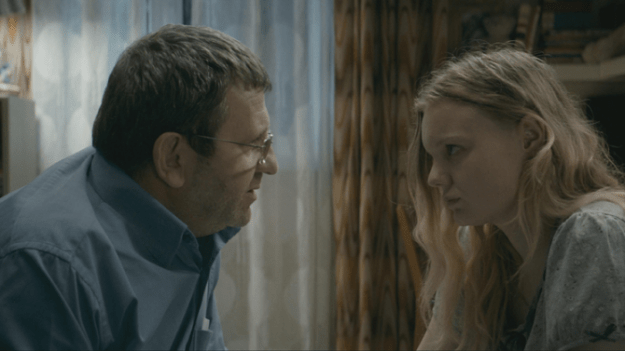
Graduation
From time to time, we all have to compromise our own values. It’s part of growing up. But do you remember the first time that you betrayed your own moral code?
According to Romanian filmmaker Cristian Mungiu, director of the brilliant and beautiful 4 Months, 3 Weeks, and 2 Days (which I have not seen), Graduation is about a lot of things. “It’s about family. It’s about aging. It’s about you. It’s about me”. But mostly, as the Cannes Best Director winner articulated at the North American premiere, it’s about that pivotal moment in one’s life where they make a conscious decision for the first time to do what they know in their heart to be wrong.
Romeo (Adrien Titieni) couldn’t be more proud of his daughter Eliza (Maria-Victoria Dragus) when she gets accepted into a fancy British school but he still can’t relax. Despite her stellar grades, she still needs to pass her finals to get out their Romanian town. When a vicious random assault threatens to shake Eliza’s confidence just days before her exams, Romeo can’t help feeling tempted to use his position as a well-respected surgeon to bargain with her educators in exchange for some leniency.
Graduation takes its time. It takes time to establish the relationships, set up the scenario, and let the story play out. Mungiu doesn’t resort to melodrama or even a musical score to beg for our attention. Almost every scene plays out in just one meticulously framed take. It’s an approach that gives his actors plenty of room to shine and his story the time to come alive. If you don’t mind the slow pace, Graduation asks big questions and will get you talking. It’s a very rewarding experience.
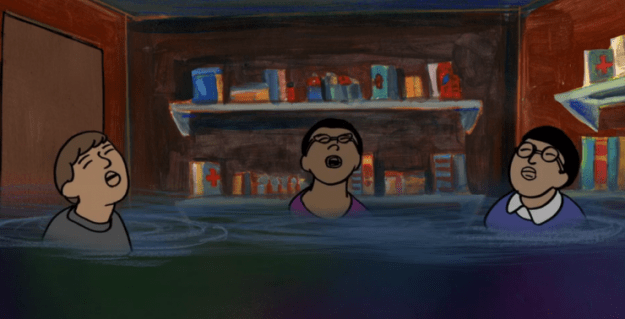
My Entire High School is Sinking Into the Sea
Dash Shaw was in high school when James Cameron’s Titanic was in theaters and couldn’t help imaging what it would be like if his school sank like the famous ship with all of his classmates inside. When you think about it, to avoid drowning to death in a sinking building, the smartest would head for the top floor and try to get to the roof. Once Shaw, director of My Entire High School is Sinking Into the Sea and apparently quite an accomplished comic book writer, started imaging each floor being occupied by a different grade level, he knew he had a story worth telling.
To see a film called My Entire High School is Sinking Into the Sea without feeling like you’re seeing something completely unique would be a letdown. So I’m pleased to announce that, whether you love it or hate it, Shaw’s debut feature will not let you down. The unusual animation style takes a little getting used to at first and, even once you get comfortable, there is so much to look at that many of the movie’s jokes- and the jokes are almost constant- can be easy to miss. My Entire High School may eventually be best remember for its carnage (those who are spared from drowning are mostly impaled, electrocuted, or eaten by sharks) but it’s made all the more special by the hilarious and sometimes touching dynamic between three adolescent friends whose bond is in crisis just as their lives are in imminent danger. And it’s all brought to life by some of the best voice acting you’ll hear this year from Jason Schwartzman, Lena Dunham, Maya Rudolph, Reggie Watts, and Susan Sarandon.
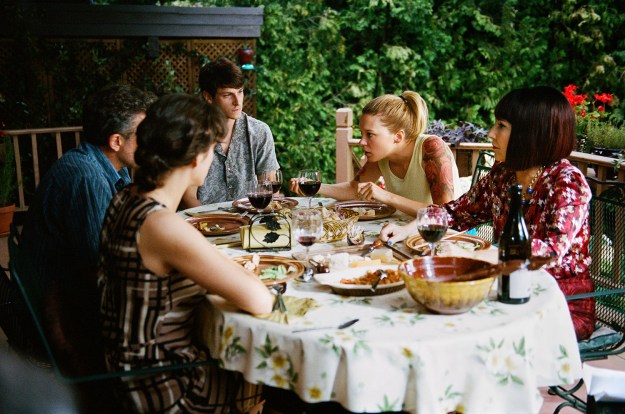
It’s Only the End of the World
I was one proud Asshole walking out of the Toronto premiere of Quebec director Xavier Dolan’s latest family drama. I was genuinely moved by a Xavier Dolan film. I admired Mommy, his last movie, I really did. It was just too self-indulgent for me to really relate to it in any real way.
So I was pleased to find myself loving this movie, more than almost anything else I saw at the Festival this year. I was finally starting to get it. I was quite disappointed to see that not everyone was as impressed as I was. It’s Only the End of the World currently has a score of 48 on Metacritic. If you’re not familiar with that site, let me put that in perspective. That’s only four points higher than Batman v. Superman’s score. Ouch.
I stand by my recommendation though. Based on a play by Jean-Luc Lagarce, It’s Only the End of the World tells the story of a family who are easier to relate to than to understand. After a 12-year absence, Louis (Gaspard Ulliel) is finally coming home but he is bringing sad news with him. He is very sick and doesn’t have much time left. He’s not quite sure how to bring it up but it wouldn’t matter anyway because his mother, brother, and sister can’t stop alternating between picking fights with him and each other and awkwardly trying to force reconciliation. They try to bond over trivial things and fight over tiny details but can’t seem to bring themselves to talk about anything important.
The claustrophobic family reunion atmosphere seems to rein Dolan in a bit. He still manages to make Lagarce’s play his own though. For such a talky film, it’s surprisingly cinematic with its unnerving score and great performances from Ulliel, Nathalie Baye, Marion Cotilliard, Lea Seydoux, and Vincent Cassell. Using his signature tight close-ups, Dolan works with the actors to find subtext amid all the shouting. No easy task. Hard to act like you’re holding back when you’re screaming at each other.
I’m still not entirely sure what they were fighting about. But the story feels real and profoundly sad.

Nocturnal Animals
Careful with this one. The people around me at the TIFF encore screening of Nocturnal Animals were basket cases watching it.
It’s easy to imagine yourself in the same position as Tony (Jake Gyllenhaal), a husband and father whose family finds themselves terrorized while driving a lonely Texas highway in the middle of the night. The tension is nearly unbearable as this story unfolds. Those around me could barely sit still watching it and Susan (Amy Adams) is getting even more stressed reading about it. See, the scary part of Nocturnal Animals is but a story within a story. It’s the plot of a manuscript that Susan’s ex-husband (also Gyllenhaal) has sent her of his latest novel. As unnerving as the novel is to watch, it’s even worse for Susan. She’s quite sure the novel is about her.
The three narratives (there are also a lot of flashbacks of Susan’s marriage) are balanced beautifully in the second film from director Tom Ford (A Single Man). Susan is a successful art dealer and everything around her is beautiful and fake. In the story within the story, Tony’s world is harsh and all too real. Nocturnal Animals is sure to be divisive. Ford lays out his themes very clearly and I’m sure I feel comfortable with all of his implications. But there’s so much to look at and so much to feel, think,about, and talk about that you kind of just have to see it.

Oh, and if you’re not sold yet, Michael Shannon plays a crazy cop in it.

 voices the social worker, although you wouldn’t be wrong for thinking the character bears a striking resemblance to the gangster he played in Pulp Fiction). Nani thinks that some joy and stability will be brought into the family if they adopt a dog, but the mutt they actually come home with is Stitch, not a puppy at all, but an alien genetic experiment who is so out of control he’s been banished to Earth.
 integration of lots of Hawaiian culture into the film. Although it’s scored by Alan Silvestri, he collaborated with Mark Keali’i Ho’omalu, a veritable hula master. It’s no coincidence that I’ve always treasured the soundtrack. Hula plays an important part in the film. To accurately capture the dance, Disney took their animators to a halau (a hula school) where they studied the techniques. An introductory hula dance is modeled in the film, and I look forward to seeing the real thing live at a luau tonight.
  its violence. But Moana is called by the sea, and encouraged by her water-loving grandmother, she discovers that her ancestors were once voyagers who travelled the ocean in impressive “canoes” to find new islands to inhabit. With this in mind, she takes off on a self-taught sailing adventure to find the demi-god Maui and set things right for her ailing homeland.
 like Lilo & Stitch before it, should be celebrated for being a Hawaiian movie that actually features Hawaiian people (I’m looking at you,
  musical ventures. Jemaine Clement, playing a oversized crab, sings a song called Shiny which sounds an awful lot like something Flight of the Conchords would have done, though it is indeed written by Miranda (and performed with a David Bowie flair by Clement). And of course I’d be remiss if I didn’t mention the little girl (14 at the time of recording) who voices Moana herself, Auli’i Cravalho, who has a powerhouse of a voice, rich and full, and sounds authentic in the role too. I’m very glad to report that Disney cast this movie using a plethora of Polynesian performers, and it really pays off.
 read currents and measure the stars from the demi-god Maui, voiced by Dwayne Johnson. The animators do a really great job of bringing a few identifiable Johnson traits into Maui’s features, and Miranda carefully crafted a song that he could sing successfully, without having a traditional talent for singing (“You’re Welcome” is a heck of a song!). Maui’s body is covered in tattoos that represent acts of heroism, or particular challenges that he’s overcome. Unlike the rest of the computer-animated film, his tattoos are hand-drawn, and add an extra layer of fun to the story, as well as acting as his moral compass. Maui often pokes fun at
 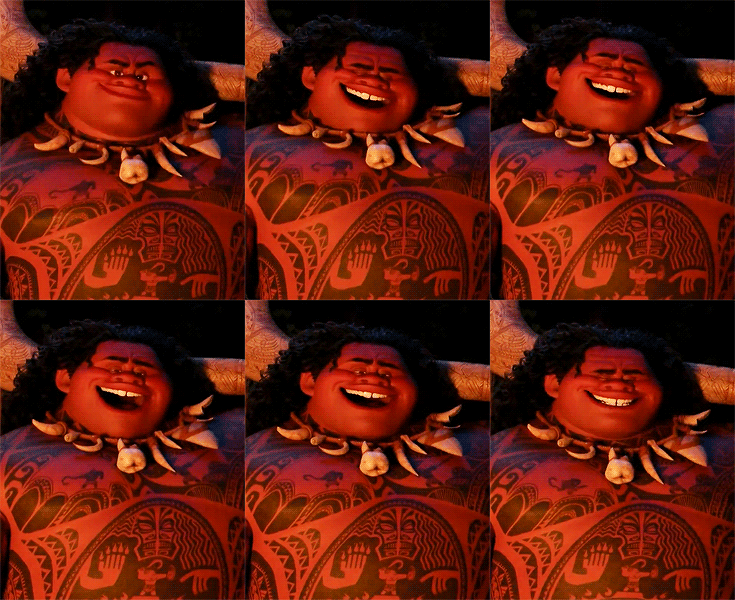 Moana’s insistence that she is “not a princess”, a self-aware bit of humour from a studio known for relying on certain formulas.
 years in advance. Nicolas Cage was offered the part of Shrek but turned it down, not wanting to be drawn as an ugly ogre (he apparently missed the whole point of the movie, unsurprisingly). Chris Farley was then cast as Shrek but at his death in 1997, producers decided to recast the role and it went to SNL alum Mike Myers (you can hear Farley’s work
  dating game show portion as the Magic Mirror, but in the film that hit theatres (and your DVD shelf), it’s just storyboard artist Christopher Miller.
 references that would have seemed fresh at the time (The Matrix, for example), and some that seemed almost immediately dated (the Macarena, and Riverdance, for example). It also gave the Dreamworks lawyers plenty of time to go over the film with a fine tooth comb: no one wanted to get sued by Disney for the many satirical pokes and jabs at their theme parks.
 he looks a little too cute and cuddly for a donkey, you’re right – although he’s modeled after a real-life miniature donkey named Perry who lives in Palo Alto, near DreamWorks, his movements mimic that of a dog rather than a hooved animal.
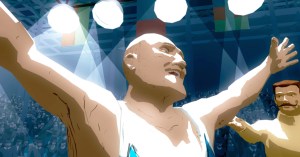 Cafard is the French word for cockroach. But make no mistake, the animated film Cafard is not the French version of A Bug’s Life. It’s a bleak, adult tale about the horrors of the first World War, from the perspective of a world champion wrestler who enlists in the Belgian army in 1914 after his daughter is raped by German soldiers. Unfortunately for all involved, that terrible event is only the start of the awfulness.
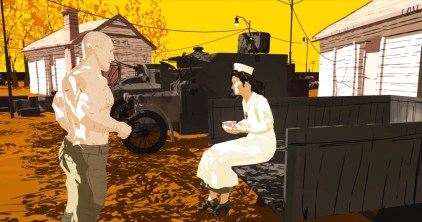 coat any aspect of war’s horrors. While that approach is commendable, it is that much more difficult to embrace Cafard. I would have liked for the film to have offered something to offset its harsh subject matter, but there is no joy to be found in this world. Any hint of happiness feels fleeting, like a consolation prize at best.
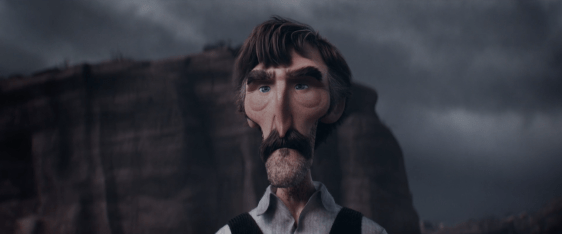 A tired old Sheriff is flooded with disturbing memories at the site of an old accident. Can he bear it? Can you?
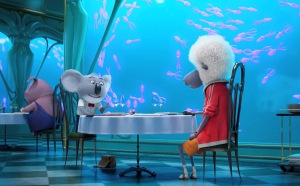 living. The theatre’s bankrupt. He hasn’t had a successful show in – well, maybe ever. The bank’s about to swoop in and take it from him, so in a last ditch effort to save it, he plans a singing competition.
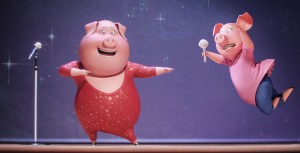 Gunther, a flamboyant dancing pig (Nick Kroll) partnered with Rosita, a shy momma pig with a big voice (Reese Witherspoon); an arrogant crooner of a mouse (Seth McFarlane); and a timid teenaged elephant with stage fright (Tori Kelly).
 As you may know, Pixar started the trend of releasing shorts before their films. It was a great way to showcase some stellar work that often gets overlooked. Disney has taken a page from the Pixar handbook and saw lots of success with its Frozen short, Frozen Fever, which aired before Cinderella. Inner Workings is slated to debut before their November release of Moana.
 and his heart. From the moment he wakes up, we see the interplay between his two most boisterous organs, and the way they direct the others as well. The organs have been properly Disneyfied – they are cute, they are funny, but they are never gross or full of blood and guts. Paul is just a regular guy who’s got to get to work. His brain marches him toward the office while his heart is distracted by the many other tempting options. The pace is jaunty, the jokes are clever, the short is colourful.
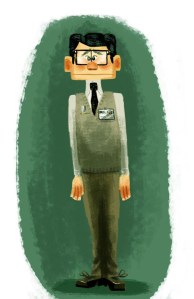 the encyclopedias he studied as a child, clear plastic pages holding the nervous system, circulatory system, etc of a man that could be overlaid on a body to see what fit where. Working at Disney as a storyboard artist, Leo along with many others, was invited to an open-pitch, where anyone could present their idea to John Lasseter and one would be chosen for production. Leo wrote his story with those encyclopedia images in mind. Spoiler alert: Leo won. Lurie mentioned that his deadpan pitched coupled with fanciful and humourous drawing really made his presentation stand out.
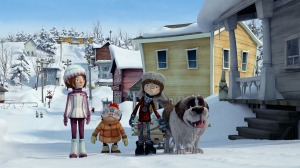 territory, the whole school would assemble into our tiny gym, and one of the few movies screened for us on a 24-inch TV was La guerre des tuques. It was a movie about a bunch of kids who wage an all-out snowball fight in the vicinity of a huge snow fort during their winter break. La guerre des tuques literally translates to war of the tuques, but the English version was called The Dog Who Stopped The War.
 yes there are hockey sticks, but also lacrosse sticks and curling brooms.
 not going to query studios or go to auditions, they’re done with doing it the Hollywood way. Now they’re desperate enough for the lowest kind of fame: Internet fame.
 underground tape X-V, literally a supercut of every fantastically horrific, violent, gory thing that has ever happened on film, set to some delicious pop. It’s nauseating good fun.
 ASSHOLES WATCHING MOVIES