Tag Archives: based on a true story

Darkest Hour

Darkest Hour should maybe be called Darkest Month. In 1940, Winston Churchill was asked by the King to take over as Prime Minister. It was a shitty time to get the job: Hitler was marching his Nazi army across Europe, and the threat of invasion was uncomfortably close. During this particular month, Churchill’s first on the job, he’s got an impossible task. He must decide whether to negotiate a treaty with Hitler, or whether to stand firm against the Nazis but in so doing risk his country. And he had to do this without his party’s support or the public’s understanding or any help from the King.

Winston Churchill is an iconic and influential figure in British history and he’s been portrayed with varying success by some truly venerable actors:  Albert Finney, lead_960Brendan Gleeson, Timothy Spall, Robert Hardy, and most recently by John Lithgow in The Crown. He is not a saintly figure. He was a great orator but had some problematic positions that hindsight can’t afford to be kind about. Portrayals of him often emphasize his omnipresent cigar, and his particular style of speech (his custom dentures helped cover up a lisp). Gary Oldman is the gentleman tasked with bring old Winnie to life in Darkest Hour, and though he’s seen chomping on the necessary cigars, he turns the performance into something truly remarkable.
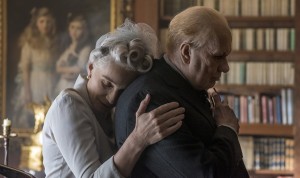
Oldman is transformed by makeup and prosthetics; his jowls are considerable. His tics and posture help render him unrecognizable. He dissolves into character. As Churchill he delivers some of history’s most famous and familiar speeches and he is electrifying. Kristin Scott Thomas as his tell-it-like-it-is wife, Lily James as his newbie secretary, and Ben Mendelsohn as the King help round out the cast but Darkest Hour feels like a one man show and Oldman is equal to the cast. Truthfully I don’t know many others who could carry 125 minutes of infamy, but Gary Oldman deserves his frontman status in all the Oscar pools. His portrayal is vigorous and complex and maybe even a little bit compassionate.

As for the movie itself, it’s not quite as formidable. The events are told simply, without a lot of cinematic flair, and it sometimes feels sluggish. There’s not a lot of imagination on display, and perhaps that’s an unfair criticism with the burden of historical accuracy weighing heavily, but director Joe Wright is more precise than entertaining. It’s Oldman who kept me in my seat, and I’m sure it’ll be Oldman bounding out of his on Oscar night to collect his well-deserved award.
All The Money in the World

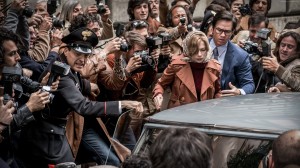
In 1973, masked men kidnapped a teenager off the streets of Rome. He was the favourite American grandson of J. Paul Getty, the richest man in the world. Nobody gets that rich by being nice, and Getty is not. And of all the shitty things he is, miserly is one of them. You don’t get to be a billionaire by spending your money, after all. So when the kidnappers demand $17 million for him, Getty refuses. “Very little in life is worth paying full price for” he says, but he doesn’t plan to negotiate, he plans on just not paying. “It’s an awful lot of money for such a young boy.” But you can imagine how well that goes over with Junior’s mother.

JPG III, 16 at the time of his kidnapping, has a strong-willed mother, Gail, and thank god. But Gail (Michelle Williams) has no money of her own and no access to her allthemoney2former father-in-law’s fortune. Getty (Christopher Plummer) is pretty set in his ways, and to avoid dealing with his mouthy daughter-in-law, he sends his “security guy” Chase (Mark Wahlberg) to do the dealing for him. But will this weird and uneasy alliance be enough to save Junior (Charlie Plummer, no relation)? If you were alive at the time you likely already know the answer.
If you’re alive right now and not willfully burrowing under some very thick boulders, you’ve probably heard that Kevin Spacey was originally tapped to play Getty Senior. Spacey’s creepy past caught up with him just a month before this film was to be released, which left producers scrambling. Ultimately, director Ridley Scott decided to reshoot Getty’s 22 scenes with another actor who had read for the part, Christopher Plummer. They filmed for 10 days and then frantically re-edited, and what results is a role for which Plummer received an Oscar nomination. Mark Wahlberg had costar approval built into his contract, and he refused to approve Plummer unless he got paid an additional $1.5M to come in for the reshoots. This eventually blew up in his face when it was reported that Michelle Williams only received her per diem of $800 per day. Wahlberg ended up donating the $1.5M to the #TimesUp campaign to stem the backlash. It’s fair to say this movie was under a lot of scrutiny before it was ever released, and I admit I wondered if Plummer’s nomination was perhaps just a reward to the film’s production crew for so quickly doing the right thing, but now I just think it unfairly overshadowed what is indeed an Oscar-worthy performance – by Michelle Williams.

All The Money In The World obviously has a lot to say about the soul-suckingness of money, at its centre is an old man with a corroded heart, but Christopher Plummer manages to play him with just a touch of warmth, which is an interesting surprise. There’s a compelling story here with great acting (with the exception of Wahlberg, who isn’t so much bad as just useless, extraneous), but the movie is just a little muddled (and a little fond of unadorned exposition). It flits between genres – family drama, crime, thriller. At its core though it’s really about this epic tug-of-war between a frantic mother and a cold grandfather, the struggle between love and money, and that’s a story that never gets old.

Miles

Ron’s heart bursts while reading the Saturday morning paper in his lazy-boy. He leaves behind a wife, Pam (Molly Shannon), and a teenage son in his senior year of high school, Miles (Tim Boardman). His family is devastated, but not in the usual way. Miles is desperate to escape the confines of his small town for film school in Chicago next year, and Pam has been slowly asphyxiating in her crappy marriage for years. Turns out Ron wasn’t a very nice person, and he recently used his son’s college fund to buy his mistress a Corvette. The mistress is the only one without dry eyes at the funeral.

Pam copes by flirting with a widower (Paul Reiser) in her grief group, and by threatening the mistress, and the mistress’s mother. Miles copes by joining the girl’s volleyball team. Apparently it’s the only scholarship he’s eligible for.

The movie is set in 1999, which means the AV club consists of rolling a large tube TV around on a trolley and chatting looks boxy and pixelated and awful. But it still encompasses a pretty big chunk of the plot. There’s really to recommend setting the movie in 1999 except it’s based on a true story, which is also an awkward implication.

But anyway: we’re going to rock the boat in small town wherever, circa 1999, when boys didn’t play on girls teams and coming out to your parents was still an occasion. So maybe there’s still room for this kind of courage, whatever that means. There’s an effort here to be relevant but the truth is, our protagonist is narrow-minded in his own way. He sees only his own needs and wants, not the larger picture, so it’s hard to really extrapolate the kind of meaning that would make this film feel satisfying.

Goodbye Christopher Robin

I wonder in what ways the world would have been different if Alan Milne had not married a perfectly horrid wife. Daphne is an excellent socialite but not terribly prone to marital bliss. She waited for her husband to come back from war and is not impressed with the man who comes back. Her advice to just “not think” about the war is not exactly practical, and then she has a son she doesn’t want or know how to love to cheer him up, and that doesn’t work either!

But of course it’s their son, C.R., aka Christopher Robin, aka Billy, whose stuffed animals and wild imagination inspire the very thing he’ll become known for. And it’s his wife’s abandonment of the family that allows father and son to spend meaningful time together, time enough to write the stories that will enchant the world and change their family forever.

goodbye-christopher-robin-domhnall-gleeson-slice-600x200

Domhnall Gleeson plays the famous author A.A. Milne, a man ravaged by war, confused by his wife, haunted by the characters he created. Winnie the Pooh is a beloved story for children, but the people behind it are much darker than I’d imagined. This is not really a happy story. Margot Robbie plays his flitty wife, a woman easy to scorn but Robbie humanizes her, has compassion for her. Kelly Macdonald plays the woman who actually cares for young C.R., a nanny her charge calls Nou but the world will know as Alice, from the books. She’s the one who bears the burden placed upon a little boy upon whom the whole world has expectations. The cast is quite wonderful; even the little kiddo (Will Tilston) playing Christopher Robin is good, as he must be.

But as you can imagine, it’s difficult to flick back and forth between the horrors of war and the child-like wonder that inspired a favourite picture book. It adds little pops of whimsy to lighten the mood, but make no mistake: it is a dark mood in need of lightening. At times the movie really hits the right note, but it’s a tone that’s hard to keep – especially since the point is not really Winnie the Pooh OR war, but the nasty consequences of celebrity. Goodbye Christopher Robin surprised me and moved me, but it’s not a water-coloured, feel-good picture, just the sad truth behind a story you thought you knew all too well.

Professor Marston And The Wonder Women

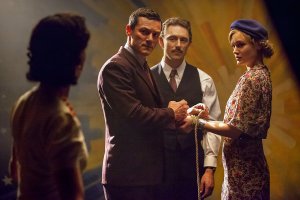
William Marston was a professor of psychology; his wife Elizabeth was an equally and likely superior mind, but being female, was relegated to assistantship. Professor Marston  (Luke Evans) was developing lots of new ideas about behaviour, and had a new theory based on  dominance, inducement, submission, and compliance. He and Elizabeth (Rebecca Hall) were looking among their students for a young apprentice, and found what they were looking for and more in Olive (Bella Heathcote).

The Marstons both fell in love with her, and a polyamourous relationship was born. They had children together and continued to work and invent together – the modern lie detector test is thanks to them. But what may be most remarkable about this MV5BNzMwYmUzZjItNDVjMy00YWE5LWE0MWUtNWZlYThlNmQ1NTQ1XkEyXkFqcGdeQXVyNDg2MjUxNjM@._V1_SY1000_CR0,0,1499,1000_AL_relationship, taboo and reviled in the 1930s and 40s, was that it inspired the creation of the Wonder Woman comic. Marston’s original stories (written under a pseudonym) incorporated the feminist ideals embodied by his wives. Wonder Woman was a strong woman who needed no man. His early comics also involved a fair amount of bondage and submission, which he pursued in his own bedroom and thought more young men should be turned onto. You can imagine the sort of censorship and uproar he faced.
With Wonder Woman so fresh in our cultural memories at the moment, it’s interesting to witness her birth, to see the surprising and sometimes literal inspirations that Marston drew upon. The performances are strong and the three have a nice chemistry that, despite accusations of “sexual perversity,” feels very honest and sometimes nearly wholesome. Rebecca Hall in particular shows the conflict and the consent and the curiosity that pushes her character toward an unconventional life. I must say, however, that I’m a little disappointed in the title. Though the film makes clear enough that Marston is bested by his lovers, they still seem to take second seat in this story, and that feels like a let down to our hero, and her real counterparts.

The Polka King

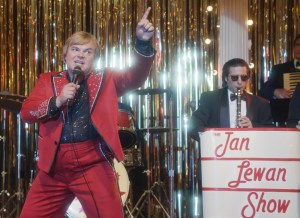
Jan Lewan, Polish immigrant, is a hard-working polka enthusiast. He works 18 day time jobs just so he can afford to keep touring the Pennsylvania polka circuit. His band, however, isn’t content to work for peanuts. In a bid to fatten their paycheques, he recruits some of his elderly fans to become “investors”, and he writes promissory notes guaranteeing a 12% return on investment. His investors are quite happy: Jan always finds new investors, so he can always cover generous quarterly payments. But then the FBI finds out.

polka-kingThe FBI gets one whiff of this and feel it must be some sort of Ponzi scheme. They shut Jan down, but since he promises it was an honest mistake, and to pay back his investors, problem solved. Except, in order to pay back his investors, he ends up creating a second, bigger scheme.

The thing about our Polka King is that he’s very, very charming. Jack Black is perfect to play him: guileless, open-faced, enthusiastic. Even when he’s dirty, his heart is squeaky-clean. Jenny Slate appears as his beauty queen wife, Jacki Weaver as his scowling mother-in-law,  and Jason Schwartzman as his best friend and bandmate, Mickey Pizzazz. The film bubbles with energy thanks to its cast, and Jack Black’s eyes are never not dancing. Black’s been honing his indie acting chops these past few years, and it shows. But it never hurts that this wacky guy is exactly in his wheelhouse. It just so happens that this wacky guy is a real person, and if you were a polka fan in the 1990s, especially around Scranton, you may have caught a performance. But even if you didn’t, now all you need is a Netflix subscription. The screwball energy is infectious…although it must be said: directors Maya Forbes and Wallace Wolodarsky seem to love their protagonist a little too much. But heck, I love him a little too much too. The Polka King is endearing and entertaining.  He may be conning his way into our hearts, but he’s there.

The Post

In 1971, Kay Graham was the first of her kind, a female newspaper publisher, but she was never supposed to have the job. The Washington Post was part of the family business but her father passed it down not to her, but to her husband. But when her husband committed suicide, she stepped into shoes that had always been loafers, not heels.

Then, something amazing happens: someone leaks top secret documents that detail the Vietnam cover-up that spanned 4 U.S. presidents including the current one, Richard Nixon, who’s kind of a dick. The NY Times gets ahold of them but gets shut down by Tricky Dick and his cronies. The papers then filter down to The Washington Post, and Kay Graham has to decide whether she’s going to risk her little empire AND a serious prison sentence.

Interesting facts about Mrs. Graham: she was not a powerful business person, or used to MV5BMTg5Nzg3NjUzNV5BMl5BanBnXkFtZTgwNTY5NzA1NDM@._V1_SX1500_CR0,0,1500,999_AL_being in charge. She’d never had another job. She was naturally meek, and kind of nervous. She was surrounded by assertive men, some of whom weren’t crazy to have her among their midst and certainly didn’t see her as an equal never mind a boss, and none of whom were shy about voicing their opinions. She was, however, an accomplished socialite, which in the city of Washington, means she counted many prominent politicians among her friends – and the particular politician at the epicenter of this scandal was among her closest. These facts are not to diminish her but to illustrate just how courageous she truly was to take the stance she did.

Newsflash: Steven Spielberg is a good director. Yeah, we already knew this, but this film had me noticing all kinds of little details that I admired greatly. This movie has the feel of a smart and sharp little indie; it’s taut and thrilling and lots of fun. It gets a little heavy-handed at times but its best moments are when it’s showing, not telling.

Maybe Spielberg’s greatest asset is his incredible ensemble cast. Tom Hanks is the fevered editor, and he’s flawless. Bob Odenkirk is stupendous as a hard-working investigative journalist. But of course it’s Meryl Streep who steals the show as Kay Graham. It’s not a showy role. Mrs. Graham is never the biggest personality in the room. She’s not commanding, but we are nevertheless riveted by Ms. Streep. Her shaking hands, her tremulous lip – we see how hard this for her, and so we admire her all the more for doing it.

You are not contractually allowed to write a review of this film without using the word “timely”. About a year ago, Nixon was down-graded to only the second most douche-baggiest president in history. Truth matters. The press belongs to the governed, not the governors. Support journalism. Subscribe to a newspaper, even if you read it online. One day they’ll be making movies about this time. But this is not just a news story, it’s also, of course, a nod to feminism. Mrs. Graham walks through a sea of secretaries before she’s admitted to the all-male floor of the New York Stock Exchange. She faces a Supreme Court that has never had a female Justice and wouldn’t for another decade. When someone says that Mrs. Graham’s father willing the family business to Kay’s husband says a lot about the man, Tom Hanks replies that actually, it says more about the time. So yeah, this is the movie we all need right now. It’s essential viewing. But even if wasn’t so “timely”, it’s so thoroughly peppered by exceptionally talented people that The Post is an easy recommendation and a damn fine film.

I, Tonya

Margot Robbie is convinced this film will change your mind about Tonya Harding. Is she a villain or a victim? Abused or abuser? The truth is, your opinion doesn’t really matter and truth doesn’t really exist. What does exist: a wholly funny film that never fails to entertain.

{In the unlikely event you’re in need of a refresher: Tonya Harding was an American figure skater in the 1990s, and competed twice in the Olympics. She was known for two things: for being the first American female to land a triple axel in competition, and for bashing in her Nancy Kerrigan’s knee.}

Margot Robbie is well-cast as Tonya Harding. She’s still just a little too pretty to play elm120117intelmovies-007-1512400299white trash, even with the poofy 90s bangs, but she comes down low and it’s pretty glorious. Sebastian Stan plays Harding’s good for nothing husband, Jeff Gillooly, and he disappears into the role of dumb fuck. Jeff’s dumb ass best friend Shawn (Paul Walter Hauser) pretends to be an international spy even though he’s a grownup who lives with his parents. Not exactly criminal masterminds, but this is the trio that brought us the most delicious scandal of 1994 (until OJ Simpson that is – if you thought Lillehammer was competitive, try being a celebrity fuck up). But for my money, I’d have to say that the real cast stand-out was Ms. Allison Janney, who plays Tonya’s mother LaVonam who, by sheer comparison, makes bathtub scum look appealing. She’s the dirtiest of dirts with not a kind word or intention in the world. If being a crummy mother was an Olympic sport, she wouldn’t have to resort to breaking any kneecaps.

The first thing that may surprise you about this film is that it’s funny. Actually funny, though pretty dark – the kind of laughs you feel slightly guilty about succumbing to, but you’ll need to just embrace the absurdity. It is farcical, in the way only a true story can be when it’s populated with idiots.

The second thing that surprised me anyway, was that it actually does dredge up sympathy for our poor Tonya. Her guilt (or innocence) is not really the point. This is Tonya’s story, hers alone from beginning to end. No one’s trying to excuse what happened, but putting “the incident” within context is actually very interesting.

I, Tonya is funny, dramatic, pumped full of energy, and even the sports angle is well-done. Certainly Margot Robbie can be commended for all the hard work she put in getting skate-ready, but she gets a lot of help from choreographers, stunt people, and CGI – effects that are pulled off almost seemlessly. But it’s the camera work that makes the figure skating extra exciting – you really get a sense of the speed and athleticism, two hallmarks of Harding’s style in particular. No matter your experience of “the incident” at the time, I, Tonya turns tragedy into triumph.

Battle of the Sexes

In 1973, a tennis has-been named Bobby Riggs thought of a great way to become relevant again: he challenged current champion Bobbie Jean King to a game. No, not just challenged her: assured the world that he would win, because he was male, and that was enough. Bobby Riggs probably didn’t truly believe in most of the chauvinistic slogans he chanted, but he knew they’d get him attention in the era of “burning bras” and “women’s libbers”, and he was right. He was a Kardashian of his time; he knew how to work the media and how to gain attention for himself. It just so happened that the women’s movement generally, and women’s tennis particularly, needed exactly this kind of opportunity.

Battle-of-the-Sexes-posterSteve Carell does an excellent job of making the buffoon Riggs more than just a brash loud mouth; in fact, Carell was probably my favourite part of the film. And that’s maybe a little sad considering this really should have been Billie Jean King’s story to tell. And to some extent, it is. It’s just that I thought Emma Stone’s version of her was pretty beige. She’s more than just a prominent pair of glasses with a side of closeted lesbian.
But at least the film is layered and tries to establish the game within the context of its time, not just within the characters’ lives but societally as well. The film may bear the name of The Battle of the Sexes but directors Jonathan Dayton and Valerie Faris seem to know that the most interest part of the conflict happened off the court.

This film hit theatres in a very timely fashion – a reminder of how incredibly not very far we’ve come. Now that it’s available to rent, why not watch it as a drinking game, and take a shot of female empowerment every time a Grand Slam title champion is referred to as a “little lady.” On the press circuit, the real Billie Jean King reminded us that at the time, a married woman couldn’t hold a credit card in her own name. But here we are in 2018 (happy new year) and you just know this movie didn’t get made without someone getting sexually harassed. In 40 years, what will the #MeToo movie say about us?

The Greatest Showman

Phineas Taylor Barnum was a showman first and foremost. His legacy includes a best-selling memoir, museums, philanthropy, and a circus who just closed its doors earlier this year, after something in the neighbourhood of 175 years of success. The Greatest Showman is the story of his life, only not: it’s the fictionalized, glamourized, told-in-an-entertaining-and-succinct-105-minutes version that somewhat resembles his life, or at least a rags-to-riches edition of it. It’s not historically or personally accurate but it IS beautiful and breath taking and fun. In fact, it’s the most excited I’ve felt at the movies all year.

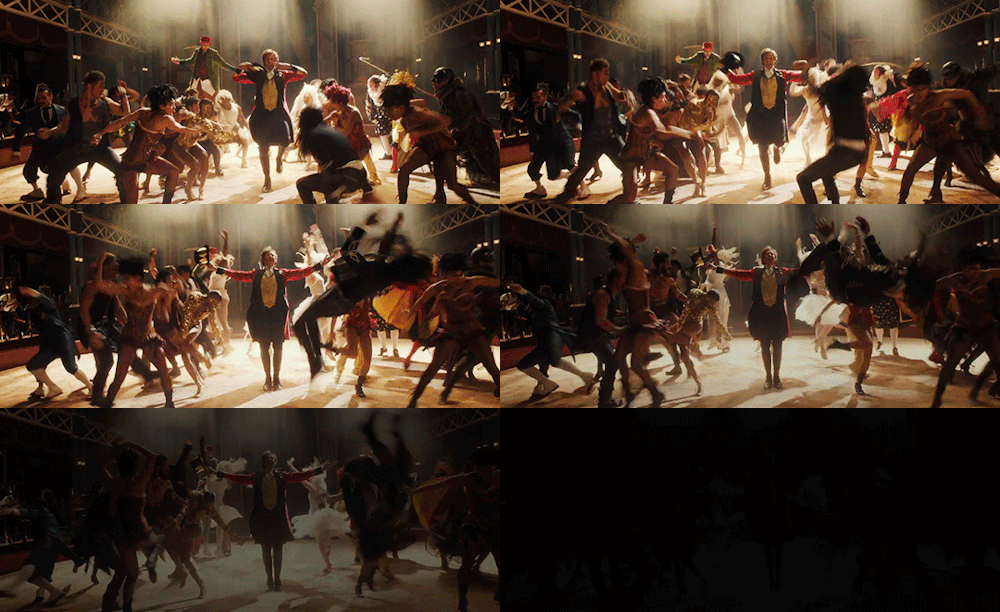
Hugh Jackman has already established himself as a versatile actor: he makes Logan, a veritable man of steel, seem both tough and vulnerable. Here he straddles Barnum’s pursuit of fame, money, and success with his more modest but fulfilling tumblr_os9fxwinjy1qd4rf5o2_500.gifgoals of happiness and family. Ultimately we see Barnum find both fame and family in the circus. He collects ‘freaks’ and ‘sideshows’ and gives them purpose and a platform. People pay the price of admission to look on in sensational horror.
The film is glossy, a glory to look at, and a wonder to hear. It’s a musical, with lyrics by Tony-winning (Dear Evan Hansen) and Oscar-winning (La La Land) duo, Benj Pasek and Justin Paul. A mashup of modern-sounding, toe-tapping, pop and hip hop, the music reflects an aesthetic that isn’t so much true to the time period, but more a tribute to Barnum’s constantly being ahead of his time. With dazzling, daring cinematography by Seamus McGarvey (Life, Nocturnal Animals, Atonement) and buoyant, irrepressible, vibrant production design by Nathan Crowley (Dunkirk, Interstellar, The Dark Knight trilogy), The Greatest Showman is a work of art by veteran professionals – except for its director. Michael Gracey had in fact never directed any movie at all before – why, then, did 20th Century Fox trust him with 80 million dollars and a promising script, co-written by Bill Condon, Oscar nominee for best adapted screenplay for Chicago, and winner for Gods and Monsters?

Hugh Jackman met Michael Gracey 8 years ago when Gracey directed him in a TV commercial in Rio de Janiero. The two hit it off creatively, and within months Jackman was suggesting him as the director a passion project of his, and with Jackman on board as star and producer, it only took about a hundred pitches or so before someone finally said yes. Yes! And true to the Barnum name, the movie wouldn’t just be a musical, it would be over the top, larger than life, bursting at the seems with spectacle.

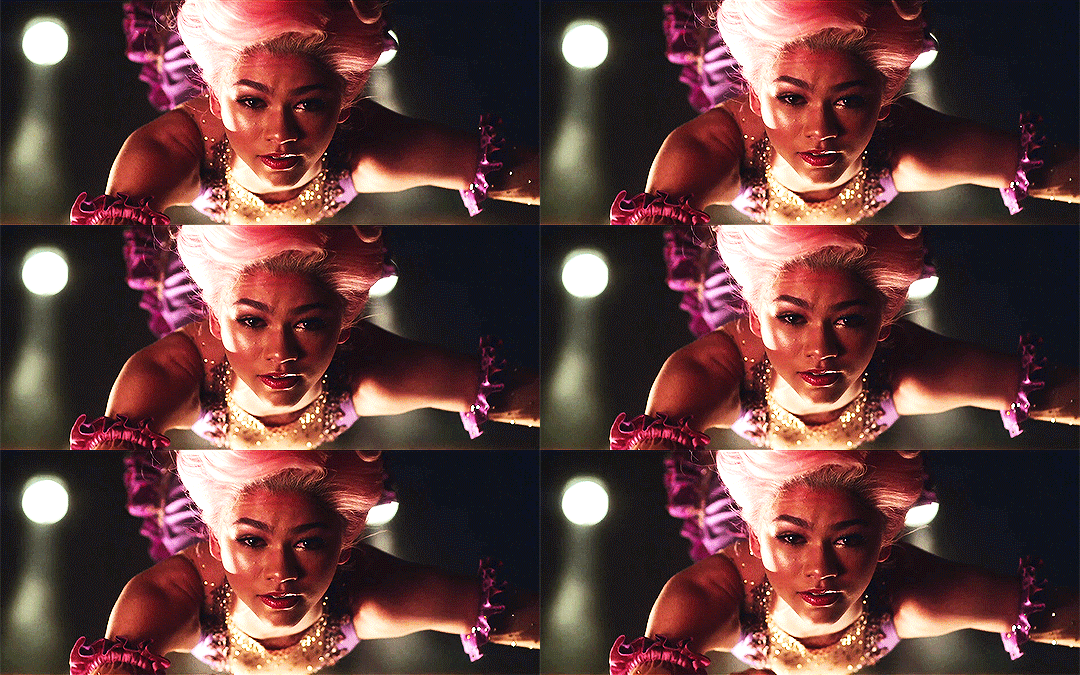
In addition to Jackman, the cast boasts the likes of Michelle Williams as his long-tumblr_os9no4BmGt1qk2b83o5_r1_540.gifsuffering wife, Charity, Zac Efron as his business partner, Zendaya as a talented trapeze artist, and Rebecca Ferguson as the songstress who legitimizes his success (though credit for her amazing voice goes to Loren Allred, who dubs her in the film).

The Greatest Showman is like the best parts of Big Fish and Moulin Rouge smooshed together. It lit my heart aglow. If you’re looking for a true account of PT Barnum’s life, read a book. What The Greatest Showman offers is a damn good time at the movies, so see it in theatres, on the big screen, the way it was meant to be seen. Hugh Jackman will thank you for it.