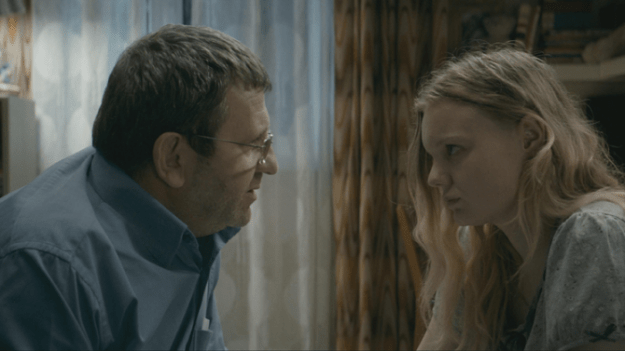
Graduation
From time to time, we all have to compromise our own values. It’s part of growing up. But do you remember the first time that you betrayed your own moral code?
According to Romanian filmmaker Cristian Mungiu, director of the brilliant and beautiful 4 Months, 3 Weeks, and 2 Days (which I have not seen), Graduation is about a lot of things. “It’s about family. It’s about aging. It’s about you. It’s about me”. But mostly, as the Cannes Best Director winner articulated at the North American premiere, it’s about that pivotal moment in one’s life where they make a conscious decision for the first time to do what they know in their heart to be wrong.
Romeo (Adrien Titieni) couldn’t be more proud of his daughter Eliza (Maria-Victoria Dragus) when she gets accepted into a fancy British school but he still can’t relax. Despite her stellar grades, she still needs to pass her finals to get out their Romanian town. When a vicious random assault threatens to shake Eliza’s confidence just days before her exams, Romeo can’t help feeling tempted to use his position as a well-respected surgeon to bargain with her educators in exchange for some leniency.
Graduation takes its time. It takes time to establish the relationships, set up the scenario, and let the story play out. Mungiu doesn’t resort to melodrama or even a musical score to beg for our attention. Almost every scene plays out in just one meticulously framed take. It’s an approach that gives his actors plenty of room to shine and his story the time to come alive. If you don’t mind the slow pace, Graduation asks big questions and will get you talking. It’s a very rewarding experience.
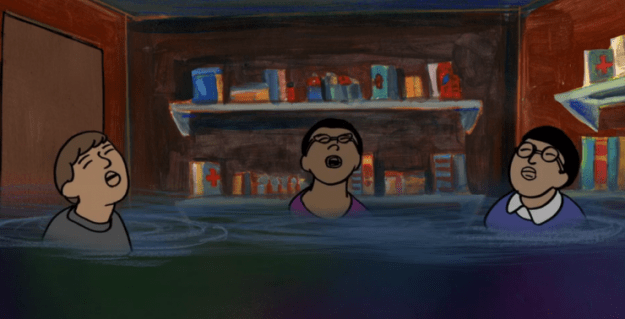
My Entire High School is Sinking Into the Sea
Dash Shaw was in high school when James Cameron’s Titanic was in theaters and couldn’t help imaging what it would be like if his school sank like the famous ship with all of his classmates inside. When you think about it, to avoid drowning to death in a sinking building, the smartest would head for the top floor and try to get to the roof. Once Shaw, director of My Entire High School is Sinking Into the Sea and apparently quite an accomplished comic book writer, started imaging each floor being occupied by a different grade level, he knew he had a story worth telling.
To see a film called My Entire High School is Sinking Into the Sea without feeling like you’re seeing something completely unique would be a letdown. So I’m pleased to announce that, whether you love it or hate it, Shaw’s debut feature will not let you down. The unusual animation style takes a little getting used to at first and, even once you get comfortable, there is so much to look at that many of the movie’s jokes- and the jokes are almost constant- can be easy to miss. My Entire High School may eventually be best remember for its carnage (those who are spared from drowning are mostly impaled, electrocuted, or eaten by sharks) but it’s made all the more special by the hilarious and sometimes touching dynamic between three adolescent friends whose bond is in crisis just as their lives are in imminent danger. And it’s all brought to life by some of the best voice acting you’ll hear this year from Jason Schwartzman, Lena Dunham, Maya Rudolph, Reggie Watts, and Susan Sarandon.
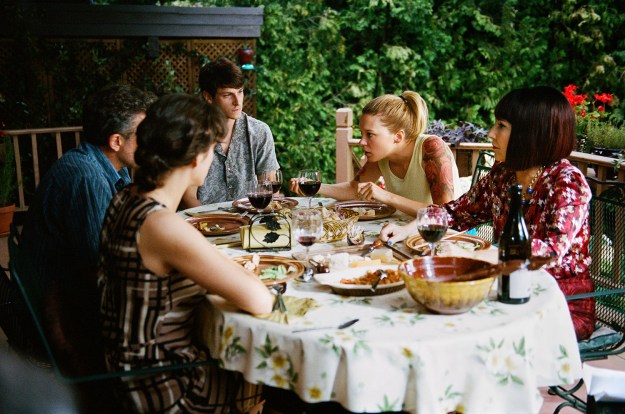
It’s Only the End of the World
I was one proud Asshole walking out of the Toronto premiere of Quebec director Xavier Dolan’s latest family drama. I was genuinely moved by a Xavier Dolan film. I admired Mommy, his last movie, I really did. It was just too self-indulgent for me to really relate to it in any real way.
So I was pleased to find myself loving this movie, more than almost anything else I saw at the Festival this year. I was finally starting to get it. I was quite disappointed to see that not everyone was as impressed as I was. It’s Only the End of the World currently has a score of 48 on Metacritic. If you’re not familiar with that site, let me put that in perspective. That’s only four points higher than Batman v. Superman’s score. Ouch.
I stand by my recommendation though. Based on a play by Jean-Luc Lagarce, It’s Only the End of the World tells the story of a family who are easier to relate to than to understand. After a 12-year absence, Louis (Gaspard Ulliel) is finally coming home but he is bringing sad news with him. He is very sick and doesn’t have much time left. He’s not quite sure how to bring it up but it wouldn’t matter anyway because his mother, brother, and sister can’t stop alternating between picking fights with him and each other and awkwardly trying to force reconciliation. They try to bond over trivial things and fight over tiny details but can’t seem to bring themselves to talk about anything important.
The claustrophobic family reunion atmosphere seems to rein Dolan in a bit. He still manages to make Lagarce’s play his own though. For such a talky film, it’s surprisingly cinematic with its unnerving score and great performances from Ulliel, Nathalie Baye, Marion Cotilliard, Lea Seydoux, and Vincent Cassell. Using his signature tight close-ups, Dolan works with the actors to find subtext amid all the shouting. No easy task. Hard to act like you’re holding back when you’re screaming at each other.
I’m still not entirely sure what they were fighting about. But the story feels real and profoundly sad.

Nocturnal Animals
Careful with this one. The people around me at the TIFF encore screening of Nocturnal Animals were basket cases watching it.
It’s easy to imagine yourself in the same position as Tony (Jake Gyllenhaal), a husband and father whose family finds themselves terrorized while driving a lonely Texas highway in the middle of the night. The tension is nearly unbearable as this story unfolds. Those around me could barely sit still watching it and Susan (Amy Adams) is getting even more stressed reading about it. See, the scary part of Nocturnal Animals is but a story within a story. It’s the plot of a manuscript that Susan’s ex-husband (also Gyllenhaal) has sent her of his latest novel. As unnerving as the novel is to watch, it’s even worse for Susan. She’s quite sure the novel is about her.
The three narratives (there are also a lot of flashbacks of Susan’s marriage) are balanced beautifully in the second film from director Tom Ford (A Single Man). Susan is a successful art dealer and everything around her is beautiful and fake. In the story within the story, Tony’s world is harsh and all too real. Nocturnal Animals is sure to be divisive. Ford lays out his themes very clearly and I’m sure I feel comfortable with all of his implications. But there’s so much to look at and so much to feel, think,about, and talk about that you kind of just have to see it.

Oh, and if you’re not sold yet, Michael Shannon plays a crazy cop in it.

 dangerous beast called a basilisk. Pehn depends on the guidance of his mentor and the memories of his mother to give him the courage to confront the monster he can scarcely define, let alone identify. Shot in lush coastal California forest, Lookouts is about as beautiful and accomplished a short film as I have ever seen and the acting is superb. It uses practical effects and real locations to elevate this period fantasy based on Penny Arcade’s Lookouts to something truly unique and special. Director David Bousquet has tapped into real magic, and you can share in it by watching the film here. You’re welcome. 😉
 man extraordinaire, Canadian superstar Gord Downie had recently announced that he had a brain tumour and was terminally ill. Since making music has always been his passion, he and the Hip went on a farewell tour and despite the ravages of cancer, he performed full-throttle at each and every show, somehow finding the energy and the courage to power through. Their final
  date was in their hometown of Kingston Ontario, just a little ways down the road from Ottawa. Our Prime Minister, Justin Trudeau, was in the front row, and spoke for all of Canada when he thanked Gord and the whole band for their decades of artistic serviced to the country. It was a stirring night. The end is coming for Gord and he knew it, you could see it in his eyes, feel it every time he was overcome by emotion, but instead of making it about him, he chose to use this spotlight (and believe me, about 32 out of our 33 million strong
 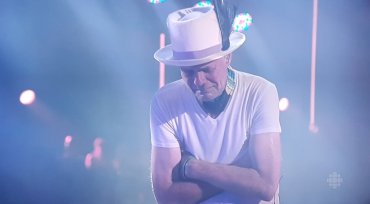 population were tuned in one way or another) to speak on behalf of Canada’s indigenous population.
 Prohibited from speaking their languages, practicing their spirituality, or honouring their cultures, teachers stripped them of their identity. Many children suffered terrible abuse, but all of these kids were deprived of their childhoods, and all of the families suffered terribly as I’m sure you would if your child was removed, perhaps never to be seen again, or if you were lucky enough to be reunited, we can only hope that you can find a common language in which to communicate. Communities were destroyed in what many Aboriginal people refer to as a genocide. It’s a dark part of Canadian history that wasn’t acknowledged until very recently. Today our First Nations peoples often live in poverty and other consequences of this intergenerational tragedy. Healing is not an Aboriginal problem, it’s something we need to address as an entire country. Gord Downie is doing his part.
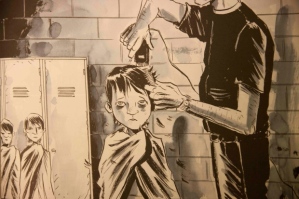 and hundreds and maybe even thousands of Chanies dotting our countryside. Lonely and miserable, many children made an escape an attempt only to lose digits or limbs to frostbite, arms and legs on traintracks, or lives to exposure, or to punishment when recaputured. How many tiny bodies are still unaccounted for? The fact that we don’t even know is proof of how little white Canada cared for Aboriginal people, and this is a guilty fact we struggle to reconcile even today.
 Aboriginal man is paying his respects at a rustic grave. The mud takes hold of his boots, lets go only reluctantly. He plods back to his humble shack, and sets to work counting stores. His traps are empty. Nothing grows. A way of life very likely already threatened is now near extinction with floods inching ever closer.
 Growing up on a reservation, Judd had limited exposure to outside influences like film and television, and what little he did see never reflected his own image. Today he creates the kind of images that would have comforted his younger self in a style blending pop culture and Native art that’s all his own. Banksy-esque, even Warhol-esque, his art is at once familiar and thought-provoking. His bold, “indigenized” pieces, overtly or covertly political, give people pause. But more than that, they offer his people representation, a chance to see their own culture and identity as a direct influence on the popular culture of today.
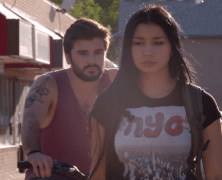 Marie’s experience through a re-enactment narrated using Marie’s own words.
 Mannahatta focuses on one of those Manhattan pizzerias. The film maintains a tight focus in order to convey its message, and that is a wise choice. Mannahatta is a small story of a new employee at the pizzeria who is haunted by a man that no one else sees. At first he is confused and annoyed by this ghost but eventually he listens to and understands him. It’s a cooperative awakening and we see that a joint effort is required to truly bury the horrors of the past.
 education, the ability to visit over 40 countries while still in his teens, and loads of opportunity. He sprinkled his good fortune with charitable acts for others. But in the movie we don’t see a lot of Dan Eldon, activist. Rather we see Dan Eldon, purveyor of white privilege, with a side of white saviour to further sour the milk.
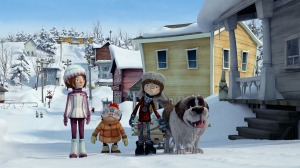 territory, the whole school would assemble into our tiny gym, and one of the few movies screened for us on a 24-inch TV was La guerre des tuques. It was a movie about a bunch of kids who wage an all-out snowball fight in the vicinity of a huge snow fort during their winter break. La guerre des tuques literally translates to war of the tuques, but the English version was called The Dog Who Stopped The War.
 yes there are hockey sticks, but also lacrosse sticks and curling brooms.


 aliens, she’s the one who listens well enough to actually crack the code. And it’s a hell of a code, unlike anything our puny human brains can really comprehend. This deep gulf of understanding makes plenty of people nervous – people with their fingers hovering over big red buttons. Annihilation-type buttons. Dr. Banks puts her own life at risk to keep things from escalating to an out-and-out global (universal? galaxal?) war.
 arresting. It works in synchronicity with a hauntingly beautiful score by Jóhann Jóhannsson. Twinned together they remind you that though the plot feels startlingly realistic for a sci-fi film, there’s something otherworldly at play. Young’s work is atmospheric, Jóhannsson’s is pulsating.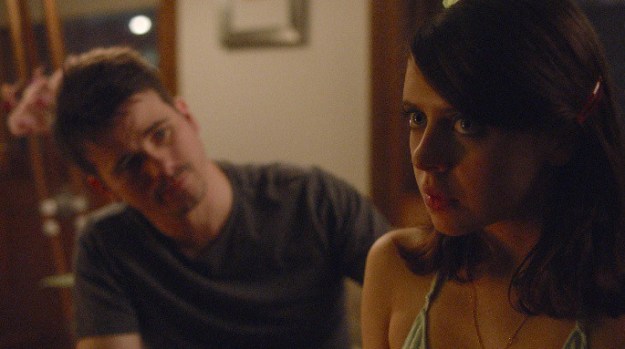

 Mysterious. Maybe a little…creepy? In an unguarded moment Bob (Aden Young) shows us his secret. Under layers of clothes and bandages, his flesh is disappearing.
 TV’s The X-Files, The Flash, and Fear The Walking Dead, and in movies like Watchmen, Deadpool, Warcraft, and the upcoming Star Trek Beyond, but that’s just a fraction of his IMDB credits. The list is so long and impressive that you might wonder where he found the time to make this move into writing and directing, but it’s clear that movies are his passion.
 ASSHOLES WATCHING MOVIES