
Director Pablo Giorgelli has it in for us. His protagonist, Ely, is a marginalized teenaged girl who finds herself pregnant by the adult, married son of her after-school employer. She’s brilliantly played by Mora Arenillas, no small accomplishment because much of what is conveyed is done in total silence. Arenillas must constantly reach into her bag of tricks in order to portray the insight and the mental toughness, and the resilence shown by her character.
For his part, Giorgelli sets his gaze upon the social margins of Argentina with a sparse aesthetic that will test your limits. He likes agonizingly long, silent shots in which we contemplate our heroine as she stares out the window of a moving bus [which, by the  way, why do movies always make this seem so peaceful? If you’ve ever rested your forehead on a bus window in real life, you’ll know it feels more like going through the wash with a bunch of rocks, but whatever, don’t mind my grumbling, that’s neither here nor there]. The point is: looooooooong shots with little to no action, little to no dialogue, little to no plot. The whole movie can be summed up as: She’s pregnant. Oh jeez. How to get an abortion in a country where abortion is illegal? It’s only 87 minutes long but it feels more like 87 hours. Case in point: Sean fell dead asleep.
Invisible is a love letter to spartan film making. Although Ely dominates the screen in almost every shot, the things that remain unseen are as significant. We don’t know much about her home life, and glimpses are enigmatic. Her living situation and long commute suggest poverty but Giorgelli doesn’t rub our noses in it. His lens is sympathetic but we get a sense of her loneliness as she faces the biggest decision of her life.
There’s no pointed political criticism to the film but Ely’s exploration of the underground abortion scene is chilling. She is so matter of fact, so responsible, it’s easy to forget that Ely is still a young student. The actress is formidable as she bravely, stoically faces down an impossible situation. But as interesting as I found the topic, I couldn’t forgive the long, boring stretches of just watching her mute in her daily routine. It felt stagnant, bled of life, like a carnival ride that pelts you with boredom.
 standing right over me until he chose this moment to cut me off. “I just saw that,” he complained. “It was terrible“.
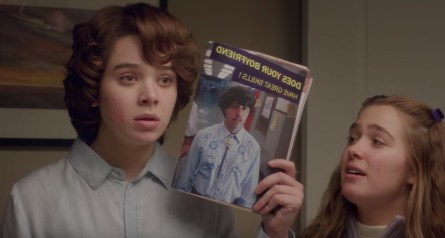 awkwardness just goes on and on. To make matters worse, her brother Darian (Blake Jenner) has it easy: perfect skin, perfect grades, the perfect apple of his mother’s eye, and a perfectly terrible person to be compared to for the rest of your life. To make matters EVEN worse, Darian starts dating Nadine’s best friend (read: only friend), which means he’s getting all the comfort that used to be hers, and she’s forced to be at war with them both while still, you know, blundering her way through life and high school, with only an irascible teacher (Woody Harrelson) in her corner – and believe me, that’s a bit iffy.
 time in one’s life.
 Moonlight is the quietest tour de force I’ve probably ever seen. Never have I rooted for a drug dealer in this way, and never have I sympathized so much with a kid who wanted to follow in that drug dealer’s footsteps. Moonlight is spectacular in its simplicity. It is also entirely different than the movie I expected.
 Chiron’s adolescence is the subject of three tightly focused vignettes. It’s a wonderful storytelling choice that perfectly explains Chiron’s choices as he grows up, without having to engage in any exposition. Moonlight is brave in many ways but to me it’s the choice to let us figure things out for ourselves that makes this film great. It makes the journey more fulfilling, the experience more real, and greatly increases our empathy for Chiron. Moonlight helps us understand Chiron to a degree that I would not have thought possible. Regardless of your race, wealth, or sexual orientation, we are all a lot like Chiron.
 Alex Hibbert, Ashton Sanders and Trevante Rhodes each take remarkable turns as Chiron and the extent to which they feel like the same person is incredible. Mahershala Ali is not the only other actor deserving of mention (the supporting cast is consistently great) but for my money his performance as the aforementioned drug dealer shapes Chiron’s life and makes us understand his growth to a degree that is virtually unmatched in film.
 its violence. But Moana is called by the sea, and encouraged by her water-loving grandmother, she discovers that her ancestors were once voyagers who travelled the ocean in impressive “canoes” to find new islands to inhabit. With this in mind, she takes off on a self-taught sailing adventure to find the demi-god Maui and set things right for her ailing homeland.
 like Lilo & Stitch before it, should be celebrated for being a Hawaiian movie that actually features Hawaiian people (I’m looking at you,
  musical ventures. Jemaine Clement, playing a oversized crab, sings a song called Shiny which sounds an awful lot like something Flight of the Conchords would have done, though it is indeed written by Miranda (and performed with a David Bowie flair by Clement). And of course I’d be remiss if I didn’t mention the little girl (14 at the time of recording) who voices Moana herself, Auli’i Cravalho, who has a powerhouse of a voice, rich and full, and sounds authentic in the role too. I’m very glad to report that Disney cast this movie using a plethora of Polynesian performers, and it really pays off.
 read currents and measure the stars from the demi-god Maui, voiced by Dwayne Johnson. The animators do a really great job of bringing a few identifiable Johnson traits into Maui’s features, and Miranda carefully crafted a song that he could sing successfully, without having a traditional talent for singing (“You’re Welcome” is a heck of a song!). Maui’s body is covered in tattoos that represent acts of heroism, or particular challenges that he’s overcome. Unlike the rest of the computer-animated film, his tattoos are hand-drawn, and add an extra layer of fun to the story, as well as acting as his moral compass. Maui often pokes fun at
  Moana’s insistence that she is “not a princess”, a self-aware bit of humour from a studio known for relying on certain formulas.
 y school in any Ohio, this is a Christian school in 1951 Ohio, where attending chapel services is a required part of the curriculum.
 ng from me, but I could have used a lot more romance than Indignation delivered. I liked watching Marcus and Olivia deal with their issues. It was a lot more real than what we usually get from romantic movies. But too often, just as it was getting interesting between the pair, we’d cut to some other aspect of Marcus’ college life, seeing him ask important-sounding questions in class or arguing with the Dean or quarrelling with his two roommates. Many of these other scenes halted the movie’s momentum without adding anything important, and as a result ended up feeling like unnecessary filler.

 strained. There are whiffs of resentment. Luckily Jonathan has his father’s beautiful young nurse (Julia Koschitz) to distract him, but as the film lurches shakily through its middle third, Jonathan realizes that time is running out for his father and if the family secrets are to be unlocked, it’s now or never.


 ASSHOLES WATCHING MOVIES