Tag Archives: discussion

Social Anxiety & Celebrity

Sean and I watched Neal Brennan’s stand-up special 3 Mics on Netflix earlier this week. Neal Brennan was the co-creator and co-writer and co-everything else on Chappelle’s Show, which meant a whole lot of success all at once, and then even more abruptly, nothing at all. He has since reinvented himself as a stand-up comedian, but what you get from watching 3 Mics isn’t your typical routine. It’s got plenty of laughs, particularly from the “one-liners” mic, but he’s most riveting when he’s at another mic, a less funny mic, the one where he talks about  “emotional stuff.”

He talks candidly about his depression, his childhood, his career, his father’s alcoholism and emotional abuse. He talks about the void where self esteem usually goes, and how he spent many years all too happy to hide behind his more gregarious partner, Dave Chappelle. Still fighting his demons, he is nonetheless up on the stage, and he’s getting very honest about how hard it is for him to be there, and why it’s so important that he stay.

Which set me to thinking a couple of days ago when I was at a USS concert. Ubiquitous Synergy Seeker is the best band you’ve never heard of, an electronic-based alt-rock duo (comprising a singer-guitar player named Ash and a hype man called Jason) who describe themselves as “camp fire after-party” and sound kind of like if kurt cobain and kanye had ever met and made an album – only not, it’s way more unique than that, and so, so listenable. Singable. Danceable. Turn-uppable. Bliss outable. And it just so happens that the singer-guitar player dude, Ashley Buchholtz is a notoriously shy “hyper-introvert” who’s battled his own demons, struggled with self worth, and even now, to a crowd of adoring fans, admits that singing the songs we paid to hear is hard for him – his greatest fear, actually.

So that made me think about how we view performers as people who are outgoing, and who seek the spotlight, even though that’s not always the case. And as I read up on actors I’d heard were particularly shy, I heard over and over that performing was a way to overcome shyness, but for a lot of people, it’s never completely overcome. Carol Burnett felt she could only perform “in character” and would clam up if she was just being herself. Barbara Streisand rarely performs live because even after decades of super-stardom, she’s still a pack of nerves before every show (so, reportedly, is Adele).

Adam Sandler is so shy he rarely does press and when he does, it’s almost always in character. You’ll notice that when he sings, it’s almost always in another voice; funny accents help him overcome his nervousness.

Kim Basinger struggles so much that when she won her Oscar in 1997 (best supporting actress – L.A. Confidential), she was hardly able to speak. She has agoraphobia, panic attacks, and social anxiety: some days, leaving the house is more than she can bear.

Kristen Stewart has a reputation for being cold and distant, but the true source of her reserve is crippling shyness. She worries so much about what others think of her, she can barely stand to talk about herself, and comes off guarded and sullen in interviews.

Nicole Kidman has overcome the stutter that made her so shy as a child, but even now there are days she can’t stand to walk into a restaurant or a party alone. Richard Gere was so shy as a child that his parents wondered if he could even speak. Evan Rachel Wood was too shy to even order a pizza.

Courtney Cox has said that her shyness has limited her career. Being too nervous to audition, to risk rejection, she hasn’t pursued a movie career like other Friends.

Mark Ruffalo describes himself as an introvert and a bit of a “depressed person” who negotiates happiness for himself on a day to day basis. Director Tom Ford thinks of himself as a loner, and  “Very introverted. I’m very shy. I’m very emotional.”

Of her anxiety, Jennifer Lawrence says “I have a prescription.” She doesn’t think it’s likely to get any easier, either: “No, I’m always just very nervous. I never feel like, ‘I’ve got this.’ I’m always very nervous and aware of how quickly people can hate you and that scares me.”

Sarah Silverman adds “People use “panic attack” very casually out here in Los Angeles, but I don’t think most of them really know what it is. Every breath is labored. You are dying. You are going to die. It’s terrifying. And then when the attack is over, the depression is still there.”

Emma Stone’s panic attacks were so intense when she was little, it led to agoraphobia. She manages them better today, but that doesn’t mean she doesn’t get them, it just means she’s learned some ways to cope. The red carpet life must be extra-stressful for anyone who suffers with social anxiety. I think it’s really cool to pursue your passion even when it butts heads with your fears. I applaud anyone who has to work hard just be among people, and I’m even more impressed with those who find a voice with which to speak out, and to remind us that we’re never alone. Someone else is feeling it too.

Words of wisdom from USS: Chill out. Be easy on yourself.

Method Acting 101

There was a time when “committed” actors swore by method acting for really nailing roles, really living in the skin of the characters they portrayed. It’s a technique wherein the actor aims for total emotional identification with the part, and once they’re in the zone, they don’t leave it. They don’t break character when the director yells cut. If the character is angry and volatile, the actor will be angry and volatile for the whole 4 months. If the character is needy and vulnerable, then so will be the actor. You can understand why it’s difficult to work with such an actor – it must feel like working with a toddler, one who doesn’t take naps and won’t be sent to time out.

Lots of actors have taking method acting so far it makes my eyes roll around in their sockets but it was Jared Leto’s method approach to the Joker in Suicide Squad that led
jaredletojokerhqAngelica Jade Bastien of The Atlantic to declare “Method acting is over.” Thanks to its overuse in Oscar-baity screeners by those actively seeking accolades, the method has lost its appeal, but Leto’s over-the-top zeal revealed the “technique” as more marketing tool than anything else and the prestige is all but gone. Jared Leto sent his fellow costars screwy gifts of used condoms, dead pigs, and live rats, apparently because he felt that’s the kind of thoughtful gesture the Joker would make, or at least that it would play well as an anecdote on Jimmy Kimmell. He also watched footage of brutal crimes online because apparently pretending to be a bad person isn’t enough, one must actually become reprehensible.

Going “method” is really just a new way for an actor to show off; it makes the creation of a character more visible and signals to the Academy “I’d like my Oscar now.” This identity branding is indulged by Hollywood but often divisive if not downright disruptive on set.

Practiced by Hollywood heavyweights like Paul Newman, Montgomery Clift, Dustin Hoffman, and Jack Nicholson, method acting was revolutionary in its time, and idealized in the performances of Marlon Brando. James Franco recently wrote that “Brando’s performances revolutionized American acting precisely because he didn’t seem to be ‘performing,’ in the sense that he wasn’t putting something on as much as he was being.” But Brando never took it to the extremes that we see today.

Leonardo DiCaprio has used method acting to rebrand himself as a “serious actor” after being mistaken for a hearthrob in his early career. His recent Oscar campaign for The the_revenant2Revenant emphasized the grueling ordeal he went through, including eating bison liver (despite being vegetarian), risking hypothermia by striding into freezing rivers, and sleeping in an animal carcass. But doesn’t this sound more like an episode of Fear Factor? Isn’t acting really about pretending? The Revenant isn’t a documentary about frontiersmen. I’m sure it would have played just as well had he shot the scene in a lukewarm stream instead. CGI in some breath clouds and it’s all the same to me.

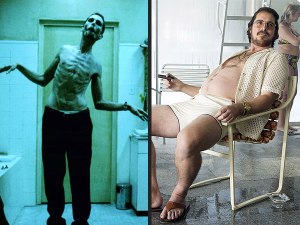
Christian Bale seems to be a practitioner of the method in order to add machismo to his a99013_christian-600x450work. “I have a very sissy job, where I go to work and get my hair done, and people do my makeup, and I go and say lines and people spoil me rotten. This is just not something to be quite as proud of as many people would have you believe.” So Bale counters this by really losing himself in a role. For The Machinist, he lost 70lbs and got down to a very unhealthy 120 (on a 6′ frame), and then turned around and gained 100lbs to play Batman just 4 months later.He went on to stay in Bruce Wayne’s American accent not just for the duration of the filming, but for all the press as well.
Shia LaBeouf went 4 months without washing on the set of Fury, where he played a soldier in the trenches (this got him banished to a bed and breakfast far away from the hotel where the other cast and crew stayed). He also cut his own face with a knife, and pulled his own tooth. His co-star, Brad Pitt, non-Method, injects roles with his natural charisma rather than stunts and overly-studied contrivances. Whose performances do you prefer?

Daniel Day-Lewis may be the most over-the-top Method actor of his time. While filming My Left Foot, he refused to get out of his wheelchair, forcing crew to carry him around, and spoon-feed him dinner. He lived in the wild while shooting Last of the Mohicans, and ate only what he shot himself. He insisted that everyone address him as “Mr President” on the set of Lincoln, and forbade people from speaking to him unless it was in language (and accents) from the time period. He refused a winter coat on the set of Gangs of New York, and when he inevitably caught pneumonia, he refused “modern day” medical treatment.

DeNiro got a real cab license while filming Taxi Driver, and picked up fares around NYC 100-male-film-oliviergngk-thumb-500x250-153952between takes. Pacino made an actual citizen’s arrest while filming Serpico. Adrien Brody starved himself and sold his apartment to feel “lost” while playing a Holocaust survivor in The Pianist. If you’re getting the feeling that this so-called Method is about ego more than art, you’re not alone. And I wonder if you’re seeing the other pattern here…that all the names on this list are men.

There are plenty of Method actresses as well: Marilyn Monroe, Ellyn Burstyne, and Jane Fonda all studied the technique. They just never adopted the crazy stunts. Gena Rowlands is probably the best Method actor you’ll ever come across, but she does it without resorting to tricks. Sadly, when we hear a woman is “immersed” in a role, it almost always means she’s altered her physical appearance. So it’s pretty obvious that not only is method acting obnoxious and ridiculous, it’s also pretty sexist. But what else is new?


La La Land: Discussion

If you’re looking for a spoiler-free review of the film, please check it out over here. I wrote it all the way back in September, fresh from seeing it at TIFF, and I’ve been waiting all this bloody time just to talk about what for me is the best film of the year. I was absolutely giddy for this movie, how it made me feel, how it made me think, how it whisked me away into something both surreal and familiar. We exited the theatre from La La Land and rushed on to the next (I think it must have been Lion) but between the two, I wept. I wept for heartbreak, and for beauty, because La La Land  is brimming with both.

If you’ve kept reading, then you know by now that La La Land, for all of its romance, does not have a traditionally happy ending. But are the characters unhappy? Mia and Seb separate in part because their ambitions overshadow their love. Was this the right move? Do they have regrets? Certainly they’ve both gone on to achieve the success they so coveted. Mia is married, la-la-land-1with children. When she sits in Seb’s club at the end, we are treated to an alternate version of events in which they manage to stay together. Do they wish that this was so? Do they still love each other? Have they moved on?

One of Chazelle’s unspoken themes must be “Is it worth it?” – is it?

During their courtship, the movie takes cliches about love and makes them true: love lifts them, they dance on air, they sing from rooftops. Did this feel organic to you in the movie? I often felt that when things felt intense to them, they broke out into song as a metaphor for feelings that are too fervent to verbalize. When words fail, they’d sing, or dance, which is often the way we feel in our excited little hearts when we’re first falling in love (reminds me of a certain scene in 500 Day of Summer).

Sean noticed that when the relationship got rocky, the movie got a little more ordinary, and frankly, a little repetitive. The songs are reused. But in time he felt like that was sort of the point: that the newness and wonder of the relationship had worn off, that they were beyond the first crush and settling into patterns and habits and less passion. The film itself reflects it. Did you find new meaning in songs as they were revisited? During the second half of the film, during the relationship’s demise, there is noticeably less music, which means less joy, less intensity. Their world goes a little drab when the shine has worn off. Did you miss the music when it was gone? Certainly when it returns in that final scene, it’s a heart breaker.

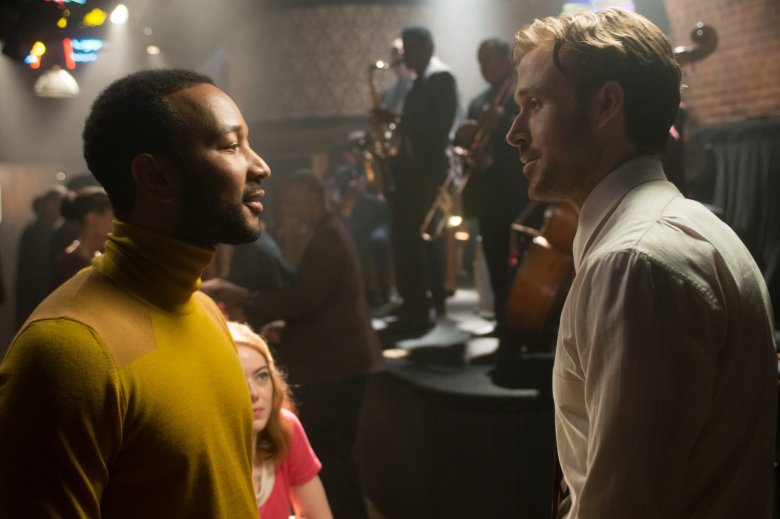
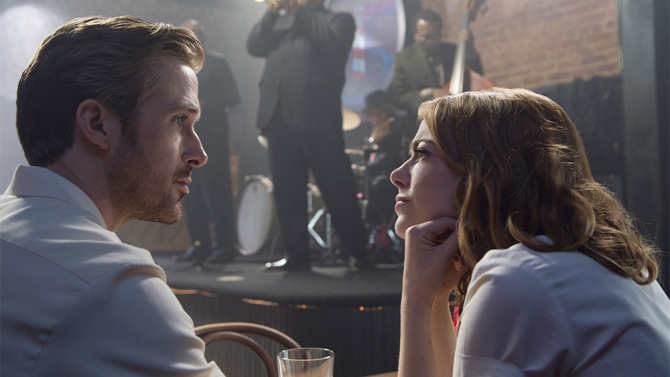
Originally Chazelle imagined that Miles Teller and Emma Watson would fulfill the lead roles. I can’t picture Teller ever being right for the part. Watson left the project so she could do another musical, Beauty and the Beast. Ryan Gosling ended up turning down the opportunity to play the Beast so he could do this instead, with frequent collaborator, Emma Stone. Chazelle has stated they were hired together intentionally, because they’re a modern-day version of an old-Hollywood couple, frequently working together and already having an established chemistry. Do you think anyone else could have pulled off these roles? Do you think either of them has a legit chance at an Oscar?

Seb states that jazz has to be experienced. He’s disgusted by people who use it as ‘background music.’ It’s a special language that he teaches her and she comes to appreciate. He takes full advantage in the final scene, telling her he still loves her using only his music, and he plays so passionately that she can see how he wishes things had been different. However, there’s an interesting part in the movie, the “sellout” phase where Seb is playing jazz in the background during a scene. Is this where it all went downhill? What would you say was their final straw?

Chazelle has deliberately taken this musical off the backlots and grounded it in modern-day Los Angeles. The opening number helps set the tone. This is the world in which they live, but both are outsiders amongst that set. At the end of the number, Gosling gives Stone the finger before driving off. The offramp used in this number is the same one they used in Speed, where they had to jump the gap. Lots of real locations were used in the film – even Seb’s apartment is an actual apartment, not a set. Let’s not forget that the movie isn’t called Mia or Seb, it’s called La La Land: the city is also a character. City of stars, city of dreams. Did the locations help give the movie a sense of reality to you?

The one criticism I’ve heard of this movie is that it never addresses the true roots of jazz: does La La Land “whitesplain” jazz? Is it racist in its portrayal? Did Damien Chazelle fail us by casting white actors in a movie about jazz? Then I wondered – wouldn’t Whiplash have faced the same controversy? It’s another movie about jazz starring two white dudes, but I don’t recall hearing any hooplah over it [turns out the criticism was there all along]. Of course it’s not for me to say, but I can understand how it might sting a little to have an art form that was “invented” by African-Americans, music by Black people for Black people, be told by white people. Not to say that jazz belongs to any one people, but if these are the only stories being told about jazz, then maybe the stories belong to the people who truly wrote them. And it does feel regressive in 2016 to see a white man play jazz, and a white woman dance to it, while people of colour make up the blurry background characters surrounding them, out of focus, besides the point. What do you think – is there cultural misappropriation going on here? Is Ryan Gosling a “white man saviour” in his quest to save jazz?

Mia and her friends are resplendent in primary colours because they’re young, and they dream in technicolour. She’s dressed in emerald, saphire, yellow. At the end of the movie though, she’s wearing white. She’s supposedly made her dreams come true, but she’s leached of colour. What’s that about?

Manchester By The Sea: Discussion

If you’re looking for a spoiler-free review of the film, please see Matt’s excellent offering. I don’t want to ruin the movie for anyone, but if you’ve seen the film, then you understand the need to discuss it. It’s deeply affecting and disturbing and it’s one of the best things I’ve seen this year.

When Lee’s brother dies, the reclusive janitor reluctantly returns to his hometown to help out with the arrangements. He’s kept there longer than expected when he’s revealed to be his nephew’s new guardian.

Casey Affleck stars as Lee, a spook more than a man, a ghost still barely among the living, haunted by his past, carrying a huge burden of guilt, grief, and regret that we can almost physically see sitting atop his slumped shoulders. His performance is really restrained, as befits an emotionally blunted character. He manages to be subtle and to find lots of power in quiet moments. His performance will almost certainly be rewarded with an Oscar nomination, if not a win. What do you think his chances are? Did you see anyone out-act him this year? And what part do you think the allegations of sexual harassment against him will play in whether or not he wins?

Lee has a new life in a new town, though it’s pretty clearly only a half-life at best, given his physical and emotional isolation. During his questioning by the police, it’s clear that Lee feels he should be punished, and directly after he tries to take his own life. While clearly still trying to punish himself, do you think Lee is still suicidal?  When he tells Patrick “I can’t beat this thing” – is he talking about depression, guilt, grief? His reputation? Or something else?

I thought the movie started off pretty slow, but looking back on it with context, I wonder if the lethargy was deliberately representative of Lee’s depression. The movie never says the D-word, but certainly exhibits all the Hallmarks: violent outbursts, hopelessness, emptiness, the inability to enjoy life or take pleasure from thinks you used to enjoy, pushing people away.

The idea for the story didn’t originate with writer-director Kenneth Lonergan: in fact, it was Matt Damon and John Krasinski who came to him with the idea and asked him to develop the script. Damon would star and direct. But conflicts with The Martian prohibited him from doing so, and they turned control of the movie over to Lonergan. Do you think Lonergan stands a chance for best screenplay, or for that matter, best director?

The script is often praised for its “masculinity” which rubs me the wrong way. I don’t think Lee’s refusal to deal with anything should be lauded in any way, and his continued self-torture isn’t exactly gender specific. But the story is told in a refreshingly sparse sort of way, where the lead character speaks only under duress, and as a little as possible. And so much is implied rather than spoken outright: the unspeakable things his ex wife said to him, the town’s rejection of him, his own struggle with addiction, his attachment to pain,  his father’s death, the legal proceedings\media scrutiny that must have surrounded his case. Was there anything you felt the film missed? Any glaring holes you needed to see filled?

Some people felt the score was sufficiently bad to pull them out of some of the movie’s most impactful scenes (the house fire, in particular). Did you notice the score being good, bad, or ugly? Were there any stand-out supporting performances for you? Did you think the nephew, Patrick, was a realistic character? He really showcases the dark humour of the film, but sometimes I thought it odd how adult he seemed for a 15 year old.

We see Patrick trying to reconnect with his mother, who seems to have sobered up and carved out some sort of life with her new conservative Christian husband. But she’s not stable. She can’t handle things not going well. What purpose do you think this subplot served? Was it jarring or distracting for you to have Matthew Broderick in the role of her husband? Did you feel sympathy for the mother?

In the scene where Patrick’s girlfriend’s Mom comes out to Lee’s car to invite him for dinner and he says no, she responds that if he changes his mind in the next 10 minutes, “we’ll all be here”. The night of the fire, Lee remembered about the fireplace grate 10 minutes into his walk. He could have changed his mind, gone home, and his wife and kids would have all still been there. But he didn’t, and that scene is such a brutal reminder. What scene was the most emotionally engaging for you?

I think when Joe makes Lee the guardian, Joe is telling him: “You’re a good dad. I trust you with my kid. It’s not your fault.” And Lee can’t handle that. It’s too much like being absolved, and Lee cannot stand to be forgiven. In some ways, the guilt might be his only connection to his girls, and he’s unwilling to give it up. He doesn’t believe he deserves a second chance. Do you think there’s any hope for Lee?

Lee’s common refrain, uttered when things get too intense, is “Can we talk about this later?” only there is no later. We never see Lee deal openly with his emotions. He never lets us in. The audience is denied closure: how well has this film sat with you? Were you able to connect with a character who is so detached?

manchester-by-the-sea-boatI noticed that in flash back scenes with the 3 Chandler men aboard the boat, there was a big white pole stretched across the back of the craft, but in more recent scenes where just Lee and Patrick take to open waters, the pole is noticeably absent. Do you think this loss of a safety net is symbolic of anything else?

I felt like the film really addressed the ways in which we can judge parents. Clearly the town blames Lee for the accident that took the lives of his children. This is hammered home when he has a close call making dinner – he passes out and wakes up to an angry fire alarm. Some may see this as further evidence of his negligence, but who among us hasn’t made a similar mistake? Either way, it seems to be a catalyst for him giving up guardianship. Maybe it’s that his own self-doubt will never abate. One mistake proved fatal to his young family, and it’s clear that society has judged him harshly for it, perhaps because it makes us feel more insulated from our own mistakes. What really slapped me in the face though was when Lee is trying to make awkward conversation with Patrick’s girlfriend’s mother. I think she knows what is most likely going on in her daughter’s bedroom and she says something like “At least we know where they are.” Lee, however, knows damn well that kids are not necessarily safer in their own homes. No wonder he couldn’t get the conversation back on track. Even the most banal things paralyze him with fear. Remember how he overreacts when his nephew tries to exit the truck at the hospital when Lee thought he was meant to drive off? He admits that he just “gets scared” and his mind immediately goes to the worst possible scenario. In part, parenting often means confronting those fears. We try to keep our children safe but have to come to terms with the fact that we won’t always be there. Lee could have changed his mind just 10 minutes into his walk; 30 minutes later, his kids were dead. When he gets the phone call about his brother, he rushes to the hospital only to discover that Joe died an hour ago. He didn’t make it back on time. He wasn’t there. He couldn’t save him. There are so many near misses. But his reaction here is so real and raw. Do you think this sets the tone for the film? Does it foreshadow some of the later revelations?

One thing that I found very profound and very interesting is that the movie levels diseases. Three main characters suffer from disease: Kyle Chandler’s character from congenital heart disease, Casey Affleck’s from depression, and Gretchen Mol’s from addiction. None of them can “beat it.” But just as in real life, sympathy is usually only given to physical illness, whereas mental illness is stigmatized, and certainly here Joe is practically remembered as a saint whereas the other two are vilified.

We’re used to happy endings, or at least hopeful ones, but this one does little to console us. The ending is a bit abrupt, and just as bleak as the rest of the movie. Lee has sentenced himself to returning to the prison cell he’s built for himself. The only difference is that now he’s maybe possibly open to visitation. But could it have ended any other way?


In addition to discussing these points in the comments, feel free to ask your own questions, and to link to your own reviews.


The Secret Path

You may have noticed there was a day this summer when Canada “went dark.” It was August 20th, the day the Tragically  Hip performed for the last time. Hip lead singer, front trudeau-the-hip-concert-kingstonman extraordinaire, Canadian superstar Gord Downie had recently announced that he had a brain tumour and was terminally ill. Since making music has always been his passion, he and the Hip went on a farewell tour and despite the ravages of cancer, he performed full-throttle at each and every show, somehow finding the energy and the courage to power through. Their final trudeau-downiedate was in their hometown of Kingston Ontario, just a little ways down the road from Ottawa. Our Prime Minister, Justin Trudeau, was in the front row, and spoke for all of Canada when he thanked Gord and the whole band for their decades of artistic serviced to the country. It was a stirring night. The end is coming for Gord and he knew it, you could see it in his eyes, feel it every time he was overcome by emotion, but instead of making it about him, he chose to use this spotlight (and believe me, about 32 out of our 33 million strong l3z58mkrpopulation were tuned in one way or another) to speak on behalf of Canada’s indigenous population.
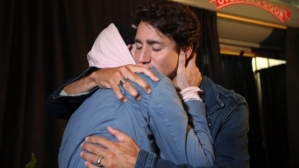
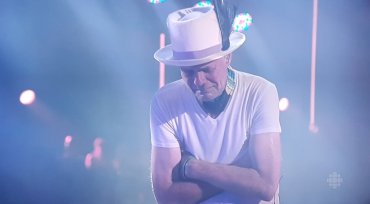
Since that night, as Downie inches closer to his final days, he’s still pouring his last energies into speaking up for our Aboriginal people. His latest endeavor is a tribute to Chanie Wenjack – in music, graphic novel, and animated form. 10 poems were turned into an album, which was turned into a graphic novel, which was turned into an animated film. They all tell the story of one boy, who represents the many, many more just like him, our first nations children ripped from the arms of their mothers, out of their communities, and into residential schools. Residential schools were run by church and state with the sole purpose of ‘civilizing’ the savages. gord-downie-sheila-north-wilsonProhibited from speaking their languages, practicing their spirituality, or honouring their cultures, teachers stripped them of their identity. Many children suffered terrible abuse, but all of these kids were deprived of their childhoods, and all of the families suffered terribly as I’m sure you would if your child was removed, perhaps never to be seen again, or if you were lucky enough to be reunited, we can only hope that you can find a common language in which to communicate. Communities were destroyed in what many Aboriginal people refer to as a genocide. It’s a dark part of Canadian history that wasn’t acknowledged until very recently. Today our First Nations peoples often live in poverty and other consequences of this intergenerational tragedy. Healing is not an Aboriginal problem, it’s something we need to address as an entire country. Gord Downie is doing his part.

If you are so inclined, The Secret Path can be streamed here for free (or in fact, down below). I hope you take the time to do so, and to share it with a friend. The images are haunting, but the lyrics will punch you in the gut. I was in tears by the third track.

Chanie Wenjack was only 12  years old when residential school became unbearable to him and he tried to find his way home. Not knowing where he was or where he was going, he walked until he collapsed in the snow, tired, lonely, starving, and he died. But there are dozenssecret-path and hundreds and maybe even thousands of Chanies dotting our countryside. Lonely and miserable, many children made an escape an attempt only to lose digits or limbs to frostbite, arms and legs on traintracks, or lives to exposure, or to punishment when recaputured. How many tiny bodies are still unaccounted for? The fact that we don’t even know is proof of how little white Canada cared for Aboriginal people, and this is a guilty fact we struggle to reconcile even today.

One day, likely sooner than later, Gord Downie will die and our whole country will mourn a great man, and a good man too. But Downie’s using his last work, and his last breaths to remind us that there are many others worth mourning too.


[As great and heartfelt as Gord Downie’s work is, it’s also really great to hear from Aboriginal artists themselves. Check out our coverage of the ImagineNative film fest]

Command and Control

We Assholes were in the lovely town of Portsmouth, New Hampshire over the weekend for a film festival, but little did we know we’d be joined by a 4th on Saturday – the king of the assholes himself, Donald Trump. Don’t worry, we managed not to catch fleas or throw pies, and we did see plenty of great movies.

Command and Control was one of them, a super scary documentary about that one time in 1980 when American almost launched a nuclear weapon ON ITSELF. Well, scratch that: no “almost” about it – the bomb was in fact compromised, and it just luckily failed to obliterate humanity. This whole thing happened before I was born, when my mother was just a pixie-haired 19 year old – roughly the same age, incidentally, as the men charged with preventing the doom of civilization

Even the best-case scenario, which the military obviously deems adequate, sounds terrifying: the Titan II, a big-ass missile carrying the biggest warhead on the books, was bunkered in an underground silo manned by teenagers not skilled or disciplined enough to get a better posting. And why are we surprised that shit went down?

It was end of shift when two little words heard over the radio would change everything -“Uh oh!” – not words you want to hear when a weapon of mass untitled.pngdestruction is at stake. Some kid used a ratchet rather than a wrench, and an 8 pound socket was dropped. Picture, for a moment, what this giant missile really looked like: from the bottom, you couldn’t even see the warhead, which was at the top, 8 stories up. The boys, working somewhere in the middle, dropped a big hunk of metal which made 1 bad bounce, tearing a chunk into the side of the missile which immediately began spurting oil. Nobody really wanted to own up to this possibly extinction-level fuck-up, so a half hour went by before anyone with any authority knew what was going on. And this being a government operation, a further 8-10 hours went by before anything was done about it. So the bottom fuel compartment was emptying quickly, which meant the top part was about to collapse in on itself at any moment, likely causing a huge-ass explosion even not counting the fact that a MOTHER FUCKING WMD WAS SITTING ON TOP!
Since I’m writing this and you’re reading this, we didn’t get wiped off the face of the earth, but the thing that saved us was dumb luck. The bile will rise in your throat watching this, knowing how close we came. The lady behind me uttered “Oh Jesus” 17 times before I lost count. But Command and Control, based on Eric Shlosser’s book of the same name, tells about that ONE time in 1980 when everything almost went black. That one time. This documentary lets us know that in fact, there have been hundreds, maybe thousands of accidents involving nuclear missiles. Every single day that some dopey American doesn’t accidentally kill us all is a miracle, and that reliance on constant miracles doesn’t exactly sit well with me. People with an awful lot of medals on their uniforms refer to the nuclear program as a “seat of the pants operation”; then-secretary of defense Harold Brown says about safety “we probably didn’t worry about it enough.” Gulp.

Today, in 2016, the U.S. still has 7000 nuclear weapons just waiting for an accident to happen. And to make matters worse, they’re threatening to elect a buffoon named Donald to hover his dumb little fingers over the big red button. So here’s the thing: accidents happen all the time. Most are covered up. American nuclear weapons have taken American life. But the bigger the accident, the more loss of life. And if there’s a big accident, there’s a mushroom cloud and ten million dead instantly. Who’s going to tell Donald to stand down, that this is “friendly fire” and not a button-pushing incident? No one. That guy will be dead. His superiors will be dead. It’ll just be Donald and his excellent decision making between us and all-out global war. Oh sweet Jesus – if this film isn’t another in a long list of compelling reasons not to vote for this guy, I don’t know what is.

Audrie & Daisy

Audrie & Daisy is a documentary on Netflix that provides an in-depth look at the effects of cyber-bullying on two teenaged girls in the aftermath of their sexual assaults.

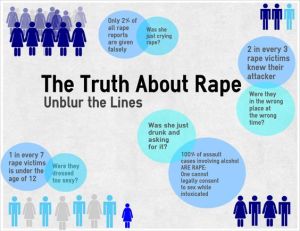
We live in a fucked up world. I was sick, and sad watching this. Sick that this is the world we’ve made for teenagers today, and it’s goddamned horrible. These little girls (14, 15 years old), nearly comatose with alcohol poisoning, are being 8747a7dd79a1b69c9906f86148c4a53cnot only sexually assaulted by gangs of their peers, but that assault is being recorded. Welcome to the digital age. These photos and videos are widely and quickly disseminated and before the bell even rings on Monday morning, everyone knows. The public shame feels overwhelming, all-encompassing. It’s nearly impossible to convince such a young girl that in fact things won’t always be this way, won’t always feel this bad.

Hearing Audrie Pott’s story made me ask Sean – was this the Canadian case, the one out in Nova Scotia? It wasn’t. Her name was Rehtaeh Parsons but the case was strikingly similar: rape, pictures, bullying, suicide. How often has this pattern repeated? OFTEN. So, so often. Daisy faced not just bullying after her attack, but open disbelief and derision from a whole town when she attempted to face the perpetrator in court. The mayor of Maryville, Jim Fall, and sheriff Darren White will make you see red. It wasn’t their sons who committed this crime, but it could have been. These are the disgusting individuals raising young men to be so crass and so entitled that they will boast about rape and take pictures for evidence. And these are the men who turn their backs on the victim, and the law, when such a crime occurs.

I was livid watching this movie, and you will be too. Good. We need to get riled up about this. Because we are endangering our daughters and quite obviously 479832cdcef9699caec033974a50b507failing our sons in some very basic way. Two of them, sentenced to testify on camera for this documentary, have learned nothing. No remorse, no responsibility. One young man volunteers that the only thing he’s taken away from this is that “girls gossip.” And these boys are free – to graduate, attend college, rape again, whatever. Free, and alive, unlike Audrie, unlike Rehtaeh, unlike so, so many.
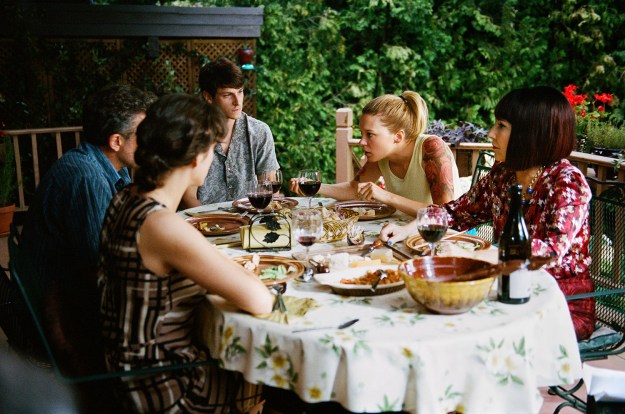
There is something broken in our culture if something like this is a trend. Directors Bonni Cohen and Jon Shenk don’t condemn the Internet, they sensibly promote it as a tool for these girls to band together, to realize they are not alone. But it clearly has far-reaching implications that we need to take more seriously. Sending or sharing a video of a 14 year old girl getting raped isn’t just taking part in the sexual assault, it’s disseminating child pornography. Penetration isn’t the only crime here. Social media is making all the looky-looks culpable. As Daisy so eloquently quotes in the film, the words of our enemies aren’t as hurtful as the silence of our friends. It takes a whole community to do the right thing. This isn’t just a bad apple scenario, it’s a blight on the whole damn orchard.

TIFF 2016: The Best


graduation

Graduation

From time to time, we all have to compromise our own values. It’s part of growing up. But do you remember the first time that you betrayed your own moral code?

According to Romanian filmmaker Cristian Mungiu, director of the brilliant and beautiful 4 Months, 3 Weeks, and 2 Days (which I have not seen), Graduation is about a lot of things. “It’s about family. It’s about aging. It’s about you. It’s about me”. But mostly, as the Cannes Best Director winner articulated at the North American premiere, it’s about that pivotal moment in one’s life where they make a conscious decision for the first time to do what they know in their heart to be wrong.

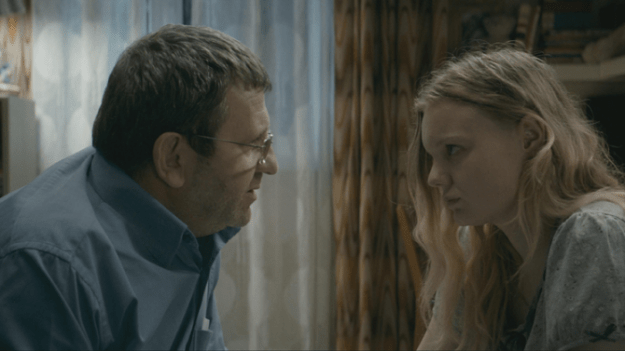
Romeo (Adrien Titieni) couldn’t be more proud of his daughter Eliza (Maria-Victoria Dragus) when she gets accepted into a fancy British school but he still can’t relax. Despite her stellar grades, she still needs to pass her finals to get out their Romanian town. When a vicious random assault threatens to shake Eliza’s confidence just days before her exams, Romeo can’t help feeling tempted to use his position as a well-respected surgeon to bargain with her educators in exchange for some leniency.

Graduation takes its time. It takes time to establish the relationships, set up the scenario, and let the story play out. Mungiu doesn’t resort to melodrama or even a musical score to beg for our attention. Almost every scene plays out in just one meticulously framed take. It’s an approach that gives his actors plenty of room to shine and his story the time to come alive. If you don’t mind the slow pace, Graduation asks big questions and will get you talking. It’s a very rewarding experience.

my_entire_high_school_sinking_into_the_sea

My Entire High School is Sinking Into the Sea

Dash Shaw was in high school when James Cameron’s Titanic was in theaters and couldn’t help imaging what it would be like if his school sank like the famous ship with all of his classmates inside. When you think about it, to avoid drowning to death in a sinking building, the smartest would head for the top floor and try to get to the roof. Once Shaw, director of My Entire High School is Sinking Into the Sea and apparently quite an accomplished comic book writer,  started imaging each floor being occupied by a different grade level, he knew he had a story worth telling.

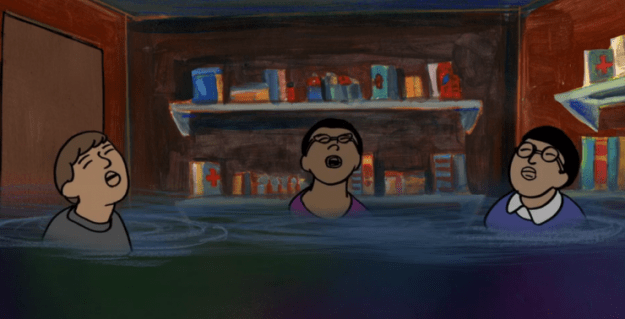
To see a film called My Entire High School is Sinking Into the Sea without feeling like you’re seeing something completely unique would be a letdown. So I’m pleased to announce that, whether you love it or hate it, Shaw’s debut feature will not let you down. The unusual animation style takes a little getting used to at first and, even once you get comfortable, there is so much to look at that many of the movie’s jokes- and the jokes are almost constant- can be easy to miss. My Entire High School may eventually be best remember for its carnage (those who are spared from drowning are mostly impaled, electrocuted, or eaten by sharks) but it’s made all the more special by the hilarious and sometimes touching dynamic between three adolescent friends whose bond is in crisis just as their lives are in imminent danger. And it’s all brought to life by some of the best voice acting you’ll hear this year from Jason Schwartzman, Lena Dunham, Maya Rudolph, Reggie Watts, and Susan Sarandon.

its-only-the-end-of-the-world

It’s Only the End of the World

I was one proud Asshole walking out of the Toronto premiere of Quebec director Xavier Dolan’s latest family drama. I was genuinely moved by a Xavier Dolan film. I admired Mommy, his last movie, I really did. It was just too self-indulgent for me to really relate to it in any real way.

So I was pleased to find myself loving this movie, more than almost anything else I saw at the Festival this year. I was finally starting to get it. I was quite disappointed to see that not everyone was as impressed as I was. It’s Only the End of the World currently has a score of 48 on Metacritic. If you’re not familiar with that site, let me put that in perspective. That’s only four points higher than Batman v. Superman’s score. Ouch.

I stand by my recommendation though. Based on a play by Jean-Luc Lagarce, It’s Only the End of the World tells the story of a family who are easier to relate to than to understand. After a 12-year absence, Louis (Gaspard Ulliel) is finally coming home but he is bringing sad news with him. He is very sick and doesn’t have much time left. He’s not quite sure how to bring it up but it wouldn’t matter anyway because his mother, brother, and sister can’t stop alternating between picking fights with him and each other and awkwardly trying to force reconciliation. They try to bond over trivial things and fight over tiny details but can’t seem to bring themselves to talk about anything important.

The claustrophobic family reunion atmosphere seems to rein Dolan in a bit. He still manages to make Lagarce’s play his own though. For such a talky film, it’s surprisingly cinematic with its unnerving score and great performances from Ulliel, Nathalie Baye, Marion Cotilliard, Lea Seydoux, and Vincent Cassell. Using his signature tight close-ups, Dolan works with the actors to find subtext amid all the shouting. No easy task. Hard to act like you’re holding back when you’re screaming at each other.

I’m still not entirely sure what they were fighting about. But the story feels real and profoundly sad.

nocturnal-animals-2

Nocturnal Animals

Careful with this one. The people around me at the TIFF encore screening of Nocturnal Animals were basket cases watching it.

It’s easy to imagine yourself in the same position as Tony (Jake Gyllenhaal), a husband and father whose family finds themselves terrorized while driving a lonely Texas highway in the middle of the night. The tension is nearly unbearable as this story unfolds. Those around me could barely sit still watching it and Susan (Amy Adams) is getting even more stressed reading about it. See, the scary part of Nocturnal Animals is but a story within a story. It’s the plot of a manuscript that Susan’s ex-husband (also Gyllenhaal) has sent her of his latest novel. As unnerving as the novel is to watch, it’s even worse for Susan. She’s quite sure the novel is about her.

The three narratives (there are also a lot of flashbacks of Susan’s marriage) are balanced beautifully in the second film from director Tom Ford (A Single Man). Susan is a successful art dealer and everything around her is beautiful and fake. In the story within the story, Tony’s world is harsh and all too real. Nocturnal Animals is sure to be divisive. Ford lays out his themes very clearly and I’m sure I feel comfortable with all of his implications. But there’s so much to look at and so much to feel, think,about, and talk about that you kind of just have to see it.

nocturnal-animals-3

Oh, and if you’re not sold yet, Michael Shannon plays a crazy cop in it.

The 4%

“The next Kubrick, in no one’s mind, is a woman.” – Julie Delpy

TIFF has organized this short documentary and asked tonnes of industry professionals, including a glut of top female talent, why such an enormous gender disparity exists in film making (only 4% of directors are female).

5f75e13ac3a619390745379e3ae3057dThe talking head interviews are culled extensively from the guest list of the 2015 festival, and include the likes of Toni Colette, Michael Moore, Patricia Clarkson, Judd Apatow, Mimi Leder, Paul Feig, Catherine Hardwicke, Angelica Huston, Jill Soloway, Mira Nair, and so many more.

Even as females slowly break through in producing, writing, and starring roles, the director’s chair remains elusive. Directing is a boy’s club, is run by a patriarchy. We are conditioned to think male when we think director. And if a woman is holding the megaphone, she effectively neuters herself in order to be taken seriously.

The documentary also touches on females being hired exclusively for “female”stories when in fact they long to tell a breadth of stories just like their male counterparts. Directing takes vision, shamelessness, openness, patience, and discernment – these are abilities that women are capable of. What it does not actually require: a penis. So why then were there more female directors in 1929 than there are today?

This documentary made me think about a female director we saw at TIFF – Hope Dickson Leach (The Levelling). She co-founded the initiative Raising Films, a campaign to make the film industry more parent-friendly. It’s certainly not a women-only concern, but it is a barrier to get more women on a film crew.

Sarah Solemani, star of Bridget Jones’s Baby, took the campaign to the red 14199431_1403270093023633_6583121126926777920_n-188x300.jpgcarpet when she broke out a sign reading ‘Budget the Baby’. She says “As an actor I can claim a massage or a facial but I can’t claim childcare. Actors are the most pampered people on sets. It’s the crews — the electricians, catering, camera people — who are often on set at 4am.” Hope Dickson Leach is a mother of two herself; you can imagine what a grueling 20 hour day on the set can mean to a family with young children.
The 4% is a small commitment – just 30 minutes of your time to enlighten yourself on a topic we should ALL be concerned about. It’s not just women who benefit from a more inclusive work place. They have stories and perspectives and voices that are distinct and worthy, and they need to be told and seen and heard. Equally.


TIFF: The Bleeder vs. Bleed for This

Ladies and gentlemen, it’s now time for the main event of the 2016 Toronto International Film Festival, coming to you live from the beautiful, historic Elgin Theatre.  

Introducing first, in the red corner, standing six feet five inches and weighing 223 pounds, with a professional record of 35 wins, including 17 by knockout, 14 losses and 2 draws, the former New Jersey State heavyweight champion, from Bayonne, New Jersey, please welcome from the Bleeder, Chuck “The Real Rocky” Wepner!!  

His opponent, in the blue corner, standing five feet eight inches and weighing in at 170 pounds,  with a professional record of 50 wins, 30 by knockout, against 10 losses, fighting out of Providence, Rhode Island, a former world champion in the lightweight, light middleweight, and super middleweight divisions, from Bleed for This, please welcome Vinny “The Pazmanian Devil” Pazienza!!

Jay was gracious enough to agree to include not one, but two boxing biopics in our TIFF schedule: The Bleeder, starring Liev Schrieber, and Bleed for This, starring Miles Teller.  In an all-out battle to capture my vote, who came out on top?  Let’s go ringside and find out!

bleeder

The Bleeder:

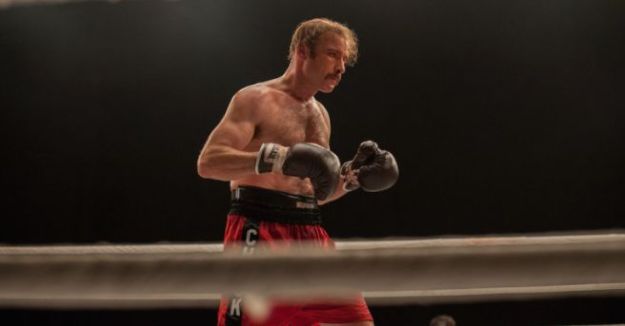
The Bleeder opens perfectly, introducing us to a guy we know even though we don’t know it.  That guy is Chuck Wepner, a human punching bag who took a punch so well he could go 15 rounds with anyone, even the Greatest.  Yes, the man himself, Muhammad Ali.  Wepner got the fight because he was the only white guy in the top ten, and during the fight he acquitted himself so well that he inspired Sylvester Stallone to write Rocky.

Along with taking a punch, Wepner’s other notable trait is the ability to consistently make the worst possible decision.  To the credit of Wepner and the Bleeder, the movie does not pull any punches with Wepner’s character.  He is a flawed person but the kind of flawed person who you can’t help but be charmed by.  Liev Schrieber is almost unrecognizable as Wepner and does a fantastic job of showcasing the charm while also making us feel for Chuck as he suffers some severe consequences, including losing his family and going to prison.

In the end, the Bleeder does justice to the Real Rocky’s story and gives us a true underdog who makes good in a real way, in his own way.  Somehow, the Real Rocky turns out to be the furthest thing from a cliche, and yet still manages to come out on top in the end.


Note: this movie has been renamed ‘Chuck’ and will hit theatres May 5.

bleed-for-this

Bleed for This:

While the Bleeder features the Real Rocky, Bleed for This features a comeback story too unbelievable to be used as a plotline in the Rocky franchise.  And that’s saying something considering Rocky has come back from: (a) Mickey being shoved to death by Mr. T; (b) Apollo being beaten to death by Drago; and (c) Adrien being written to death by Stallone as a convenient reason to make yet another goddamn Rocky movie.

Miles Teller makes a good showing as Vinny Pazienza, a champion boxer whose neck was broken in a car crash.  Told by doctors that he may never walk again, Paz somehow was able to return to the ring just 13 months after his accident and went on to fight boxing legends like Roberto Duran and Roy Jones Jr.  Teller looks like Paz and looks like he belongs in the ring, but in the transition to the screen the real-life magic that Paz possessed is lost and Bleed for This ends up feeling like just another boxing movie.  And that’s a shame, because overcoming this level of adversity should truly feel triumphant.

The Judges’ Decision:

The match goes the distance as both the Bleeder and Bleed for This are enjoyable films with charismatic turns by their stars.  There can only be one champion though, and by unanimous decision The Bleeder takes the belt.  The Bleeder is far more memorable because it’s not your typical happy ending, and it’s less about boxing and more about the trappings of fame.

The bottom line is that if you like boxing, you’ll enjoy both of these.   The difference maker is that even if you don’t like boxing, I am still confident in recommending that you watch the Bleeder.  It’s a fascinating story that captures the essence of the most interesting loser imaginable, a story so powerful that it inspired an entire movie genre.  It’s a credit to Paz and his tenacity that things were even this close, as in the end Rocky always wins.