Once upon a time it was movies based on Young Adult Fiction week, and I watched some stuff that I would normally never watch. Some of it was bad, some of it was not bad, and some of it was so bad it was almost good. In the end I was so glad to put it behind me I never got around to talking about the stuff that didn’t fit in either category – not good enough to endorse, but not bad enough to make fun of. So here it is, the middle of the road:
I couldn’t believe I hadn’t seen or heard of City of Ember because I didn’t know there was a Billy Murray movie I hadn’t already smothered in love. He plays the mayor of a town built deep  underground by a team of scientists just as the world was ending. They buried instructions on how to return to the surface after 200 years too, but stupidly entrusted them to politicians, who predictably bungled the thing and lost the instructions and now their city is crumbling, the power supply is failing and food is running out. Things are dire: teenagers to the rescue! Two “young adults” (Saoirse Ronan & Harry Treadaway) take it upon themselves to do the thing countless older, smarter, more intrepid people (including their parents) failed to do.
The visuals are stunning. I loved the sets of this underground world, everything just a little off-kilter, labyrinthine without being claustrophobic. But the story never quite lives up to what our eyes suggest. The plot is modest, maybe even thin. Writers of this young adult genre seem to 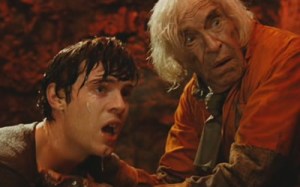 follow a pretty strict guide when it comes to their dystopian adventures: the founders, vague as they are, have decreed that people be assigned specific jobs and these jobs are ceremoniously given out and then life is spent labouring away at whatever “very important” job you’ve been given. There is little in the way of joy, but if you keep toiling away then your life is well-spent. BUT then there’s always some young upstart who questions the system. Sound familiar? City of Ember is basically Subterranean Divergent, although really I should say it the other way around since City of Ember came first.
The adventuring is pretty tame, the action mild, and the denouement predictable. This is post-apocalyptic-lite. Martin Landau gives a small performance worth seeing, and Tim Robbins isn’t half bad either. Bill Murray is, of course, always fun to watch, but otherwise this film is blander than you might think possible, though of course that was also Matt’s verdict on Insurgent.
Stardust came out in 2007, just a year before City of Ember, and it also passed me by. I haven’t been a “young adult” in at least a decade and haven’t been a typical consumer of this genre ever, so I guess it’s not so surprising.
I’m not remotely sure that I or alone else can really distill this story, but here’s my attempt:
Tristan is the young adult in question, a lad living in a quiet English village, madly in love with the town’s most beautiful girl who doesn’t give him the time of day because of course she’s way out  of his league. Throwing him a bone, she agrees to consider him if only he will catch her a star, and so of course he follows a fallen star over the breach in the wall surrounding his village and into a fantasy kingdom called Stormhold where the star turns out to be Claire Danes. Everyone following? Fallen stars that look remarkably like Claire Danes are quite popular – she’s also being pursued by a witch (Michelle Pfieffer) who wants to eat her heart to make her young, and a bunch of princes (let by Rupert Everett) who believe a ruby she carries will inherit them the throne. So now poor Tristan’s saddled with this star who’s pretty high maintenance, and the only help he gets is from his mother, who’s unfortunately bound by a spell, and a transvestite pirate (played with MUCH enthusiasm by Robert DeNiro- and no, I’m not kidding).
The story didn’t speak to me whatsoever (sorry Neil Gaiman, I’m still you’re girl!), but hello, with a great pop-up role by De Niro and another by Ricky Gervais, it’s pretty much worth watching on that basis alone, and those moments felt more like the trademark oddball Gaiman humour I’m used to. The special effects are pretty awesome (Michelle Pfieffer uses a sword designed for but never used by Magneto in Matthew Vaughn’s 2006 X-Men movie) but the action-adventure really gets bogged down by a sluggish pace. This movie drags on. It’s a string of fun moments but didn’t quite work for me as a cohesive whole.

 It sounds promising on paper: a dystopian thriller meets sci-fi Groundhog Day. The protagonists, Renton and Hannah, keep waking up in bed when a bunch of bad guys burst in on them. Things don’t go well. But every time Renton gets shot in the face, they wake up in bed again, to do it all over, though not necessarily with better results.
 isn’t worth it. The dialogue put me off immediately. It has the look and feel of the kind of television show I would never watch. Even worse, it ends like it’s the pilot of a TV show that hopes to continue this mystery in vague and infuriating terms for the next 6 years. It isn’t, though. It genuinely believes itself to be a whole movie. Don’t believe it, not for a second: ARQ is to be avoided at all costs. Keep swiping left.
 The film’s biggest problem is that it took 40 years to convert J.G. Ballard’s novel of the same name into a movie. In the meantime, Snowpiercer happened and was a way more awesome movie than High-Rise, or really anything else ever.
 and garbage bags that line the halls, and scavenge for dog meat rather than drive to the nearest supermarket for hot dogs. That’s something that was impossible for me to swallow.
 emotions. Everything is pleasantly flat. Nothing bothers them. But some are subject to a disorder in which those feelings are somehow switched back on. This disease is fatal – if you aren’t driven to suicide, you’ll be euthanatized, because being the only sensitive person in a void of flat affect is simply too much to bear.
 feels rather cold and lonely to us, the viewers, but the people living it don’t seem to notice until they come down with the disease, which sets them even further apart from their peers. But the one good thing is that Silas can see that his work mate Nia (Kristen Stewart) must also be infected. She hides her disease from others but cannot escape his awakened intuition. The two inevitably fall in love, though “coupling” is distinctly prohibited. The only way they can be together is to leave society and head for the outside world, where primitive humans still exist.
 The problem, however, is with the story. The truth is, it just feels recycled. It feels like you’ve seen this before. It’s like every second Margaret Atwood novel and does little to distinguish itself from other movies in the genre. What it doesn’t borrow from Atwood it steals from Shakespeare and it never really does its own thing. Equals is a highly-polished piece from a second-hand store. It’s not trash but it could never compete with the real thing. If you’re the kind of person who’s comfortable buying a couch off Kijiji, then maybe this one’s for you.




 ASSHOLES WATCHING MOVIES