Tag Archives: female directors

SXSW: The Breaker Upperers

For such a little country, New Zealand not only has a lot of talent oozing out of its confines, it’s also got a pretty distinct voice. Which is not to compare this movie to New Zealand’s most famous export, Taika Waititi (although it is produced by him), but there is a sense of humour there that is unique to its people, but travels well.

Madeleine Sami and Jackie van Beek write, direct, and star in The Breaker Upperers about a couple of best friends who, sharing a history of bad breakups, now run a business together breaking couples up. Mel and Jen think it’s pretty genius work. breakerSomeone wanting out of their relationship will contact them, and they’ll do what it takes to make a clean break – anything from singing telegrams, to pretend cheating scenarios, to even faking someone’s disappearance (which on paper sounds cruel, but this is all played for wide-brimmed comedy, and largely succeeds). It’s good money for them and quite entertaining for us, but we start to get an inkling that perhaps this line of work has stunted them – neither woman has a love life of her own to speak of. But when Mel starts to have a little too much sympathy for the wrong (ie, non-paying) end of the couples, what starts breaking up is their friendship, which is inconvenient when it’s the only relationship you’ve got.

The Breaker Upperers will definitely appeal to those of us who appreciate comedies that happen outside the Hollywood mainstream. Sami and van Beek have free reign to mine and prod whichever corners they choose, and they always find some sort of comedic dustbunny. If that means a 5 minute tribute to Celine Dion, then so be it. And it is funny, funny in the way it reminds of you of a movie you might have made with your own friends when you were twelve. It’s comedy that doesn’t have to hit specific buttons. It doesn’t have a predetermined arc; its route is more meandering, and retains the ability to surprise you without forgetting to entertain you.

I’m not sure how much reach this film will ultimately have, but I think it’s one worth seeking out, particularly if you’re a fan of Waititi’s, in which case, both their faces should already be familiar to you. And if they aren’t yet, they will be.

SXSW: Unlovable

Joy is on the brink of total disaster. After a failed suicide attempt, she finally admits that the disease she doesn’t 100% believe she has maybe needs to be treated: she’s a sex and love addict. So she joins a group and gets a sponsor. But restarting her life isn’t easy. She’s just lost her boyfriend and her job and her apartment. These are the kinds of circumstances that often lead her straight back into the arms of her addiction.

Luckily her new sponsor Maddie offers her her grandma’s guest house. “Just don’t bother the caretaker” she warns – so of course Joy’s first stop is to bother the grandmother’s caretaker, who is Maddie’s weird, reclusive brother, Jim.

Maddie (Melissa Leo) is of course a recovering sex and love addict herself and Jim (John Hawkes) has his own issues. [My issue is: with these actors both in their very late 50’s, how on earth do they have a living grandparent?] Throwing Joy, who is a bowl of mixed nuts what with her quirky, cheerful, suicidal, hopeless personality into the blender – well, it makes for a smoothie with a kick, that’s for sure.

Joy (Charlene deGuzman) suffers her share of ups and downs – lots of perogies and orgies – but for all the “love” and all the sex, she doesn’t really begin to understand true intimacy until she and Jim bond over music and start a friendship, and a band, not necessarily in that order.

Addiction is not a disease that is “cured” but one that is managed, very carefully, and with lots of effort. It’s sort of a relief to see a “nice girl” felled by addictions – truly, they don’t discriminate – and it’s good to see representation both good and bad on the big screen. Joy perhaps doesn’t look like she fits the common mold, but dig a little deeper and you’ll find the pain that she’s been hiding behind cat tshirts and loud prints for years. And support systems are key in maintaining a healthy life, but they don’t always come for where we’d expect. Each character in Unlovable has something to give, but also a reason for wanting to hold back.

At one point Maddie says “We get what we think we deserve” and I’ve said the same often myself. We let people treat us terribly when we think we’re worthless. Unlovable is about finding yourself lovable and worthy of love, and learning a way to give that love to yourself.

SXSW: 6 Balloons

Katie is having a busy day. She’s throwing a surprise party for her boyfriend and she’s got stuff to do: food, cake, balloons, the usual. Plus picking up her brother, Seth. Is this a good day for Seth to have relapsed on heroin? No it is not. Is there any right time to do that? Likely not. But it’s an especially bad day, seeing how Katie’s got a houseful of people waiting on her, and Seth’s 3 year old daughter Ella is along for the ride.

Yeah, I REALLY wish that last part wasn’t true. The thing is, Katie (Abbi Jacobson) has been down this road with her brother before. And she’d displaying the classic 6balloonsheadersymptoms of the caring sister who’s also sort of an enabler. Because instead of leaving him to get his shit together, she’s prepared to miss the party and spend the night driving around the dirtiest, sleaziest parts of L.A. to find her brother (Dave Franco) a detox facility, and barring that – well, something far worse.
This film accurately depicts the enormous toll that addictions take on the whole family – it truly is a family disease. Everybody plays their part. Heroin is no joke and someone withdrawing from it is in very sick, and possibly very dangerous territory. Any movie that has realistic portraying of drug use is of course going to be hard to watch, and for a lot of us, having such a young child along as a witness is just heartbreaking.

Sean left this movie quite mad at Katie, for her choices and her failures, but that’s what makes this movie interesting. Director Marja-Lewis Ryan allows us the space to sympathize with both characters and to come away with our own judgments – and it will be very hard not to judge. Addiction is a powerful disease and the truth is that most people will relapse. And it’s also true that drug addicts are judged far more harshly than, say, someone who has had a second or third heart attack – even though both diseases have genetic components, and involve some willpower over lifestyle. Nobody wants to be hooked on heroin, and no one wants to die coming off it. And Katie loves her brother but doesn’t know which choices will ultimately serve him better. Or when to say no. Or how to set boundaries. And of course drug addicts are infamous for pushing boundaries anyway.

6 Balloons is a mercifully quick ride at 74 minutes but it doesn’t let you off easily; it will pack enough horror into its short run time for 20 normal movies. But it’s not just horror, it’s also love. So much love. But is love what Seth needs right now?

You can decide for yourself: this movie will hit Netflix April 6.


Wild Nights With Emily

Emily Dickinson, that is.

This movie started and I was like: ugh. They’re really flaunting their teeny-tiny budget. This is a period piece but the costumes look rented and the sets are old (but not old enough) houses and the accents are atrocious and the props are vintage perhaps but certainly not antiques. But once I let go of my authenticity bias, I relaxed and could appreciate that no, this film can’t afford to look like an ethereal Austen period piece, but it does have something important to say.

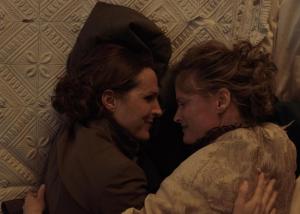
Emily Dickinson was a brilliant American poet who was never published or recognized during her lifetime because her lifestyle was not “becoming.” In order to publish them MV5BOGIyNjg0NWItYjMzMS00N2I0LTllYjUtMzBhMjJkMDgzMWM3XkEyXkFqcGdeQXVyMTc5OTQwMzk@._V1_posthumously, a narrative was created about her that has ever since called her a recluse, a virgin, a socially awkward spinster, which are all words attributed to women who just didn’t fit the mold. In reality, Emily had a passionate love affair with her brother’s wife, Susan. Many of her fieriest poems are dedicated to her – and name her. Traces of their relationship were of course literally erased from history in order to sell her poems to a conservative market. Dickinson was a woman ahead of her time in so many ways and this movie’s ambition is to have us reconsider the things we think we know about her.

Director Madeleine Olnek knows that letting Dickinson’s true flag fly may prove controversial, and that people generally don’t enjoy lectures about feminism, so she’s made a film that we can laugh at. And the best signal that this movie will be tongue-in-cheek is her casting of Molly Shannon as Ms. Dickinson. Molly gives Emily an energy and a joie de vivre that has been absent in our conception of her. But it’s clear from her poetry that Dickinson was in fact a woman of real passion – she loved and was loved. She was also constrained by her gender, class, and status, and all of those things have shaped our image of her. It’s only thanks to Susan’s daughter that we know of their great love and lifelong relationship, and to dedicated scholars who have uncovered the clues that were of course there all along. Don’t watch this movie if you can’t think outside the box. But do watch if you think the world needs more feminist, lesbian heroes – they’ve always existed, they just need our acknowledgement.

SXSW: Pet Names

Leigh’s life revolves around caregiving. Her mother is sick and her death is slow. Slow, slow, slow, like watching a corpse decompose above ground. Leigh needs a break but her mother is obviously not in any shape to take vacation…so she invites her ex-boyfriend instead.

Leigh (Meredith Johnston) and Cam (Rene Cruz) dated for a long time, and it becomes apparent on this camping trip that their ends are pretty jagged. I mean, let’s just take a MV5BYzE5ZTJjZjEtYjJlOS00YmU0LWJkZWYtYWE1MDJkNDcwMWVhXkEyXkFqcGdeQXVyMjYzNzU5MDI@._V1_SX1777_CR0,0,1777,999_AL_breather for a minute and think about whether you’d be willing to go camping with your ex. Me? Hahahaha, no. Of course, I don’t want to camp with anyone, ever, because camping is awful. But I wouldn’t go on a luxury vacation with them either. Or for a 12 minute coffee. I’m a mover-oner.

Leigh and Cam? I’m not sure they’re ready to move on, but they’ve got a lot of baggage between them and no amount of fireside whiskey is going to make it disappear. Plus, Leigh is a different person now. She’s experiencing grief and loss and it’s changing her. Maybe Cam doesn’t know her anymore. Did he ever?

Pet Names has lovely cinematography (the kind of camera trickery that might actually make camping seem like a good idea). It also has a thoughtful script, penned by Meredith Johnston herself. It’s no wonder she seems so comfortable in her character’s skin. She and Cruz have the kind of chemistry that’s believable between two people who’ve seen each other naked but aren’t supposed to anymore. Director Carol Brandt gets to the meat of this, eagerly having them confront old wounds that are not past bleeding. The camping trip may look beautiful, but with so much to unpack, it’s clear this getaway will be anything but restorative.


SXSW: Boundaries

Laura is making her therapist proud by making and enforcing some strong, much-needed boundaries with her father. She’s also lying to her therapist about plenty of things, including the actual number of rescue animals currently residing in her home, and in her purse on the floor of the therapist’s office. But Laura’s father Jack is very good at testing boundaries, and right now, he’s a man in need. His retirement residence is kicking him out, and if Laura is unprepared to house him in the home she shares with her teenage son Henry, the least she can do is drive him cross-country to her sister’s home in L.A.. Right?

MV5BMTY5NzMzNTcwM15BMl5BanBnXkFtZTgwNDg0MTc3NDM@._V1_Laura (Vera Farmiga) loves her son, and her pets, and against all odds, her father. Her son is a sensitive, gym-hating, naked-picture-drawing type (Lewis MacDougall) who’s just been permanently expelled from school. Her rescued pets are a rag-tag, flea-ridden circus of mange, as pathetic as they are cute. Her dad (Christopher Plummer) is a drug dealer and a rapscallion through and through, and terminally charming.

The cast works together as a dysfunctional unit. Director Shana Feste puts together a trio that doesn’t seem like a natural fit but somehow it works – perhaps because they’re all sort of loners in their way, much like the abandoned animals they pick up along the way, and they find a reluctant companionship that turns into some genuine, heartening chemistry onscreen. Toss in a dash of Bobby Cannavale, a splash of Christopher Lloyd (and Christopher Lloyd’s balls, as Farmiga was quick to recall, and not without a blush), and sprinkling of Peter Fonda…my goodness, it’s a bowl of mixed nuts,  more salty than sweet, but it went down mighty well.

I saw this at SXSW when I’d also just seen You Can Choose Your Family, and made me think: good lord, these directors have daddy issues. But I guess all art comes out of some frustration, some need to prove something to someone. But since father issues are nearly universal, I suppose these films feel at once familiar but also just removed enough that we can laugh at them, enjoy a moment of catharsis because someone else has it just a little tougher than you. Collectively the audience will laugh, and will emit a sigh of relief for having survived this awkward family trip.


Thanks for keeping up with our frantic SXSW coverage. We’re posting so frequently you may have missed Sean’s great review of The Director and The Jedi, or my review of the truly astonishing Blindspotting, or Matt’s review of the documentary From All Corners.

SXSW: Fast Color

fast-color-116514Julia Hart, the director and co-writer of Fast Color, almost had me fooled.  She introduced Fast Color to the SXSW crowd as a story about motherhood, and in a way that’s true.  Of course, in a way it is also true that the original Superman comics are about the experiences of Jewish immigrants.  I mention Superman because both Fast Color and Superman use superheroes to tell their stories, although the movies’ respective approaches to the genre are worlds apart.
Fast Color might be best described as a near-future quest for redemption, as Ruth (Gugu Mbatha-Raw) tries to stay one step ahead of her pursuers in the harsh wasteland that the midwestern United States has become due to a prolonged drought. Plot-wise, that’s all you’re getting from me, so you’ll have to watch the film to see how deep the rabbit hole goes.

I hope one day we won’t need to make the case for inclusion, but since we’re not there yet, Fast Color is more proof that diversity in film generates powerful, original, thought-provoking movies. Fast Color possesses all those qualities and a big reason why is because it is a story about women told by women. It is the kind of movie that we need (and deserve) more of. It is the kind of movie that helps us see things from a different perspective and realize that we are made stronger, not weaker, by our differences.

Fast Color is yet another SXSW surprise, a movie that we lucked into by virtue of scheduling and one that I urge you to keep an eye out for. It does not currently have a release date but hopefully a strong SXSW showing will change that, as this is a movie that deserves to be seen.

SXSW: You Can Choose Your Family

I chose this movie because: Jim Gaffigan. God I love him. He’s a stand-up comic whose act for many years concentrated on his 5-kid, 7-person family living in a cramped 2-bedroom apartment in New York City. He’s a family man and a good Catholic whose only sin is gluttony. I shouldn’t like him or relate to him, but he’s a genuinely funny guy, and I can never get enough (he’s got some comedy specials on Netflix and a couple of books at your local library and commercials for mini vans and KFC). So when I heard he was in a movie screening at SXSW, I was on board, no questions asked.

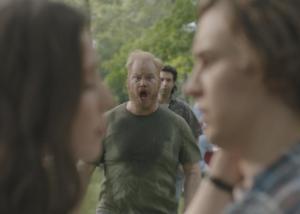
In You Can Choose Your Family, he plays Frank, a father and husband who is often absent, travelling on business. Once high school sweethearts, his wife (Anna Gunn) feels like she hardly knows him anymore, and his son Philip (Logan Miller) feels like his father MV5BMTU3NzI1NTc2N15BMl5BanBnXkFtZTgwNzQ1MTc3NDM@._V1_has never known him. Philip and his father are always clashing, and Philip can’t wait to get far, far away from his family when he goes to NYU next year. But for now he’s trapped in his father’s house, living by the rules that Frank isn’t even there to enforce. So when Frank flies to Japan on business, Philip thinks it’s the perfect opportunity to go blow off some spring break steam. But what he finds there is not what he bargained for: it’s his dad…and his dad’s second family. Oh, fudge.

So of course Philip blackmails him for all he’s worth. But now that there’s a crack in the secret…well, cracks always get bigger, don’t they? Director Miranda Bailey bills this as a comedy, and the Jim Gaffigan casting would seem to back that up, but this is a pretty unfunny situation that I suppose we’d better laugh at, because the other option is unthinkable. Bailey admits that she’s got some daddy issues to work through, and really, who doesn’t, but laughing at them kept me squirming, and huffing, and burying my head in my hands. If you really stop and think about how you’d feel – as either the child or the spouse – having your relationship and in fact your entire life be usurped by replacements – well, that’s a horrible feeling. And horrible feelings can only exist for so long on film before we’re obligated to break them up with some laughs. Is this a comedy? I wouldn’t go that far. But it was an interesting, sometimes funny, film that will make you appreciate the family you do have, whatever that is.


Note: this film has since been renamed Being Frank.

SXSW: The Shorts

Are We Good Parents?

Director: Bola Ogun

One day before school, a daughter lets slip she’ll be shopping for her homecoming outfit, and her parents are floored to find out that a certain “Ryan” will be picking her up for her first dance. As soon as the daughter’s out of earshot, Mom and Dad are questioning their whole parenting motif. They’d always assumed she was gay. What have they done wrong? Is she actually straight or just rebelling, or has something they’ve done or failed to do made her feel unsafe to come out?

The script is flipped from the hetero-normative expectation that a kid is straight until you hear otherwise. It’s an interesting statement to make but one which might have worn thin with a less authentic-sounding script (by Hailey Chavez). But this is no after-school special; Are We Good Parents is genuinely funny, thanks in large part to Tracie Thoms and Sean Maguire, who really tap into the self-doubting roles of two loving parents to a straight kid. This short film has big heart but it really makes you think about the assumptions we make not just as parents but as a society, and what ‘coming out’ really entails.

A first-generation American from Nigerian heritage, Ogun was born and raised in Texas and has a bright film making future ahead of her. Her film is making its world premiere at the SXSW film festival on March 10 and screens again March 12 and 15 as part of the Shorts Program 3.


The Coffin Club
Director: Briar March
This short is a documentary about a club formed by senior citizens in New Zealand. Through a lively musical number, the real members of the club tell us how they’ve formed a club that makes their own coffins. Sure they save some cash with their hand-made confections, but the best part is how they personalize their final resting places with glitter, paint, and pictures of Elvis. The film is 3 and a half minutes long, the whole thing sung (with Jean McGaffin and Kevin Quick providing spirited vocals), and it covers the snacks they nibble on between their morbid arts and crafts, and the trouble they got into from local funeral homes who felt their bottom lines were being hurt.
I am several decades too young and not a joiner by nature but I am desperate to be a member of the Kiwi Coffin Club. These are people who know that a box is just a box – but why not make the thing beautiful? They’re demystifying death, and preparing for it in their own way, putting their own stamp on a funeral that is usually designed by others. But it’s also clearly a social thing, with lots of camaraderie. If the club is looking for new members, I’m a great beaker and I have my own glitter, a glue gun of course, and a whole drawer full of ribbons. I’m not much of a singer, but I can snap and believe I look quite fetching in a top hat.
This doc is just minutes long but I felt like I’ve made some real friends. I could have watched for hours more. The production is great, and director Briar March turning the thing into a musical extravaganza shows us there’s more than one way to flip death the bird.
This film screens in the Documentary Shorts 1 block on March 10, 12, and 15 and honestly, it’s a whole lot of fun.

SXSW: A Vigilante

Sadie picks up her messages. There’s a code phrase, and then a woman’s voice, shaky and furtive. She wants to leave her abusive husband. She needs help. Can Sadie come?

Sadie is a one-woman vigilante ass kicker. She gets bad husbands gone, and if they won’t go quietly, she will mess them up. It’s not just the krav maga that makes her strong, it’s the history she shares with her clients. But no matter how many women she helps flee violent situations, she can never truly escape her own, because her husband is still out there, never brought to justice for his sins.

Writer-director Sarah Daggar-Nickson wanted to make a film about domestic violence MV5BMTc2NzM2NTk0NF5BMl5BanBnXkFtZTgwMjQ1MTc3NDM@._V1_that would really speak to the urgency and the desperation and the severity of the issue. She did scrupulous research, and the details that come through – like the fact that New York state will pay for the funeral of anyone murdered during your escape (fucking think about that for a moment) – are depressingly, frighteningly authentic. Real-life abuse survivors make up the support groups which Sadie attends. They share stories that will haunt you.

But this is Sadie’s story. Sadie is intent on being strong now, for herself and for others. But as badass as Olivia Wilde is in the role, we never forget that Sadie’s husband, though no longer in the picture, still has a hold on her. It sounds easy to leave, and logical to move on, but abusive relationships are a sickness, one that keeps you coming back. So while Sadie may have trained herself to assault any man she has to, her trickiest opponent will always be the demons in her own head, and it’ll take more than physical fitness and a bunch of clever disguises to defeat those.

The film is interesting because we get to see themes like control and confidence evolve throughout. We get to know Sadie and her story through flashbacks, but the film keeps a forward momentum that manages to keep its pressure building. This movie is not exactly an easy one to watch, but neither is living with the reality of domestic violence, and for that, I think we can all dig down and find a little inner bravery.


For more South By coverage, read Sean’s review of Ready Player One, Matt’s review of The World Before Your Feet, or my review of Blockers – and check out our Twitter feed – we’ve been to Westworld, and to Roseanne’s living room, and we saw Barry Jenkins and Rian Johnson and Mark Hamill and more! @assholemovies