Tag Archives: foreign films

SXSW: From All Corners

Quick question: How do you feel about cardboard?

Unless your name is Fuyuki Shimazu, the subject of this documentary, your honest answer would probably have to be “I don’t have strong feelings about it either way’. Until today, it was virtually impossible for me to imagine anyone responding any differently. Well, Fuyuki Shimazu loves cardboard.

It all started when he was a poor student wanting a wallet of his own but not able to afford one. Left with only two choices- do without for awhile or get creative- he made himself one out of cardboard. I can’t remember offhand if he made it from cardboard he found in the garbage or if he started doing that later.

Fuyuki’s outside the box thinking turned into a passion and eventually a career.  Searching the warehouses and dumpsters all over japan, he began to collect cardboard that caught his eye and began to make a living off of making and selling wallets. And they’re nicer than you might think. Seen through Fuyuki’s eyes, yeah, I can sort of see it. I wouldn’t have noticed before but there are a lot of cardboard boxes out there with eye-catching designs.

It’s not easy to know what to make of Fuyuki at first as he travels the country to various factories to learn the stories and inspirations behind his favourite cardboard boxes. he worked at a prestigious advertising firm for 3 years as an art director where his colleagues said things like “Whenever you talk, it’s always about cardboard”, “He’s a different kind of species”, and “We have all sorts of employees so he was not the only weird one, but…”. He’s a likable guy though and seems to be able to make friends with anyone. His enthusiasm, if not exactly contagious, is endearing, inspiring, and unquestionably genuine. He’s a great subject for a documentary and director Ryusuke Okajima is smart to keep the focus mostly on him.

There’s a more universal point to all this, of course, about upcycling. With Earth’s resources dwindling as they are… Oh never mind. Just watch the movie. I promise it’ll be worth your time. And if you’re as burnt out on documentaries about the environment as I am, you’ll be relieved to know that Okajima doesn’t belabor this point and only mentions it in any detail towards the end. Fuyuki Shimazu and his wallets are fascinating and From All Corners is wise to keep the focus mostly on them.


PTU

PTU follows a group of police officers charged with patrolling the city of Hong Kong, who are asked for help by another officer who lost his gun in the area during a fight with a street gang, but is hesitant to report the loss to HQ, worried it will affect his upcoming promotion.

I really don’t know what to make of PTU. It’s not at all the movie I was expecting (having seen Heroic Trio last month, I thought someone would have superpowers here) but at the same time it didn’t defy my expectations, plowing along without any real direction. PTU is almost farcical at times yet it’s so straight-laced as to make me wonder whether the silliness is by design or whether this is intended to be a straight procedural drama whose seriousness has been lost in translation.

Because when a cop slips on a banana peel, it’s hard to take him seriously.  When he does it more than once, I have to take the second fall as a “shame on me” moment. And yet, to view that cop as incompetent brings everyone else’s competence into question too, since they take him seriously to the point of taking his advice.

PTU’s slow, deliberate pace might have fit well with a different police drama, but it quickly became a problem here by giving me time to raise these questions of competence for every character involved. And they all failed the test. A more action-oriented film may have kept me too busy to get bogged down in the details, but with PTU having such a slow pace, none of the characters looked good in the end. I couldn’t invest in any of them and couldn’t connect with PTU as a result.

The Square

Sometimes, I walk out of a movie and wonder why a director decided to insert a scene that didn’t seem to add anything to the film.  With The Square, I walked out wondering why the majority of the scenes had been included.  Even the film’s poster gets in on the act, blatantly photoshopping Elisabeth Moss into a scene in which she doesn’t appear.  That is a fitting allegory for her role in the film as well as for a lot of the movie’s scenes.  Moss didn’t need to be there in the poster picture but someone went to the effort of adding her anyway, for no obvious reason.  The same thing seems to have happened with many scenThe-Square-movie-posteres in this film, the latest from Ruben Ostlund, who previously directed Force Majeure.

The Square centres around an obnoxious, entitled museum curator (Christian, played by Claes Bang) who makes more than a few mistakes in promoting his museum’s new exhibition and, on the side, searching for his stolen phone, wallet, and cufflinks.  The fact he sees himself as a pretty good guy only makes things worse for him and everyone he comes into contact with.  In between his missteps, we are treated to some truly bizarre scenes involving a human pretending to be an ape at a dinner party, a real ape acting as a third wheel at Moss’ character’s apartment, and a cheerleading performance by one of Christian’s kids, none of which advance the plot in any way, despite a lot of effort being put into staging and filming these scenes.  But to what end?  The Square repeatedly left me feeling like I had missed the point, but it happened so many times I had to conclude there was no point.

That is The Square: an overlong mess of ideas patched together into a two and a half hour long feature.  The movie starts well enough but doesn’t know where to go once it gets started, and certainly doesn’t know how to wrap up what it’s laid out.

The frustrating part is that many of the ideas in the film have the potential to make for good satire, but the movie can’t figure out how to unlock their potential or say anything meaningful, aside from pointing out how much idiocy and chaos can be created by a self-entitled boor, which we are all way too familiar with in our real lives right now.

All in all, The Square never amounts to much.  Just like its protagonist, it is aimless, clueless, and we’d be better off if it went away quietly.

Lu Over the Wall

Greetings from the Ottawa International Animation Festival, which we’re always proud to cover because not only is it our hometown festival, it’s also a really great one – terrific movies, great venues, well-organized by staff and volunteers. It makes an Asshole proud!

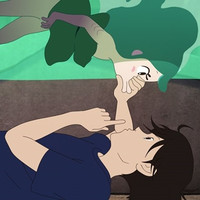
Our first stop at the festival was to the good old Bytowne, where all the best indie films get shown year-round. Lu Over the Wall is a Japanese film by director Masaaki Yuasa, and I have to say, I was pleasantly surprised by it.

The film is about Kai, a surly middle schooler who seems isolated from his peers until it 48a6ae418cf7ea14caa9daee89cfc4381491527985_largeis discovered that he makes really interesting beats with his computer, and he gets recruited into a band by Yuuho and Kuniko. The band practices on a deserted island away from the mainland so that Kuniko’s family won’t discover his dirty little secret (he’s destined to be a temple keeper, not a rock star). But out there they stir up the myth that has shrouded their town for decades: that of merpeople.

Turns out, merpeople are attracted to music, and that’s exactly what prompts Lu, a very cute little mermaid, to leave the water to sing and dance with them. Everyone else is terrified of merpeople, who, legend has it, eat people, among other atrocities, but Kai can relate to Lu and so they become friends. It’s a tricky relationship to navigate when half the townspeople want the merfolk dead and gone, and the other half hope to exploit them for money.

No, this isn’t an animated take on The Shape of Water, though it’s beginning to sound like it. But it is a story about looking beyond our preconceptions, a story made all the more palatable by its incredibly sweet animation. When it’s meant to, the joy practically leaps right off the screen. You’ll feel your heart tug upward. Lu’s happiness is infectious. I mean, what kind of a person isn’t completely bowled over by mermaids? Like, how black is your soul? And Lu is so bright and bubbly she makes Ariel seem like a puddle of puke. Lu Over the Wall is giddy, upbeat, and as you might have guessed, has a soundtrack bursting with J-pop. I love how the movie evokes emotion by changing up its animation style and if for some reason your inner darkness has been able to resist up until now, I’ll leave you with just one word, the only word this review really needs: mer-doggies.

TIFF 2017: High Fantasy

High_Fantasy_06Lexi is a white South African millennial who has recently inherited a ridiculous amount of farmland in the middle of nowhere. She is fully aware that her family stole this land from some black people and she gets a little touchy whenever the subject comes up. Which it often does when she brings her three black South African millennial friends on a camping trip on her family’s land.

The four friends (3 girls and a guy) have very different histories and worldviews, but the mood is light and friendly on the first day. Things take a turn for the awkward on Day 2 though when they wake up to discover that they’ve somehow swapped bodies overnight. The fallout is brilliantly captured by director Jenna Bass on her iPhone in found footage/mockumentary format.

Whether in South Africa or even right here in Canada, 2017 is a tricky time to make a film about racial tensions. The worst thing one can do is to reinforce the myth of easy answers just to get your Hollywood ending. Bass -and her four stars who co-workers the script with her- are very careful to avoid this trap. The interaction between the characters are every bit as messy and unpredictable as they should be. It’s a little bleak, refreshingly honest, and avoids the typical lazy talking points.

As for the fantasy gimmick, it works and it doesn’t. It does provide some opportunity for some comic relief that seems to emerge organically from the situations without resorting to too many Freaky Friday clichés. It is confusing though; I did spend a lot of time trying to remind myself who was in whose body. Which is a bit of a problem. Given how much of the story lies in subtext, it becomes important who’s saying what.

That’s all fine though. I don’t mind having to work to keep up with a film this sincere and well-acted. It just seems that much of the conflict between the characters boils to the surface due to extreme stress and not always specifically because they’ve swapped bodies. So I had to wonder if this all would have been less confusing had they just ran out of gas.

High Fantasy is exactly the kind of film that most of us go to festivals for. It’s a low budget and unique film that is surprising and challenging. You’ll probably be begging your friends to watch it so you can have someone to talk about it with.

Originally published at www.cinemaaxis.com

TIFF 2017: Bingo! I Got Bingo!, Part 2

Catching 3 films by female directors is easy. The TIFF lineup this and every year has lots of interesting films to choose from, many of them directed by women. Getting full TIFF Bingo isn’t so easy.

I have stress dreams about the Midnight Madness ball and avoid it like it’s a not deep-fried vegetable so that’s out. And, while Battle of the Sexes had its moments, I can’t honestly say that I thought “Now this I’ve got to try”.

But I did…

Thank a Volunteer

Mom and Dad– The festival and the city that hosts it can be a little overwhelming at first. Even though I feel like an expert by the end of my stay, every year I’m feeling a little disoriented when I first get into town. So I’ve just checked into my hotel, it’s 11:40 at night, and I’ve got a Midnight Madness screening of Brian Taylor’s Mom and Dad in 20 minutes. I’m running around trying to find Ryerson theater and I’m getting stressed out imagining all the ways that I could humiliate myself trying to volley a beach ball in a crowded theater. Luckily, a friendly orange shirt is never far away and I was very thankful to the volunteers who helped me find where to line up. I never miss a chance to thank a volunteer and I applaud for them every time the TIFF commercial prompts us to.

So, anyway, Mom and Dad. Taylor (Crank, Ghost Rider: Spirit of Vengence) seems to be just begging us to make this a cult classic. An unexplained virus suddenly hits suburbia in the middle of the school day that infects parents with an uncontrollable urge to violently murder their offspring. Poor Carly (13 Reasons Why’s Anne Winters) and Josh Ryan (Transparent’s Zackary Arthur) are forced to fend for themselves against their now-deranged parents played by Nicolas Cage and Selma Blair.

Mom and Dad is bananas. Almost every aspect of the film- from the basic concept down to the music and over-caffeinated editing- seems driven by the same manic energy that fuels Cage’s typically unhinged performance. The actor, who in the eyes of the enthusiastic Midnight Madness crowd may as well have been John Lennon, already starts overacting long before the virus starts making everyone crazy. He outCages himself in this movie and- while it would be a stretch to call it a good performance- it feels like the right performance for this movie. But it’s Blair, surprisingly, who somehow finds a way to keep this runaway train from going off the rails. From the start, we can tell that her character is a good mom. She loves her kids but she’s exhausted and taken for granted. She’s the only believable character in the whole thing and her presence brings Mom and Dad back to earth. It’s through her that we start to sense that the virus is tapping into an existential crisis that was already in place before the infection.

To call Mom and Dad good would be ridiculous but it’s not really trying to be. It just wants to be fun and, for the most part, it is. It’s often funny, even coming dangerously close to smart, especially when it’s in terrible taste.

Phone Dies

I got some great photos this year, many of which you can see if you follow us on Twitter. I like sitting in the front row so I was able to get some shots of Nicolas Cage, Alicia Vikander, Alexander Payne, and Darren Aronofsky that I’m really happy with. But you won’t see a photo of Ellen Page (who, if I’m not mistaken, counts as a superhero out of spandex) because my phone died.

The Cured– So I did manage to get a couple of pictures of Ellen Page during the Q&A for The Cured. They’re just not tweetable because my phone didn’t have enough juice left for the flash to work. So it’s not a great picture. It’s a shame because I love her.

And, yes, fortunately for my TIFF Bingo card, my phone officially died on my way back to my hotel.

On to The Cured. This debut feature from Irish director David Freyne finds yet another way to breathe new life into a genre that seems to never run out of ways to reinvent itself: the zombie movie. Once this version of the zombie apocalypse has died down, two thirds of the “infected’ have been successfully cured and are slowly being reintegrated into society. Ex-zombies don’t have it easy though. They still have painful memories of the suffering that they inflicted and most people still don’t trust them.

Senan (Sam Keeley) has just been released from a treatment facility and is taken in by his brother’s wife Abbie (Page) who has been widowed by the outbreak. When he falls in with a militant group of zombie rights activists, Senan struggles to find a balance between his desire to fit in and atone for his crimes and his instinct to stand up for his fellow cured.

To Freyne, his film is really about how we treat each other in today’s mixed up world. It’s a serious movie with serious themes that somehow finds time to deliver the goods when it comes to zombie scares. Freyne’s direction is confident and precise, more so than almost any other movie I saw at the festival this year.

So there you have it. I wore out my phone battery, saw 3 films by female directors, thanked every volunteer that I spoke to, and even managed to see some good movies while I was at it. By now, experienced Bingo players have probably already spotted my path to victory but please feel free to stay tuned for more details.


TIFF 2017: Bingo! I Got Bingo!, Part 1

I got TIFF Bingo! I never get TIFF Bingo!

I get close every year but I’m always missing something. Either I didn’t see enough foreign films or didn’t eat enough vegetables. And even for TIFF Bingo, I refuse to ARRRR!

But TIFF victory was mine this year and let me spend my next 3 posts telling you how I pulled it off.

3 Films By Female Directors

Battle of the Sexes– Okay, so only half of the directors are female but judges say… Still counts! Directed by Jonathan Dayton and Valerie Faris (Little Miss Sunshine), Battle of the Sexes tells the behind-the-scenes story of the now-famous exhibition match between Women’s Tennis star Billie Jean King (Emma Stone) and has-been Bobby Riggs (Steve Carell). It’s a hard movie to google or even mention without hearing about how this is the movie we need in these troubled times. “We could use more of those values today,” Dayton quipped while introducing the film. (While the directors deny that the 2016 election had anything to do with their interest in the project, its hard not to see the parallels between the 1973 match and the first Presidential debate last year).

Dayton and Faris’ film, written by Slumdog Millionaire’s Simon Beaufoy, relies a little too heavily on their positive message. It’s as if they felt that they were excused from making a smart movie jsut because most of us can agree that, yeah, sexism in general is bad and that King should be allowed to sleep with whichever gender she chooses. Battle of the Sexes has some serious pacing problems throughout the first half and Carell’s scenes tend to drag. And for something that’s billed as a “comedy”, it’s not very funny. Thankfully, things start to come together once King and Riggs start promoting the match and, by the end, the entire Princess of Wales theater was cheering for King to “whoop his ass”, as one audience member put it during the Q&A.

Stone and Carell are well-cast and do right by their characters, even if they both have done better work in better movies. Stone, in particular, nails King’s conflict with her own sexuality and the scenes between her and new lover Marilyn Barnett (Andrea Riseborough) are the best in the film. So the script and direction are uneven but it’s enough to make all of us cheer for King by the end and the men in the audience howl at the screen in outrage at the old timey sexism of the early 70s as if they’ve never heard women described as “irrational” before. It’s just not enough to make anyone remember Battle of the Sexes on nomination day.

Euphoria-  Writer-director Lisa Langseth cast Alicia Vikander in her first lead role in 2009’s Pure and Vikander has never forgotten who gave her her big break. She took a break from winning Oscars and starring in franchise films to produce and star in her old friend’s English-language debut.

Vikander’s Ines and Eva Green’s Emilie are sisters who rarely speak to each other. When the two reunite for a mysterious road trip, Ines is shocked to discover that Emilie has taken her to a country retreat that specializes in assisted suicides. It turns out that Emilie has been secretly battling cancer for the last 3 years and has decided to end her suffering. Her euthanasia is six days away and she has chosen to spend her final days eating her favourite foods and reconciling with her estranged sister.

In an extended Q&A, which as far as I can tell is just as long as a regular Q&A just where guests sit in chairs, Langseth denied that her new film makes any kind of statement one way or another on assisted suicides. To her, the film is really about two sisters. Euphoria has plenty of intriguing ideas about its fictional retreat but it’s the relationship between Ines and Emilie that drives the film. And it’s that relationship that fails to convince. It’s a shame too because Vikander and Green are completely believable as sisters. From the very first scene, their chemistry works and their body language alone raises questions about their shared history that Langseth’s script doesn’t offer very interesting answers to. The two actresses try their best to breathe life into characters that never really come together on the page but it’s just not enough. The climatic scene is so beautifully acted and directed that it almost makes up for the film’s many faults but it only winds up driving home what a missed opportunity the whole thing was.

Angels Wear White– I don’t love that my first two films of my post on Female Directors at TIFF were so uninspired. Thank God for Vivan Qu.

Angels Wear White is the second feature from Chinese writer-director Vivian Qu. Unlike Battle of the Sexes and Euphoria, it takes its time developing complex and believable characters. While working at a quiet seaside inn, eighteen year-old Mia witnesses the assault of 12 year-old Wen by a prominent male member of the community.. Despite possessing physical evidence that could jump start a police investigation that’s getting nowhere, Mia is reluctant to get involved. It soon becomes clear that she has reasons of her own for keeping her head down.

Angels Wear White is a multi-layered look at the exploitation of women by powerful men and how some men of privilege can easily escape the consequences of their actions. It’s a film that trusts its audience to be outraged by the outrageous instead of manipulating its audience to feel a certain way. I highly recommend Qu’s latest film. I only wish that I had stuck around for her Q&A.

So, there you have it. Three films by female directors. Stay tuned for more behind the scenes details of my TIFF Bingo victory.

TIFF: Soldiers. A Story from Ferentari

Ferentari is an impoverished ghetto of Bucharest. Adi, an anthropology student, moves there to work on his thesis on manele pop music. He soaks up the local culture at a seedy bar where he meets a guide, Alberto. Alberto is a colourful character, to put it politely, a gregarious man with a gambling addiction and 14 years of prison under his belt. Alberto knows how to work Adi, scheming for drinks and smokes on top of cash payment. He’s got the whole neighbourhood figured out.
The relationship between the two blossoms curiously; Soldiers is an exploration of the soldiers_story_from_ferentari_02tough and the tender, the blurring of the line between the two. Adi (Adrian Schiop) is a fish out of water, and Alberto (Vasile Pavel), rough as heck around the edges, provides interesting if skewed insight. Soon their companionable partnership turns into something sexual, quasi-romantic. It’s a quite modern gay love story from behind the poverty line and director Ivana Mladenovic’s lens is intimate and gritty.
Soldiers is Mladenovic’s feature length debut but her work is already assured and distinguished. Based on the fictionalized biography of screenwriter (and actor) Adrian Schiop, the story follows the two lovers as they move from friendship to lust to love, but it’s when things start to turn sour that the movie really has something to say. The cultural, ethnic, and economic power dynamics become unmistakable as we glimpse a side of Romania we don’t often consider.


Invisible

Director Pablo Giorgelli has it in for us. His protagonist, Ely, is a marginalized teenaged girl who finds herself pregnant by  the adult, married son of her after-school employer. She’s brilliantly played  by Mora Arenillas, no small accomplishment because much of what is conveyed is done in total silence. Arenillas must constantly reach into her bag of tricks in order to portray the insight and the mental toughness, and the resilence shown by her character.

For his part, Giorgelli sets his gaze upon the social margins of Argentina with a sparse aesthetic that will test your limits. He likes agonizingly long, silent shots in which we contemplate our heroine as she stares out the window of a moving bus [which, by the 35482-invisible__2_way, why do movies always make this seem so peaceful? If you’ve ever rested your forehead on a bus window in real life, you’ll know it feels more like going through the wash with a bunch of rocks, but whatever, don’t mind my grumbling, that’s neither here nor there]. The point is: looooooooong shots with little to no action, little to no dialogue, little to no plot. The whole movie can be summed up as: She’s pregnant. Oh jeez. How to get an abortion in a country where abortion is illegal? It’s only 87 minutes long but it feels more like 87 hours. Case in point: Sean fell dead asleep.


Invisible is a love letter to spartan film making. Although Ely dominates the screen in almost every shot, the things that remain unseen are as significant. We don’t know much about her home life, and glimpses are enigmatic. Her living situation and long commute suggest poverty but Giorgelli doesn’t rub our noses in it. His lens is sympathetic but we get a sense of her loneliness as she faces the biggest decision of her life.

There’s no pointed political criticism to the film but Ely’s exploration of the underground abortion scene is chilling. She is so matter of fact, so responsible, it’s easy to forget that Ely is still a young student. The actress is formidable as she bravely, stoically faces down an impossible situation. But as interesting as I found the topic, I couldn’t forgive the long, boring stretches of just watching her mute in her daily routine. It felt stagnant, bled of life, like a carnival ride that pelts you with boredom.


Genocidal Organ

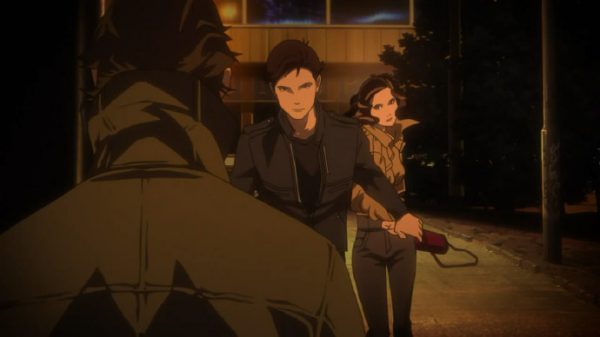
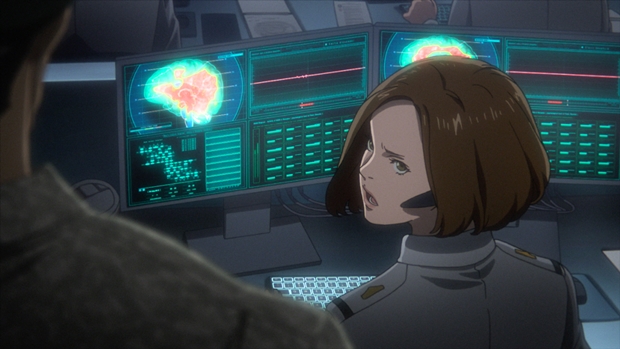
In the near future, a devastating terrorist attack in Sarajevo shocks the world. The governments of most industrialized countries use the widespread panic to justify an increase in surveillance of their own citizens. While the developed world is safer than ever before, the third world- without the means to conduct such widespread surveillance- descends into chaos and mass murder.

Captain Clavis Shepherd  is one of the few Americans unfortunate enough to have to navigate this chaos. As a covert intelligence agent, Shepherd conducts bloody and dangerous missions around the world while his superiors monitor his vitals from Washington to make sure he’s not feeling too much compassion. His latest mission is to track down the mysterious John Paul, the architect of so many genocides around the world.

Genocidal Organ is not always easy to follow but will reward those who try to try to keep up. It took me about twenty minutes, given that this is a Japanese film with Japanese animation and Japanese voice actors speaking Japanese, to realize that most of these characters are supposed to be American. It feels weird at first. This must be how Russian people feel watching Eastern Promises. Once you’ve figured out who everyone is though, it’s easy enough to settle in and just enjoy the movie.

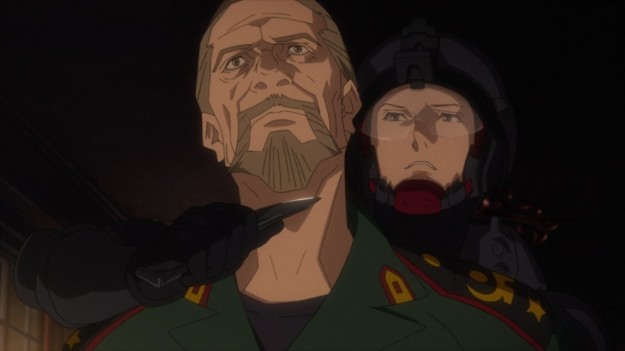
Visually, Genocidal Organ is an impressive film. The animators create a believable setting and the shootouts have better choreography than most live-action films do. As I’ve said before, I’m no good at describing animations so here are some stills to give you an idea.

genocidal organ 1

genocidal organ 5

genocidal organ 4

genocidal organ 3

As a story, it’s an engaging spy thriller that tricks you into having fun because it looks so good. At its heart though, Genocidal Organ is hopelessly bleak. It’s a movie that, like John Paul (who is quite fond of monologuing), has a lot to say. While the script probably has a couple of speeches too many, its musings on linguistics, psychology, American foreign policy, and freedom are always interesting and often troubling. Be prepared to sit and think about this one for a few days after you see it.