
At first glance, Deb (Sienna Miller) is all-too-easily dismissed. She’s a former teen mom turned grandmother at 31. She’s a mistress whose hot date turns out to be a trip to a sleazy motel room, where she is handed a plastic bag containing either dollar store lingerie or a slutty devil halloween costume (same difference, really). The next morning, we see that she is waking up alone in her own bed, suggesting the motel room was paid by the hour.
At that point, we’re about five minutes into American Woman, and you’re ready to write Deb off.
But don’t. Don’t you dare.
 Because Deb is worth more than she even knows, which she stars to discover after her daughter fails to come home one night after a date with her basement-dwelling baby daddy. A loved one’s disappearance must be life-shattering. Miller lets us see the dissapearance’s drastic effects on Deb in such a restrained and measured way that Deb’s resulting character growth is organic, believable, and most impressively, almost invisible at first. Deb’s evolution is captivating, and the Deb we know by the end of the movie is at once the same core character and a woman whose outlook and attitude have evolved beyond anything I could have ever expected.
I cannot overstate the magnificence of Sienna Miller’s performance in American Woman. She is magnetic and conveys a mix of strength and vulnerability that is as authentic a performance as I can remember. And while Miller is the standout, he excellence is almost always matched by the rest of the cast, including Christina Hendricks as Deb’s sister, Amy Madigan as Deb’s mom, and Mad TV’s Will Sasso as Deb’s brother-in-law. Deb is rightly the focal point but it’s great that the strong supporting characters each get the chance to shine.
The gauntlet thrown down by the cast’s fantastic performances is picked up by those behind the camera, and they are up to the task. Brad Ingelsby’s script is smarter than it has any right to be, discarding obvious answers on a regular basis, and showing off by giving effortless depth to secondary and tertiary characters (including turning an obvious villain into an earnest guy deserving of our sympathy). Director Jake Scott uses care and moderation rather than flash and sensationalism, particularly in a crucial scene at the film’s climax, proving beyond any doubt that less is more. Scott consistently makes brilliant choices even in small details, such as by using visuals and settings to indicate the passage of time, rather than title cards.
The result of all of this individual brilliance, naturally, is a standout character study that can hold its own against anything that TIFF18 has to offer (which I can say with certainty since I saw If Beale Street Could Talk and Roma on either side of it). American Woman is as smart, rewarding and satisfying a cinematic experience as anyone could ask for, making for a film that you absolutely do not want to miss.
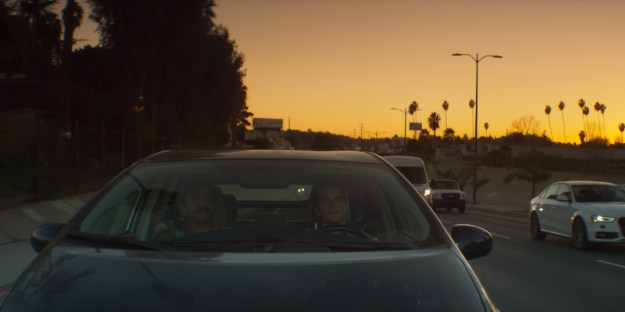
 wrapping himself up in the city where he last knew he was alive, and he finds himself in the cafe of Oren’s widow, Anat. Thomas (Tim Kalkhof) takes solace by inhabiting different aspects of his dead lover’s life, and it’s not long before he’s helping out in Anat’s cafe, and erm, doing other things for Anat (Sarah Adler) besides. Of course, Anat is unaware of the relationship her husband had with Thomas, so it’s only her grief pushing her into Thomas’s strong but unfamiliar arms.
 and horny. Nate (Jemaine Clement) would like to reconnect with his father, but the two have been distant since the death of Nate’s mother – and he was always closest to her. Other people think Bob is very funny, but since his answers to all of Nate’s very serious questions are always jokes, the two men remain separate in their grief.
 little…sticky. And perhaps in the days before a serious surgery, The Hollars could use a little less hollering and a lot more making amends.
 been super tight as far back as they can remember, and can hardly envision a future that doesn’t include each other – like, on a daily, hourly basis. So the ultimate theme of this movie is not so unusual: it’s letting go. Letting go in more ways than one, sure, but it’s not exactly groundbreaking stuff.
 an awful lot lately. Now here they are shivering the frigid scrub of one of the largest but least populated states in the country. Wind River Rez is served by a minuscule tribal police force – there are more Avengers than cops in Wind River. Well, that’s not saying as much as it used to, the Avengers continue to recruit to the point that they don’t all fit on the same poster anymore. But the Wind River cops you can count on one hand.
 solitary existences up until Addie gets up the courage to ring Louis’s doorbell and invites herself in for a chat and a little proposal. Why not sleep together, she suggests. No, not sex. Sex doesn’t interest her. But the nights are long. Very long. Couldn’t they come to some arrangement? After thinking on it, he agrees, so off he goes in his best blue plaid shirt, to have a platonic sleepover with a neighbour he’s lived alongside for decades but never really known.
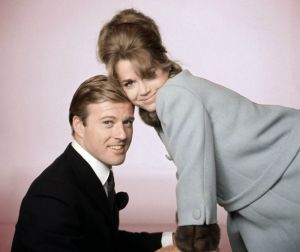 Venice Film Festival, in a ceremony preceding the screening of their new film. They’ve co-starred in movies before: The Chase (1966), Barefoot in the Park (1967), and The Electric Horseman (1979); this is their first in 38 years. To mark the occasion, Fonda said “It was fun to kiss him in my 20s and then to kiss him again in my almost-80s.” I have to say, it was fun for the audience, too. Yes, it’s great to see mature faces getting meaty roles, but you’re also getting a masterclass in acting. These two make it look easy. Their chemistry feels effortless.
 Of course, if you’re looking for classic, cheesy romance, this isn’t it. Louis and Addie are too wise for that. They have responsibilities, baggage, obligations. Kent Haruf, who wrote the novel upon which this film is based, knew a little about that. He wrote his book under a death sentence: he was 71, and he finished it just months before he died of lung cancer. The novel was published posthumously, so Louis and Addie are his legacy. Fonda and Redford would have made him proud.
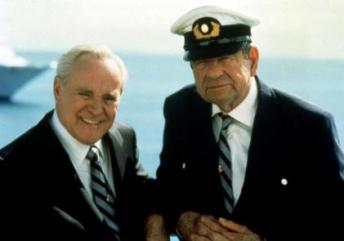 for the swinging bachelor existence Charlie has planned for them on board, but that’s only half his trouble. A snarky entertainment director is on to them and their little ruse could cost them thousands of dollars that neither can afford (hello, gambling my old friend!) if found out and no amount of Rue McClanahan flirtation can save them.
 money’s good enough to pay the rent in Paris, which is important to her. She’s in the city and won’t leave until she hears from her brother. Her dearly departed brother. Which is an obstacle of course. But she and her recently deceased twin brother are\were both mediums with a genetic heart defect, and they’d promised each other that whoever died first would signal the other from beyond, if such a thing existed.
 ASSHOLES WATCHING MOVIES