
Nick Carraway meant to be a writer but is lured by the temptation of easy money to New York City for work, and a shack to stay in outside the city, on Long Island. He’s sandwiched between mansions, and across the bay dwells the old money, including his cousin Daisy Buchanan and her husband Tom. But everyone’s gossiping about Nick’s mysterious neighbour, Jay Gatsby.

There’s almost no one more suited to the decadence of The Great Gatsby than director Baz Luhrmann. Certainly Gatsby’s epic parties, brimming with booze, booming music, and beaded dresses, are brought to life with enthusiasm and an orgasmic level of detail under his direction.
But F. Scott Fitzgerald’s seminal novel isn’t just about the excess, but its flip side as well, the roaring/rotten 20s, the social upheaval and the resistance to change. But maybe a novel as ambitious as this, a book that has spoken to us for generations, belongs strictly to the page. Because as much as Baz Luhrmann gets right, the movie never quite grabs you the way it’s meant to. The way it should. Sean is a philistine who’s never actually read the novel (gasp!) and I wonder how his experience of the film differs from mine. For that matter, his experience of life.
Gatsby, you see, is the mysterious figure who haunts the pages of Fitzgerald’s genius work, but in the film, he’s all too knowable, especially when navigated by Leonardo DiCaprio, a muse of Luhrmann’s and an extremely familiar face to American moviegoers. And Tobey Maguire was already over when Luhrmann cast him as Carraway, the news just hadn’t quite made it to Australia yet. But Carey Mulligan as the luminous, quintessential, ethereal Daisy Buchanan? That was right. Inspired, even.

The best thing about this movie is and always has been Jay-Z’s genre-defying soundtrack. Luhrmann is no stranger to pairing period films with modern music to dazzling effect, but hip hop fits 1924 like it was always there, nestled between the cigarette holders and the champagne fountains and the bobbed haircuts. The costumes are a close second of course, every woman dripping with pearls and jet beads and scandalously raised hemlines. The accoutrements are perfection, so right that they almost distract from the fact that the movie itself is just wrong. And it’s not that anyone could have done it better. It’s probably just that no one should have even tried.
 make a handy queer dating service, as it is probably the biggest concentration of homosexual folk any of these kids has seen before, if it wasn’t so nasty and abusive. That’s what it really boils down to. The head instructor, Victor Sykes (Joel Edgerton), blames your “problem” on some member of your family who made you gay. He wants you to pick someone to focus your anger on. He wants you to learn to “act” “straight” (did you know that the triangle is the straightest shape?). He focuses on behaviour – if you stop playing football, you are no longer a football player. Problem solved.
 Uh oh. “Luckily” Richard (Joel Edgerton) “knows a guy”, so they’re not going to pay the kidnappers so much as send in an “extractor” named Mitch (Sharlto Copley) who claims he’s out of the business, straight as an arrow. Right. But while Harold (David Oyelowo) is awaiting ransom or extraction or escape in Mexico, he gets into even more trouble in the form of drug cartels (notice the plural).
 a source himself or maybe he’ll turn her into a double agent, or better yet, a triple agent, or a quadruple agent, or just a woman who’s about to be assassinated by her own government, but not without blowing her way across the country first.
 ll, straight out of Tolkien or World of Warcraft. Orcs are brutes with sharp teeth, Elves are beautiful and rich, magic wands are super powerful but not everyone can use them. The script, complete with minority and 1% allegories, practically writes itself.
 The movie’s success lies in what a small, personal story this is. We never feel like the whole south is against them – but it feels worse that it must be one of their neighbours who keeps ratting them out. The police come, guns drawn, to break down their door in the middle of the night in order to catch them in a crime – that of sleeping next to itch other in marital bliss.
 reserved. There’s not a lot of grandstanding. In fact, he turns his back (and his camera) away from the big, sweeping court scene in order to keep it once again in the heart of the family. Easily eliciting a flood of emotions, it’s actually a relief to see them played out so superbly on Negga’s face, and in Edgerton’s shoulders, rather than some melodramatic speech. The restraint here is a credit to Nichols’ directing, but also to this wonderful casting.
 I’ve never been in an old-timey gun fight (knock wood!) but I imagine the only thing worse than being laid up in bed full of bullet holes, gangrene mere moments away, is to watch your wife fall into the sexy arms of her much-handsomer ex-boyfriend as he protects the both of you and you’re too weak to even protest. How embarrassing!
 producers who refused to give her final cut. Cinematographer Darius Khondji followed in solidarity, as did Jude Law. Bradley Cooper was brought on to replace him, with Gavin O’Connor in the director’s seat, totally unprepared. Michael Fassbender had already left over clashes with Ramsey so when Cooper left, Joel Edgerton was shuffled over from bad guy to good and Ewan McGregor took up the baddie role. It’s kind of a miracle this movie got made at all, and maybe they should have just left well enough alone.
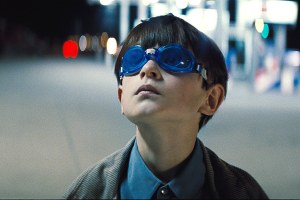 what the hell is going on, but Roy seems more familiar. Is he Alton’s father? But do relationships even matter when the boy in question seems to be…displaying certain super powers?
 I enjoyed the lack of clarity although I admit I wished some of it got wrapped up a little better. There’s a lot of information that gets thrown at us and not all of it has a “purpose.” But it’s so crazy well-acted that this feels like nit-picking. Michael Shannon seems determined, perhaps with divine meaning. Joel Edgerton’s character is more nuanced, and therefore more relatable. He’s clearly invested, but his motives are less certain. The kid, played by Jaeden Lieberher, is already familiar to audiences from the likes of Aloha and St. Vincent. He plays an intriguing mixture of vulnerable and other-wordly that keeps us guessing. This is one kid who’s not a weak link.


 ASSHOLES WATCHING MOVIES