
If this movie review could talk it would say: wow. And also: thank you.
How is it possible that Barry Jenkins is making GOAT movies right out of the gate? Is he for real?
If Beale Street Could Talk is about a love story, interrupted. Tish (KiKi Layne) and Alonzo (Stephan James) are young lovers and the world is theirs as they fall in love inside their bubble. He’s respectful, she’s adorable, they’re so in sync their clothes begin to match, the colours mirroring each other as they walk hand in hand in a highly-saturated stroll through the park, the perfect date that just happens to end at prison, where she drops him off. Alonzo is going away for rape – a crime he didn’t commit, not that the justice system particularly cares. Beale Street is both love story and tragedy at the same time.
The most powerful thing about this film, and indeed about James Baldwin’s original work, is how little shock we see from either family – and both families, and their community, rallies around them. And of course they’re upset, they’re devastated, and they should be angry and incredulous, but no one seems all that astonished that such a  thing could happen, because of course they’ve seen it happen before. So they swing into action, because they know the drill. Though they have little money, they will fund-raise and do whatever it takes to work the case themselves because they know whatever lawyer’s appointed to them will be inadequate (though he’s actually not painted as a bad guy, interestingly), and that the system is rigged is against them. They aren’t wrong.
I said earlier that this was a love story, interrupted. Thanks to director Barry Jenkins’ genius, that’s true on more than one count. First, the literal one, where the two lovers are separated just as she’s discovering they’re pregnant and would have made a home together. Through flash backs we see their love story, and it’s beautiful in its simplicity, in its sweetness, but every scene is tainted by our knowledge of where it ends up. Jenkins obviously has a respect for the poetry of Baldwin’s prose. He uses it as a bridge between scenes, uniting flashbacks which almost seem dream-like with the harsh realities and razor-precision detail of their present day (1970s). The interruption is an opportunity for Jenkins to show how lyrically he can manipulate time as well as genre. Because for every pause he takes to explore a character and make note of some sweet detail, this story is also infused with a greater cry for social justice. This Beale Street could be any Beale Street. Alonzo could be any black man. And the system of oppression, which is not limited to crime and punishment, applies just as much today as it did then. This is a cry meant to be heard across generations.
James Laxton’s stunning cinematography helps establish not just breathtaking film, but black culture itself, the streets coming alive and vibrant under his lens. The way Jenkins plays with colour astonishes me, the virginal whites, the lust-drenched reds; somehow this movie is everything a movie can be. It’s everything. And this is only Jenkins’ third feature. The costumes are perfection. The set design is perfection. The way the camera talks to us, showing us where to linger, communicating hunger, or desperation, or separation. The emphasis is masterful but never gets in the way of itself.
Beale Street’s ensemble cast is the beating heart of this film, with James and Layne both claiming rights to future stardom. Their fathers (Colman Domingo and Michael Beach) are terrific as well, but for me Tish’s mom Sharon (Regina King) was the real standout. She is fierce and unwavering. The scene in which she confronts Alonzo’s accuser is deeply affecting, and it’s because of King, of the layers of emotion playing out on her face. I couldn’t look away. Notably, I also thought the mother in The Hate U Give (played by Regina Hall) was the best part of the movie, so I’m not sure if black moms are having a moment, or if it’s Reginas specifically, but watch out, they’re coming. Jenkins puts together a cast that becomes the fabric of his film. There is no detail too small to have escaped his love and attention. This is one of the better adaptations I’ve ever seen on film, and possibly the best. It works on so many levels at once you don’t even see the train coming until it hits you. It’s hard to outdo yourself when your last film won Best Picture, but Barry Jenkins is a director not to be fucked with.


 unlucky victim takes Max by surprise when he crashes through his windshield. That fearsome windshield crack will be a thorn in Max’s side, but it’s just a small obstacle in a rather wild ride. Max is a hostage but under surveillance by the cops he looks rather like an accomplice. Good thing Detective Fanning (Mark Ruffalo) is on the case! He’ll save him!
 Considered to play the role of Vincent: Russel Crowe, Edward Norton, John Travolta, Leonardo DiCaprio, Colin Farrell
 Once in a while I wish I had a more literary mind. When I write, it’s pretty direct and while I used to attempt subtext I’ve pretty much given up on it at this point – too much effort for too little payoff. But that’s for my writing, where no marks are given for artistry. All that matters is the end result.
 movie ever made, the Citizen Kane of bad movies, a movie so bad it’s achieved cult status. Tommy Wiseau was obsessed with movies and had enough cash to get one made, so he did. And he did it with such earnestness and such a complete lack of talent that people love to watch it. Ottawa’s own
  with him. James and Seth debuted
  were big. Nowadays he’s lucky to get work schilling BBQ sauce. Bad news about his health forces him to put his life into perspective. So does receiving a ‘lifetime achievement’ award at a time when his lifetime is feeling quite finite. He has a tangled relationship with his daughter (Krysten Ritter) and a complicated, budding relationship with a woman roughly his daughter’s age (Laura Prepon). Just about the only person he can talk to is a former costar\current drug dealer (Nick Offerman) who has a pretty relaxed attitude about everything.
 Darling (Eiza Gonzalez), Griff (Jon Bernthal), Buddy (Jon Hamm), and my personal favourite, Bats (Jamie Foxx), personal motto: “I’m the one with mental problems in the group. Position taken.” GUYS, HE’S NOT KIDDING.
 Wright is a phenomenal writer, and Baby Driver is just as quippy and quotable as any other in his oeuvre. The music jangles, sometimes wildly incongruous to what’s developing on screen, sometimes deliciously ironic, but it stitches the film together between Wright’s explosive action sequences. Wright’s films are always kinetic. His own exuberance for film making comes across on the screen, is barely contained by it, in fact.
 to do is exchange the briefcase full of cash for the crates full of guns, and the deal is done. But they just rub each other the wrong way. Everyone’s got an unchecked ego, everyone wants to be the boss, and nobody’s going to make this easy. If arms dealers had HR ladies stashed away in some ficus-strewn office, all of this could have been resolved with a stress ball and some trust exercises. But arms dealers tend to offer very few benefits as employers, so instead it goes to hell.
 really embodies the pure fun and wackiness of this film. It’s madcap madness and I totally loved every minute of it. I didn’t know I could have so much fun at a Ben Wheatley film. A terrific script by Wheatley and Amy Jump is quotable, the cheeky dialogue rolling off the tongues of a delightful ensemble cast. The frenetic, non-stop energy sometimes makes it difficult to keep track of who is shooting who, and where, but once you realize that even the principal players are confused, it really takes the pressure off. The anarchy is entertaining and you can tell it was as gleefully acted and directed as it is consumed. No true hero ever distinguishes him or herself , which doesn’t mean you won’t find your own favourite to root for, only that’ it’s an even playing field where anything is possible.
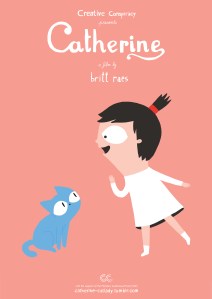 them to suicide) and that seems about right to me. Even though Catherine’s a bit of a hazard, you can’t help but root for her, root for her happiness. I am completely drawn in by the animation by Creative Conspiracy studios – it looks very picture-book friendly, yet the humour within is surprisingly dark. The colours are like candy and used thoughtfully throughout. I always admire short films because to tell a story well they must be economical and equally strong visually and narratively. Catherine (the film) is all of these things wrapped up in a cutesy little package. Catherine (the character) is not so perfect, nor, it turns out, so cute: Catherine grows up. Into a woman who means well but can’t connect with humans. Wonder why? See the film!
 ASSHOLES WATCHING MOVIES