Tag Archives: social issues

TIFF18: White Boy Rick

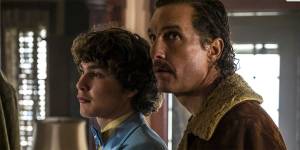
The trailers for White Boy Rick deceived me. I expected a frenetic, over-the-top throwback full of 80s excess, rollerskating, and outlandish behaviour as fifteen year old Ricky (Richie Merritt) breaks into the Detroit crime scene in 1984, assisted by his gunrunning dad (played by the madcap Matthew McConaughey). I expected a dark comedy. I hoped for Scarface, the teenage years, with lots of action and quotable dialogue. I would have settled for half-assed ripoff of Boogie Nights, with a naive rising star breaking into a criminal enterprise.

But instead, I got a melancholy family drama about a group of deadbeats with whom I had no interest in spending any time at all. Not as friends, not as neighbours, and certainly not as the subjects of a two hour feature. Ricky’s story is not a story that deserves to be told on screen, and that’s fatal. I never could bring myself to care about him or his family, not even a little bit. That is in no way the fault of Merritt or McConaughey. It is also not an issue arising from the screenplay or the direction. It’s more basic than that: there was no saving these characters. They were simply irredeemable.whiteboyrick_01
It’s unfortunate because there is a story underlying White Boy Rick that does deserve our attention: the fact that the 80s “War on Drugs” was primarily a scheme to keep America’s prisons stocked with young black men. And, as a bonus in many states, strip them of their right to vote once convicted of a felony, which many might even plead to if they were locked up and mistreated for long enough prior to trial.

That is a story that has been much better told by Ava DuVernay’s 13th (which is definitely worth your time). That is also a story that should probably not be told from a white family’s perspective, as doing so suggests that mandatorylife sentences without the possibility of parole for crack dealers are only a problem when white people start getting locked away too.

Yet, here we are. Ricky’s life is onscreen for you to shake your head at, if you so choose. But you have much better options available to you in the coming weeks (such as The Predator and Life Itself, to name two I saw this past weekend at TIFF). Then again, if you are about bad choices, like choosing White Boy Rick over either of those, then maybe you will find the movie more enjoyable due to having something in common with little Ricky and his family, who never met a bad choice they didn’t like. Yes, I just went there, but it’s for your own good.
First Reformed

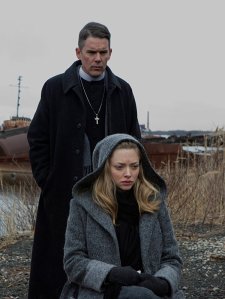
The Reverend Ernst Toller is the minister at First Reformed church, a small congregation in upstate New York. Mary, a young woman in the community, asks him to counsel her husband, who is struggling with her pregnancy. Michael is an environmental activist who is gripped by despair and hopelessness – he cannot imagine bringing a child into this world. Ernst (Ethan Hawke) takes him on, but it’s a tough case, and he relates more to the wife (Amanda Seyfried) than to the husband, who seems unreachable.

But the truth is, the Reverend is in no condition to counsel anyone. He’s messed up. MV5BYjA3OTJlODAtZjNlNi00ZTE1LTkxNzctNzJlNjQ5NjQxZTcyXkEyXkFqcGdeQXVyNDkzNTM2ODg@._V1_SX750_CR0,0,750,999_AL_And Michael’s question “Can God forgive us for what we’ve done to this world?” messes him up even more. He defends god, but struggles privately. He takes up Michael’s obsession but continues to pollute his own body, as we watch his physical and mental health spiral downward.

The first half of the movie is a lot of Ernst feverishly and guiltily Googling, while also drinking himself to death. It’s is not overly compelling stuff. But it’s super jarring when there’s suddenly a scene that feels like a complete divergence from everything that came before it. It’s almost like director Paul Schrader is shaking things up to allow room for the spiritual. He reminds us that we’re not in charge. We may think we know what’s happening, but we don’t.

And that’s true. I was very caught off guard by the ending, and there’s not many stories in the world that I don’t see coming a mile away. I mean, we know this dude is having a breakdown in a major way. But things get extreme, and, um, open to interpretation? This movie is getting a lot of love from the critics, but it does boil down to: 90% boring, 2% omg wtf, and I guess 8% wrapping your head around Cedric the Entertainer’s casting. It’s one you’ll have to see for yourself.

Ethan Hawke is quite good, and he has to be because this character embodies so many conflicts – faith & science, love & fear, strength & despair, consecration & desecration. It’s hard to really put this one into words, which I think is kind of the point. Schrader tackles the inexpressible, he goes there, and treats spirituality with more seriousness than I’ve seen from a movie in a long, long time. It does not make for fun viewing. Can you hack that? Is that how you want to spend 108 minutes?

King Kong (2005)

king_kong_2005Even if you haven’t seen King Kong or its many remakes (like me, until yesterday), you probably know the story. A struggling filmmaker (Jack Black) leads a rag tag crew on a voyage to a forgotten island where he’s going to complete his movie against the studio’s wishes. While there, the filmmaker and his cast encounter a mess of overgrown B-movie creatures including dinosaurs, bugs, lizards, bats, and of course, the giant gorilla who rules them all.
In the course of this grand adventure (which ought to have killed everyone involved several times over), the gorilla falls in love with the lead actress (Naomi Watts), now the damsel in distress, who already has a thing for the screenwriter (Adrien Brody). That leads to a very awkward love triangle.  Things get even more awkward when the filmmaker conspires with the ship’s captain to bring the gorilla back to New York City as a way to salvage the mission once his camera and footage (and film crew) are destroyed.  Indeed, once back in NYC the situation gets so bad that Brody’s character even starts to feel sorry for Kong, as Kong is now trapped in the Empire City with nowhere to go but up (and then a long way down).

Peter Jackson helms this remake and it shows.  That’s not a bad thing, necessarily, it just means there’s a three-hour-plus runtime, a lot of CG rag dolls flying across the screen/into walls/off cliffs during action scenes, and a significant number of emotional orchestral swells combined with ethereal vocals and closeups of teary eyed actors to make sure we feel sad at the proper times.  For better and for worse, he delivers a movie that feels like a throwback to classic Hollywood cinema.

But the “for worse” is really, really bad.  Black “savages” feeding a white lady to a monster bad.  It is possible that the issue of systemic racism is particularly fresh in my mind right now thanks to BlacKkKlansman (which, if Jay’s review wasn’t clear enough, you should see immediately),  but a movie pitting backwards black natives against righteous white people only reinforces racist stereotypes that we need to eliminate from our society.   One way to help eliminate those stereotypes would be using discretion and thoughtfulness when remaking old movies to ensure we don’t recycle harmful racial stereotypes.  Jackson failed in that respect, and his failure gives power to those stereotypes instead of helping to put them to rest once and for all.  It’s a glaring mistake.

That Kong contains such racially insensitive scenes is truly a shame, on at least two different fronts.  First, it’s a shame because the Kong that Jackson and Andy Serkis created is absolutely amazing.  Even though many of the other special effects in this movie have not aged well, Kong remains a marvel, an expressive and lifelike CG character who’s worthy of being the hero of this picture.  Of course, hero status is Kong’s by default, since the humans in the film are consistently terrible, destroying everything they touch, acting entitled all the way through the carnage, and worst of all, blaming Kong’s unfortunate ending on beauty rather than the beasts who tried to exploit nature for personal profit.

Which brings me to the second disappointing aspect of the film: but for the racism, the film’s main message would have been as suitable for our times as it ever was, but the presence of racism or at least racial insensitivity makes this film one that is better left in the past.

Circles

Eric is a Katrina survivor who has built a new life for himself and his son Tre in Oakland, California. From his own childhood, he knows all too well the importance of fathers and father figures, particularly in the lives of young African Americans. That’s not the only reason he’s a restorative justice warrior in a really rough high school, but it just might be the reason he’s so good at it. Restorative justice tries to understand the circumstances which contribute to crime. Its emphasis is on the rehabilitation of offenders through reconciliation. In terms of Eric’s work, his bottom line is to keep kids in school, to keep them from getting expelled, and maybe circles_2even graduate. He sees a lot of himself in his students, and even though the staff and school board often feel at odds with his work, he perseveres and fights hard for them.

But during the making of this documentary, Eric’s own son is arrested for a crime he didn’t commit. So you can imagine that Eric’s ethics and beliefs (not to mention patience) are tested, and his son is about to be his toughest case. That’s what so great about documentary film – sometimes the movie you set out to make ends up morphing into something else entirely. You couldn’t really have planned this if you tried, but over the course of two years, director Cassidy Friedman has incredible access to this collision between Eric’s personal and professional lives.

Eric’s work is in impoverished neighbourhoods. His students are largely people of colour, vulnerable, with unstable family situations. He’s fighting racial discrimination, the insidious, every day kind, even if that’s not explicitly stated. He connects to the kids because the tragedies of his own life are so similar, and he’s not shy to relate them. But when things disintegrate for his son, he starts to really question himself, his efficacy as a teacher and as a father.

What Circles becomes is a sad, honest, difficult portrait of a man who is desperate to be the father his own could never be.


Behind The Curtain: Todrick Hall

Dear Todrick Hall,

I’m sorry. As a film reviewer at a festival, we have dozens and usually hundreds of choices to make, and a tight schedule to keep, and we just cannot see them all. This documentary was available to me and I didn’t make time for it because I had no idea that it would blow me away. I’d have to wait to discover that for myself on Netflix. So I’m late to the party, but I brought tequila and nachos. Peace?

You may or may not know Todrick Hall as a Broadway and Youtube star. Having found the roles for gay African-American men to be quite limited, he simply started creating his own. He re-wrote other people’s songs and created short films to accompany them, and gained huge notoriety on Youtube because of it.  But Todrick Hall is no flash in the pan; his talent is of such cosmic, galactic proportions that of course he would burst out of MV5BNDY3YmM4OTUtYjRiMy00ODMyLWI1OTEtM2ZjNmRiNzJiMjEzXkEyXkFqcGdeQXVyMTI4MjIwMjQ@._V1_SY1000_CR0,0,666,1000_AL_Youtube and make a scene wherever he landed. But one of his absolute greatest accomplishments is a musical that he wrote and produced himself. Biographical, and inspired by The Wizard of Oz, Straight Outta Oz is an all-original production that covers the yellow-brick road he followed from being gay in small-town Texas and the struggles and hurdles that led to fame and acceptance and being fabulously gay anywhere he goes, including but not limited to small-town Texas.

Hall is enormously talented and handsome enough to coast on his looks, but what makes this documentary great is that he’s transparent and genuine. Behind The Curtain means actual access. And director Katherine Fairfax-Wright’s skill is for setting her subject within real social context. This musical was being mounted in a time when young black boys were being gunned down by police, a fellow Youtube star by the name of Christina Grimmie was murdered by a “fan”, and Hall’s old stomping ground, Pulse nightclub, was terrorized, a hate crime that left 49 dead. Both Todrick Hall and this documentary operate within this very real world, but both manage to remain optimistic and inspiring.

I hope one day I’m lucky enough to sit in his audience, but until then we can content ourselves with some of the amazing Youtube content he’s created.

I’m sorry we still live in a world that couldn’t immediately recognize the glittery, amber rays emanating from this shining star, but this kind of light cannot be contained under a bushel for long. Todrick Hall is destined for success because he knows the value of friendship, which is evident by the tight crew he keeps around him and the family that he’s made of his own choosing. And because of his voice, which is strong and knowing. And because he actually has lots to say with it, and the means to write it down, coherent and catchy. And because he wants it. He wants it so bad he’s not going to sit down and wait for it, he’s going to go out there and create it, and god damn do I admire that.

Cornered in Molenbeek

Few things are more ubiquitous than a group of old men chatting about life in a local barbershop.  Cornered in Molenbeek starts innocently enough as it drops us, seemingly randomly, into one of those barbershops.  Sure, the customers are speaking Arabic, but they are also speaking about things that I might talk about with my barber (sorry, stylist).

The shop closes for the day and then, in an instant, everything changes.  News breaks of a terrorist attack on Paris.  It’s November 13, 2015 and when the cornered_in_molenbeek_1dust settles, 130 people are dead and 413 more are injured in a series of coordinated attacks at a number of locations throughout the city.  The investigation quickly determines that the attackers are from Molenbeek, Brussels, the very neighbourhood where this barbershop is located.  Of course, the attack becomes the main topic of conversation here, just like it was everywhere else.
Not surprisingly, this barbershop collective has no real answers as to what made the attackers do what they did.  Because guess what?  I have no real answers either.  The lack of answers here is revealing, though, particularly as the collective’s attempt to find an explanation weaves through a wide variety of possible causes, often looking for someone or something to blame, such as government, poverty, and the attackers themselves, with one notable exception: these people do not try to place blame Muslims as a group for these attacks, because they are Muslims themselves.  Contrary to the torrent of right-wing nationalist propaganda that is so often shouted at me online by a host of faceless idiots (oh, and also by the President of the United States), this group of Muslim acquaintances in this barbershop are just as innocent, just as angry and just as confused about the attacks as the rest of the world, and maybe more so because their religious and geographical association with the attackers draws them personally into the aftermath, exposing them to significant consequences that most people don’t have to worry about.

The phenomenon of terrorism is worthy of examination, and it was a refreshing approach to do so through the familiar lens of this barbershop, which otherwise would be functionally closed to me as a uni-lingual white Canadian (Arabic and French are the only two languages being used in these conversations).  The film’s structure serves to enhance the fly-on-the-wall feeling by letting us experience the barbershop’s normal environment before the attack happens.  The stark contrast in what is being discussed before the attack as opposed to afterward clearly shows that these types of attacks affect everyone regardless of their religion or native language, and really, we all need to be involved in this discussion on terrorism in order to stop it.  Cornered in Molenbeek does its part to start the conversation, and it’s up to us to keep it going.

Indian Horse

imagesThe residential school system is not the only black mark on our country but it has to be the darkest stain. We and our government could not have done worse by our indigenous people if we tried. We should have known from the start that this imperialistic plan would go horribly wrong. After all, we chose to put the Catholic Church in charge of many of these awful residential schools (and not just the Catholic Church, but a bunch of others share the blame, including the Anglican, Presbyterian, and United Churches of Canada), because it wasn’t enough to tear children from their families and literally beat their culture out of them, it seemed appropriate for some reason to facilitate child molestation too, feeding 150,000 potential altar boys and girls to more than a few insatiable priests over the lifetime of the program. 150,000!

Not surprisingly, the end result of this utter disaster was the destruction of generations upon generations of indigenous people, something we cannot ever be ashamed of enough. And this is not something we can blame on our long-dead racist ancestors, since the last residential school did not close until 1996.  1996!

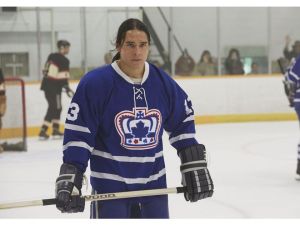
Indian Horse tells the story of one of those unfortunate kids who was sent to residential school, a boy named Saul Indian Horse. Saul happens to be a natural at hockey, quickly becoming the star of the school’s team. But for some reason, despite his hockey-playing prowess, Saul is clearly struggling to find his place. Could the reason for his struggles be that he and everyone he knew were subjected to horrific abuse every single day?

You don’t have to watch Indian Horse to learn that yes, all those years of abuse hurt Saul really, really badly. And you don’t have to watch Indian Horse to grasp that his story is just one of 150,000 about those who were directly and irreparably harmed by residential schools, not to mention the thousands more who were harmed just as badly by the loss of their family members to the schools, and not to mention the subsequent damage caused by attendees of the schools when, surprise, surprise, after being removed from their families and their culture as kids and abused by those who were supposed to take care of them, they were unable to even care for themselves, let alone their children, a cycle that we still haven’t been able to break. But you should watch Indian Horse anyway.

You should watch Indian Horse to remember that to the extent that Saul or any other survivor of residential schools fell short, it’s not for lack of will or effort on their part. It’s because the Canadian government, and by extension the white Canadian majority, failed them monumentally.  Indian Horse demonstrates our country’s massive failure clearly and effectively despite its shoestring budget, while at the same time paying tribute to the inner strength of one survivor who, but for his race, would have been a hockey-loving Canadian kid on his way to stardom.

So here’s to Saul and to each of his friends. I’m so sorry for what you had to suffer through, and I promise not to ever forget it or let anything like this ever happen again.  I know that’s not enough to right these wrongs and nothing ever will be.  But hopefully it is a step in the right direction after hundreds of years of horror. It is truly a shame that the Pope doesn’t feel that way, but hardly surprising the Catholic Church won’t acknowledge any of its wrongdoings – we’ve seen that movie already.


The Legacy of a Whitetail Deer Hunter

It’s hard to imagine a movie more out of touch with the greater culture right now. In the era of #neveragain, this movie puts an assault rifle in the hands of a gleeful, stupid 12 year old, and expects it to be funny.

Buck Ferguson (Josh Brolin, 40 lbs heavier, with an inexcusable mustache) is an asshat hunter who makes his living making juvenile hunting videos caught on film by his faithful manservant\camera man, Don (Danny McBride). Now, I don’t care for (white) featured_legacy_whitetail_deer_hunter10hunters any day of the week. Unless you’re preserving a (native) way of life, food can be purchased in a civilized manner at the super market, and anything else is just fulfilling a latent desire for murder. So I already despise Buck and his way of life, but now he’s bring along his son Jaden (Montana Jordan), ostensibly to “reconnect” after divorcing his mother, but actually because he hopes it’ll be ratings gold.

If arming a preteen doesn’t nominate Buck for worst father of the year already, he’s also just checked out and uninterested. His son has plenty of other hobbies, but Buck either ignores them or flat-out forbids them (or tosses them in the river, because he’s an intolerant bastard). The only acceptable form of bonding is hunting, and the only acceptable form of hunting is to stalk a beautiful animal and then watch the life leave its frightened eyes as it bleeds out all over your boots.

I would like to believe this kind of insensitive fatherhood and unfathomable personhood is a dying way of life, but whether or not I’m right, it’s definitely no joke. I’m pretty sure I didn’t crack a smile this whole entire movie because as long as a trigger is twitching near fingers that aren’t even finished growing yet, I could not take my eye off the gun(s). It made me angry. As tens of thousands of kids walked out of class to protest their continued slaughter at the hands of fellow students, armed to the teeth, the world just doesn’t have room for this kind of “entertainment”, or for the kind of people who would be entertained by it. Shame on Netflix for picking this one up.

SXSW: Blindspotting

So by now you know we’re in Austin, Texas for the almighty SXSW (South By Southwest, or “South By” for short) film festival (and comedy, music, gaming, plus TONNES of crazy cool conferences and networking for professionals from around the world), and we’ve seen some really cool, high profile movies like A Quiet Place, Blockers, and Ready Player One (which was a secret screening we got into by the skin of our teeth). Did we flip out to watch Ready Player One WITH Steven Spielberg? Of course we did. Did we visit the taco place recommended by Emily Blunt? You bet. But all of those movies will eventually get big theatre releases. They’re not the reason we come to film festivals. We come to festivals to see the little guys, movies that might otherwise get overlooked. In the age of Netflix, our chances of those movies being available to us are actually better than ever, but you need to hear about them in order to look them up, and we take pride in being a part of that process.

That said, Blindspotting isn’t exactly low profile; it played at Sundance earlier this year and audiences and critics came away buzzing. While Sean sat in an incredibly long line for Ready Player One (and that theatre reaching capacity two and a half hours before the screening start time!), I had a much cushier seat inside a theatre, watching a movie that just blew me away.

Written by and starring Daveed Diggs and Rafael Casal, it’s about some very current issues in Oakland California. Collin (Diggs) served a short term in prison and is serving MV5BMjk4YmVjMDUtZjJiZC00ODI2LTk4NDctMzRkNmYzNjA0YmM0XkEyXkFqcGdeQXVyNDg2MjUxNjM@._V1_SY1000_CR0,0,1642,1000_AL_his year of probation, with just 3 days left. Can he survive the next three days without any thing going wrong? The chances of that are increasingly unlikely when, while driving home before curfew one night, a young black man nearly slams into his truck at a deserted intersection. Relieved to have avoided a serious accident, Collin is unprepared for what happens next: a white cop, giving chase, pulls out his gun and shoots the man 4 times in the back, killing him.

So for the next 3 days, Collin suffers the PTSD resulting from witnessing that kind of violence, but in his neighbourhood, you’re not exactly allowed to show fear. In fact, projecting this tough guy image is maybe what got him in trouble in the first place. His best friend in the whole world, Miles (Casal), is always there for him, but he’s also always causing trouble. And though they’re both Oakland natives, born and bred, when the cops show up to break up the trouble, Collin knows that they’re more likely to blame and\or shoot him, the black guy, than Miles, who is white.

This film, directed by Carlos Lopez Estrada, takes an unflinching look at race. They understand that you can’t talk about race without mentioning the environment, which is rapidly gentrifying, or the culture, which is splitting. Everything intersects with class and opportunity and it makes for some complicated themes that the writers have unraveled a bit with hip hop, or spoken word poetry if you will, which is actually how Diggs and Casal met, at a program for at risk youth in Oakland. The script born out of their friendship and shared experience is truly genius, and makes for a movie experience that literally had  me pushed back in my seat, gulping in admiration. This movie is a cultural powder keg that the world needs right now; it’s a touch-stone that will be remembered for decades in the future as a film that really spoke not just to its time, but to the people living in it.

But please don’t think for a single minute that this film is some boring piece of art that is merely ‘important’ – it’s also wildly fun to watch, funny and thrilling and bursting with energy. Visually, it’s a love letter of sorts to Oakland. But it’s not the kind of film that pretends to have all the answers. With so many issues raised, all Blindspotting can do is point them out, and trust us to do the rest, which is a kind of self-assurance I don’t expect from a first-time film maker, but there’s a deep well of talent here, one that deserves to be tapped, so I hope I’ve inspired you to seek this one out.

SXSW: A Vigilante

Sadie picks up her messages. There’s a code phrase, and then a woman’s voice, shaky and furtive. She wants to leave her abusive husband. She needs help. Can Sadie come?

Sadie is a one-woman vigilante ass kicker. She gets bad husbands gone, and if they won’t go quietly, she will mess them up. It’s not just the krav maga that makes her strong, it’s the history she shares with her clients. But no matter how many women she helps flee violent situations, she can never truly escape her own, because her husband is still out there, never brought to justice for his sins.

Writer-director Sarah Daggar-Nickson wanted to make a film about domestic violence MV5BMTc2NzM2NTk0NF5BMl5BanBnXkFtZTgwMjQ1MTc3NDM@._V1_that would really speak to the urgency and the desperation and the severity of the issue. She did scrupulous research, and the details that come through – like the fact that New York state will pay for the funeral of anyone murdered during your escape (fucking think about that for a moment) – are depressingly, frighteningly authentic. Real-life abuse survivors make up the support groups which Sadie attends. They share stories that will haunt you.

But this is Sadie’s story. Sadie is intent on being strong now, for herself and for others. But as badass as Olivia Wilde is in the role, we never forget that Sadie’s husband, though no longer in the picture, still has a hold on her. It sounds easy to leave, and logical to move on, but abusive relationships are a sickness, one that keeps you coming back. So while Sadie may have trained herself to assault any man she has to, her trickiest opponent will always be the demons in her own head, and it’ll take more than physical fitness and a bunch of clever disguises to defeat those.

The film is interesting because we get to see themes like control and confidence evolve throughout. We get to know Sadie and her story through flashbacks, but the film keeps a forward momentum that manages to keep its pressure building. This movie is not exactly an easy one to watch, but neither is living with the reality of domestic violence, and for that, I think we can all dig down and find a little inner bravery.


For more South By coverage, read Sean’s review of Ready Player One, Matt’s review of The World Before Your Feet, or my review of Blockers – and check out our Twitter feed – we’ve been to Westworld, and to Roseanne’s living room, and we saw Barry Jenkins and Rian Johnson and Mark Hamill and more! @assholemovies