So. This is a difficult subject to broach because of its sheer scope. Unless you’ve been hibernating under the proverbial rock, you know now that Harvey Weinstein has been accused of rape, sexual misconduct, and various kinds of inappropriate behaviour that are mind-boggling in their number. Harvey Weinstein is (was?) a producer and film studio executive who co-founded Miramax, which produced several popular indies, including Pulp Fiction, Clerks, and The Crying Game, and 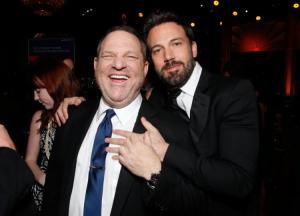 won an Oscar for producing Shakespeare in Love. He was recently ousted from his own company because of these accusations, though it should be said that it was likely a form or self-protection for the company rather than any sense of moral obligation. Indeed, many people at said company will have had knowledge of, and helped cover up, the very reprehensible behaviour that got him ousted in the first place.
We know why women stay silent – it’s the same reason the abuse took place in the first part. Men in positions of power take advantage. Weinstein is (was) a king of Hollywood. He did indeed make and break careers. To reject him is to risk your career, your whole life ahead of you. But his power continues to assert itself long after you’ve left the room. It’s something that has clearly haunted dozens if not hundreds if not thousands of women for decades, and now, because of a few brave women speaking up, it’s all come tumbling out. But Weinstein, who clearly has an M.O. as you’ll see below, cannot have done what he did without people knowing. People as in the many, many male colleagues who have attended the same meetings and events. Weinstein, for example, is responsible for the breakout success of Matt Damon and Ben Affleck. He greenlit Good Will Hunting and they have remained loyal friends of his. So you know what? Hollywood’s women are calling them out.
Ben Affleck came forward to condemn him (eventually), only the second man in Hollywood to do so (George Clooney was the first). Affleck’s statement:
I am saddened and angry that a man who I worked with used his position of power to intimidate, sexually harass and manipulate many women over decades. The additional allegations of assault that I read this morning made me sick…We need to do better at protecting our sisters, friends, co-workers and daughters.
BUT a) he was then reminded of his own groping incident, for which he has since apologized; and b) Rose McGowan has reminded him that when it happened to her (when they were costarring in Phantoms), he said “Goddamnit! I told him to stop doing that!” Which, you know, kind of sounds like he knew about prior incidents on top of her own. And can I just say: stop branding us as sisters and daughters. We’re human beings and we deserve to not be sexually abused regardless of our relationship to you. You shouldn’t have to be fond of or related to someone before you don’t want to see them get raped.
But Affleck’s not the only one under fire: both Matt Damon and Russell Crowe have been accused of killing one journalist’s report of these incidents as far back as 2004. Damon claims he did call the reporter but didn’t know anything about sex-related accusations in the article, and that may be true, but it’s also sort of damning that he didn’t have anything to say about this until it was to clear his own good name. Just how many men in Hollywood have been complicit with their silence?
Trigger Alert: I’m including all the victims we know about so far, and the crimes that were perpetrated against them. These are just the ones we know about, and in cases of sexual abuse, that’s usually the tip of ice berg, which is disconcerting since we’ve already uncovered a land slide. Harvey Weinstein is a bad dude that Hollywood’s been covering for for far too long. And he’s not the only one.
Gwyneth Paltrow: recently confessed to the New York Times that Weinstein touched 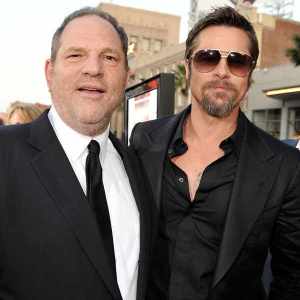 her and suggested having joint massages in the bedroom shortly before filming Emma. She said she told her then boyfriend Brad Pitt about the incident and he confronted Weinstein [Brad Pitt has confirmed].
Angelina Jolie: Jolie told the Times she had to turn down advances from Weinstein in 1998 and chose never to work with him again, after making Playing By Heart. She has been warning other women about him ever since.
Louisette Geiss: Called to a late night meeting with Weinstein in 2008, he emerged in a bathrobe and told her he would green light her script if she watched him masturbate. “He returned [from the bathroom] in a robe with the front open, buck-naked. He told me to keep talking about my film and that he was going to get into his hot tub which was in the room adjacent to his office, steps away. I kept talking as he got into the hot tub. When I finished my pitch, he asked me to watch him masturbate. I told him I was leaving. He quickly got out of the hot tub. As I went to get my purse to leave, he grabbed my forearm and pulled me to his bathroom and pleaded with me to watch him masturbate. My heart was racing and I was very scared.”
Judith Godreche: Weinstein tried to massage her and pull off her sweater after asking her up to his Cannes suite in 1996.
Dawn Dunning: Called to his hotel in 2003, Weinstein presented her with three scripts for his next three movies which he would let her star in, if she had a three-way with him.
Tomi-Ann Roberts: Weinstein met her when she was waitressing as a college junior in 1984 and told her to meet him at his home. When she arrived he was naked in the bath and told her she would give a better audition if she was nude.
Rosanna Arquette: Claims her career suffered after she rejected Weinstein’s advances in the early 1990s – he tried to put her hand on his erect penis during a meeting.
Asia Argento: Weinstein forcibly performed oral sex on her when she was 21. “He terrified me, and he was big. It wouldn’t stop. It was a nightmare.” She documented the alleged attack in her 2000 film Scarlet Diva.
Katherine Kendall: Weinstein changed into a bathrobe and told her to massage him. When she resisted he returned naked and chased her.
Lucia Evans: Weinstein forced her to perform oral sex on him in 2004 at a ‘casting meeting’ in a Miramax office in Manhattan.
Mira Sorvino: Weinstein tried to massage her in a hotel room at TIFF in 1995. He then went to her home in the middle of the night but she called a male friend to protect her. She claims turning him down adversely affected her career.
Rose McGowan: She’s been talking about being raped by a studio head for years, always keeping his identity secret. Now we know she sued him after he assaulted her in 1997 at Sundance. He paid her off, like he did many others, and she had to sign a non-disclosure agreement to close the suit.
Ashley Judd: During the filming of Kiss The Girls, Weinstein repeatedly asked her to watch him shower. She says “Women have been talking about Harvey amongst ourselves for a long time, and it’s simply beyond time to have the conversation publicly.”
Emma De Caunes: Weinstein offered to show her a script, and asked her up to his hotel room, where he began to take a shower. He emerged naked and erect, asking her to lay down with him on the bed and telling her that many others had done so before. ‘I was very petrified,’ said de Caunes. ‘But I didn’t want to show him that I was petrified, because I could feel that the more I was freaking out, the more he was excited.’
Lauren O’Connor: A former employee of The Weinstein Company, she told executives there in 2015 of the ‘toxic environment for women at this company’ after one of her colleagues told her that Weinstein had pressured her into massaging him while he was naked.
Cara Delevingne: Weinstein brought up sexual subjects during more than one business meeting and also tried to get Delevingne to kiss a woman in front of him.
Ambra Battilana: In March 2015 Weinstein asked if her breasts were real before grabbing them and putting his hands up her skirt during a meeting. She reported the alleged incident to police, but they did not press charges. Weinstein later paid her off.
Jessica Barth: Pressured her repeatedly to give him a naked massages from 2011 onwards.
Laura Madden: An ex-employee, Weinstein had asked her to give him massages from 1991 onwards. “It was so manipulative.”
Emily Nestor: Temping for the Weinstein Company for just one day in 2014, Weinstein approached her and offered to boost her career in exchange for sex.
Zelda Perkins: An assistant of Weinstein’s, she confronted Weinstein after she and ‘several’ others were harassed and later settled out of court.
Elizabeth Karlsen: The Oscar-nominated producer of Carol and The Crying Game, told of an incident dating back almost 30 years where an unnamed young female executive who had worked at Miramax with Weinstein had found him naked in her bedroom one night.
Liza Campbell: Weinstein summoned her to his hotel room and told her to get in the bath with him.
Lea Seydoux: “We were talking on the sofa when he suddenly jumped on me and tried to kiss me. I had to defend myself. He’s big and fat, so I had to be forceful to resist him. I left his room, thoroughly disgusted. I wasn’t afraid of him, though. Because I knew what kind of man he was all along.”
Lauren Sivan: Weinstein trapped her in a closed restaurant and masturbated in front of her to completion in 2007.
Jessica Hynes: She was asked to audition for Weinstein when she was 19 – in a bikini. When she refused she lost the job.
Romola Garai: Was already hired for a part in Atonement when Weinstein scheduled yet another work meeting in his hotel room and showed up to it in his bathrobe. He asked for another audition so she could be “personally approved by him.”
Unnamed assistant: Weinstein behaved inappropriately toward a woman employed as his assistant in 1990; the case settled out of court.
Another unnamed assistant: In 2015, Weinstein reportedly pressured another assistant into giving him a naked massage in the Peninsula Hotel, where he is also said to have pressured Barth.
Unnamed Miramax employee: At one point in the early 1990s, a young woman is alleged to have suddenly left the company after an encounter with Weinstein. Also settled out of court.
Unnamed woman: Was summoned to his hotel and raped.
The truth is, there are plenty more Harvey Weinsteins in Hollywood (and let’s face it- elsewhere, everywhere). Hollywood is built on sexism. It routinely treats women as inferior to men. It exploits the very young, ignores the not so young, denies female directors work, and treats its female audience like trash. Like we don’t exist, like we don’t buy movie tickets, like our stories aren’t worth telling. It’s a boy’s club that has gone on far too long. You’ve heard of the casting couch? Now think about what kind of sick euphemism that really is. And if you’ve read all this and are still wondering why these women didn’t come forward sooner – yeah, you’re part of the problem.


 The Marvel Cinematic Universe is so bloated at this point that Marvel usually crams as many superheroes as possible into the “solo” movies in between Avengers instalments. For example, Iron Man pops up in
  ess the same movie. Clearly, that’s Marvel’s goal with a shared universe as that way, we movie-loving rubes have to see them all, and throw even more cash into Disney’s money bin (which by now must be bigger than Scrooge McDuck’s).
 ty disputes in Black Panther are resolved through lots of punching and kicking (which, for all its flaws, is clearly a more efficient political system than the one the USA is currently using).
 first woman to direct an animated feature from a major studio with a personal favourite of mine, The Prince of Egypt. She came aboard Pixar in 2003. There were NO women at all in the story department and they needed her to fix the one-dimentionality of the female characters in Cars (they were too far along in production for her to have much impact). Next, she conceived Brave and directed the project until they replaced her because of “creative differences.” Since they still had to give her co-director credit, she became the first woman to win an Oscar for (co) directing an animated film. She left Pixar and went on to LucasFilm and back to Dreamworks. Of her exit, she has said “I made the right decision to leave and firmly closed that door. I have no desire to go back there. The atmosphere and the leadership doesn’t fit well with me.” And I can’t help but read that “me” as “women” generally. “This was a story that I created, which came from a very personal place, as a woman and a mother. To have it taken away and given to someone else, and a man at that, was truly distressing on so many levels.”
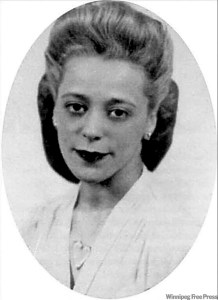 options for women of colour and decided she would be the woman to correct this. But her skin colour prevented her from beautician training at home, so she went off to Montreal and then to New York to complete her education. Returning to Halifax, she opened her own hair salon, where she would tend to a young Gwen Jenkins, later to be the first black nurse in Nova Scotia. And she didn’t stop there. She went on to found The Desmond School of Beauty Culture so black women could train closer to home. Students were taught how to open their own businesses, providing jobs for other black women in their communities. Then she started her own line of beauty products, Vi’s Beauty Products, which she sold herself.
 attracted the ire of a neighbour who reported him. A cease and desist letter from the city made him think twice – not about the rightness of gardening his own land, but about the rightness of this world. Never before motivated to activism, Finley took up the cause, providing free soil so that others could plant too. Now you’ll find the neighbourhoods dotted with planters, and if you think that’s interesting, just wait until you meet the people who are cultivating them.
 illnesses, no one’s going to let an emaciated Lily Collins push a fish stick around her plate for dinner. And they’re also very difficult to treat because unlike drinking, you can’t simply give up food. You have to learn to eat in moderation. Eating disorders are often (but not always) about control. Often there is some type of childhood abuse that accounts for someone wanting very much to exert control over their bodies now.
 a) Is it even ethical to “give away” a baby as promotional material?
 ASSHOLES WATCHING MOVIES