
I was sitting on the floor of the Austin Convention Center, waiting to get into the SXSW conversation between Nick Offerman and Nick Kroll when I got the news: Stella was gone. Out for a walk in the mountains near her Zurich home with her husband and her beloved Boxer, Odin, she slipped in some snow and fell 40m to her death. Just like that, one of the most vibrant women I’ve ever known, gone forever. Unfortunately I’ve had some experience with losing  people unexpectedly, but that doesn’t make it easier. It’s unreal, incomprehensible. Sean held me tight as I fell apart in the middle of hundreds or thousands of happy festival-goers. I think Sean’s first thought was to get my soppy self back to the hotel room where I could grieve less publicly, but instead I found myself being filtered into the Nick Offerman thing, and then following my rigorous SXSW schedule, one thing after another: Bob Odenkirk and Fred Armisen, followed by Lemon, followed by Atomic Blonde. But it just so happens that the screening for Atomic Blonde ran late, and as I sat in an increasingly crowded theatre listening to a DJ spin some danceable 80s music, I had too much time to think, and my thoughts were filled with Stella, my own Atomic Blonde. This review is inadequately dedicated to her memory.
Atomic Blonde is a cross between James Bond and John Wick, except its protagonist, Lorraine (Charlize Theron), could kick both their asses without smudging her lipstick. Charlize made a splash as a kick-ass hero in Mad Max: Fury Road but this movie is pure Id, all sex and violence, with some 80s fashion and music thrown in for your hedonistic pleasure. Lorraine is an undercover MI6 agent sent to Berlin in the days before the Wall comes down to investigate the murder of a fellow agent and recover a important list containing the names of double agents.
 James McAvoy plays David, a fellow agent who’s been in Berlin a little too long. Berlin is, of course, in a state of chaos. Everything is changing, everything is moving fast. Lorraine has basically been sent into an impossible situation, and she’s going to have to fight like hell just to survive, let alone fulfill her mission.
The fight choreography on this film is amazing. Full stop incredible. Director David Leitch co-directed the first John Wick (uncredited) and will direct the second Deadpool, but he got his start in stunt work in films like Blade, Fight Club, Daredevil, and The Matrix films. His action sequences, which are perhaps 80% of Atomic Blonde, are faultless but relentless. The actors are BRUTALIZED. Charlize Theron had 8 trainers to prepare her for the role, and she trained alongside Keanu Reeves as he got ready for John Wick 2. Theron is fearless and dauntless. The violence is graphic and unending. The story, however, isn’t quite equal to it.
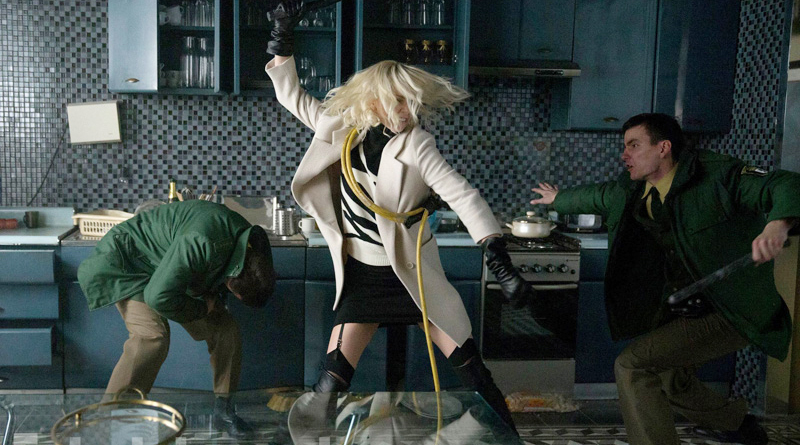 The story is retold during an investigation conducted by an MI6 officer (Toby Jones) and a CIA executive (John Goodman). They’re an odd couple good for a couple well-needed laughs, but it drags you out of the action and out of Lorraine’s flashy world where her slick 80s ensembles (big props to Cindy Evans for creating so many memorable looks) are an interesting juxtaposition to Berlin’s crumbling dumpster fire of a city. And the thing is, with a premise that’s almost silly in its duplicity, the action is really the justification for this movie’s existence. With long cuts and mind-numbing body counts, the fight design won’t disappoint action purists. But anyone requiring a satisfying story should maybe look elsewhere.
 Mills, feel very much like real people because their problems are so distinct. The women don’t bleed into each other; they are each accorded with specific neuroses, anxieties, passions, and influences. We know a little about how they were born, and how they will die, but mostly we know how they are living. 20th Century Women is not plot-driven; nothing “happens” except truth is revealed through meticulous character study.
 better endorsement for a film that couldn’t be further from his own experience. And that’s what’s so remarkable. Though its genius is in the details, the specificity of the characters, it’s all somehow very relatable. And any movie that’s also a mirror is definitely worth its salt.
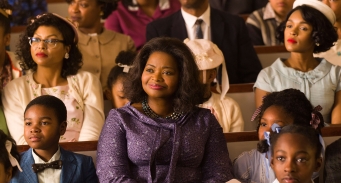 NASA pay them equally? Not by a long shot. Treat them fairly? Not so much. Promote them? Never. But hire them they must because there’s a space race on with the Russians, and they can’t afford not to hire the best and the brightest no matter the skin colour encasing the brains.
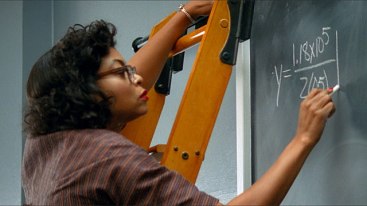 had the audience applauding. These women are so inspirational that it would be hard to mess up the story, and Hidden Figures manages not to stand in its own way. At the Toronto International Film Festival this fall, Pharrell Williams, who collaborated on the score with Hans Zimmer, gave a concert of all the original music he’d worked on for the film. I worried that he might overshadow the film, but in fact his music fits right in very comfortably, establishing the time period in a pop-heavy way.
 picking up the pieces of her middle age and trying to formulate some acceptable version of the future for herself. She’s disconnected from her youth and perhaps her old passions, but she’s not done, far from it. The film, and Huppert’s performance, has a stiff upper lip: she submits to a series of diminishments with cool detachment, but we watch as these changes slowly affect her relationships, even the one she has with philosophy.
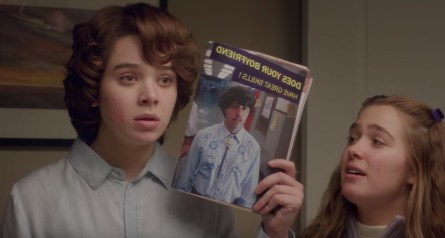 awkwardness just goes on and on. To make matters worse, her brother Darian (Blake Jenner) has it easy: perfect skin, perfect grades, the perfect apple of his mother’s eye, and a perfectly terrible person to be compared to for the rest of your life. To make matters EVEN worse, Darian starts dating Nadine’s best friend (read: only friend), which means he’s getting all the comfort that used to be hers, and she’s forced to be at war with them both while still, you know, blundering her way through life and high school, with only an irascible teacher (Woody Harrelson) in her corner – and believe me, that’s a bit iffy.
 time in one’s life.
 its violence. But Moana is called by the sea, and encouraged by her water-loving grandmother, she discovers that her ancestors were once voyagers who travelled the ocean in impressive “canoes” to find new islands to inhabit. With this in mind, she takes off on a self-taught sailing adventure to find the demi-god Maui and set things right for her ailing homeland.
 like Lilo & Stitch before it, should be celebrated for being a Hawaiian movie that actually features Hawaiian people (I’m looking at you,
  musical ventures. Jemaine Clement, playing a oversized crab, sings a song called Shiny which sounds an awful lot like something Flight of the Conchords would have done, though it is indeed written by Miranda (and performed with a David Bowie flair by Clement). And of course I’d be remiss if I didn’t mention the little girl (14 at the time of recording) who voices Moana herself, Auli’i Cravalho, who has a powerhouse of a voice, rich and full, and sounds authentic in the role too. I’m very glad to report that Disney cast this movie using a plethora of Polynesian performers, and it really pays off.
 read currents and measure the stars from the demi-god Maui, voiced by Dwayne Johnson. The animators do a really great job of bringing a few identifiable Johnson traits into Maui’s features, and Miranda carefully crafted a song that he could sing successfully, without having a traditional talent for singing (“You’re Welcome” is a heck of a song!). Maui’s body is covered in tattoos that represent acts of heroism, or particular challenges that he’s overcome. Unlike the rest of the computer-animated film, his tattoos are hand-drawn, and add an extra layer of fun to the story, as well as acting as his moral compass. Maui often pokes fun at
  Moana’s insistence that she is “not a princess”, a self-aware bit of humour from a studio known for relying on certain formulas.
 and came together under the influence of scuzzy manager Kim Fowley (Michael Shannon). Like any respectable rock band of the era, they eventually combusted, but not before releasing four albums in as many years. They never made it huge in North America but had some crazy success in Japan for a while, where their sound and aesthetic were appreciated.
 more pic. It barely scratches the surface. We don’t get to know anyone, and at any rate, Joan Jett’s post-Runaways life and music is where the real meat is. That said, it’s a clichéd ride about sex, drugs, and rock & roll, but it’s one worth watching to see Dakota Fanning get salty and Stewart own the role of rock’s first goddess. But it’s a condensed version featuring some character composites. The only member of the band besides the two front ladies that is touched upon is that of Sandy West, the drummer, but by the end they don’t give a shit about her, forgetting her in the title cards. She’d died before production began. Pesky cancer. The Runaways were revolutionary, a band about self-empowerment, but not all selves are created equally.
 Equity is a cold, unblinking look at Wall Street’s backrooms, through the eyes of a female dealmaker who’s trying to recover from a failed transaction. Her client’s shares traded too low during the initial public offering, and now she’s got a target on her back. Equity throws us into the immediate aftermath and we watch her as she tries to save her career by putting together a bigger, better deal.
 If you have at least a passing interest in finance, Equity’s story will draw you in and keep your attention until the end, avoiding most cliches throughout, at least when it comes to the main females. The male supportung characters fare less well, as they are all thinly sketched stereotypes (e.g., sexist boss, backstabbing boyfriend, and frat boy internet sensation). It is refreshing, though, for women to be the most compelling and realistic characters for a change.
 (John Ortiz), an ex lover, is married with a kid, though his relationship isn’t rock solid. He’s excited to have Anna around again, but you wonder if it’s real friendship he’s after, or the attention she can bring to his flagging career. A play wright, he’s got one ace in the whole: a new script he’s developed that revolves around a character that very closely (and unflatteringly) resembles Anna. Kate (Cara Seymour) is more reluctant to see her old friend. Is it because of the betrayal, or something else?
 girlfriend on Sons of Anarchy), which registers a double impact for every blow the film lands. Literally seen swimming amid a sea of scripts containing empty female parts, Siff is every female actress of a certain age searching for meaningful work. Anna’s opposite, Nadia (Dagmara Dominczyk), has given up her own work to be the rock of her family; her husband, Oscar, depends on her to be the stable one at home. But Nadia doesn’t want to be the rock anymore – “the rock is boring” she says, a line many of you will want to high-five because women are more than just someone else’s support (note to Jax!).
 ASSHOLES WATCHING MOVIES