Tag Archives: TIFF18

The Predator

In light of recent events, I feel obligated to point out that the title of this film refers to the fictional species of intergalactic trophy hunters, not director Shane Black’s real-life registered sex offender pal who was somehow cast in a bit role here (whose scene was then removed from the final cut when his sex offender status came to light).  With that major misstep remedied, though not forgotten, the latest entry in the Predator franchise arrives with the theme of evolution underlying the on-screen battles between humans and giant fang-faced aliens.

thepredator_02The ever-evolving Predator crash lands on earth and interrupts a U.S. sniper’s top secret Mexican mission. After ejecting from its ship, the Predator kills the sniper’s support team but the sniper (Boyd Holbrook) manages to escape, mailing a few pieces of the Predator’s gear home as evidence of the encounter. The gear finds its way to the sniper’s son (Room‘s Jacob Tremblay), who figures out how to activate it and in doing so becomes the Predator’s target. The army is no help in containing the Predator so the only ones standing between the Predator and the rest of the world are the sniper, a biologist (Olivia Munn) and a misfit group of soldiers. And the fight is on!

In addition to being a key plot point, the concept of evolution looms large for me as I reflect on this film, because the Predator series has definitely evolved. It’s so much different than the cheesy action/horror nostalgia trip I expected to see. The Predator is a gleeful, self-referential comedy that takes more pleasure in delivering quick, clever banter than it does in splattering the screen with gore.

Make no mistake, though. The Predator is an exceedingly gory film. Faces will be ripped off. Bodies will be sliced into pieces. Internal organs will ooze out of gaping wounds. That, more than anything, illustrates how consistently funny the Predator manages to be, because comedy is the film’s dominant element even in the presence of buckets and buckets of gore.

Black is known for his action-comedies, and his script for Lethal Weapon is rightly recognized as a standout in the genre. An evolution, even. Thirty years later, Black is still rolling along. A bit player in the original Predator (his character lasted all of seven minutes), Black now directs and co-writes (with Fred Dekker) the 2018 version, which is not a reboot of the original. Instead, it revisits what has come before to tell a new story and, by the end, sets a whole new course for the franchise that is as intriguing as it is ridiculous.

thepredator_04Of course, ridiculousness is a Black staple and while Predator does not quite measure up to Black’s best (namely, the amazing Lethal Weapon), it is a wonderfully entertaining film thanks to Black and the extremely solid cast. The standouts of the teriffic ensemble are Tremblay as the protagonist’s code-cracking son and This Is Us’s Sterling K. Brown as a scenery-devouring special agent whose motives are never clear but always nefarious. The Predator keeps up a steady stream of action and laughs from start to finish, and as a result, I’m now waiting eagerly for the even-more-ridiculous sequel that the Predator blatantly and shamelessly promises.

TIFF18: Wildlife

Joe Brinson’s family has just recently moved to Montana but his dad’s already out of work. You can tell it’s 1960 because father and son play football in belted khakis with their perfectly-pressed polo shirts neatly tucked in. Jerry Brinson (Jake Gyllenhaal) has a lot of pride and believes he’s “just too well-liked.” Jeanette Brinson (Carey Mulligan) swallows whatever disappointment she feels with her husband out of work again after yet another move to a place she doesn’t want to be, and still manages to ask politely for his permission to find work herself. Joe goes to work too, part-time, as his father slides into depression. But when Jerry finally gets off the couch and goes to work, Jeanette finally lets her anger erupt. He’s going to fight the massive forest fires for a buck an hour, and she doesn’t think that’s worth risking his life for. When he goes anyway, the crack in their marriage fractures perhaps irreparably, and Jeanette goes off the rails.

Wildlife is a movie about people on the brink. The Brinson family are on the brink of financial ruin. Jerry and Jeanette are on the brink of divorce. With fires ever raging, theMV5BZjhiNzJkZjctZjY2Ny00YTdjLWIxMjYtNjQwZjVmNjFiNGRjXkEyXkFqcGdeQXVyNjUxMjc1OTM@._V1_SX1777_CR0,0,1777,922_AL_ whole town’s on the brink of disaster. In 1960, the whole country’s on the brink of a sexual revolution, and women’s lib. But they’re not there yet. It’s shameful that Jeanette has to work instead of staying home with her son (who is 14 and never home). And they clearly don’t know how to do divorce; they forget the part about telling each other, and not committing adultery in front of the children. It’s a crazy time to be alive!

Paul Dano directed and co-wrote (with partner Zoe Kazan) Wildlife and the love and care show up on film, but he somehow holds back from showing us all the fancy tricks he can do, flexing his muscle with restraint instead. It’s impressive.

And given his pedigree I suppose it’s unsurprising how great he is with his cast. Carey Mulligan, to my  mind, turns out one great performance after another, but this still might be my favourite. It’s almost certainly the most complex. Jeanette is a woman ahead of her time. Her agency is startling, her behaviour a direct challenge to the values of 1960. The fact that her son (Ed Oxenbould) is a direct witness to her wantonness is often challenging, but Mulligan makes sure that Jeanette is given a humane treatment, while the script kindly paints the couple without heroes or villains – just two people forced to flaunt and rewrite the rules. It’s a sympathetic family portrait, if not quite an intimate one (we’re often at an emotional remove). And sometimes the story loses steam, but damn if Mulligan doesn’t just keep pulling me back in. All eyes on her.

TIFF18: The Kindergarten Teacher

Lisa is having a mid-life crisis. No, Lisa (Maggie Gyllenhaal) is having an existential mother fucking emergency. She’s been a kindergarten teacher for 20 years and she’s tired of teaching a curriculum she doesn’t believe in. She feels invisible at home, a mother to grown kids who don’t need her anymore, a wife to a man she doesn’t feel connected to. A continuing education class in poetry only highlights her unrealized potential and stifled creativity.

So Lisa is ripe for a prodigy, and what do you know, she “discovers” one right in her own classroom. Five (and a half) year old and full-time cutie-patootie Jimmy (Parker Sevak) MV5BMTYxODY2NDU5MV5BMl5BanBnXkFtZTgwNDE3MTgyNDM@._V1_composes poetry that is beautiful and eloquent beyond his years. Lisa feels an addictive high when she recites it as her own in poetry class, receiving praise by peers and teacher (Gael  Garcia Bernal) alike. But mostly she just becomes obsessed with this kid, believing she’s the only one who can nurture his talent. Her behaviour becomes increasingly troublesome, though even on the mild end of the spectrum (depriving him of naps, luring him into bathrooms, alone, with candy bribes), I was uncomfortable.
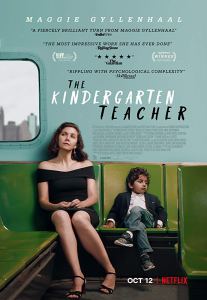
Lisa is a complex character. You’re picking up on that, right? She legitimately believes she’s got a Mozart-level genius on her hands, and also that our current culture crushes creativity. And she’s not wrong, definitely not about one of those things, and maybe not about both. But she believes that gives her the right to overstep her bounds in some pretty major, pretty outrageous ways.

Maggie Gylleenhaal deserves every good word you have to say about her performance. It’s melancholy, human, and desperate. There’s something universal about a woman’s unsatisfied needs. But you don’t quite know where or how far Lisa will take this – it’s just slightly unhinged, which keeps you riveted despite the fact that the film sometimes feels like it’s not quite sure what it should be.

Director Sara Colangelo explores the many facets of her protagonist even when motivations are muddled and compromised. There’s almost a dark comedy running through the veins of this movie, throbbing and daring in a way that’s surprising given it takes place in a kindergarten class. You’ll laugh, you’ll wince, you’ll sympathize, you’ll condemn, but you won’t look away, even when it stumbles, even if it can’t commit. The Kindergarten Teacher offers a confident performance and a fascinating character study.


Catch The Kindergarten Teacher on Netflix October 12.

TIFF18: Female Voices

I am proud to say that the Toronto International Film Festival has been at the forefront of committing to diversity and gender parity in its films. Everyone with half a brain is doing it this year, but TIFF’s been doing it for a while. They have shown us repeatedly that screening a higher proportion of female-directed films doesn’t affect the overall quality of the films shown at all. They have continued to curate fantastic films no matter who’s in the director’s chair. It’s just that programmers have to dig harder to unearth gems that aren’t always backed by studios. For every Wonder Woman or A Wrinkle In Time, there are dozens of indie films with hardly any attention, just waiting for someone smart enough to see it for what it is (Julia Hart’s Fast Color comes to mind as a recent example).

This year at TIFF, 34% of films are helmed by women. A few to look out for:

Can You Ever Forgive Me? Marielle Heller directs Melissa McCarthy in this movie about a sad sack writer (Lee Israel) who can’t get any work so she turns to forgery to pay her rent.

High Life: Claire Denis directs Robert Pattinson, Juliette Binoche, Andre Benjamin, and Mia Goth in a sci-fi film about a bunch of criminals who get sent into space for an experiment on human reproduction that of course goes wrong because IT’S IN SPACE and then they just have to struggle to be, well, not dead IN SPACE. Despite the caps lock, I honestly cannot wait to see this one.

Galveston: We’ve already seen this one, so we can recommend it wholeheartedly. Mélanie Laurent directs Ben Foster and Elle Fanning in a real doozie of a crime thriller, with a distinctly European flavour despite its very American setting.

Destroyer: Karyn Kusama directs Nicole Kidman as an undercover agent who has to reconnect with the gang member she once worked, a situation that ended in life-altering tragedy. There’s already Oscar buzz about Kidman’s performance.

The Weekend: Toronto-born writer-director Stella Meghie directs Sasheer Zamata in this film about a stand-up comedian who gets embroiled in a weird love-triangle with her ex and his new girlfriend on an awkward weekend away.

Quincy: Who better to (co)direct the documentary about Quincy Jones than his talented daughter, Rashida? It’s sure to be an intimate portrait of an influential man, and I can’t wait to see what she does with it.

A Million Little Pieces: After James Frey’s “autobiography” got a lambasting from Queen Oprah for its inauthenticity (read: fabrication, read: lies), this screenplay cooled its heels while the furor died down and apparently Hollywood thinks we’re as ready for it now as we’ll ever be. Aaron Taylor-Johnson plays the “Frey” character and his wife, Sam Taylor-Johnson directs him and a cast including Charlie Hunnam, Billy Bob Thornton, and Juliette Lewis.

Where Hands Touch: The crazy-talented writer-director Amma Asante tells the story MV5BZDIxNjIwNjktZTQzNS00ODI1LTkyZGItNDhkYjJlM2FhODcyXkEyXkFqcGdeQXVyMTMxODk2OTU@._V1_SY1000_CR0,0,690,1000_AL_of a biracial teenage girl struggling to survive in Nazi Germany, starring Amandla Stenberg and George Mackay.

The Kindergarten Teacher: Sara Colangelo’s film already has tremendous buzz coming out of Sundance. Maggie Gyllenhaal plays a teacher (duh) who becomes obsessed with a young student she believes may be a child prodigy (is that redundant? I think adult prodigies are just, you know, educated).

The Land of Steady Habits: Nicole Holofcener directs Ben Mendelsohn in this film about a man who has everything but still feels vaguely dissatisfied so he leaves his job and family and ends up down a rabbit hole of regret.

So, yes, it’s entirely possible to feast on female-directed films alone at TIFF, and leave feeling fully sated. But before you go, there are a couple other initiatives you should know about.

  1. Via Brie Larson, who was herself a director at TIFF last year, the festival announced a commitment toward media inclusion. They accredited 20% more journalists this year to bolster their under-represented numbers. I absolutely believe that female critics are essential to female-directed films being seen and appreciated, and I want and need all voices to be heard and represented. Love this initiative.
  2. TIFF has made a five-year commitment to increasing participation, skills, and opportunities for women behind and in front of the camera, with a focus on mentorship, skills development, media literacy, and activity for young people. Join the movement!
  3. TIFF’s Festival street will host the Share Her Journey rally on Saturday, September 8th. Everyone who’s remotely able to should come fill the streets (King St. West between University Ave. and Peter St.) and talk about the inequality plaguing the industry. Sign up here to live-stream the event if you can’t make it – beginning at 10am we’ll hear from Mia Kirshner, co-founder of #AfterMeToo, the above-mentioned Amma Asante, and many others.


Thanks for helping make this the best TIFF yet – because movies only matter when everyone’s represented.