Have you met Moomintroll? Inspired by the stories of Tove Jansson, Moomintroll brings his adventures off the pages of popular children’s books and onto the big screen – it’s available on DVD and VOD right now.
With an all-star voice cast and music composed by Moomins’ biggest fan, Bjork, this little movie is hitting plenty of high points.
With the help of his father, Moominpappa (Stellan Skarsgård), Moomintroll (Alexander Skarsgård) and his worried friends embark on a journey to the observatory to find out why everything in their valley is covered in thick grey dust and the sky continues to get redder by the day. They discover a comet is heading straight for them, but can they make it back to Moominhouse to get everyone to safety in time?
The Moomins are the world’s favourite troll family, and they’re brought to life with the help and voice work of Max von Sydow (The Exorcist, Star Wars: Episode VII – The Force Awakens),Alexander Skarsgård(True Blood, The Diary of a Teenage Girl), Stellan Skarsgård (Good Will Hunting, The Avengers), Mads Mikkelsen (Hannibal, Casino Royale), Peter Stormare (Fargo, 22 Jump Street), andHelena Mattsson (Iron Man 2, American Horror Story: Hotel). Do you think this gang can work together and overcome obstacles to beat the comet and save everyone from disaster? Skarsgårds to the rescue!
Will the Moomins win over North America? Only time will tell.
If you’ve seen this movie or know the books, let us know what you think!!
In Rebel Without a Cause, James Dean used an Ace Comb and suddenly every cool teenaged boy in American had to have one, which meant a huge bump in sales for the company. Product placements in movies are way more effective than traditional advertising because when placed within the context of a storyline, we become emotionally invested in the image. Plus, you won’t fast-forward through the movie like you would over a commercial.
Man of Steel made $160 million dollars before it was ever released in theatres because there were A HUNDRED products either scattered throughout the film or tied-in afterward. Did you catch them all? Nikon, Budweiser, Sears, 7-Eleven! The producers were all over free money like it was Star Jones’s wedding.
Not all product placements are so cringe-inducing. In Steven Spielberg’s E.T., Reese’s Pieces were actually part of the plot. In the original script, it was M&Ms Elliott used to bribe E.T., but Mars wouldn’t allow their candy in the film if they couldn’t see the final script, so Reese’s Pieces stepped up and made history. Hershey didn’t pay a cent, but they did provide the movie with 1 million dollars worth of free tie-in advertising. Worth it? They saw a 65% increase in sales during the film’s run, so I’d say yes.
The James Bond movies have always been a potpourri of product placements, from fancy-schmancy BMWs and Omega watches to elaborate vacation destinations. But Heineken trumps them all: they paid a reported $45 million dollars to be in Skyfall. And it would be worth a pretty penny to see James, renowned for preferring a martini, to be caught drinking a beer. It’s a sad day when film makers are willing to forgo characterization, history, tradition, and story for the all-mighty dollar, but it’s not just one dollar, it is after all 45 million of them. How many cars can you smash up for 45 million? They destroyed about $34M worth in Spectre.
Speaking of cars, let’s segue to The Italian Job and their iconic use of the Mini Cooper, which became the star of the movie. BMW provided 30 Minis to be used in the film and they saw a 22% rise in sales that year – not bad for a feature-length car commercial. I even rode an Italian Job roller coaster once where the cars were in fact little Minis. The movie made people reconsider the Mini Cooper – what was once thought to be a ‘girly’ car was no rebranded as sporty, speedy, and cool.
Cool is always being sold in the movies. In 1983, Ray-Ban was thinking about cancelling their Wayfarer line when it suddenly got a big bump thanks to Tom Cruise in Risky Business. He made the sunglasses cool again, and the brand attributes the sale of 360 000 pairs to the movie. So you can bet that 3 years later they were only too happy to enter into partnership with Top Gun, which this time high-lighted their Aviator line, which gave them a nice 40% increase.
There’s a battle in Hollywood for King of Product Placement: will it go to director Michael Bay, or to Adam Sandler? Michael Bay is notorious for cramming his movies full of products for sale so they look more like fast-moving catalogues that films. Adam, on the other hand, is much more frank about his brands. And that’s because, embarrassingly, the products in his movies are usually there because he loves them, not because he makes money off of them. “Sandler Marketing” is the shining beacon of product placement, because it’s not a blink-and-you’ll-miss-it can of Diet Pepsi, it’s a blatant shout-out. In Happy Gilmore, it’s actually a plot point that the golfer becomes a spokesman for his favourite sandwich shop, Subway – he’s seen eating a sub while wearing a Subway t-shirt and SHOOTING AN ENTIRE SUBWAY COMMERCIAL. It’s unclear whether Subway paid a dime for this, but that movie was also responsible for increased ratings for The Price is Right, so anything is possible.
Michael Bay, on the other hand, goes another route. You may consider that his Transformers franchise is already advertising since the series was created to sell toys. But that’s not enough anymore. Transformers #4 was nicknamed Advertising In Disguise for the sheer amount of branding jammed into its bloated corpse. The use of GM cars for all the Autobots is obvious enough, but Bay doesn’t have time for subtlety. What he does have time for: a transforming Xbox, Mountain Dew vending machine, and Nokia cellphone.
This stuff is so rampant that there’s actually an awards ceremony to pat people on the back for managing to stuff brands into movies: the Brandcameo product placement awards. Age of Extinction of course took home the trophy the year it was released (ironically it was still sued by a Chinese company for failing to include their logo), with Gone Girl a close second. Apple took home a special prize for overall product placement, having appeared in The Lego Movie, Captain America: The Winter Soldier, and in fact in 9 of the 35 highest-grossing films last year. The Theory of Everything also took home an award for marrying an Oscar-bait biopic with product placement (remember the bit about Tide? It wasn’t Tide in the original script.) These awards are always held on Oscars Eve, and this year it wasn’t Apple but Mercedes taking home the overall prize, having appeared in Furious 7, Jurassic World, Spy, 50 Shades of Grey, Focus, and Spectre. Meanwhile Apple managed a paltry Daddy’s Home, Sisters, Our Brand is Crisis, The Last Witch Hunter and The Intern. Achievement in Shameless Product Placement, a title I can’t help but love didn’t go to a movie this year, it went to a person: Mark Wahlberg. He appeared in the movie Entourage as himself, wearing a hat advertising the bottled water he’s invested in, and a t-shirt advertising his own line of body building supplements which he launched in conjunction with his body building movie, Pain and Gain. Meanwhile his other movie, Daddy’s Home, had a whole subplot about Indian motorcycle, for which he is a paid spokesperson, and which sells a “Mark Wahlberg line.”
And the Lifetime Achievement Award went to Pepsi for a veritable orgy of product placement. Last year it appeared in the likes of Tomorrowland, San Andreas, Ant-Man, and Jurassic World. It’s been in Twilight, Moneyball, 127 Hours, Fight Club, Gone in 60 Seconds, Tron, Salt, The Spice Girls Movie, Steve Jobs, Basic Instinct, Election, American Gangster, X-Men: Days of Future Past, Snakes on a Plane, The Blindside, Twister, World War Z. In Home Alone, it garnered a “Fuller, go easy on the Pepsi.” In Big, Tom Hanks’ man-child installed a Pepsi vending machine in his apartment. Pepsi vending machines have taken beatings in several Terminator movies. It’s also been beyond some meta-product placement, like the Doritos (owned by PepsiCo) breaking of the 4th wall in Wayne’s World, and the same basic gag being done by George Clooney in Return of the Killer Tomatoes. But are either of these half as memorable as Joe Manganiello’s stripper routine in Magic Mike’s XXL gas station scene? Didn’t think so. Touché, Pepsi. I raise my glass to you.
“It’s going to be a long 102 minutes”. This was my first impression of Aim for the Roses, which made its world premiere at the Hot Docs Film Festival in Toronto.
John Bolton’s documentary opens on a reenactment of Ken Carter (played by actor Andrew McNee with a yellow jumpsuit and terrible 70s beard) proclaiming his destiny to become the greatest of all daredevils. I was disoriented at first by the double bass player standing next to Carter on the fake ramp but his presence would still be explained.
Apart from a single reference to a Roger Waters concept album, Aim for the Roses is about as Canadian as it gets. In 1976, Montrealer Ken Carter declared his crazy ambition to jump over the Saint Lawrence River (literally from one country into another) in a rocket-powered car. In 2008, Vancouver-based composer Mark Haney got the crazy idea to make a double-bass concept album to pay tribute to “the daredevil stunt to end all daredevil stunts”. Finally, filmmaker John Bolton got the crazy idea that all this would make a good documentary. Basically, Aim for the Roses is a movie about Canadians doing crazy knuckleheaded things.
Visually, Bolton (the filmmaker) has a bit of a problem. There doesn’t seem to be nearly enough archival footage of Carter (the daredevil) to fill a whole movie and, as interesting as Haney’s music may be to listen to, it obviously doesn’t give us much to look at. Bolton’s solution is inspired. He turns Haney’s album into a music video, playing it over a reenactment of Carter’s feat filmed on a reconstruction of his takeoff ramp.
Bolton’s reenactment is bizarre. Maybe a little too bizarre. Haney’s soundtrack doesn’t help. His concept album has already been called “utterly amazing and completely fucking ridiculous” by the Georgia Straight. Passing off exposition as song lyrics, his music- as haunting as it is- can seem a little silly. But featuring McNee in that costume on a fake takeoff ramp with Haney playing base behind him is a little too much.
Fortunately, you don’t have to like Bolton and Haney’s musical to be fascinated by this documentary. Aim for the Roses is about the people who come up with crazy ideas and stubbornly pursue those ideas no matter how many puzzled looks they get. Haney , who is interviewed extensively in the film, is quick to point out the parallels he sees between his own life and that of Carter’s. He suggests that making the most ambitious concept album of your career is a lot like jumping a rocket-powered car over a river. It doesn’t matter what your ambition is. The best daredevils are artists and the best artists are daredevils. I wouldn’t be surprised if Bolton feels a certain kinship with these two men himself.
Hey kids, can you say B-movie? Because that’s what this one is! Big disappointment. Boring. Badly plotted. Blearily devoid of charm. Bland. Bargain-bin. I’m not even sure how this one made it to the theatres considering how low-budget it feels.
Norm of the North feels shoddily and hastily put together with a barely-there eco-friendly message and not much else. Norm is a polar bear, and he dances and also speaks human. That’s it. That’s the whole she-bang. Sorry I ruined it for you, but you’ve seen it before, and you’ve definitely seen it done better. The bar is set so low that any random episode of Paw Patrol will be more entertaining for your kids and less annoying for you. Yeah, I said it.
And the voice cast? The thing that’s easiest to hit out of the park? Norm of the North gets an F. Talk about B-list (or C-list) (or D-list, let’s be honest) celebrities: Rob Schneider and Heather Graham. I mean – seriously? Did they record all of the voices on Oscar night or something? Like, which “celebrity” is not only not invited to the Academy Awards, but not to any of the post-Oscar parties either, and doesn’t even have friends or cable TV to be watching them from home, and doesn’t have a job to go to Monday morning that they’re getting to bed early for? And so they called Balki from Perfect Strangers and he was busy. And they called Tori Spelling and she said no. Screech from Saved By The Bell thought the script was lame. Carrot Top thought it might compromise his artistic integrity. And on and on through a rolodex of reality-TV “personalities” until they finally scraped the bottom of the barrel, and guess who was there, desperate for a pay cheque?
(Apologies to Bill Nighy who somehow got tangled up in this mess, and to Gabriel Iglesias who did punch things up a bit.)
I was unprepared for how bland and pointless Norm of the North would be. How can you release this alongside Pixar fare and think you deserve to be there? It’s like hanging one of my kindergarten macaroni Christmas ornaments at the Louvre and not being embarrassed. The only thing I can console myself with is that it did set a record for worst opening for an animated feature and so maybe, just maybe, Lionsgate learned a lesson in humility.
Maybe I’m a little hungry, but to me, finding a good movie on Netflix is like finding the juicy peach hearts among all the other loser gummies. Fucking jackpot!
Autism In Love is, you guessed it, a documentary about people in love or looking for love, who also happen to be autistic (to varying degrees). Director Matt Fuller does an impressive job of teasing out a narrative that rarely gets seen in mainstream media: they’re on the spectrum, but they have needs and desires too.
We’ve tended to categorize autistic people as being emotionless, but that’s not true at all. They struggle to recognize and express feelings, but they’re there, and the more I learn about autism, the more I see similarities instead of differences. Autism in Love follows 4 individuals who I have to thank for their openness and bravery. It’s not easy for any of us to expose our vulnerabilities, and I can only hope they know how moved their audience has been.
Lenny is a young man in his 20s who, not unlike his peers, is struggling to find himself. He’d like to find a girlfriend, preferably a very independent one, but he feels strongly that they’re all out of his league. There’s anguish here. Lenny will break your goddamned heart. Lenny is a smart guy in his way, and he’s aware. He’s aware of how much his differences have set him apart and all he wants is to be “normal.”
Stephen is a middle-aged gentleman who’s been married for several years to a woman with her own disabilities. Though not a classic love story, you can see how much love and care there is between them. His wife knows how to get him talking, and how to recognize his affection. It’s incredibly endearing.
Lindsey & Dave are a young couple who are high-functioning professionals navigating a romantic relationship that’s just a little bit harder when both partners are autistic. But when you watch them together, it’s embarrassing, but you start to think that they’ve got it right, because in recognizing their weaknesses, they’re actually working harder at overcoming them than a lot of the rest of us. Their communication is open and honest, even if it’s a bit of a trial. Everyone should be so lucky.
What Fuller puts together is a piece that’s stereotype-shattering. It’s personal and intimate; you’ll laugh, you’ll cry. And you’ll come away with a better understanding of what it means to be autistic, and what it means to search for love no matter who you are or where you fall on a spectrum.
Today is a momentous day at Assholes Watching Movies because we’re giving out a prestigious award to the two most hard-working guys in Hollywood, Mark and Jay Duplass. These two have so much hustle that there’s hardly a corner in all of dusty Los Angeles that they haven’t conquered, so when we called up Queen Bey herself to crown them with all the glory implicated in this event, she didn’t hesitate to say yes. To be fair, Rihanna and Katy Perry also accepted but those girls are so confused they couldn’t stop crowning themselves. So, Jay & Mark, in the name of Beyoncé, with the power invested by her entire Beyhive, I now pronounce you Most Industrious Assholes.
Just who are these indefatigable guys? Jay you may know from the show Transparent, while Mark’s claim to fame was The League. Then they both appeared on the show they wrote and directed themselves, Togetherness. But that’s just what they do in their spare time. They’re also writing or producing or directing or micro-financing movies pretty much round the clock. Movies are either their passion, or their death wish.
“I consistently go to therapy and work on this one issue. … ‘How do I be a workaholic, do what we love to do, and not die of a heart attack, destroy myself and my family, and keep my friends?’” – a commendable insight from Mark.
The Duplass brothers have been at heart of the Mumblecore movement for a long time. Mumblecore movies are a subgenre of indies that are known by their incredibly small budgets, their “natural” (read: amateur) acting, with an emphasis on dialogue over plot, lots of which may be improvised.
Together they’ve written and directed The Puffy Chair (it debuted at SXSW, which is where the Mumblecore genre was first identified in 2005), Baghead, Cyrus, Jeff, Who Lives at Home, and The Do-Deca Pentathlon. They’ve also produced or executive produced Adult Beginners, Creep, Tangerine, Safety Not Guaranteed, The Skeleton Twins, The Overnight, and half a bazillion more (or less). These dudes are busy. And if the days start growing magical 25th and 26th hours, they’ve also got production deals with both HBO and Netflix, plus they’ve got a book deal at Random House so they can school us in the art of collaboration, which is a rarity in the ego-driven business of Hollywood.
Talented, busy, and honourable: now that their names have bank, their production company isn’t just about churning out Duplass stuff. They’re also bringing up lots of their friends along with them. They’ve got enough pull to make pretty much whatever they please, but they’re sticking close to their humble beginnings. The brothers are famous for bottom lines of less than a million dollars, and they always come in under budget. With their success and auteur status they’ve recently been asked to helm a real popcorn movie (shh – a superhero one!) and of course they turned it down, unwilling to make the kind of compromises that would entail. “We’re not making that level of money [of directing a blockbuster franchise],” Jay says. “But we don’t need that level of money because we lived like starving artists for 15 frickin’ years. It’s like, we don’t need things. We just like to make things.”
Jay and Mark aren’t just running their own little empire, they’re changing the industry as a whole. “There’s no excuse not to make movies on the weekend with your friends” says Mark, and you know he really, truly means it.
In 2007, writer-director-musician John Carney released one of those rare films that literally everyone loves. Sure, Once featured unprofessional actors and didn’t have much going in the way of plot but the music and characters struck such a chord mostly because of the unpretentious sincerity that everyone involved seemed to bring to the project.
In 2014, Carney tried to top himself in the acoustic meet cute musical genre with Begin Again, which had a considerably bigger budget and an all-star cast. Though not without its charms or hummable songs of its own, Carney’s second film about writing and recording songs just wasn’t nearly as relatable as his first effort, largely due to the presence of Keira Knightley and (worse still) Adam Levine.
Carney does his best to get back to basics, returning to Ireland with mostly unknown actors, in Sing Street. Cosmo (Ferdia Walsh-Peelo) has just started at a new school and, though he hasn’t made any friends yet, instantly falls for an older girl (Lucy Boynton) who aspires to be a model. Based in part on Carney’s own memories of the mid-80s, Cosmo decides to start a band inspired by The Cure, Duran Duran and Hall & Oates. For Cosmo, this project is mostly an excuse for him to film music videos starring his crush at first but the opportunity to write and play his own music soon becomes about much more. Music, he’ll soon learn, can be the perfect outlet to express his feelings about the tension between his parents, their financial troubles, and the restrictions at his strict Catholic school.
Sing Street is no Once.
Maybe that’s a good thing. While Once had a more improvised feel, Sing Street has a more insightful and considerably funnier script. (I laughed myself into a coughing fit twice and I don’t even have a cold)..It is much better acted and more imaginative. The dream sequence of Cosmo’s ideal video for Drive It Like You Stole It is my favourite scene by far but there are so many perfect moments in Sing Street.
But it doesn’t always feel like a good thing.Ironically, for a movie about the agony and the ecstasy of first love, Sing Street underestimates the attachment that so many of us feel to Carney’s first attempt at the indie-rock musical. Once may not have been perfect but it felt real. Its dialogue never distracted from the story by being either too lame or too witty, it just felt natural. With more experience and a bigger budget, he has clearly made a more polished film with Sing Street. But I prefer the rawness of his first effort.
George Clooney and Julia Roberts were enough to sell this movie to me, and in the end, they were enough to save it from itself.
The truth is, Money Monster teeters between a comedy and a socio-political thriller and suffers tonally. George Clooney plays Lee Gates, a slick and smug TV show host who makes stock market recommendations in between hip hop dance moves, obnoxious hats, and lots of gimmicks. One day, live on the air, a young man (Jack O’Connell) shows up with a bomb, ready to hold him and the CEO of a certain company (Dominic West) accountable for the loss of his life savings. Julia Roberts, playing the show’s director, is stuck in the booth directing the hell out of a show that is now being broadcast worldwide to billions, while keeping her colleague (who suffers from foot in mouth disease) alive.
The problems start with Kyle, the young man who’s just lost everything. Kyle is the audience place holder. We’re not millionaire TV hosts, or billionaire CEOs. We’re the people who work hard for our money, and are subject to the whims of Wall Street. But there’s a problem with the character when he’s just not relatable – and not because he’s brought a bomb to a TV studio. In fact, I think I am more likely to start making revenge bombs than I am to ever lose everything in the stock market. You know why? Likely you do: because you never put EVERYTHING in the stock market! The stock market is NOT free money. It’s a gamble. Sometimes you win, sometimes you lose. And if, like me, you know very little about this mysterious money market, you have to take advice from strangers. I tend to avail myself of the type of strangers who sit behind ornate desks with gold nameplates, but I take everything they say with a margarita-rim’s worth of salt and skepticism. Kyle preferred to go with the smarmy guy on TV who has a weekly “pick of the millennium” which is kind of like trusting Judge Judy to try your murder one charge – but who am I to judge? Kyle gambled his whole kit and caboodle and lost the kitty in no time. And did Kyle get mad at himself for being so rash? Of course not! Kyle is a dumb millennial who feels entitled to everything but responsible for nothing and so Kyle goes looking for someone else to blame, and brings a bomb as his sidekick. Nice one, Kyle.
So we don’t really feel badly for Kyle, but nor do we root for Lee Gates. He’s making a fat paycheque doing his thing on TV, and it’s pretty clear he’s forgotten that his words have real-world repercussions for people with far more to lose than he does. He’s a self-involved guy who hasn’t questioned anything until a bomb strapped to his chest forced him to. Between Kyle and Lee, it’s unclear to the audience just who the protagonist is. There aren’t any characters to really invest in – and yes, I’ve been dying to make that financial pun for 500 words now.
So maybe this is why some critics are calling this movie empty\hollow\vacuous. Sean certainly felt that the film’s final moments were jarring, and maybe inappropriate. I had a different read on them though.
The movie is kind of a fun ride, with an almost real-time hostage situation, and we feel like we’re experiencing it along with the rest of the world. Imagine if this was happening in real life: you’d be glued to your TV or your tablet or your laptop or your phone. Where were you when President Kennedy was shot? When OJ fled in the Bronco? When the twin towers fell? Where were you when Lee Gates was held at gunpoint on live TV and made to account for his mistakes? Wouldn’t that be a Big Deal? But in the movie, the minute our characters hit a point of resolution, the whole world switches channels. They go back to their sandwiches and their IKEA catalogs. The immediacy with which it’s forgotten is arresting. Sean thought that was disgusting, and I thought it was brilliant social commentary.
So yes, I can understand why people are leaving this movie frustrated. But I also thought that was kind of the point.
Is cynicism a sub-genre yet? Because it kind of should be. American Psycho. The Wolf of Wall Street. Network. Fight Club. I assume that Kill Your Friends was hoping to rub shoulders with these Kinds of Nihilism, except it isn’t quite clever enough to be admitted to the club.
It’s about the music business in London, circa 1997. Certainly a heady time to be an A&R man, which is exactly what Steven Stelfox (Nicholas Hoult) is. It’s the height of Britpop, and business is booming. If you find the next Oasis, or hell, the next Spice Girls, you’re made. But one misstep can also mean career suicide. It’s a super competitive industry, and both the screenwriter (John Niven) and the director (Owen Harris) have decided to bonk you over the head with this fact. And when, after the first 10 minutes or so, you’ve been completely bludgeoned with this theme, they yank open your jaw and force-feed it to you for 90 minutes more until you’re veritably choking on it.
Hoult is fun to watch. He’s doing the heavy lifting in this movie, out-acting the material he’s given. But his character is one-note, and it’s the exact same note as the movie in its entirety, so nothing sticks out. The bitterness is unending. Kill Your Friends aims to be the blackest of comedies, but when everyone is horrible all the time it really dulls your senses. It’s a grueling film to slog through without a single redeeming character so you can’t emotionally invest. Stelfox is pushed to further and further extremes but you won’t care an iota because nobody deserves to get out of this with their dignity intact.
To their credit, they spared zero expense on the soundtrack: Blur, Prodigy, Radiohead, The Chemical Brothers, Oasis. It reminds you what a good time it was to be alive in the late 90s. It also makes you angry that they’ve failed to live up to these bands. Almost certainly there’s an interesting tale here to tell. Kill Your Friends has no idea what it is though, and hopes you’ll be impressed with blood and cursing instead, which is almost the same as story, right?
Haha, okay, no I don’t. I love it. I knew I’d hate this movie, I avoided it like I feared it might give me Zika, and when I finally did break down and watch (because it was the fare being offered on the first night of drive-in season), I hated it even more than I’d anticipated. That uptick is maybe partially your fault. It’s received some fairly positive reviews so I had hope that it wasn’t as bad as my gut was telling me. But now I know the truth: either the movie-going public are idiots, or they talk up a bad movie in order to trick others into paying to see it too, thus assuaging their guilt and annoyance at having sat through it themselves.
Self-righteous, much? Yes, I enjoy being that too. But I truly did loathe this movie. I had little to no interest in seeing this movie and was relieved when Matt said he’d cover it for us (being a boy scout, he felt he had some personal connection to the material). But guess what? Matt never saw it, the chump, and he’s left it to me to attack people’s childhoods. I can only assume that’s what it’s about. I don’t have any warm fuzzy feelings attached to the 1967 animated version of this one. I could have hummed some of the bars of the more popular songs, but couldn’t have told you the plot. But the minute I heard it was live-action, I was out. Forget it. Realistic-looking animals that still for some reason talk? I couldn’t fathom how this would be done well.
Neither could Jon Favreau, as it turns out. And the thing about realistic-looking animals is that they’re still cartoons. They’re very accurate, very expensive cartoons, but it’s just some fancy animation that makes it harder for me to anthropomorphize but doesn’t stop them from breaking out into song. The tiger is so menacing looking you can practically smell the rotting meat caught between his yellowed 3-inch teeth, yet he has the velvety smooth voice of Idris Elba. Bill Murray was a nice choice for the more playful Baloo, but let’s remember that Baloo is still a bear. A sloth bear, sure, but a bear’s a bear. Sloth bears are usually known to be docile for a bear, but they’ll still attack humans who encroach upon their living space, and Mowgli doesn’t just encroach, he fucking rides him! And then there’s King Louie, the big-ass scary mother fucking ape. Modeled after Apocalypse Now’s Colonel Kurtz, King Louie is a gigantopithecus, an ancestor of the orangutan, who in real life would have been about 10 feet tall and over 1000lbs. He’s hostile AF but he’s oddly voiced by Christopher Walken. Now, I love Walken almost as much as his mother does, but it was a weird and jarring choice. King Louie is scary, but Walken’s voice is far from it. He’s got the voice of a stand-up comedian or a jazz band leader, it’s one of the most recognizable voices out there, and it didn’t belong to this ape. And then he breaks out into a show tune, which is NOT something Colonel Kurtz would be caught dead doing, so the tone of the movie just falls apart like the chain falling off of a bicycle, and the whole thing just stinks. Stinks! And not just because it’s a temple full of monkeys.
So why bother making a “live-action” version of the movie when there’s only a single live thing about it? Neel Sethi as little Mowgli is pretty charming, but he never met a single animal during the filming of The Jungle Book – which is a good thing, because seeing a small boy in the arms of a black panther makes most adults want to scream “Run you little idiot!” In fact, Jim Henson’s Creature Shop was brought in to make puppets for Sethi to act against, but those were completely replaced with CGI versions later. And as for the lush Indian landscape, it’s 100% phony too. The whole thing was filmed on a back lot in smoggy Los Angeles with a blue screen and some Styrofoam painted to look like jungle.
Tonnes of people loved this movie and I’m not one of them. If you’re going to give me talking animals, that’s fine, but they’d better also have careers and pants and fart jokes. If an animal looks real and normally eats people, I don’t want to see him dancing around with a man-cub. I have zero tolerance for this movie and as far as I’m concerned, King Louie can kiss my ass.

 With an all-star voice cast and music composed by Moomins’ biggest fan, Bjork, this little movie is hitting plenty of high points.
 Royale), Peter Stormare (Fargo, 22 Jump Street), and Helena Mattsson (Iron Man 2, American Horror Story: Hotel). Do you think this gang can work together and overcome obstacles to beat the comet and save everyone from disaster? Skarsgårds to the rescue!
 Reese’s Pieces were actually part of the plot. In the original script, it was M&Ms Elliott used to bribe E.T., but Mars wouldn’t allow their candy in the film if they couldn’t see the final script, so Reese’s Pieces stepped up and made history. Hershey didn’t pay a cent, but they did provide the movie with 1 million dollars worth of free tie-in advertising. Worth it? They saw a 65% increase in sales during the film’s run, so I’d say yes.
 renowned for preferring a martini, to be caught drinking a beer. It’s a sad day when film makers are willing to forgo characterization, history, tradition, and story for the all-mighty dollar, but it’s not just one dollar, it is after all 45 million of them. How many cars can you smash up for 45 million? They destroyed about $34M worth in Spectre.
 Cooper, which became the star of the movie. BMW provided 30 Minis to be used in the film and they saw a 22% rise in sales that year – not bad for a feature-length car commercial. I even rode an Italian Job roller coaster once where the cars were in fact little Minis. The movie made people reconsider the Mini Cooper – what was once thought to be a ‘girly’ car was no rebranded as sporty, speedy, and cool.
 cancelling their Wayfarer line when it suddenly got a big bump thanks to Tom Cruise in Risky Business. He made the sunglasses cool again, and the brand attributes the sale of 360 000 pairs to the
  movie. So you can bet that 3 years later they were only too happy to enter into partnership with Top Gun, which this time high-lighted their Aviator line, which gave them a nice 40% increase.
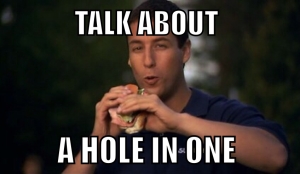 it’s actually a plot point that the golfer becomes a spokesman for his favourite sandwich shop, Subway – he’s seen eating a sub while wearing a Subway t-shirt and SHOOTING AN ENTIRE SUBWAY COMMERCIAL. It’s unclear whether Subway paid a dime for this, but that movie was also responsible for increased ratings for The Price is Right, so anything is possible.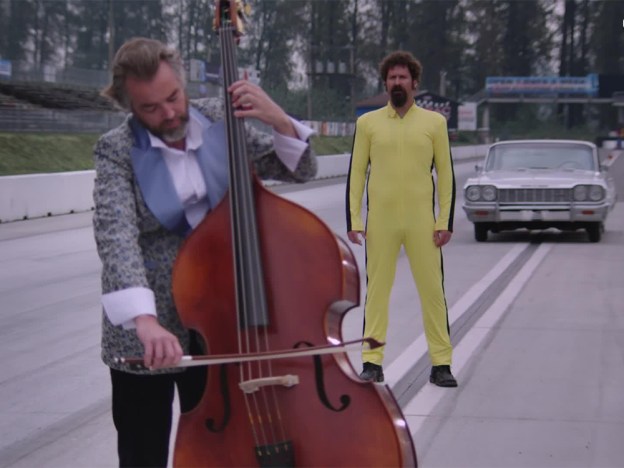
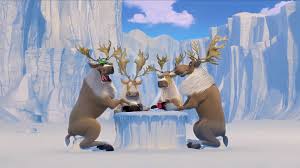 and also speaks human. That’s it. That’s the whole she-bang. Sorry I ruined it for you, but you’ve seen it before, and you’ve definitely seen it done better. The bar is set so low that any random episode of Paw Patrol will be more entertaining for your kids and less annoying for you. Yeah, I said it.
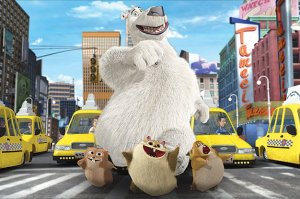 record all of the voices on Oscar night or something? Like, which “celebrity” is not only not invited to the Academy Awards, but not to any of the post-Oscar parties either, and doesn’t even have friends or cable TV to be watching them from home, and doesn’t have a job to go to Monday morning that they’re getting to bed early for? And so they called Balki from Perfect Strangers and he was busy. And they called Tori Spelling and she said no. Screech from Saved By The Bell thought the script was lame. Carrot Top thought it might compromise his artistic integrity. And on and on through a rolodex of reality-TV “personalities” until they finally scraped the bottom of the barrel, and guess who was there, desperate for a pay cheque?
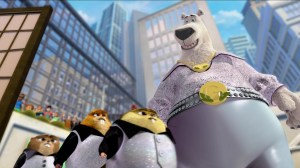 I was unprepared for how bland and pointless Norm of the North would be. How can you release this alongside Pixar fare and think you deserve to be there? It’s like hanging one of my kindergarten macaroni Christmas ornaments at the Louvre and not being embarrassed. The only thing I can console myself with is that it did set a record for worst opening for an animated feature and so maybe, just maybe, Lionsgate learned a lesson in humility.
 Lenny is a young man in his 20s who, not unlike his peers, is struggling to find himself. He’d like to find a girlfriend, preferably a very independent one, but he feels strongly that they’re all out of his league. There’s anguish here. Lenny will break your goddamned heart. Lenny is a smart guy in his way, and he’s aware. He’s aware of how much his differences have set him apart and all he wants is to be “normal.”
 woman with her own disabilities. Though not a classic love story, you can see how much love and care there is between them. His wife knows how to get him talking, and how to recognize his affection. It’s incredibly endearing.
 it’s embarrassing, but you start to think that they’ve got it right, because in recognizing their weaknesses, they’re actually working harder at overcoming them than a lot of the rest of us. Their communication is open and honest, even if it’s a bit of a trial. Everyone should be so lucky.
 These two have so much hustle that there’s hardly a corner in all of dusty Los Angeles that they haven’t conquered, so when we called up Queen Bey herself to crown them with all the glory implicated in this event, she didn’t hesitate to say yes. To be fair, Rihanna and Katy Perry also accepted but those girls are so confused they couldn’t stop crowning themselves. So, Jay & Mark, in the name of Beyoncé, with the power invested by her entire Beyhive, I now pronounce you Most Industrious Assholes.
 while Mark’s claim to fame was The League. Then they both appeared on the show they wrote and directed themselves, Togetherness. But that’s just what they do in their spare time. They’re also writing or producing or directing or micro-financing movies pretty much round the clock. Movies are either their passion, or their death wish.
 workaholic, do what we love to do, and not die of a heart attack, destroy myself and my family, and keep my friends?’” – a commendable insight from Mark.
 The Duplass brothers have been at heart of the Mumblecore movement for a long time. Mumblecore movies are a subgenre of indies that are known by their incredibly small budgets, their “natural” (read: amateur) acting, with an emphasis on dialogue over plot, lots of which may be improvised.
 Beginners
 company isn’t just about churning out Duplass stuff. They’re also bringing up lots of their friends along with them. They’ve got enough pull to make pretty much whatever they please, but they’re sticking close to their humble beginnings. The brothers are famous for bottom lines of less than a million dollars, and they always come in under budget. With their success and auteur status they’ve recently been asked to helm a real popcorn movie (shh – a superhero one!) and of course they turned it down, unwilling to make the kind of compromises
 that would entail. “We’re not making that level of money [of directing a blockbuster franchise],” Jay says. “But we don’t need that level of money because we lived like starving artists for 15 frickin’ years. It’s like, we don’t need things. We just like to make things.”
 Jay and Mark aren’t just running their own little empire, they’re changing the industry as a whole. “There’s no excuse not to make movies on the weekend with your friends” says Mark, and you know he really, truly means it.
 are films that literally everyone loves. Sure, Once featured unprofessional actors and didn’t have much going in the way of plot but the music and characters struck such a chord mostly because of the unpretentious sincerity that everyone involved seemed to bring to the project.
 Carney does his best to get back to basics, returning to Ireland with mostly unknown actors, in Sing Street. Cosmo (Ferdia Walsh-Peelo) has just started at a new school and, though he hasn’t made any friends yet, instantly falls for an older girl (Lucy Boynton) who aspires to be a model. Based in part on Carney’s own memories of the mid-80s, Cosmo decides to start a band inspired by The Cure, Duran Duran and Hall & Oates. For Cosmo, this project is mostly an excuse for him to film music videos starring his crush at first but the opportunity to write and play his own music soon becomes about much more. Music, he’ll soon learn, can be the perfect outlet to express his feelings about the tension between his parents, their financial troubles, and the restrictions at his strict Catholic school.
 insightful and considerably funnier script. (I laughed myself into a coughing fit twice and I don’t even have a cold)..It is much better acted and more imaginative. The dream sequence of Cosmo’s ideal video for Drive It Like You Stole It is my favourite scene by far but there are so many perfect moments in Sing Street.
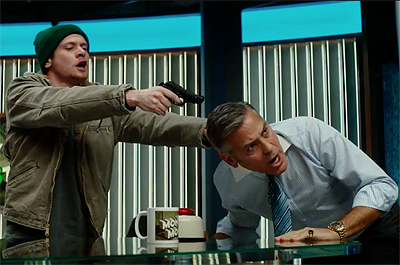

 man, which is exactly what Steven Stelfox (Nicholas Hoult) is. It’s the height of Britpop, and business is booming. If you find the next Oasis, or hell, the next Spice Girls, you’re made. But one misstep can also mean career suicide. It’s a super competitive industry, and both the screenwriter (John Niven) and the director (Owen Harris) have decided to bonk you over the head with this fact. And when, after the first 10 minutes or so, you’ve been completely bludgeoned with this theme, they yank open your jaw and force-feed it to you for 90 minutes more until you’re veritably choking on it.
 entirety, so nothing sticks out. The bitterness is unending. Kill Your Friends aims to be the blackest of comedies, but when everyone is horrible all the time it really dulls your senses. It’s a grueling film to slog through without a single redeeming character so you can’t emotionally invest. Stelfox is pushed to further and further extremes but you won’t care an iota because nobody deserves to get out of this with their dignity intact.
 To their credit, they spared zero expense on the soundtrack: Blur, Prodigy, Radiohead, The Chemical Brothers, Oasis. It reminds you what a good time it was to be alive in the late 90s. It also makes you angry that they’ve failed to live up to these bands. Almost certainly there’s an interesting tale here to tell. Kill Your Friends has no idea what it is though, and hopes you’ll be impressed with blood and cursing instead, which is almost the same as story, right?
 fault. It’s received some fairly positive reviews so I had hope that it wasn’t as bad as my gut was telling me. But now I know the truth: either the movie-going public are idiots, or they talk up a bad movie in order to trick others into paying to see it too, thus assuaging their guilt and annoyance at having sat through it themselves.
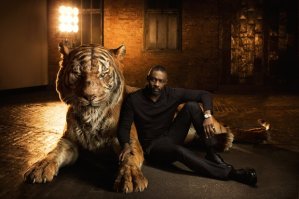 animals is that they’re still cartoons. They’re very accurate, very expensive cartoons, but it’s just some fancy animation that makes it harder for me to anthropomorphize but doesn’t stop them from breaking out into song. The tiger is so menacing looking you can practically smell the rotting meat caught between his yellowed 3-inch teeth, yet he has the velvety smooth voice of Idris Elba. Bill Murray was a nice choice for the more playful Baloo, but let’s remember that Baloo is still a bear. A sloth bear, sure, but a bear’s a bear. Sloth bears are usually known to be docile for a bear, but they’ll still attack humans who encroach upon their living space, and Mowgli doesn’t just encroach, he fucking rides him! And
  then there’s King Louie, the big-ass scary mother fucking ape. Modeled after Apocalypse Now’s Colonel Kurtz, King Louie is a gigantopithecus, an ancestor of the orangutan, who in real life would have been about 10 feet tall and over 1000lbs. He’s hostile AF but he’s oddly voiced by Christopher Walken. Now, I love Walken almost as much as his mother does, but it was a weird and jarring choice. King Louie is scary, but Walken’s voice is far from it. He’s got the voice of a stand-up comedian or a jazz band leader, it’s one of the most recognizable voices out there, and it didn’t belong to this ape. And then he breaks out into a show tune, which is NOT something Colonel Kurtz would be caught dead doing, so the tone of the movie just falls apart like the chain falling off of a bicycle, and the whole thing just stinks. Stinks! And not just because it’s a temple full of monkeys.
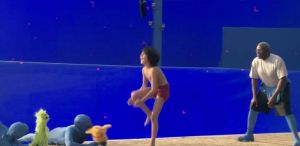 a black panther makes most adults want to scream “Run you little idiot!” In fact, Jim Henson’s Creature Shop was brought in to make puppets for Sethi to act against, but those were completely replaced with CGI versions later. And as for the lush Indian landscape, it’s 100% phony too. The whole thing was filmed on a back lot in smoggy Los Angeles with a blue screen and some Styrofoam painted to look like jungle.
 give me talking animals, that’s fine, but they’d better also have careers and pants and fart jokes. If an animal looks real and normally eats people, I don’t want to see him dancing around with a man-cub. I have zero tolerance for this movie and as far as I’m concerned, King Louie can kiss my ass.
 ASSHOLES WATCHING MOVIES