Author Archives: Jay

Overboard (2018)

When it’s over, Sean turns to me and says ‘I know you recently crowned SPF-18 the worst movie ever, but what do you think, could this usurp it?’ And the thing is yeah – he’s not wrong, though I must uncomfortably remind him that while we watched SPF-18 for “free” (Netflix), we paid to watch this shit. Which makes its awfulness that much harder to swallow.

Sure the 1987 version was horribly sexist, but it was also soaked in charm. Goldie Hawn and Kurt Russell had major chemistry, and Garry Marshall knew how to wring a scene for laughs. In the 2018 remake, it’s hard not to compare Anna Faris to Goldie Hawn, and it’s impossible for her not to lose, and by quite a large margin. Hawn has big presence and effortless likeability. Faris has her wide mouth and not much else.

In 2018, the roles are reversed. Kate (Faris) is the hard-working widow, and Leo (Eugenio Derbez) the pompous, spoiled brat. She meets him one day vacuuming up a glitter bomb on his beautiful yacht, and failing to meet his impossible standards, is MV5BZjNkOTNjMjktZGI5Yi00ODJjLWFhMzQtZWQ2YTU3NDBiNzRmXkEyXkFqcGdeQXVyNDg2MjUxNjM@._V1_SY1000_CR0,0,1502,1000_AL_thrown overboard, unpaid. He later suffers an accident and ends up unidentified in a hospital with amnesia (his evil sister refusing to claim him so she can inherit the family business) so Kate, egged on by her best friend Theresa (Eva Longoria),decides to claim him as her husband and force him into a life of servitude in order to extort retribution. Nothing about this new life feels familiar to Leo, and he’s not immediately great at working a back-breaking job, doing all the housework, caring for 3 kids, and getting nothing in return.
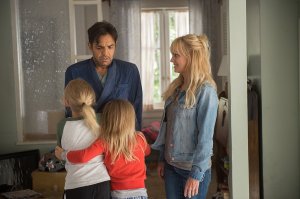
Eugenio Derbez is a curious choice to play the leading man here. He’s a big star in Mexico but virtually unknown to the rest of North America. He’s also too old for Anna Faris, and not handsome enough, and doesn’t seem at home in either end of his role’s spectrum – the rich playboy, or the blue-collar dad. Either Overboard got some major Mexican money and had to meet certain conditions, or they were courting the Mexican box office (indeed, that’s where it made half its money) hard. Either way, Derbez just doesn’t fit. And Anna Faris, while never my favourite, has something to offer, though that something was left on the table. She’s more adept at physical comedy, screwball stuff, and the script did not play to her strengths at all. The chemistry between them is non-existent. How did this thing even get off the ground?

Never mind the fact that the premise just hasn’t aged very well. I mean, she’s basically kidnapping a mentally disabled person and forcing him into slavery. And when she delivers a laundry list of chores for him to complete on top of his two jobs and caregiving responsibilities, it just comes off as mean. Which isn’t nearly as bad as how she comes off as a mother. First, the gall to complain that her mother (Swoozie Kurtz, whom I have never not loved) is not prepared to derail her whole life in order to care for Kate’s kids full-time. Um, they’re your kids Kate. I get that it’s tough to be a single parent, but it’s nobody’s responsibility but yours. Second, she constant reminds us how icky it is to leave her three young daughters alone with a strange man (the only thing she knows about him is that he’s a horndog douchebag, ie, not great babysitting material) and yet it happens over and over. Kate is a widow, apparently, though that’s mentioned once and forgotten. There is no mourning being done in her household – no mentions, no memories, no pictures even. So I get why she might “fall” for a provider type, someone to lessen her burden. But why would Leo fall for her? She’s so much worse than just your standard liar: she’s amoral and selfish and exploitative. This is not a love story you can root for and not a comedy you can laugh at. So what the heck’s the point?
TIFF18: Female Voices

I am proud to say that the Toronto International Film Festival has been at the forefront of committing to diversity and gender parity in its films. Everyone with half a brain is doing it this year, but TIFF’s been doing it for a while. They have shown us repeatedly that screening a higher proportion of female-directed films doesn’t affect the overall quality of the films shown at all. They have continued to curate fantastic films no matter who’s in the director’s chair. It’s just that programmers have to dig harder to unearth gems that aren’t always backed by studios. For every Wonder Woman or A Wrinkle In Time, there are dozens of indie films with hardly any attention, just waiting for someone smart enough to see it for what it is (Julia Hart’s Fast Color comes to mind as a recent example).

This year at TIFF, 34% of films are helmed by women. A few to look out for:

Can You Ever Forgive Me? Marielle Heller directs Melissa McCarthy in this movie about a sad sack writer (Lee Israel) who can’t get any work so she turns to forgery to pay her rent.

High Life: Claire Denis directs Robert Pattinson, Juliette Binoche, Andre Benjamin, and Mia Goth in a sci-fi film about a bunch of criminals who get sent into space for an experiment on human reproduction that of course goes wrong because IT’S IN SPACE and then they just have to struggle to be, well, not dead IN SPACE. Despite the caps lock, I honestly cannot wait to see this one.

Galveston: We’ve already seen this one, so we can recommend it wholeheartedly. Mélanie Laurent directs Ben Foster and Elle Fanning in a real doozie of a crime thriller, with a distinctly European flavour despite its very American setting.

Destroyer: Karyn Kusama directs Nicole Kidman as an undercover agent who has to reconnect with the gang member she once worked, a situation that ended in life-altering tragedy. There’s already Oscar buzz about Kidman’s performance.

The Weekend: Toronto-born writer-director Stella Meghie directs Sasheer Zamata in this film about a stand-up comedian who gets embroiled in a weird love-triangle with her ex and his new girlfriend on an awkward weekend away.

Quincy: Who better to (co)direct the documentary about Quincy Jones than his talented daughter, Rashida? It’s sure to be an intimate portrait of an influential man, and I can’t wait to see what she does with it.

A Million Little Pieces: After James Frey’s “autobiography” got a lambasting from Queen Oprah for its inauthenticity (read: fabrication, read: lies), this screenplay cooled its heels while the furor died down and apparently Hollywood thinks we’re as ready for it now as we’ll ever be. Aaron Taylor-Johnson plays the “Frey” character and his wife, Sam Taylor-Johnson directs him and a cast including Charlie Hunnam, Billy Bob Thornton, and Juliette Lewis.

Where Hands Touch: The crazy-talented writer-director Amma Asante tells the story MV5BZDIxNjIwNjktZTQzNS00ODI1LTkyZGItNDhkYjJlM2FhODcyXkEyXkFqcGdeQXVyMTMxODk2OTU@._V1_SY1000_CR0,0,690,1000_AL_of a biracial teenage girl struggling to survive in Nazi Germany, starring Amandla Stenberg and George Mackay.

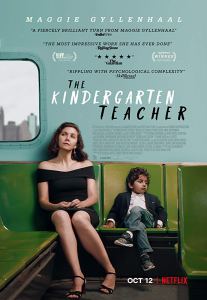
The Kindergarten Teacher: Sara Colangelo’s film already has tremendous buzz coming out of Sundance. Maggie Gyllenhaal plays a teacher (duh) who becomes obsessed with a young student she believes may be a child prodigy (is that redundant? I think adult prodigies are just, you know, educated).

The Land of Steady Habits: Nicole Holofcener directs Ben Mendelsohn in this film about a man who has everything but still feels vaguely dissatisfied so he leaves his job and family and ends up down a rabbit hole of regret.

So, yes, it’s entirely possible to feast on female-directed films alone at TIFF, and leave feeling fully sated. But before you go, there are a couple other initiatives you should know about.

  1. Via Brie Larson, who was herself a director at TIFF last year, the festival announced a commitment toward media inclusion. They accredited 20% more journalists this year to bolster their under-represented numbers. I absolutely believe that female critics are essential to female-directed films being seen and appreciated, and I want and need all voices to be heard and represented. Love this initiative.
  2. TIFF has made a five-year commitment to increasing participation, skills, and opportunities for women behind and in front of the camera, with a focus on mentorship, skills development, media literacy, and activity for young people. Join the movement!
  3. TIFF’s Festival street will host the Share Her Journey rally on Saturday, September 8th. Everyone who’s remotely able to should come fill the streets (King St. West between University Ave. and Peter St.) and talk about the inequality plaguing the industry. Sign up here to live-stream the event if you can’t make it – beginning at 10am we’ll hear from Mia Kirshner, co-founder of #AfterMeToo, the above-mentioned Amma Asante, and many others.


Thanks for helping make this the best TIFF yet – because movies only matter when everyone’s represented.


On Chesil Beach

Two young people are trying to have sex, apparently on their wedding night, which is important to note because they’re old-timey virgins who are nervous and awkward and don’t really know where things go or for how long or how hard.

Somewhere between toes and tits, Florence (Saoirse Ronan) and Edward (Billy Howle) reminisce about their entire relationship, through flashbacks. Spoiler alert: MV5BMmFlOTkyYjQtYWQyYS00ZDY3LWE3ZjktZDE4Y2Y5M2EyMzQwXkEyXkFqcGdeQXVyNTc5OTMwOTQ@._V1_SY1000_CR0,0,666,1000_AL_they have a history! Their courtship was often influenced (often negatively) by their pasts, by their families, by what they know and what they don’t. Sound familiar? That’s probably because it’s true of absolutely every human who has ever lived. So how did this movie get made?

Well, Ian McEwan wrote a wonderfully descriptive book, as he does. The kind of book that languishes and meanders around in a poetic bath of language. On film, oh gosh, it’s beautiful, and Saoirse Ronan is luminous and wonderful, but there’s not a whole lot of action. Haha, even saying the word action in this context feels bizarre. I mean, on their hottest date, Edward chastises Flo for her lukewarm bird watching.

Anyway, if you find it hard to imagine what sex was even like in 1962, before the sexual revolution had really…revolved…well, consider yourself lucky. On Chesil Beach gives you an eyeful in all its pasty glory, which doesn’t actually involve any nudity because this is the generation that has never seen their partners naked. Anyway, the fumbling is real. Activities are prematurely aborted, or, well, not quite. Things are said. Things like: that’s revolting, which is hard to recover from. It begs the question: does sex just sometimes…not happen? ‘Frigid’ is another word you don’t recover from.

Anyway, the whole thing feels rather minor, and that’s not a comment on poor Eddie’s manhood. It’s just very introspective, and perhaps a visual medium is not quite the best path for this story. And the movie just stretches on and on, beyond what feels right or makes sense. Certainly beyond my patience, and beyond the tether of my empathy for these people. The film fails its characters and fails the audience by not having much of a bigger picture. At least with a book you can hurl it across the room – hell, I’m sure I’ve even broken a window or two launching a stupid book right through it, but a movie? Those faces loom so large and yet I cannot reach out and slap them, and that is the greatest travesty of all.

SPF-18

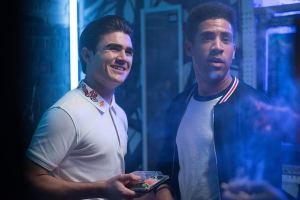
The first half of SPF-18 is about virginity, or the loss thereof. Penny (Carson Meyer) needs a prom do-over, and when her boyfriend Johnny (Noah Centineo) house sits for Keanu, she brings her cousin Camilla (Bianca Santos) and a pack of condoms and and the deflowering is on.

The second half of SPF-18 is about surfing, and using it to somehow honour one’s dead father.

MV5BZjVhMmFmYTQtYTMwNC00Y2JiLTg1MDAtOGM3ZGM3Y2I0YWMyXkEyXkFqcGdeQXVyNTQ3MjE4NTU@._V1_SX1777_CR0,0,1777,999_AL_There’s a very thin line between these two halves where SPF-18 could have crossed over with The Meg, and had these vapid teenagers been devoured by a megalodon, I might have hated this a little less. As it was, just thinking of them as shark poop helped get me through.
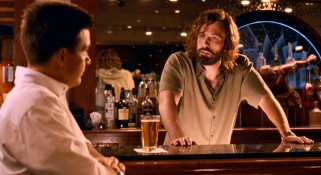
In reality, a Christian country artist wannabe named Ash (Jackson White) baptizes himself in the nude in front of the girls, thus cementing himself in their hearts. And even though her virginity is still freshly smeared all over Keanu’s sheets, Penny’s heart goes the way of her hymen – torn.

And then Johnny’s dead dad’s surfing protegee resurfaces, guilt-ridden about his drug usage which may or may not have contributed to his mentor’s untimely death. This story really doesn’t need to be here, but the film is already a scant 75 minutes, so I guess it added some flesh to the bare bones. The rest is just redistributing the lovers. Ash has a soulful voice but Johnny has abs worth praying about.

You should be able to deduce that the script is bad but that really doesn’t do it justice. IT’S HORRENDOUS. The dialogue is embarrassing and cringe-worthy, but it’s not the worst part. The worst part are the disparate ideas strung together to make a movie. They’re so random I don’t even know how they decided which order to put them in (Evil studio executives! The benefits of pilates! Illegal doping scandals! Greek mythology! Animated meditation! High school superlatives! Unnecessary narrators! Intellectual property law! Unexplained lip lesions!). Can you hodge podge these together to make a film? No you can’t, you definitely can’t, but that’s not stopping anyone.

I don’t know anything about director Alex Israel, but I can guess that he’s an 80s kid. He certainly reveres the decade. Why else would you give a millennial rom-com a power ballad-filled soundtrack? And how else to explain small roles for Pamela Anderson, Goldie Hawn, and Molly Ringwald? This movie was painful for me, and not just because SPF-18 may as well be bacon grease (I like a nice hard 50 myself) for all the good it does. It feels like this may have been made and edited in the drunk tank by people with double vision and shaky hands and very, very poor judgment. I literally cannot believe this is a movie and I definitely cannot warn you away vehemently enough.

Extract

Chances are, every pantry has a little bottle of pricey vanilla extract on its shelves. It’s practically ubiquitous in baking. Just try to make a cookie without it. But have you ever wondered where it comes from? No. And neither have I. But that’s not going to stop Jason Bateman from trying to tell us.

Joel (Bateman) is one of those classically sad, back-boneless middle aged men who aren’t particularly effective at home or at work. He owns the extract company, but it’s barely profitable and the employees bully him. At home, his wife Suzie (Kristen Wiig) dons her sweatpants in a nightly ritual to thwart his bedtime advances. They’re going through a dry spell. So when Cindy (Mila Kunis), an alluring young woman, comes looking for a job at the factory, can we blame Joel for wanting to give her something else? I mean, yes. We absolutely can. And even Joel is a bit wishy-washy on the whole thing, so it takes the bad influence of his best friend (Ben extract-02.jpgAffleck) to come up with this convoluted plan: they’ll hire a teenage gigolo to seduce Suzie, leaving Joel free to have an affair guilt-free. That’s a legit loophole in the vows, right?

Anyway, turns out Cindy’s a conwoman who’s trying to influence a former employee (Clifton Collins Jr.) to sue Joel for the loss of his testicle. So who, exactly is going to get a happily ever after?

From the mind of writer-director Mike Judge, I expected a lot better from Extract, and I probably shouldn’t have. I mean, it’s funny. And there are a lot of great cast members really selling their parts (David Koechner is a scene-stealer in a part that will infuriate you). None of these things add up to anything significant, but if you can live with some ridiculous, and often ridiculously funny, bits and pieces, you might be able to make this work for you. It’s no Office Space; like the extract itself, a little goes a long way, but if you’ve got a hankering for some ethical flavouring, Extract has the essence.

Love After Love

Warning: do not ask your spouse (or your friend or your kid or your brother) if they’re happy unless you’re really, truly prepared to hear the answer. Unless you’re certain the relationship, and your heart, can survive honesty. Happiness is a tricky thing, perhaps overvalued, perhaps not, but certainly contentious, perhaps elusive, always sought-after.

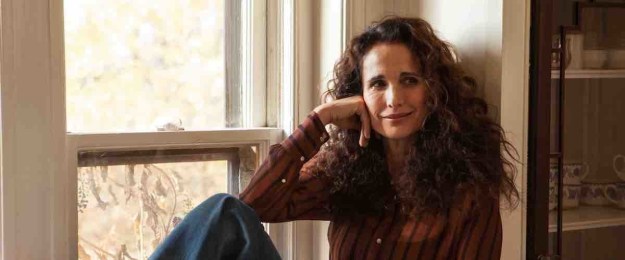
Brothers Nicholas (Chris O’Dowd) and Chris (James Adomian) are dealing with the death of their father, which was a rough one (or are they all?). Grief never exists in a vacuum. Death doesn’t wait for marriage, divorce, career, or even nervous breakdowns. It doesn’t wait to be convenient. Grief gets woven into the pastiche of life and it’s hard to watch these two mostly lovable guys flail about. But in some ways it’s even harder to watch their mother (Andie MacDowell. Andie MacDowell!) try to cope. She’s too young to be a widow and too vibrant to just curl in on herself. And too concerned about her children to not say what’s on her mind. Grief doesn’t make you a better person.

hero_Love-After-Love-2018-2

Love After Love is a bold movie that refuses to put on a brave face. There are no easy answers and no Hollywood endings. Grief changes a person, distorts a family dynamic. It can be ugly and it can be cruel, and director Russell Harbaugh savours those moments like they’re precious, and I suppose in some essential way, they are. The film feels loose and untethered; a series of family gatherings reveal their struggle to return to stasis. It’s as messy as they are, and seeing these emotions portrayed so honestly and unflinchingly is bleak of course but refreshing – I almost felt a sense of relief to not have to buy into the normal Hollywood tropes.

The cast is wonderful because they’re fearless. I have loved Chris O’Dowd since I first laid eyes on him and in the past few years he’s shown incredible range (though I tend to believe that if you can do comedy, you can do anything – not true in reverse). But I’m also super glad to see Andie MacDowell because we never get enough and she’s as underrated as they come. Together, the three of them reflect an authentic experience that can be hard to watch because it feels personal. This kind of unraveling is meant to be private, or at least that’s what the death rites in North American tell us, and it makes us uncomfortable to witness it. This film delivers some very raw performances and if you can maneuver around the emotional minefield, I think you’ll be quite pleased that you did.


Zoe

Got your fill of rom-coms? How about a sci-fi romance for a change?. Ewan McGregor plays Cole, an artificial intelligence engineer who creates a beautiful and highly realistic synthetic “woman” named Zoe (Lea Seydoux). Cole’s lab isn’t just making convincing companions, it’s also revolutionizing love. “The Machine” is a highly complex algorithm that can predict whether a relationship will ultimately work out. It has also synthesized a drug that can mimic the feeling of falling in love. But all of these things together don’t exactly mean a world full of meaningful relationships: humans will always exploit emotions. And Cole is lonelier than most.

MV5BZDZjOTUyNTctM2E0Zi00MGIwLWEyZmYtYTIzNDg2MmZiN2FmXkEyXkFqcGdeQXVyNzk3NjQ1MTc@._V1_SX1777_CR0,0,1777,999_AL_Zoe doesn’t understand that she’s synthetic at first, and it’s a little heartbreaking when Cole has to tell her. Then she questions everything. Like these unrequited feelings she has for him – was she programmed to have them? She was not. But as the two grow closer, and become a couple, she senses things are still unequal. Knowing who she is, what she is, has him holding something back.
Zoe is a movie about the complexities of love, and what happens when technology disrupts it. Men are eager to visit synthetic brothels (Christina Aguilera plays a robot hooker, for some reason) but will they ever trust synthetics to have real feelings? Of course, in a world where those feelings can be manufactured and manipulated with a pill, I wonder if they haven’t been sufficiently devalued that synthetic or not, it shouldn’t really matter anymore.

At any rate, there are some really interesting ideas here, they just aren’t executed all that well. The movie opens up this delicious Pandora’s box but then offers almost no social commentary, and its protagonist’s navel-gazing is immature and insensitive. There are no glaring problems with any of the movie’s moving parts, it’s just that they don’t add up to anything all that gripping or compelling (except for the soundtrack, which was the only notable standout). With themes of authenticity of both personhood and emotion, Zoe pales in comparison to Ex Machina and even Her, and you can’t quite forgive its shortcomings. I suppose movies are a little like robots in that, if you can’t make it better, why bother making it at all?

The Happytime Murders

It’s not a total bag of shit. But it is a mixed bag, and I suppose we must allow that there is some shit in that mix.

I have a certain admiration, and perhaps a higher tolerance, for movies that take risks and push buttons. But a movie like this is going to test even my boundaries, flimsy as they are.

It’s set in a Los Angeles where humans and puppets live together, though not exactly peacefully. The puppets are treated like second-class citizens. And despite the fact that they’re called puppets, there’s no acknowledgement that traditionally that word has referred to an object animated by a human hand up the puppet’s bum. These puppets are people, and their plight is a very interesting allegory for the African American experience. Unfortunately, the film makers keep up that thread for maybe 10 minutes before they drop it in favour of shock-factor antics.

And I get it. Who can resist making puppets do rude things? I LOVE Avenue Q, but MV5BMjEyMjg5NDMwNl5BMl5BanBnXkFtZTgwNjQ4OTMwNjM@._V1_SX1500_CR0,0,1500,999_AL_Avenue Q has a message and a point. It’s well-written and cleverly delivered. The Happytime Murders derails itself with its lewd antics, and if they get a laugh, they also take away from the plot, which is thin to begin with.
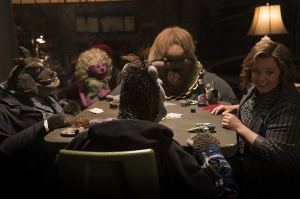
The gist: The Happytime Gang was a TV show, and now someone’s murdering its cast one by one. Detective Connie Edwards (Melissa McCarthy) and her ex-partner, puppet Phil Philips (Bill Barretta) have to overcome their history and a massive grudge to work together to save their friends.

But then: porn! So much puppet porn. And not the tasteful or vanilla, either. Puppets are in to some crazy stuff. Not to judge. But there were buckets of jizz, and puppet pubes, depraved bunnies, thirsty cows, and literal horn dogs. The murders are so much more sedate in comparison, puddles of stuffing rather than blood. It’s amazing, though, that something that sets out to be so shocking can so quickly become rather dull. One Sharon Stone-inspired puppet pussy shot is brilliant; repeating it can only reveal your lack of material.

The saddest thing, though, is the movie’s complete waste of funny ladies Melissa McCarthy and Elizabeth Banks. The script asks very little of them. McCarthy is relegated to sidekick status, and though she seems at ease among puppet costars, she doesn’t really get a chance to shine. If anyone, it’s Maya Rudolph who kind of steals the show as Philips’ long-suffering secretary, Bubbles, although it must be said that the puppetry is top-notch, and between you and I, I think I would have 100% enjoyed a documentary about the making of this movie better than the actual movie.

The Happytimes Murders is frequently disgusting, and often crude, but it’s not always bad. It’s not meant for everyone, but there was one woman in my screening who laughed like a hyena for the entire 91 minutes, so it does have its audience, it just may not be you. Or me. It goes out of its way to be ludicrous. If director Brian Henson (Jim Henson’s son) could hide in the theatre and poke you with a big puppet penis, he probably would. The movie was clearly made with glee and abandon, even if it isn’t always received that way by audiences. Personally, I just think it confuses lewd and dirty with entertaining a little too often, and for me that joke wore thin. But I won’t pretend I didn’t laugh occasionally – it was just usually the kind of laugh where you hide your own eyes in shame and hope that Grandpa isn’t watching from Heaven.


The After Party

Owen (Kyle Harvey) is known as Oh! when he’s rapping, and he’s hoping that as his high school career wraps up, his rap career will take off. For now, he’s working at his dad’s burrito shop. His best friend Jeff (Harrison Holzer) is acting as his “manager”, getting whatever amateur\talent show gigs for his bud that he can. But then something amazing happens: Wiz Khalifa turns up at one of his shows, and brings party favours. Which seems like the best thing ever until Oh! projectile-vomits on Wiz during the show, and collapses into a seizure on stage. It’s 2018 so that shit goes viral, and pretty soon Oh! is still a nobody but “Seizure Boy” becomes a laughing stock, even sparking a (very insensitive) dance craze.

MV5BNDgxMjE5Mzk0M15BMl5BanBnXkFtZTgwODQxNzYwNjM@._V1_SY1000_CR0,0,1499,1000_AL_Discouraged, Owen decides to join the Marines, and Jeff has one last night, a French Montana concert and its after party, to get Oh! in front of the right executive and secure him the deal that will save him from his broken dreams.

I have a feeling The After Party is supposed to be a fun ride but oh my god I hated it. Possibly because of Jeff, who was often in the driver’s seat. What a terrible human being. Casual narcissism and misogyny aren’t much fun to watch, especially when no one acknowledges his flaws. His $800 jeans are allowed to stand in lieu of personality. But Jeff isn’t my only beef, he’s just the beefiest.

There’s also a cheesy, contrived plot that relies on this friendship when the script makes it awfully hard to believe in. And makes it hard to root for these two knuckleheads. And I often found myself wondering who this movie is for – there are eye-rolling and probably already out-dated references to dubstep and Venmo meant to establish some youth cred, but alongside  cameos from Rakim and DMX, it feels like maybe the film makers aren’t sure which demographic they’re trying to appeal to. Frankly, when we have Donald Glover’s rapper-manager dynamic in Atlanta for comparison, The After Party just doesn’t stack up. It feels forced, superficial, and not particularly grounded in reality. Despite some recognizable rap faces, The After Party is just another annoying, uninspired, raunchy teen comedy in a  hip-hop costume. If this was on a mix tape, you’d have a free pass to fast forward through it every time. Hard skip.

You Were Never Really Here

Joe (Joaquin Phoenix) is a troubled war veteran and basically a hired gun, specializing in the finding and retrieving of missing and trafficked young girls. He lives with his elderly mother (Judith Roberts), who is the only person left in his life. And once you start seeing what’s in his head, you’ll understand why. He’s haunted by flashbacks, riddled with PTSD. It’s rough stuff, and it’s hard to keep straight. It actually appears hard for him to keep straight, and as he grapples with thoughts of suicide and questions of sanity, it seems his past might be catching up with him.

But the present’s not much better. His next job is to rescue Nina, a 13 year old girl MV5BNDQwOGQyYTMtNTc2MS00Nzg3LTgyMjctOWFmM2YzZWE3YTBlXkEyXkFqcGdeQXVyNjUwNzk3NDc@._V1_being held in a brothel. Her father works for the government and doesn’t want to get police involved. And if Joe could, you know, fuck up the men who did this to her, he’d be pleased. But walking a mile in Joe’s boots is never straight forward. He’s plagued by violent images, by death, by his own abusive childhood.

Once the killing starts, it doesn’t end, and Joe is basically a zombie, barely evading death, and barely caring. Writer-director Lynne Ramsay keeps us off kilter with static-y flashbacks. We’re as unbalanced as Joe is, and we’re unable to really trust everything we see. It’s disorienting and clever, unhinged and a little scary since we never know what we’re walking into. It’s gory, or course, likely enough blood to fill an Olympic-sized swimming pool, but we start to feel anesthetized to it because Joe barely registers it. Joaquin Phoenix really sells it. He sells a man who stopped caring about himself a long time ago. Who doesn’t trust his own reality, and isn’t particularly bothered by it. He suffers from these violent memories but nothing really jolts him from his stupor. It’s a great performance. And Ramsay somehow manages to evoke sympathy for this wounded soldier. She makes this action movie something special, something worth watching, even if the finished product is rather like a nightmare.