In this week’s episode, we discuss the best and the worst of our Toronto International Film Festival experience. The best is easy to agree on: La La Land. The bloodiest? The saddest? Those are up for debate. Join in!

In this week’s episode, we discuss the best and the worst of our Toronto International Film Festival experience. The best is easy to agree on: La La Land. The bloodiest? The saddest? Those are up for debate. Join in!
Christopher Guest has long since held an esteemed spot in my heart and my DVD shelf for his improv-heavy mockumentaries. He wrote and starred in the grandfather of them all, Spinal Tap, but came on as director as well for his classics Waiting For Guffman, Best In Show, and A Mighty Wind. He’s poked fun at small town theatre, dog shows, and folk music, and after an agonizing decade-long hiatus, he’s back with Mascots.
As you might guess, Mascots does indeed take on the little-explored world of mascotery: you know, the guys at football games dressed up in the big fuzzy suits, trying to get the spectators to cheer and do the wave. The fun is more 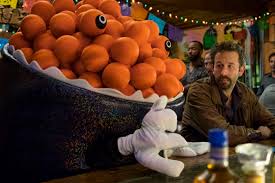 sincere than scathing, but no less amusing for its kindness. Christopher Guest’s body of work is so aligned with what I find funny that Mascots was my number 1 pick for TIFF, ahead of La La Land or Nocturnal Animals or Loving. I was delighted to be able to attend the world premiere, but somewhere in a secret place down near my toes I was worried that perhaps his latest just wouldn’t measure up. With a ten year break, would the chemistry still be there?
I needn’t have worried. Biiiiiiiig sigh of relief. It’s funny! So funny I’m in immediate need of a re-watch. The laughs from one joke often drowned out the next – and what a pleasant problem to have! Mascots is vintage Guest, and he’s got a lot of the old troupe assembled for more.
Jane Lynch, Ed Begley Jr, and Don Lake play judges at this year’s Golden Fluffy awards. They’re former mascots themselves and are pleased to judge this year’s finalists in a cut-throat competition. Chris O’Dowd is “The Fist,” hockey’s bad-boy mascot. Parker Posey is a dancing armadillo. Tom Bennett is a football club badger. Christopher Moynihan is a plush Plumber. It sounds absurd and it absolutely is, but that’s what has always worked so well in Guest’s movies: he takes a hobby that exists on the fringes and is practiced  with total obsessiveness, and he shows us the incredible underbelly. It’s fascinating. Like a car wreck or a wonky boob job, you can’t help but stare.
In the case of Mascots, Guest seems to take a particular interest in the proceedings, giving ample screen time to the “performances.” This is way more earnest than we’re used to seeing from him, but it works, largely because the actors commit with such deadpan abandon. It takes a lot of guts to make a movie the way Guest does – he doesn’t know what he’ll end up with until the camera stops rolling and he starts cutting in the editing room. He relies on a deep pool of talent – too deep, as most only get to shine for a line or two. I want more Balaban, more Willard. And definitely more Corky St. Clair, a role Guest reprises from Waiting for Guffman. If we can’t have it all, though, Guest and company still give us a pretty fair shake. I left the theatre with rosy cheeks and a bounce in my bottom.
The good news is that just two films into my Toronto International Film Festival experience, I’d already found a film to love. The even better news: you’ll love it too, and soon – it’ll be out on Netflix October 13th.
It is sometimes difficult to separate the message from the movie. I’ve already braved backlash by confessing that I didn’t care for 12 Years a Slave. This is not the same as saying I love slavery or I hate black people, but some people will choose to hear it that way. I can see with my own eyes that 12 Years A Slave does have artistic merit. Steve McQueen has a stylistic sensibility I can’t ignore, and Chiwetel Ejiofor gave a riveting performance amongst a strong cast. But the movie felt derivative to me. In a crowd of slavery movies, this one didn’t have a distinctive voice and I was bored. How does Birth of a Nation compare?
Well, it’s both better and worse. The first two-third to three-quarters of Nate Parker’s movie is a lot of the same old. We get it: slavery is bad. I actually don’t require 90 minutes of convincing on that subject. But the last chapter of the story is when it finally comes alive: the slaves rise up.  Nat Turner, a docile preacher, reaches his breaking point and leads a rebellion. A bloody rebellion. White slave owners will be slain in their beds. These scenes are so jarring that I can understand why one might think that 90 minutes worth of context are important. Those minutes establish that yes, slavery is bad. There were indeed lots of vicious slave owners who were just despicable human beings. But slavery movies often have a benevolent slave owner as well, one who is “not so bad,” I suppose so that white people don’t shout “They’re not all like that!”
As Samuel, Armie Hammer is this year’s Benedict Cumberbatch. He’s not too terrible. But his character’s arc is perhaps the most compelling of the film. As children, he and Nat are playmates. They aren’t equals, but maybe they’re friends. It is only as Samuel inherits the plantation and all of its chattel – which of course includes the human beings who work the land – that this relationship transforms. It is clear that Nat is not just his employee – there is a subservience to their interactions that is immediately repulsive. Times are tough in the south. Plantation owners are under a lot of pressure, and the slaves are of course the first ones to suffer, to work longer hours with less food. Samuel, being “one of the good ones” begins to drink, ostensibly to deal with the increasingly degrading things he must demand of his slaves. He slides from benevolent to aggressive, and it’s a great performance from the man you’re probably not watching as closely as you should. But that’s the problem with owning slaves. Once you accept that owning another human being is okay, of course it’s a slippery slope that leads directly to the rapes and whippings and deprivations we’re so used to seeing. There is no good way to own a slave.
As Samuel slides further down into the muck, Nat is rising from it, with increasingly radical ideas about his oppressors. So Nat Turner rises up. Samuel Turner gets cut down. Are we prepared to see this? Prepared to watch people be chopped up as they sleep in their homes? It’s brutal and shocking. And justified: the film has made sure of that. Of course this is a true story so you know there is no happy ending here. Nat Turner’s is a necessary voice in the story of slavery, and Nate Parker’s choice to make religion both a weapon, and salvation, are a fresh take on a crowded genre.
Nate Parker co-wrote and directed himself in The Birth of a Nation, and his passion is evident. I only wish he trusted his audience more. In the hands of a more competent director, we might have a Best Picture contender here, but instead he allows his slow build to be overplayed, turning his third act into a bit of a cocky circus act. It’s uneven. It neglects secondary characters – and with Aja Naomi King so damned good, it seems a crime not to give her more screen time.
Speaking of which. I would feel irresponsible if I didn’t bring up the skeletons in Nate Parker’s closet. The Birth of a Nation was a Big Deal at Sundance. Fox Searchlight eagerly bought it up and set an October release date, certain it would be on the path toward Oscar. But rape allegations in Parker’s past resurfaced. When he was a student at Penn State, he was accused and charged with sexually assaulting a woman along with his roommate and The Birth of a Nation co-writer, Jean Celestin. They stood trial; Parker was eventually acquitted but Celestin was found guilty before having the verdict overturned on appeal. The story gained traction when it was reported that the victim had committed suicide. Even with an acquittal to his name, an a newfound belief in god, Parker’s mea culpa press tour has been lacking. His remorse has been sparse. Gabrielle Union, the actress who plays a rape victim in The Birth of a Nation, herself a real-life survivor of sexual assault, has struggled to reconcile his past and her part in his present. Can we and should we separate the art from the artist? What kind of shadow does this cast over his film? As Union puts it, “As important and ground-breaking as this film is, I cannot take these allegations lightly.”
The Birth of A Nation is an important story and deserves to be seen and heard. I said before that I thought it was both a better and a worse film than 12 Years A Slave. What I meant was: it’s not as good a movie. It’s more formulaic, more conventional, less sophisticated, a little too obvious. But as a piece of art, it inspires conversation and controversy. I can’t discount it.
Rasmus Heisterberg is perhaps most well known to date for having written the screenplay for The Girl With The Dragon Tattoo but this Dane’s putting himself on the map as a writer-director with In The Blood (I Blodet).
In The Blood is about a defining time in a young man’s life. It’s summer in Copenhagen and Simon’s enjoying the bright nights as always – drinking and partying and waking up in a stranger’s bed, late and hung-over for class where 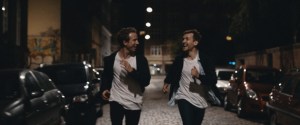 he’s a successful medical student. He’s content to have this repeat on an infinite loop, but the friends he shares an apartment with are not. They’re ready to sell up and move on – to girlfriends, babies, and different cities. Simon’s hitting the brakes hard but his friends’ growing-up momentum may just pull him over the cusp into adulthood, like it or not.
Kristoffer Bech, usually performing with his band Shiny Darkly, is well-cast in his first role. As Simon we see both his playful spirit and also a creeping melancholia as impending adulthood and responsibility cast their shadow over carefree youthful days.
In The Blood carefully studies the tipping point in an identity-seeking year of one’s 20s. There’s joy and freedom, reflected in the saturated cinematography by Niels Thastum. Copenhagen looks lush and full of life. But there’s also confusion and uncertainty in this self-seeking, and unfortunately, that’s reflected in the film making too, in overlong scenes that don’t accomplish much, and a run time that feels bloated.
This movie has a personal edge to it that veers into self-indulgence at times. Simon isn’t a very likeable character and it’s hard to hang in there as he flails about between one bad decision and another. As much as it may seem all-engrossing to the person going through it, this kind of personal growth is a little boring to watch.
Film festivals are curated by the best in the business. That said, when you’re seeing a couple of dozen films back to back to back, usually knowing very little about them, it’s inevitable that you’ll rub up against some you don’t like. I didn’t connect with this one. At all. I found it insufferable. But I still want to stand up and applaud this first-time director for getting his baby over an ocean to a world-respected film festival. That’s an accomplishment. And if this is the worst thing I see at TIFF this year, that’ll be an accomplishment too.
This review first appeared on Cinema Axis.
Damien Chazelle has bested himself, and everyone else. With just 3 feature films to his name, he has established himself as a visionary, an innovator, a pusher of boundaries, a seeker of beauty.
Sean was immediately aflame with praise. He wasn’t just finding a spot in his top ten of the year for it, but dusting off old standbys in his all-time list to make room. And let me remind you that this is a musical. Not normally Sean’s cup of tea. Sean needs one of three 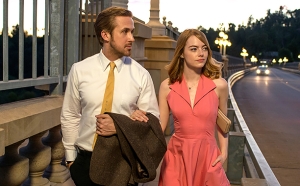 things to love a movie: sports, explosions, boobs. La La Land has none of those. It has singing and dancing and old-fashioned romance. Yet Chazelle has breathed new life into the genre, with riots of primary colour, energy so vivid you can taste it, and music that evokes deep troughs of emotion. And by ‘breathed new life’ I mean that he’s actually found a way to bring great musicals from cinema’s past into modern times. Forget made-for-Broadway musicals like Chicago or Into The Woods, their theatre sets turned into movie sets – it’s more reminiscent of Singin In The Rain. La La Land takes place in the streets of Los Angeles and Chazelle takes advantage of its sprawling landscape, and its glittering skyline.
Emma Stone and Ryan Gosling, in the two lead roles, don’t just burst randomly into song. You very quickly get to sense that they sing when ordinary words just won’t do. They play Seb, a jazz pianist, and Mia, an aspiring actress, both a little down on their luck when the meet. The song and dance make up their courtship. The pair do not meet-cute; they meet-ugly several times until it takes: toes tap, together. New love is exhilarating. You feel as though you could sing your lover’s name from the rooftop, as if you could dance on air. It just so happens that in La La Land, they do these things literally. And it’s glorious. The fluid, ethereal dance steps will remind you of Fred and Ginger. Chazelle weaves magic, and a touch of fantasy, into their story, and even though you may never have waltzed among 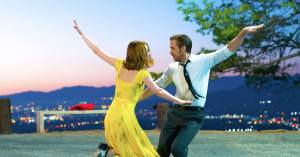 the stars in your sweetheart’s arms, you sort of know how it feels. But this great passion never lasts. It tapers off. Songs repeat. Sean felt himself longing for the exuberance of the beginning of the movie, and realized that was the point. Seb and Mia were missing it too.
If you’ve watched the gorgeous trailer, you’ll recognize the song that Ryan Gosling sings. The lyrics go: “City of stars, are you shining just for me?” But the movie reminds you that L.A. isn’t just a city of stars, it’s a city of dreams, and Seb and Mia are there to chase theirs. They haven’t come to Los Angeles to find love, but to find meaningful work. To become famous and\or successful. La La Land is about following your dreams, and it’s about the cost of following those dreams.
So Sean, whose movie reviews often consist of just three words (“It was good”) can’t shut up about this film. He’s fumbling to find the right words, but he knows he hasn’t just seen a good film, but experienced something unforgettable. I, on the other hand, have been oddly silent in the 24 hours since we saw it. Not for lack of trying, it’s just that every time I open my face to speak, more tears fall out of it. And lest you start to worry that this is some tragedy wherein Ryan Gosling ends up shot, it’s not. These aren’t just tears of sorrow, but of joy and of wonder. This movie has made me feel. It has made me feel all the feels. I can’t even make it through this review with any dignity. La La Land is why I go to the movies. It’s unselfconscious and unabashed, a cake among pies, and as soon as I’ve finished weeping, I want another slice.
If you’re as desperate as I am to keep reading (and talking! and weeping!) about this wonderful movie, please visit our discussion section – SPOILERS – be warned.
Voyage of Time: The IMAX Experience is the 45 minute version of Voyage of Time: Life’s Journey, written and directed by Terrence Fucking Malick; a 30 year labour of love.
We watched the shorter version in the IMAX theatre where Sean watched Spider-Man 2 with a girl named Tall, Stupid Rebecca. Did you guys know Sean dated other women before me? How rude. But he did, apparently, when he used to live in the fine city of Toronto (and  by the way, I also lived here at the time, and yet: Rebecca BitchFace. I’m sure she’s a lovely girl.) Where was I? Oh yes.
It takes a special brand of masochism to attempt a Terrence Malick flick as your fourth film of the day, and yet there we were, sitting in the same seats where Sean once fumbled an “accidental” boob graze of another woman’s tit. I KNOW YOUR MOVES, SEAN. Ahem. I digress.
Voyage of Time is billed as an examination of “the origins of the universe, the birth of stars and galaxies, the beginning of life on Earth and the evolution of diverse species” but that’s COMPLETE HORSESHIT. Calling it a documentary at all feels like a stretch. Or, you know, a flat out lie. But it is the movie Terrence Malick was born to make. His feature films tend to be languorous, dreamy imagery interspersed with the vaguest tendrils of plot. Voyage of Time is all the imagery and none of the plot. It’s loaded up with his signature “sun flares through a leafy tree” but these alternate between CGI renderings of what Terrence Malick thinks the beginnings of life might have looked like. Terrence Malick is many things, but: astrophysicist? Nope. He’s definitely got some scientific advisers on  board but the result isn’t science at all. It’s conceptual; more contemplative than comprehensive. No science teacher will ever show this in class – but a yoga teacher might. Getting the gist? It’s a thing of beauty, often thoughtful, but far from educational.
Brad Pitt narrates, often in such a way that you can hear the italics in his voice. It’s like he’s reciting poetry with his eyes closed (Cate Blanchett narrates the longer version, for some reason). I tried very hard not to snort because the director of photography was sitting directly behind me, and that’s a lot of pressure. I felt sometimes that I should sigh appreciatively just so that he didn’t get a complex. Or lean back for a high five every time there was a sun-dappled field or rays of sunshine peaking from between limbs of a majestic tree.
It’s obvious even from Malick’s narrative films that he has a thing for nature and philosophy and theology, for lack of a better word. The pace of the movie is soulful, at the rate of about 1 fact per 1-2 minutes of silent reflection.
Did I enjoy it? Well, fuck. It is an experience. Plus, making it to the end of any Malick movie is an accomplishment, almost equal with having climbed Everest. It’s definitely CV-able. And he did raise a question I’ll be chewing over for days to come. Most documentaries in the vicinity address life – what, where, when, why. But Terrence asked about death – when did death first appear? And you know what? Not only do I not know the answer, I didn’t even know to ask the question. We think of life and death as inseparable, but who’s to say? Life’s first ambition is to go on living, and maybe that’s exactly what it did. Until. Until what? I don’t know. Neither does Malick, but at least he’s asking, and you know he’s asking in the most magical way he knows.
Steve Aoki is a world-famous EDM DJ. Mile for mile, he’s the most-traveled musician in the world (via his private jet, natch). He started a record label when he was 19 years old and turned it into a success, breaking Bloc Party among others. He parlayed that into a DJ gig, and attracted a cultural following. His energy kept driving him forward. Now he plays  as many shows per year as there are days, or more. He’s ambitious. He never stops. He helped transform EDM into a personality-based business. On any given night there are thousands of voices chanting his name. But it’s not enough. It’s never enough.
Steve’s dad was the guy who invented Benihana. Success runs in the family. But Steve’s dad was never impressed, and never supported him financially. Steve’s dad is dead now, but Steve’s still trying to impress him.
This documentary forces Steve to sit still for maybe 6 minutes, total, in an attempt to be introspective for a damn minute. The film attempts tension and conflict, but there’s only so high-stakes you can make a dance music concert. Still, his family situation is sad and it’s clear that even as a man he’s still yearning for a validation that will never come. Can only come from himself, ultimately, but until he can sit down in earnest and look inward for it, he will be fated to repeat this pattern indefinitely.
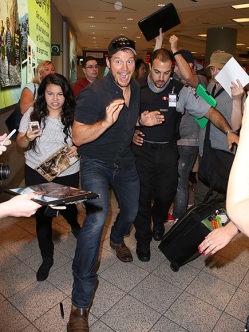
The Toronto International Film Festival kicked of last night, September 8, with the premiere of Magnificent 7. The party started the minute Chris Pratt stepped off the plane and strutted through Pearson airport. He manages to look pretty happy about being swarmed though, doesn’t he?
Actually, technically the party started the night before, at the traditional benefit gala. This year Michael Fassbender was the guest of honour, where he confessed that his super power was his ability to nap anywhere, anytime, and that his biggest challenge was learning lines (a real obstacle to taking on the Steve Jobs role, a wordy Aaron Sorkin script). Fassbender has a somewhat limp movie in theatres right now, The Light Between Oceans, but he’s also got one screening at TIFF: Trespass Against Us, where he plays Brendan Gleeson’s son who is trying to escape his crime family’s fate. Fassbender’s no stranger to TIFF, having been 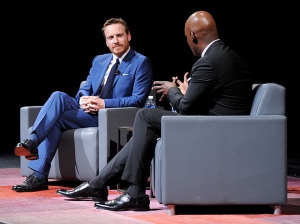 part of the 2013 People’s Choice winner, 12 Years a Slave. In fact, he mentioned that when he and director Steve McQueen first met, McQueen hated him, and called him arrogant. Was it nerves? Fassbender’s not sure, but the two went on to collaborate very successfully three times.
Michael Fassbender wasn’t the only star on hand Wednesday night: Canadian stars Pamela Anderson and Martin Short were part of the pre-show at the AMBI gala. Short was dressed in his Jiminy Glick and interviewed the Baywatch babe (who was actually looking pretty good in a stunning gown) and elicited her  top-secret beauty regime – “donuts and sex.” Honourary co-chair James Franco and his creepy little mustache were in the audience, and weirder still, so were Mike Tyson and Billy Baldwin, among others. And then, as if that wasn’t enough, Earth, Wind & Fire performed.
Thursday night was all about Magnificent 7. It’s a remake of the 1960 classic with an obvious twist: Antoine Fuqua deliberately chose a diverse cast, and then just as deliberately chose not to have race mentioned much in the movie. He cast friend and frequent collaborator Denzel Washington in the lead role; Denzel, having earned an Oscar under Fuqua’s direction in Training Day, jumped at the chance to work with him again. Fuqua, meanwhile, maintains “I just wanted to see Denzel Washington on a horse!” Don’t we all.
Magnificent Seven is meaner and edgier than its predecessors, and funnier too. Chris Pratt, as you can imagine, has a lot to do with that. He even had reporters in stitches in the press conference, declaring that the whole ‘remake’ question was moot: “Eventually you just run out of names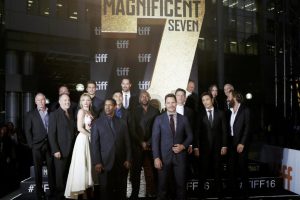 . If I have a son named Chad, is he a remake of somebody else named Chad? No! And I’m not going to give him another name like Schnarkle. This [The Magnificent Seven] has reach. It gets people engaged. But it’s probably a lot more The Wild Bunch than it is The Magnificent Seven. We used the title. We used the story. There are seven guys and we’re all fucking magnificent. But let that movie [the 1960 version] be that movie. This is a different movie.” For now we have to take his word for it, but Magnificent 7 will be out in theatres September 23rd, and you can judge for yourself. Last night, significantly more than just the 7 magnificent bastards walked the red carpet, including Peter Sarsgaard, who was easily mistaken for a homeless person. Both Chris Pratt and Ethan Hawke struck a lot of goofy poses as they were quickly ushered along the press line (they were running 30 minutes late!) but it was Denzel Washington who created the biggest crush, and he still had a smile for everyone.
Late, late on Thursday night, there was another premiere at the kickoff of TIFF’s Midnight Madness programming. The midnight movies are not always horror, but they’re scary or violent or grotesque. Last year Matt saw Hardcore Henry at Midnight Madness; this year he’ll be taking in Headshot. Some of the Midnight screenings are surprisingly commercial, with the new Blair Witch set to make its debut, and Emile Hirsch bringing his new film, The Autopsy of Jane Doe, and last night’s screening bringing out some big stars indeed: Brie Larson and Armie Hammer for the new Ben Wheatley movie, Free Fire, a genre homage to vintage action movies.
Check out the comments section for more photos, and be sure to be following along on Twitter where we’ll be posting all the action, as it happens: @AssholeMovies
So my mother gave me a film recommendation last weekend. She couldn’t remember the title, naturally, but she said it was an 1800’s western where they “say modern jokes.” Had my brother-in-law not come to the rescue I may never have guessed Seth McFarlane’s A Million Ways to Die in the West. A critical and commercial flop, I would never thought that its only thought was my mother of all people: the woman who taught us that “shut up” and “vagina” were bad words, and who to this day can barely utter “Frig” when the absolute worst has happened.
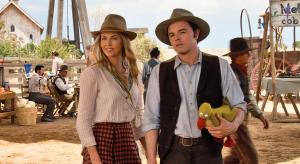 Yet just ten seconds in, someone’s shouting “Pussy!” – a term I’m sure was used very sparingly in the western novels by Louis L’amour her father always read. Then there’s the death by flatulence, and Oscar winner Charlize Theron’s fat ass, and Sarah Silverman’s sore asshole. And MY MOTHER WATCHED THIS.
The premise of the movie is “the west fucking sucks and I bet I can get a lot of mileage out of that.” In truth, you can get a little mileage out of it. Seth McFarlane, managing to only half sound like Peter Griffin, somehow attracts not just Theron but Amanda Seyfried as well, even though he’s a terrible sheep herder and looks stupid in a bolo tie. There are a few laughs along the way but the plot is useless-to-nonexistent, yet it still takes entirely too long for nothing to ever happen.
So, Mom, what was your favourite part? The daisy up the butt? The 15 year old spinsters?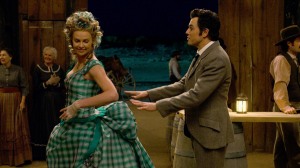 The sheep penis? No, wait. It was the pooping in hats, wasn’t it? I bet it was the diarrhea-filled cowboy hats that really got you giggling. A Million Ways to Die in the West will cost you 116 minutes of your life, but finding out your mother has a dirty, disgusting sense of humour? That’s priceless.
Captain Fantastic, the movie and the man, asks big questions, gives brutal answers, and leaves you with deep thoughts for analysis.
Captain Fantastic, played with vigour by Viggo Mortensen, is a man raising 6 kids in the woods like a pack of wild coyotes. They’re off the grid. They hunt 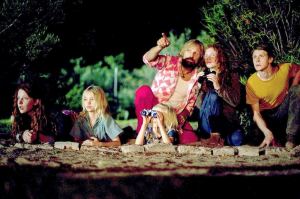 and grow food, read meaty novels by campfire light, and train their bodies strenuously, sometimes dangerously. Each kid has a unique, made-up name so they’ll be the “one and only” in the world. It sounds heavenly or lonely, depending on your perspective. Not all the kids are happy. Not all the parents are happy either, although so far I’ve only mentioned Captain Dad. Mom, as it turns out, is off in a mental health facility, and has been away from the family for several months before they learn she’s committed suicide.
Her death is the catalyst for the family returning to civilization to attend her funeral.
Viggo Mortensen is fantastic, although not always likeable. I’ve seen enough documentaries to know that raising a family off-grid, though idealistic, is not always so great for the kids. In Surf Wise, a doctor raises his kids on the beach, establishing a surf school. He turns out some great athletes, but the kids are otherwise totally unprepared for real life. Without education or even identification, it’s tough for them to rejoin the ‘real world.’ In The Wolfpack, a bunch of kids are kept pent up in a New York apartment. They develop rich inner lives and lots of art, but are totally unaware of what real life entails. In Captain Fantastic, the kids are book-smart but lacking in experience. They don’t know how to interact with the modern world, so unless all of them are prepared to continue subsistence living, and form an incestuous colony, it’s not really a sustainable lifestyle. And the kids are growing resentful.
Captain Fantastic raises a lot of interesting questions about parenting. Should a parent’s decisions always be respected? Are anti-capitalist, anti-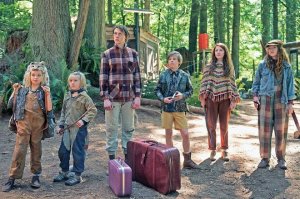 establishment values best addressed by dropping out of society? How much freedom is too much freedom for children? And what kind of risk is acceptable? And do children need to sometimes be shielded from difficult or painful concepts, or is complete honesty always the best policy?
This film is quite funny in parts, and quite serious in others. And by serious I mean I cried a small ocean’s worth of salty tears. The kid actors are mercifully good, and Mortensen is generous with them in their shared scenes. Writer-director Matt Ross delivers some pretty satisfying emotional release, and a captivating twinning of joy and sorrow. Unfortunately the script dips a bit in its final acts, letting Captain Fantastic off a little easily, but it’s already a philosophical triumph by that point, a good movie that’s actually about something.

