Category Archives: Kick-ass!

The highest honour we can bestow on a film. Anyrhing in this category is a must-see.

Booksmart

It’s the last day of school, and best friends Molly (Beanie Feldstein) and Amy (Kaitlyn Dever) are ready to bid high school goodbye. They’ve been serious students, buttoned down and focused, and their hard work has paid off: they’re off to Yale and Columbia respectively. But their pride is tamped down a little when they learn that that many of their classmates are also headed for the Ivies – this despite the fact that they rarely seemed studious, and made lots of time for parties and fun. “I’m incredible at hand-jobs but I also got a 1560 on the SATs,” says one.

Molly is particularly devastated; sure she’s the valedictorian, but did she sacrifice fun for nothing? She doesn’t want to show up at college in the fall a party virgin. Her whole worldview is sliding down a crap chute, and her instinct is to dive in after it. Luckily, they have one last night before graduation, and Amy’s departure for a summer of volunteering in Botswana. One night to make up for 4 years of skipping parties and feeling left out of the in-crowd. They set their sights on Nick’s party – the most effortlessly popular kid in school (played by Mason Gooding, son of Cuba Gooding Jr).

The ladies do not get from point A to point B without boatloads (and sometimes they are literal boatloads) of shenanigans. This is Superbad, only because it’s girls, it’s much smarter. And it seems like this one night of trying to party teaches them more about themselves than the previous four years of high school. That sounds about right, doesn’t it?

The movie gets so much right even as we learn how much the girls have gotten wrong. Molly always assumed she was purposely excluded, but it turns out these kids are all too happy to greet her socially; her exile was self-imposed. How maddening, isn’t it, to discover that too late – and a good reminder for us all to check in with ourselves. How often do we impose our own limitations? Amy tackles her fears while Molly checks her ego, and her assumptions. The two women in the lead have amazing chemistry and it’s a lot of fun to witness the particular dynamic of their friendship. You and I know that college will test the bonds of their friendship, and inevitably change it if not crush it outright. They’re starting to have inklings that this might be so. So this last night out has some tangible pressure to it. Beanie Feldstein is a cinematic lantern, lighting up every screen she’s on, and lighting the way for others. Kaitlyn Dever is an excelling pairing for her, able to play off her energy in a more conservative and subdued way, while still holding her own.

Olivia Wilde tries out the director’s chair and seems to find it a pretty comfortable fit. She’s got an eye for letting actors do their thing; so much of the best bits feel spontaneous and are the best kind of weird. She’s also got an amazing feel for music – she introduces characters and themes with pop songs, and it really took me back. I bet most of us can come up with a soundtrack of our own high school experience. Music is such an important part of that time in our lives. I still surround myself by music constantly, but I will never again spend the day on my bedroom floor inhaling lyric booklets, or spend hours recording stuff off MTV like I did then. I know which songs I kissed to, slow-danced to, had sex to. Which ones we played on repeat as we drove recklessly and restlessly around parking lots doing donuts, which ones played at the diner as we split an order of fries, which ones we cried to when boys were mean to us, which ones accompanies us down the aisle at our own graduations and commencements. Wilde seems to have an intuitive sense of that, and I caught it.

There’s a theme in Booksmart that is hinted at but never spoken of: class. As in economic and social class. Molly points out the school’s 1% (Billie Lourd and Skyler Gisondo, whom Sean finds uproariously funny), but it’s clear that the Los Angeles high school as affluent as heck. Everyone, it seems, except for Molly. Not a single thing is ever said about it, but we see that she lives in an apartment building while everyone else has a McMansion, and her parents are absent from the film. So when Molly discovers that all her other classmates also got into good schools, she berates herself for having skipped the fun when she didn’t have to. But you and I know that she probably did: that kids like Molly have to earn their way in, but kids from rich families do not. They have legacy status, they know alumni who can pull strings. Their families donate money to schools. And, as we’ve seen in the news recently, they pay money to fake their way in on a little-used athletic scholarship or some other fraudulent means. College admissions are not the meritocracy we want to believe they are. There are very valid reasons why Molly worked so hard and others did not, even if the film never states them. So maybe Molly’s takeaway was to loosen up a bit, and experience life, which are not bad lessons. But for us, it’s a little bit more than that.

Even with these subtle layers, Booksmart never stops being fun. The cast is lively and diverse, the tropes are thankfully on the unexpected side, and the movie has a great pace. Plus it has an exception friendship at its centre. Just when you think we’ve said all there is to say about high school, Boomsmart is a charming, genuine and clever addition to the field.

Rocketman

Elton John has had a life full enough to fill many biopics, but Rocketman shines its spotlight on his most troubled years, as he shot to success and earned the world’s respect and adoration but struggled to know and love himself.

Little Reggie Dwight was a brilliant but shy piano player. His parents were by times abusive and neglectful in their own unique ways, and he retreated into the safe space created by music. As a young man, the self-styled Elton (Taron Egerton) could compose music easily but the lyrics came hard. So his meeting Bernie Taupin (Jamie Bell) was a special gift from the universe – together, they wrote pop songs that would change and infect the world with catchy, raucous tunes.

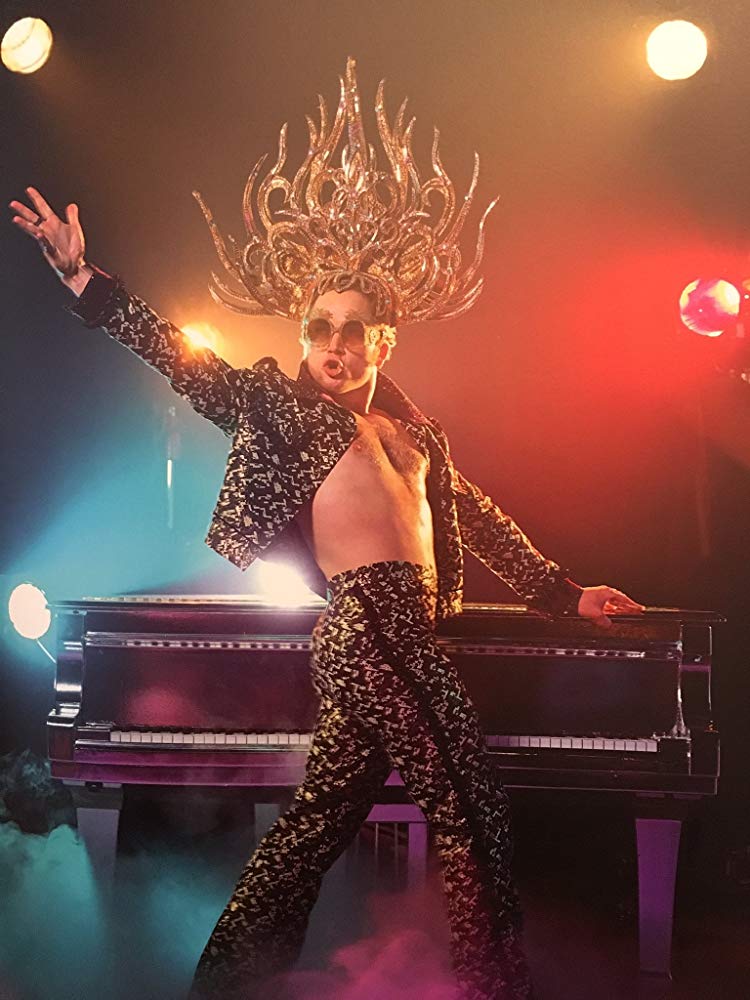
Elton developed an on-stage persona that was larger than life: in costume he could be brave, and better still, he could be merry. He could play for thousands despite being torn up inside by grief and self-doubt. He was tormented by the possibility that he would never truly be loved – this, even as he continued to seek the approval from parents who could never give it to him, and affection from a man who would use and abuse him.

Rocketman chronicles both the highs and lows of Elton’s life, whether plumbing the depths of his despair in group therapy or lifting an entire audience off its feet – this latter shown quite literally through the magic of cinema. These fantastical elements really elevate the material beyond the standard biopic and help establish a sense of the unreal. In other parts, the film’s a little draggy, and though his unhappiness is obviously a recurrent theme in his life, I wish it was a little less returned to in the film.

The monstrously successful, deeply conflicted, young, gay addict Elton is brought to life on the big screen by Taron Egerton, doing all his own singing, dancing, wallowing, and dazzling. He may not be his physical twin, but he embodies his spirit and he nails his tight-lipped grin. He manages both the bravura and the pathos, and nails them both.

Director Dexter Fletcher’s Rocketman is a bedazzled piece of inventiveness and daring. The movie truly thrills when he embraces his creative vision, translating the highest of emotions into visual delights that pair amazingly well with songs we still want to sing along to. While it’s by no means an exhaustive list of his hits, the movie folds them into itself with purpose and delight. It’s easy to get swept along by this engaging, vulnerable, triumphant story.

Snowpiercer

Thank you, Snowpiercer, for giving me a Bong Joon-ho movie that I can watch! Bong is such a talented director that it made a wimp like me try (and fail) to watch The Host. But not only is Snowpiercer his first English-language movie, it’s also accessible to jerks like me. Which is not to say it isn’t scary because intellectually, it’s nasty as hell. It’s not horror so much as dystopia, and the scariest thing of all is how soon it’s set: 2014. Well, technically the main action is taking place in 2031 or thereabouts, but basically in 2014 humans tried to repair some of the damage we’ve done to the climate and it went disastrously wrong. The earth froze over, so a very select few were chosen to fight for survival on a perpetually moving train. The train has elite passengers at the front, living in luxury, and the unwashed masses are crammed in at the back, living in filth and poverty and darkness.

Mason (Tilda Swinton), the train’s disciplinarian, doles out some very harsh punishments to those who step out of their lane. But there are serious rumblings coming from the back of the train – Curtis (Chris Evans) is the reluctant leader of a rebellion. Soon he and others (Jamie Bell, Song Kang-ho Song, Octavia Spencer, Asung Ko) will make a violent push toward the front, but as usual, the haves will never make it easy for the have-nots.

The film, based on a graphic novel, is a brilliant commentary on class warfare. But it’s not just a matter of class, or economics. It smacks of Marxism, but is tainted with Darwinism. The oblivious first class passengers see their station as right and just, pre-ordained even, and cluelessly talk about their own sacrifices. But ultimately, they are being controlled just as much as the proletariat in the back. The propaganda starts with the schoolchildren and never ends. Free will is an illusion carefully meted out by those in charge. So is hope, and that’s a pretty bitter pill to swallow.

The film’s momentum is as relentless as the rebellion. Once they start making their push toward the engine, the train itself is a revelation. Production made a 100m replica of the train, and each of the train’s cars is wilder than the last, each more breathtaking, each scattered with clues. And the view outside the train’s windows of the frozen wasteland of earth is strangely beautiful, almost mesmerizing – it’s both serene in its tranquility and violent as the train continues to punch through the continually forming ice and snow. Bong tends to shoot the action with the tail section toward the left of the screen and the engine toward the right, so you always get the sensation that things are moving. It’s a really cool way to orient the audience and keep things pressing forward.

Tilda Swinton gives one of the most compelling and bizarre performances of her career, and if you know Swinton’s body of work at all, you know what a tall, broad drink of water that statement is. Bong Joon-ho originally wrote the part of Mason with John C. Reilly in mind; at the time he was a much more peaceful character. When Swinton landed the part, Bong changed the role but left in the male gender markers. Swinton wears glasses that were once her own – when Bong visited her at her home, he found them in her children’s dress up box, and insisted she wear them. Mason has a gold glinting tooth that is often visible, especially the more unhinged she (he?) becomes. She’s based the character on Margaret Thatcher, which is the funniest thing I’ve ever heard. Thatcher died the year this came out (2013) so I doubt she ever saw/heard of this unflattering ode, which may be for the best.

Chris Evans pursued the part even though Bong Joon-ho thought he was wrong for it. Bong thought he was simply too fit for a guy who’s been living in the cramped quarters of a dirty train compartment for the past 15 years, never seeing sunlight, subsisting on protein bars made of ground up insects. Evans was clearly persuasive and he’s clearly right for the part – Bong made it work by strategically using wardrobe and camera angles to downplay his physique.

The action sequences are other-worldly. You know which scene I’m going to talk about: a door slides open to reveal a car full of men wearing black fetish masks. Only they’re not here to have safe-word sex. They’re all holding hatchets. They’re here to murder you. In a deep, cleaving way. And then the lights go out. It’s dark like a nightmare and the axe battle is on. They pass up torches from the rear and that’s the only light lighting the scene, which is expertly done. Park Chan-wook serves as a producer and you can’t help but see Oldboy flavours in this scene. It’s spooky and tense and brutal.

Though the train’s engine is meant to be one of perpetual motion, lots of stuff inside the train is actually going extinct (like cigarettes, which will be missed). Life outside the train, however, may actually be returning. In the film’s final shot, the survivors’ sense of hope is buoyed by the sight of a polar bear, a sure sign that life on earth will continue. I think the choice of a polar bear is significant: our news feeds have been inundated with the sight of starved polar bears, of polar bears literally drowning because the ice is melting and swims between ice floes have become too long to sustain. Polar bears are a vulnerable, at-risk species. Snowpiercer’s healthy, satiated polar bear indicates that what they really need to thrive is the loss of their greatest threat: humanity.

Aladdin (2019)

Maybe it’s just time we admit that no remake, perhaps especially a live-action remake, will live up to the extremely high bar set by the animated films of our youth. Not only were these movies straight out of Disney’s renaissance, they are coated in the glittery gold of nostalgia, elevated by the place they had in our lives at the time, rendered flawless and important in our cherished memories. It’s an impossible standard, is what I’m saying. That said, Aladdin is probably among the better ones.

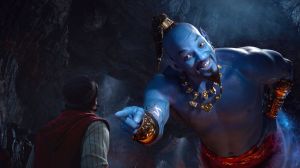
As you know, Aladdin isn’t really about Aladdin. Oh sure, it’s ostensibly about a boy wooing and trying to be worthy of a princess. And about a greedy man who’ll stop at nothing to gain power. But really it’s about a genie trapped in a lamp, longing to be free. Robin Williams 110% stole the first movie. His ad-libbed sessions in the recording studio had Disney re-writing the script to accommodate all of his beautiful material. These were agl0580.pcomp_publicity.v02.1039_grd004.000000.0immense blue shoes to fill, so in a way, I admire the impulse to steer the ship in a different direction, as Will Smith IS a different direction – though not as different as I’d imagined. He makes the character his own, for better or worse, but the fact that this film is such a close remake means inevitably you’ll be comparing movies and this one will be coming up short. It can’t quite recapture the magic, especially when we know every word and anticipate every action. And Will Smith’s Genie is a dull cousin of Williams’. This is not entirely Smith’s fault – who among us could compete with the limitless freedom of a cartoon? Animated Genie is just that – animated. At all freaking times. Will Smith can’t even touch the manic energy of the original, and frankly, his songs leave a little to be desired. I’d heard that his remake of Friend Like Me would be largely hip-hop inspired, but I heard wrong. But it may have been the wiser choice; if you’re going to fail by comparison, then do something to distinguish yourself. The 2019 version is fairly faithful to the original – it has all the basics but none of the colour.

Well, I don’t meant that literally. In fact, that’s one of the things I liked best about the movie: the absolute riot of colour. Jewel tones abound! The colours of spice fill up the screen, sometimes metaphorically but sometimes quite literally. Jasmine’s costumes are the stuff little girls’ dreams are made of. In animation, it’s too expensive to have different outfits for characters, so they mostly wear just on the one thing, a cartoon uniform if you will. And Jasmine’s is no joke. But in the live-action remake, costumers have given themselves permission to create a wardrobe befitting a princess. It’s a feast for the eyes.

I mentioned before that the 2019 film is fairly faithful to the original and that’s true – but there are a few exceptions, and I’m glad that Jasmine is one of them. In the 1992 feature, Jasmine is a passive character. Yes, she’s 15, but she’s very much a damsel in distress. That’s not quite the character the writers meant to portray, but several scenes in which she was to exercise her voice were cut because they were simply too expensive to animate. That decision saved production budget but cost Jasmine something in character. In 2019, she’s a fuller version of herself. Of course, that’s partially because you’ll find her singing a song you don’t recognize (called Speechless – it’s Disney’s bid at an Oscar this year, as only original, written-for-this-movie songs qualify).

Speaking of which: Jasmine and Aladdin. I hereby give you permission to get your Aladdin thirst on. I mean, maybe you’ve always had a certain lustful feeling toward the MV5BZTc3NTA1YmEtZTkyNy00ZDMyLWJkMmItODFkYjU0MTc2N2I0XkEyXkFqcGdeQXVyNDQxNjcxNQ@@._V1_SY1000_CR0,0,1233,1000_AL_street rat with the not little nipple-less bod. Now he’s played by the very attractive Mena Massoud, who conveys all of his boyishness and charm. Jasmine, meanwhile, is portrayed by  the lovely Naomi Scott. Since cartoon Jasmine is 80% doe eyes, you might think she’d be difficult to replace. In fact, Scott is everything you could ever want in a Jasmine, now with 50% more agency. And unlike Will Smith’s renditions, everything Scott and Massoud sing sounds like the soundtrack of your childhood. You’ll find it difficult not to sing along. Why resist, really? Someone has to be the crazy lady in each and every movie theatre, and it may as well be you.

Director Guy Ritchie brings an energy to the film that’s quite unexpected. I mean, he’s made a career putting hustlers on the big screen, and who is Aladdin if not that? And those were Sean’s favourite scenes: Aladdin deftly avoiding arrest in the streets of Agrabah, streets he knows well, like the back of his hand. He  navigates those in the slight elevation above reality – quick, slick, agile. My favourite scenes, however, were the colourful spectacles I didn’t know Ritchie was capable of. Will Smith’s Genie introduces Prince Ali to Agrabah with fanfare that’s nothing short of visually stunning. It’s choreographed to within an inch of its life, with a rainbow of costumes and a riot of feathers and dancing girls and exotic animals.

Aladdin is a lot of fun if you let it be. It is not the Aladdin of your childhood, but there’s enough room for both of them. Now go be the crazy lady in your local cinema.


Support The Girls

Lisa (Regina Hall) is the hard-working manager of a tittie bar. She’s a little defensive about it; you might hear her call it a family sports bar “with curves,” but the uniforms leave little room for debate.

On this one day in particular, Lisa is dealing with a thief stuck in the vents after a robbery goes wrong, an undocumented worker in her kitchen, TVs that aren’t working minutes before a big game, an employee who’s dating a customer, a revolt over a missing pool table, and a half dozen new girls who show up for interviews and training. Plus there’s the impromptu car wash she’s organizing to raise money for another employee dealing with a DUI, which she has to hide from her boss, who’s an asshole. Oh, and her marriage is falling apart.

MV5BN2QwNTNiNzUtMDE2MS00ZWVhLWIyOTMtNzgwMTVjZjYyYzRlXkEyXkFqcGdeQXVyMzEzMjg5NjA@._V1_Despite the fact that she’s undervalued and underpaid, Lisa clearly cares about her job, and about doing her best. And she definitely cares about her girls. Usually when your employer starts calling you ‘family’ it’s because they’re about to ask you to do something for nothing. But when Lisa says it, she means it. She’s got misplaced optimism coming out the wazoo but on a day like this, even Lisa’s perky sunshine demeanor will be tried.

Support The Girls is a workplace comedy, but it tackles bigger themes than that. You just might not notice because writer-director Andrew Bujalski has such an impressively light touch. He manages to keep everything witty and bright. His biggest asset is of course Regina Hall, who never stops shining her light. Lisa is doing her best to sell the American Dream, even though it’s not her dream and she’ll never see the profits. Bujalski clearly has compassion for Lisa though Lisa never asks for any. Hall makes sure that her unending kindness is seen as strength, not weakness. These are perhaps tough to pull off amid a cacophony of T&A, but that’s why you buy them. Because integrity is not what you expect to find at your local Hooters, but that doesn’t mean it isn’t there. The smartest thing Bujalski does is that he never, ever underestimates the women in his film.

See You Yesterday

CJ (Eden Duncan-Smith) and Sebastian (Dante Chrichlow) are the smartest kids in their Bronx high school, and they’ve got the perfect experiment to win a pair of scholarships to M.I.T.: a time machine.

Any time travel movie that makes a bold reference to Back To The Future is all right in my book, but this one’s got an even twistier twist. It’s a time travel movie with a social conscience.

CJ’s brother Calvin (Astro) is one of the dozens of unarmed young black men who get murdered by the police every year. If you were a teenage girl with both a dead brother and the ability to move through time and space, wouldn’t you go back to save him?

But like their high school teacher tries to warn them, time travel has moral and ethical MV5BMmU4ZDYxZTUtMmI0My00MGVmLWE2NGYtZDQ2NmE5ZjQ0ZWE0XkEyXkFqcGdeQXVyMDM2NDM2MQ@@._V1_SY1000_SX1500_AL_implications that are not just beyond their understanding, but beyond ours. Even the tiniest unintentional change can have unpredictable consequences.

Despite its science fiction premise, See You Yesterday feels very grounded thanks to its social relevance, its community in mourning, and the anger that simmers just below the surface. I really enjoyed this genre mashup, the in-your-faceness of reality interfacing with the fantasy. The world feels believable too – sure there are a surprising number of nawt nerds in one high school, but CJ and Sebastian are experimenting in grandpa’s garage, with grandma’s cheese and cracker snacks. The cast is uniformly strong, but Duncan-Smith is the inevitable stand-out.

It’s the grieving, though, that makes this film exceptional. I had no idea what I was in for when I put this movie on. I didn’t expect to be moved. I didn’t expect such powerful imagery. Plenty of sci-fi has a social agenda, but most have to be set in the dystopian future to make their point. This one is set today. Without ever saying it, the message is clear: if you’re poor, if you’re a minority, today IS your dystopia. But director Stefon Bristol leaves us with a shard of hope: the future is female. The future is black. The future may be a young kid working away in the garage next door. Please don’t shoot her.

The Lion King (1994)

Disney is releasing a whole slew of “live action” remakes of its most beloved classics, so Sean and I are taking a stroll through the Disney vault to revisit movies we haven’t seen since childhood. So far, the only one of these that I’ve genuinely enjoyed is Cinderella; the others – like Beauty & The Beast, Mary Poppins, and Dumbo – have missed the mark, and I downright disliked The Jungle Book. And unfortunately, I’ve tended to assume that I’ll feel the same about The Lion King, mostly because I don’t approve of calling this “live action” when it’s clearly also animated, just animated in a more realistic, CGI-style. But it’s still just computers. In real life, lions don’t sing and dance and cuddle up to warthogs in a strictly platonic, non-hungry way. BUT it does have an AMAZING voice cast that I admit intrigues me. More on that later.

The Lion King (1994) doesn’t need improving upon. It’s quite a lovely film. The animation holds up. The songs are part of our cultural lexicon. We all know the story: Simba is a young lion prince who will won day rule the pride lands when his father Mufasa passes. But Mufasa’s death is hastened by evil uncle Scar, who wants the seat of power for himself. Scar murders his brother and exiles his nephew. He giphyallows his pals the hyenas to share hunting grounds with the lion tribe, which totally fucks with the circle of life, and pretty soon they’re all starving. Meanwhile, Simba has grown up with a sweet gay couple, Timon and Pumbaa, who adopt him despite their initial misgivings about him being a meat eater and all. Their worry-free existence is pretty sweet until Simba’s past shows up to shame him into returning. And once he knows how bad things are, he can’t help but engage. He returns, but he’ll have to face his uncle Scar if he wants to take his rightful place as King.
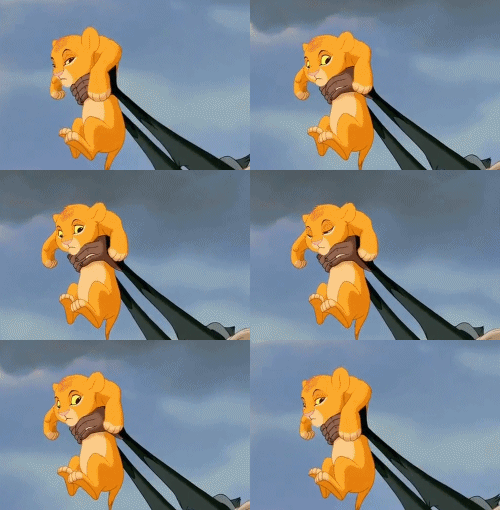
As a kid I didn’t pick up on the Shakespearean undertones of this film because I was just a dumb, Sesame Street watching baby. It’s definitely Hamlet-adjacent. But as an adult, I have so many more experiences that are informing my viewing.

Like any good Canadian who often escapes the winter by going down south, I first saw The Lion King musical experience at an all-inclusive resort where they pirate 1Vzuthe heck out of anything they can and squeeze it until the lawsuits come. The first time I saw it, it was an excellent production (I think I was in Mexico). It made me want to see the real Broadway version, so when it came to my city, I saw it with my in-laws, and it was even better than I’d imagined. Then I saw several low-rent versions at less ambitious resorts – my favourite at a Cuban hotel where my friends got married and their young daughter was cast as the baby Simba.
Hakuna Matata (such a wonderful phrase!) was a full-on craze in the 90s. People cross-stitched it onto pillows. Nothing trendier than that! It means “no worries for the rest of your days” and was lampooned by Matt Stone and Trey Parker in The Book of Mormon. In that Broadway musical, which Sean and I were lucky enough to see with its original cast, Josh Gad and Andrew Rannells), the phrase they pick up is Hasa Diga Eebowai. It inspires its own musical number which is every bit as perky and upbeat as Hakuna Matata – only imagine the little Mormons’ consternation when they find out it means Fuck You, God. Oops.

Last month Sean and I took the niece and nephews to see Disney on Ice, and they  had quite the generous Lion King portion, no doubt to generate interest for a movie hitting theatres later this year. But the original film is also celebrating its 25th anniversary, and sure, you could figure that out with simple math, but we found it out at Disney World, where they’d outfitted Animal Kingdom with photo ops celebrating it. We also frolicked at the animation hotel, where an entire branch of the resort is dedicated to the film, its rooms are movie-inspired and the grounds are full of scenes from the movie. I turned to Sean and said: “Hey, remember when YOU played in an elephant graveyard?” and I kid you not, he responded “At the hotel?” Now, like most (all) men, Sean is an idiot. But he’s also the King of Stupid Questions. Now let me ask you, perfect stranger: how many times do you think Sean has played in an elephant graveyard? We’re CANADIAN. I think the fact that he’s done it once is remarkable. Why, then, the clarifying question, as if he’s done it so many times he’s not even sure to which one I’m referring. Hasa Diga Sean.

When Scar undertakes to kill his brother, he orchestrates the murder so that it looks like an accident. He plants Simba in a gorge and then sparks a wildebeest stampede. It’s a frantic, pulse-pounding scene that took 3 years and the invention of new software to animate the thing. Musafa of course saves his son, but Scar pushes him to his death. In the aftermath, little Simba finds his father’s body and curls up next to it, wrapping his father’s dead paws around him. It’s a very tender scene of course, but it reminds me of my nephew and something he once said. This kid loves his family and insists he’ll never marry and never move out – he simply can’t imagine a time when he won’t be vitally attached to his parents. He’s even insisted that when he dies, he wants to be buried in his father’s arms. These are soul-destroying words to his sensitive aunt’s heart. I wept over it then, and I wept over it again when Simba all but reenacts the scene.

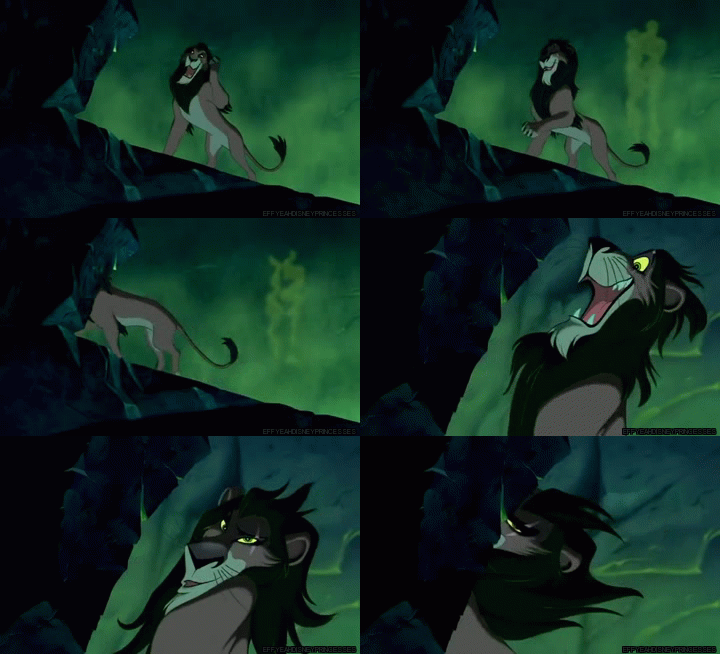
So there’s no doubt, really, that Scar must be among Disney’s very worst villains. But there’s a secret (or not so secret) side to Scar that I never considered as a kid. The LGBTQ community has adopted him as a coded-gay character. Of course it’s problematic as hell because he’s a reprehensible guy, but when you were gay in the giphy (1)90s, you didn’t exactly have a lot of choice. Scar IS slightly effeminate, I suppose. And he’s camp. He’s snide. He slinks around. He has a goatee! He’s scrupulously correct and he’s British for christ’s sake. Is he a mean old Queen? Possibly. He’s definitely the bachelor uncle who, while inheriting his brother’s kingdom, has absolutely no interest in the pride’s lionesses. He spends his time with a singing parrot. So when people saw the trailer for the “live action” Lion King, fans of Scar were dismayed. In the cartoon he comes off as very vain and very feline, but in the trailer for the new one, he just looks emaciated. Anyway. I think we can do better than Scar for gay icons, but so far Disney really hasn’t. There’s a void there, and a gaunt, bedraggled Scar isn’t going to fill it.
Anyway. Jon Favreau’s The Lion King will hit theatres in July, with James Earl Jones providing continuity as the voice of Mufasa but Jeremy Irons has been replaced as Scar – and so has everyone else.

Simba: Donald Glover

Nala: Beyonce

Scar: Chiwetel Ejiofor

Pumbaa: Seth Rogen

Timon: Billy Eichner

Zazu: John Oliver

So it’s not The Lion King of your childhood. But might it still be good?

John & Yoko: Above Us Only Sky

John Lennon died before I was born, but that hardly means he’s failed to have an impact on my life. He casts such a long cultural shadow, his musical catalogue has such depth, and his ideas and philosophies linger still, in even the simplest line drawing of his face.

John & Yoko: Above Us Only Sky focuses on the 1971 recording of his album, Imagine, at Tittenhurst park, where he and his family had retreated from his swollen, frantic lifestyle as the world’s most recognizable pop star. Imagine stands apart from the work he did with The Beatles, and is in fact very much a collaboration with his wife, Yoko, and the ideas she tested out in her written work – especially 1964’s Grapefruit.

MV5BMzM1OTRhNzctOTRkNC00YjU4LTg1ZTYtOGVhMzZiMDA3Yzk2XkEyXkFqcGdeQXVyNDYxOTY1Njg@._V1_SY1000_CR0,0,827,1000_AL_The documentary is replete with never before seen footage and home video. It shows John and Yoko in repose, at play, at work, the midst of inspiration. Lots of session musicians and music journalists are interviewed – director Michael Epstein has literally sought out every and any person who was in or around the Tittenhurst recording studio at that time, including Yoko Ono herself, and son Julian.

Imagine surpasses musical status and has become a cultural touchstone. John & Yoko brings the album back to earth, back to its humble beginnings as bits and pieces inside John’s head. We see the songs mature from ideas to sometimes orchestral pieces, the musicians alive with an excited motivation they’ve probably never reproduced. Still, my favourite moments of this documentary are the domestic ones. It’s thinking about little Julian, who gets to crawl around a legendary recording studio but is bored out of his gourd listening to the same song over and over again. To him it’s just dad’s work. I also really loved watching John record a dis track against Paul – with George! Of course we didn’t know to call them dis tracks yet in 1971, but that’s exactly what it was, and it’s a delicious part of history, and John himself addresses the tension between himself and fellow Beatle Paul McCartney. They were brothers to the end, I think, often fighting because they were simply too close.

This documentary has lots of juicy little moments, literally something for every fan. But it’s also a tribute not just to John and Yoko’s love story, but to their partnership, their meeting of the minds. Because it’s clear that John is not just infatuated – he admires and respects her. She clearly influences his thinking, solidifies his philosophies. They’re changing each other at a cellular level and you can almost see it happening. John & Yoko is definitely worth a watch as it breathes new life into an album that’s hard to picture the world without.

Wine Country

Six women, all former pizza waitresses, super longtime friends, head to wine country to celebrate a birthday: Rebecca is turning 50.

Rebecca (Rachel Dratch) is not so into this 50 thing. She’s a therapist who’s got great “feedback” for everyone else but has neglected the problems in her marriage.

Catherine (Ana Gasteyer) is a successful workaholic who’s having trouble disconnecting…and connecting, for that matter.

Naomi (Maya Rudolph) is a stressed-out mom of 4 who needs this time away so badly she’s bringing a weird intensity to the trip.

Val (Paula Pell) has a brand new set of knees and is hoping to find a new girlfriend to match.

Jenny (Emily Spivey) rarely leaves her house and has a super tepid reaction to literally everything.

Abby (Amy Poehler) has over-scheduled them all to within an inch of their lives. They’re having fun! (it’s on the itinerary in 20 minute increments).

These women are clearly tremendous friends, but their friendship is also so storied and MV5BMTJiMDEyYmMtNzVlOS00NTRhLTllNjEtNjdmZGRjYTQwODI2XkEyXkFqcGdeQXVyNjg2NjQwMDQ@._V1_SY1000_SX1500_AL_complicated. And a tarot reading only brings up their internal conflicts – then they add all the wine! Oooh, shit’s about to become unglued.

Amy Poehler directs for the first time, and assembles her own Avengers (mostly SNL veterans) and she brings such an amazing energy to the thing. Instead of non-stop laughs, Poehler trusts that we’re in the right company, and enjoying our time with the ladies will be enough. She’s right. It’s like being among your own friends. They randomly burst into pieces of song. They openly roll eyes at over-eager sommeliers. And they’re mostly just supportive of each other, sometimes in abrasive ways that only comes with true intimacy, but it’s nice that it’s so assured. It feels right.

I’ve been to Napa for a birthday too, with my 2 favourite assholes, Matt and Sean. And it seems like we did a lot of the same things: wine tunnels and short buses and organic wineries. These ladies probably went  home with the exact same high-end olive oil as souvenirs. So there’s room in this script for you to project your own shit, which I always think is nice.


Aladdin (1992)

Of course I watched Aladdin when I was little. Disney’s renaissance era was such a great time to be kid: The Little Mermaid, Beauty & The Beast, Aladdin, The Lion King. Instant classics, all. I remember my aunt giving my little sister Jana a pair of Princess Jasmine pajamas – gauzy and midriff-bearing. They were an instant source of jealousy (we were four little girls, but Jana was the smallest and the blondest and the default cutest, and I suppose the rest of us felt that our chubby little bellies were not deemed worthy).

MV5BMTYwODYyMzY5OV5BMl5BanBnXkFtZTgwMzg4MjY5NzE@._V1_SY1000_CR0,0,1710,1000_AL_But I hadn’t watched Aladdin since I was young, on VHS, naturally. On DVD I’ve fallen in love all over again with the movie. Gosh it’s crisp, the animation looks beautiful. I find that I still know every word to every song (it probably helps that I have the soundtrack on vinyl).

It’s a sad story if you stop to think about it: Aladdin is a homeless youth who is so hungry he resorts to stealing even though the punishment is having your hand chopped off. Jasmine, the resident princess, has never been hungry a day in her life, but is far more eager to escape her life of confinement in the castle and the pressure to marry a prince before her next birthday (at which time she turns all of 16). The two meet in the market where they also get in some trouble. Jafar, the nefarious vizier to the sultan, tells Jasmine that Aladdin has been executed (to death!), but actually he’s going to use him to break into the Cave of Wonders and steal the magic lamp.

As you know, Aladdin does get his hands on the lamp, and imagine his surprise when out pops a big blue genie (voiced by Robin Williams). Genie turns Aladdin into a prince so he can court and marry Jasmine, but there’s a lesson in there about being your true self, and the lesson must be taught.

Anyway, Robin Williams recorded his part while on breaks from Hook and Toys. He’d call up Steven Spielberg, who was filming Schindler’s List at the time, and make him and the cast and crew have a much-needed laugh. So much of the movie was ad-libbed by Williams, it no longer qualified for best adapted screenplay at the Oscars. Not that anyone complained: animators literally added whole scenes just because Williams said something too brilliant not to use.

Robin Williams was reluctant to even do the movie. He wanted to try his hand at voicing an animated character but he balked at the whole Disney merchandising machine. Eventually he agreed to do the film for scale (!) on the condition that his voice not be used for merchandising, and that the Genie not take up more than 25% of space on posters, billboards, and trailers. The idiots at Disney did not abide his rules so Williams was actually mad at them for years. Michael Eisner even tried to apologize to him with a Picasso, but Williams turned it down. Only when Jeffrey Katzenberg was fired and replaced by Joe Roth did things thaw: Roth apologized publicly.

If Jasmine and Aladdin look familiar to you, you’re not wrong: Jasmine was modeledMV5BMTgzNDI3ODUyMV5BMl5BanBnXkFtZTgwNDg4MjY5NzE@._V1_SY1000_CR0,0,1416,1000_AL_ after Jennifer Connelly, and Aladdin after Tom Cruise, which has to make you wonder – does Tom Cruise not have nipples either? I met Princess Jasmine recently. I was having dinner at Cinderella’s castle (at Disney World), and quite a few princesses drop by to say hello. She asked me if Sean was my diamond in the rough and I must have scrunched up my nose quite skeptically because she amended it to “Diamond in the scruff?” – in fact, Sean has a no-razors-on-vacation policy, so I let that one stand even though it wasn’t the rough I objected to.

Anyway, we gave this one a re-watch because Guy Ritchie is doing a live-action remake hitting theatres later this month (May 24). Although I was disappointed by both Mary Poppins Returns and Dumbo (both of which I’d hoped would be good but weren’t quite) already this year, I’m going to go ahead and reserve some moderately-sized hope for this one. They can’t all be bad, right?