Category Archives: Kick-ass!

The highest honour we can bestow on a film. Anyrhing in this category is a must-see.

SXSW: Unrest

Myalgic encephalomyelitis (ME), commonly referred to as chronic fatigue syndrome (CFS). It’s a debilitating chronic disease as often misunderstood as it is misdiagnosed. People like to call it “the lazy disease” or “the I don’t want to go to work” disease. Doctors often diagnose a mental disorder rather than the autoimmune disease it actually is, telling patients “it’s all in their heads.” But to the 1-2.4 million people who suffer with it in the United States alone, it’s a disease that leaves you drained, sensitive to light and noise and possibly much else, perhaps unable to stand and walk. Permanently housebound and bedridden, they feel they’ve gone missing from their lives – it passes them by while they lie in bed, sometimes with cognitive impairments that make them feel like they’re not truly living.

Director Jennifer Brea is one such person. She was a happy newlywed when suddenly she just got hit with a disease she didn’t even know about. Robbed of the things she once loved doing, this film documents her daily struggles, the constant tug of war that must be waged against her body. She also reaches out to people around the world suffering the same thing, and together they try every supposed miracle cure on the market. When none work exactly as they hope, they stage a protest most are unable to attend. It’s really sad to see such vibrant people struck down by such sweeping disability. It is no wonder that despite serious medical symptoms, one of the most common causes of death for ME sufferers is suicide.

I am moved personally by this film because as you may know, I too have an autoimmune disorder. There are tonnes of autoimmune disorders and all but a handful are practically unknown, even to doctors. I admit to a small bit of jealousy when Brea complains about ME being the least-funded of the major diseases because my disease doesn’t even rate – we call it an “orphan disease”  – nobody’s even trying to cure it. There is no funding. There is no ribbon. There is no textbook. I’ve visited approximately 100 doctors and I’ve had to educate all but 2. The lives this disease ruins are too few for anyone to care. So in that way I understand perfectly what she’s going through; you have a terrible disease and you have no hope of cure. You have no hope, period. And on top of having no hope for yourself, you also have this huge burden of guilt because like her, I’ve dragged someone else into the equation. And while Sean is not sick, his life is also disabled by my disease. If I’m too riddled with pain to leave the house, he stays home with me. He cares with me. He deals with my terrible moods when I’m in pain, and my pushing him away when I’m in despair. He has brought me around the world to different doctors, and he feels the same low when I leave another appointment hopeless. In order to live our lives, I push myself out of bed and out of the house too often, and we both know I’ll pay the price. I’ve cried in anguish in Paris, outside the Centre Pompidou. I’ve bled across the Miami boardwalk. Even right now, in Austin, Texas for the South By SouthWest Conference and Festival, my suitcase is bursting with pills, gauze, and needles (that Sean has had to learn to inject me with) just to get me through, and I’ve limped along in secret pain, unable to even bring one of my most depended-upon medications with me because it’s illegal in this country.

So you’ll understand why I think a film like Unrest is so important. It sheds light in a dark corner of the medical community. It’s important to remember the real people who live their lives in this dark corner. They have voices. They have families who love them. They have friends who miss them. And if we cannot contribute to the cure, we can become allies. We can be witnesses and sympathizers and believers, so that nobody needs to hear from a doctor that “it’s all in your head.”

It’s screening at SXSW March 14 at the Vimeo Theatre and March 16 at Alamo Lamar, which serves great pretzels.

Rules Don’t Apply

I feel like I heard about this movie such a long time ago – Warren Beatty’s Howard Hughes biopic. Beatty’s return to acting in, what?, 15 years? His first directorial effort since Bulworth, which was 1998 if my memory of the great soundtrack song serves.

Lily Collins plays Marla, the Apple Blossom Queen, who is under contract with Howard Hughes, an elusive man she has yet to meet despite the fact that she’s been living and rulesdontapply-collins-ehrenreich-car-700x300earning a stipend in Los Angeles for several weeks. Her devout mother (Annette Bening) has already returned home in frustration, so now it’s just Marla and Frank (Alden Ehrenreich), her devoted, reliable driver, who hasn’t met Hughes yet either. His only job, besides driving her around, is not to fall in love with her. That’s kind of tricky even though he’s practically married and she’s a prim virgin. But when a man tells you your beauty and uniqueness means “rules don’t apply to you” – well, crap, it’s the kind of think that dampens the panties.

When Howard Hughes (Beatty) finally does make an appearance in their lives, he’s a larger than life figure of course, and on the bring of insanity (though close enough to the one side that he’s paranoid as heck about seeming crazy). He’s obsessively keeping out of rules_dont_apply_h_2016the public eye while skulking about in the dark. He doesn’t have as much use for these two young protagonists as they have for him, but it makes for an interesting dynamic.

The movie is only funny, or romantic, in fits and starts. Tonally it seems to be a little wayward. I found it interesting nonetheless. Beatty has chosen to show only a small window of Hughes’ life, not his best years by any stretch. He also relegates him to a supporting character in the film, with Frank and Marla providing life and context to Hughes’ sad descent. Perhaps more than a biography of Howard Hughes’ life, this is a tribute to the earliest days of Beatty’s career, when he was a young, ambitious actor just getting his footing in L.A. And with a supporting cast including Matthew Broderick, Martin Sheen, Alec Baldwin, Candice Bergen, Ed Harris, Steve Coogan, Oliver Platt and Paul Sorvino, there’s just too much talent to ignore. Beatty is good; Collins is even better.


Michael Bolton’s Big, Sexy Valentine’s Day Special

Peak 1990s Michael Bolton was a cheesy, long haired dude who belonged in my mother’s cheesy CD collection, not mine. He was “adult contemporary” in the worst way imaginable. But then he cut off his mane and hooked up with Lonely Planet. The result?

Wait a minute: Michael Bolton has a sense of humour about himself? Indeed he does. And if you thought the above three minutes were worth a hoot, then you should definitely check out his Valentine’s special on Netflix because it’s a whole hour worth of laughs. If you’re anything like me and can’t handle sappy movies without copious eye rolls and squirms, and you think the softcore porn of Fifty Shades of Whatever is just plain undignified, finally we’ve got something you and your hunny can curl up to.  Laughter makes couples stronger – trust me, it’s science.

But you certainly don’t need to be a couple to enjoy this as its basic function is to poke fun michaelboltonsbigsexyvalentinesdayspecial_2at the whole romantic notion anyway. The premise, which is a generous way to describe it, is this: Santa needs an extra 75k babies to deliver presents to by next Christmas, so Michael Bolton agrees to host a sexy telethon to inspire love\baby making. Answering the phones of this telethon include seldom-thought of celebrities such as Brooke Shields, Sinbad, and Janeane Garofalo. But that’s hardly the limit as far as celebrity cameos go. Bolton is helped by the likes of Michael Sheen, Maya Rudolph, and very briefly, his best friend Adam Scott. Plus about 2 dozen more.

Bottom line, it’s stupid. It’s quite stupid. It was the kind of stupid I enjoyed because it’s skeweringly silly, raunchy, sparkling with tongue-in-cheek homages. It’s quite reminiscent of the Bill Murray Christmas special, A Very Murray Christmas. And the truth is, Michael Bolton still sounds good. So on the rare occasion when he actually does sing, it’s perfectly pleasing. But it’s never, ever with a straight face. And that’s what makes it stupidly glorious.


[It also begs the question: what’s next? Murray got Christmas, Bolton got Valentine’s…who would you like to see tackle a holiday?]

Divines

Shit. This is not some easy-breezy coming of age story, I’ll tell you that much for free. You’d be forgiven for assuming as much when the camera originally picks up with two teenaged girls who goof off in class and daydream about making big money, but that’s just the first sign that you should buckle the fuck up.

Dounia (Oulaya Amamra) and Maiimouna (Deborah Lukumuena) are from the shanty side of Paris, where they’re expected to train as receptionists at school. The teacher is as clueless as divines-movie-download-english-subtitlesthe class is hopeless, and you can’t quite bring yourself to blame these girls for dropping out. But then Dounia meets two people who might potentially change her life:  Djigui, an untrained but talented dancer, who makes her think a different kind of life is possible, and Rebecca, a glamorous young drug dealer\sex worker who makes that different kind of life accessible.

Dounia is nothing if not an upstarter. With boundless energy and roiling teenaged cynicism, she and her friend put themselves in situations they’re too stupid to realize are crazy dangerous. They’re both too mature and too naive, eager to make their mark but easily manipulated. The camera’s gaze is unflinching, even if ours is not. No matter how big and bad the girls pretend to be, their youth and inexperience betray them.

Writer-director Houda Benyamina gives a  gritty but sympathetic look at the less polished side of Paris, where money, race, and power are unapologetically at the forefront of everyday existence. The film is raw and filled with rage, which means it’s got this really buzzy undercurrent that makes you feel like anything is possible and you have no idea where it’s all going. The energy is astounding, especially from a largely unknown cast (Amamra is Benyamina’s little sister), and even though this isn’t a typically “enjoyable” film, I felt pulled inside of it, headlong, and we all just prayed that we’d make it out alive.

Other People

Cancer is what happens to other people. It just so happens that right now, the Mulcahey family are those other people. It’s happening to them. Technically, it’s happening to matriarch Joanne (Molly Shannon) but her last year is having quite an effect on the whole family – on her husband, Norman (Bradley Whitford), on her son David (Jesse Plemmons), on her two daughters, her colleagues, her friends, her extended family, on a whole bushel 960of people who are grieving even as she still lives, dealing with a loss that is still happening before their very eyes.

David has moved home to care for and spend time with his mother. He lives in New York City, and is trying to be a writer, but the pilot he was working on didn’t get picked up and he hasn’t had much other luck. His return is complicated by his religious family’s refusal to accept his sexuality. Ten years after he came out to them, his mother is trying to make amends but his father is still unable to come to terms with it.

The movie avoids most of the cancer cliches and rewards us with a more subtle look at loss. Plemmons is really great, and I like Zach Woods in a small role as his boyfriend. But I’ve been holding onto a dirty secret for two whole paragraphs now and it’s time to air it: I really dislike  Molly Shannon. I disliked her on SNL and I’ve disliked her in every thing since. She just bothers me, but for some reason I feel like a bad feminist admitting it. In this century, all of the greatest SNL talent has been female, but in the 90s, that wasn’t true. With the exception of the truly great – Gilda Radner, Jane Curtin, Jan Hooks – female cast members were tokenish, ill-used, mistreated up until Tina Fey and Amy Poehler landscape-1473341376-other-people-leadstarted turning things around. But Molly Shannon was a break-out, and some of her characters even got movie deals. I just didn’t like them. I thought she was brash, over the top, and obnoxious. I still do. But in this movie, as they dying mother, she’s none of those things. I still don’t like her, but she was easier to stomach when he’s mostly occupied evacuating hers. Is that a terrible thing to say? Yes it is. But it’s the truth.


This movie blends comedy and drama successfully, with a touch of cynicism and just enough compassion. Cancer isn’t exactly new ground to break in an indie film, but you’ll find that writer-director Chris Kelly finds truth in small things, and those add up to a pretty satisfactory whole.

Nocturnal Animals

As the film opens, Susan (Amy Adams) feels guilty for not being happy, despite having ‘everything’ – Armie Hammer plays her current husband, but apparently they were maybe never truly supposed to be together.

A successful art gallery owner, Susan’s home is perfectly styled, filled with lacquered objets, 18nocturnal1-master768-v2beautiful things, much like herself, impeccably dressed, heavily made up. Her “bare” (movie bare, of course) face comes as a shock when she curls into bed to read a manuscript that has arrived that earlier that day, a surprise from the ex-husband she hasn’t heard from in 20 years.

She’s immediately engrossed in the story, which we see recreated as a movie within a movie. Jake Gyllenhaal and Isla Fisher play two halves of a couple travelling down a remote road at night. Aaron Taylor-Johnson plays a sinister man threatening them. It’s immediately tense. Disturbing. Distraught, Susan slams the book shut.

But that’s not the end, is it? No, she keeps going. And things get darker, and trickier. Director Tom Ford pulls a nasty trick on us: in casting Isla Fisher, he is intentionally making her a very easy substitute for Amy Adams (Isla Fisher once sent Christmas cards to friends and family with Amy Adams photo-shopped in her place, and no one noticed). But we’re not the only ones to notice the similarities: Susan starts to feel a little unsettled too.

This is only Tom Ford’s second film; I was blown away by his first effort, A Single Man. He has a distinctive style, he’s incredibly visual, but the story in A Single Man held up. More than that: it crawled right into my soul and crushed it, just a tiny bit. Colin Firth was robbed when he didn’t maxresdefault-6win an Oscar for it (well, he lost to Jeff Bridges for Crazy Heart, and that was certainly deserved as well; luckily Firth one the very next year for The King’s Speech). You may know that Tom Ford is a fashion designer, but that’s clearly not the only trick up his sleeve. His direction is not a gimmick (it likely helps that he leaves the costuming to someone else, and that no Tom Ford suits appear in the film). Maybe it’s little more style than substance, but it’s not without substance, or merit, or worth. Nocturnal Animals is dark and moody and horrible. It is sometimes graphic, and psychologically tortured, and stunning.

It’s the kind of movie that will haunt you for days. There are lots of performances worth talking about: Amy Adams, and the sadness she can convey in her downturned eyes; Jake Gyllenhaal’s fire, and his anguish. Aaron Taylor-Johnson was nominated for a Golden Globe for his supporting skeevy work here, but I think it’s Michael Shannon who maybe deserved the nomination, mustache and all. Can this man do any wrong? Oh wait

Most people bill Nocturnal Animals as a work of revenge, but I feel it’s more about regret. I suppose your interpretation may rest on the ending, which is intentionally vague, but I believe an indictment on Susan’s character. What did you think?


Gleason

Steve Gleason was an unlikely football star: too small to do what he did, he did it anyway, for the New Orleans Saints. It was the NFL that brought him to New Orleans but it was falling in love with a free-spirited local girl named Michel that kept him there beyond his retirement in 2008. They soon found themselves expecting a baby, which would be a happy occasion  except that about 6 weeks prior Steve was diagnosed with ALS.

ALS, or amyotrophic lateral sclerosis, is a neurodegenerative disease where the nerve cells that control your muscles die. The brain can’t talk to muscles, leading to a loss of mobility, loss of speech and eventually the ability movie_headerto breathe. Everything is still right in your head though, so you’re still smart and alert and you see everything happening to you, helpless to do anything about it. There is no cure. It is fatal, and will likely be so within 2-5 years of diagnosis.

Within months, Steve is walking and talking with noticeable problems. As Michel’s belly grows with their baby inside, he starts keeping a video diary so that one day his unborn child may know him.

The documentary is bittersweet; the Gleason family experiences highs and lows, and no matter what we hear the clock ticking. As hard as it is for us to watch him deteriorate so quickly on film, to see that hardship mirrored on his wife, Michel’s, face, is just agony. Steve seems determined to share his struggle honestly, even when that means admitting that he’s trying to live up to this banner of ‘inspiration’ and ‘hero’ that the media has ascribed to him and not always knowing that means.

He does, however, establish the Gleason Foundation, which focuses on service and equipment. He felt that much of what ALS takes away, like speech and mobility, technology can give back. And while that’s true to an extent, it can’t quite account for everything: not time, not life. But the foundation gives him purpose, and he’s certainly in the position to bring awareness and to raise money for this disease.

It’s sucky to watch this movie. It’s hard. But as Steve himself says, it’s sad but it’s not all sad. And maybe it’s those moments of not-sad that we need to attend to: the hope, the faith, the optimism, the acceptance, and certainly the closeness and love of this family.  And as difficult as it is, it’s also an amazing piece of film. It’s raw and emotional and real. As a famous athlete and the face on a poster on many bedroom walls, many would have called him a hero. But giving a voice to those who have lost them? That’s heroic. His wife’s caregiving? That’s heroic. This film has the power to provoke the hero in all of us. I can’t recommend it enough.


Forgetting Sarah Marshall

Heartbroken over a breakup with his TV star girlfriend, Peter takes his tears on vacation to Hawaii only to find that his ex is there too – with her new boyfriend!

You’ll find a theme here over the next 2 weeks: Hawaii. And that’s because Sean and I are Hawaiing it up ourselves. I made up that word, but I couldn’t have made up the great state of Hawaii because it’s just too beautiful and magical for normal people to process. That’s why they put it way out in the middle of nowhere, so that you’d have to really want it, you’d have to earn it in the getting there. The travel is so arduous that by the time you debark, you’re in deep need of a vacation, and as luck would have it, you’re in paradise.

forgetting-sarah-marshallForgetting Sarah Marshall was filmed on Oahu, which is the island we happen to be flying into today, and from which we will embark on our cruise in a few days (near the beach where the plane’s fuselage from Lost was filmed, which I like to believe is not an omen).
It’s a romantic comedy for guys. Peter (Jason Segel) is messed up and fsm-pinavbewildered, but why not be bewildered with an orchid in your hair, right? Segel wrote the movie based on many of his real-life breakups, like from his own TV-star (ex)girlfriend, Linda Cardellini (they starred in Freaks and Geeks together). He wrote the part of Aldous Snow with  his Undeclared costar, Charlie Hunnam, in mind but it was Russell Brand who brought Aldous to life and then kept the character alive in Get Him To the Greek.

I wonder if the movie theatre on our ship will be playing Hawaiian selections. I also wonder if, on one of our multi-island destinations, we’ll find out whether or not the rumour Sarah Marshall shares is true: is one of them really filled with lepers? Stay tuned to find out!


Green Room

I think we can all agree that Jeremy Saulnier would make a terrible dinner party guest. He’s the writer-director of the most sadistic movies I’ve ever seen and I think someone needs to give him a houseplant and one of those sappy Hallmark cards with a nice beach scene on the front. Like, the man needs a hug only I wouldn’t recommend anyone get close enough to give him one. A man who makes movies this crazy has to be a little deranged, right?

Okay, I don’t really know a single thing about Saulnier, and judging by his IMDB profile pic, I’d say he’s a Mumford & Sons listening, Wholefoods shopping, Keds wearing dude like any other. Only he’s also a brilliant writer and director who just happens to like fucking with people.

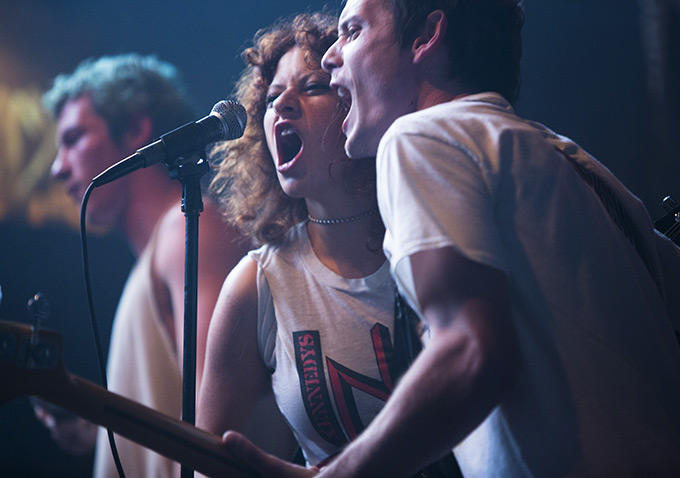
I watched Blue Ruin all by my lonesome and survived. Green Room is even downloadmore of a trial. It’s about a not very successful punk band on a tour of tiny bars and rec rooms about to head home when they get one last gig that pays too well to ignore. They should have ignored it though because the neo-Nazis who show up to hear them play are a little more than they bargained for. Shit goes down, and it’s not just uncomfortable racist undertones, it’s more the literal tearing out of your throat variety.

It’s a horror-thriller that doesn’t apologize for relishing the bloodiness of greenroom4the genre, but this one has the surprising addition of exceptional acting. I liked Blue Ruin for defying my expectations of the genre, and Green Room of guilty of the same, to some extent. It has a real plot and a set-up that won’t make you cringe in its obviousness or its thinness. When Saulnier’s name is attached to a film (this is his third – the perfect opportunity, and maybe his only opportunity to indulge and be indulged in such a gorefest) you’re pretty much guaranteed a nail-biter. There’s breathtaking cruelty around every corner, but I was even more surprised by the tiny flickers of humanity that sneak up on you.

Green Room is not an easy watch, but if you think you have the stomach for it, you should probably put Saulnier on your watch list.


Queen Mimi

Director Yaniv Rokah is a barrista\wannabe actor in Santa Monica, where he encounters the woman who lives in the laundromat across the street.

Marie ‘Mimi’ Haist was born in 1925, married young and ‘obeyed’ her domineering husband. After 29 years of marriage she was left with nothing when he preferred his mistress. She was out on the streets in her 50s, homeless, spending her days in a renee-zellweger-062313-kiss-10__optlaundromat until one cold night a kind laundromat owner didn’t kick her out at closing time. She’s been living in Fox Laundry ever since – some 25 years now.
The documentary is pretty low-key about how the laundromat guy, Stan Fox, was really her saviour. Not just for letting her stay, but for knowing her story, and for putting up with her. She’s not exactly a picnic; if she doesn’t like you, you’ll know it. But if you show her kindness, she’s a blast. She doesn’t work for Stan Fox but she does work in the laundromat, undercutting his business and often making more money than the actual employees. She likes nothing better than putting on some tunes and dancing her head off.

She’s 88 years young in the film and dresses like she’s 12. Her face is one of years hard-lived. Her teeth are nonexistent. Her back hunched, perhaps a side effect of sleeping scrunched up in a lawn chair in a laundromat for so long.

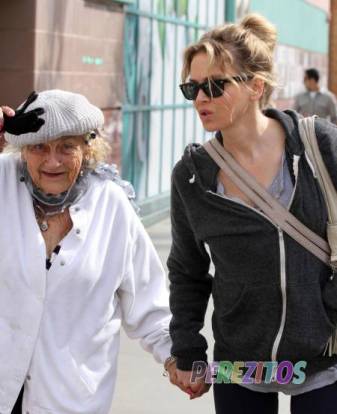
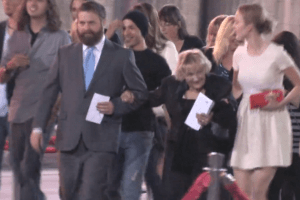
You kind of have to watch this film. Queen Mimi is a character, one you’d hardly credit in a movie, and one you have to see in a documentary to believe. She’s got her philosophies, screen-shot-2013-09-24-at-2-05-59-pmher hard-won wisdom, and an outlook that’s totally unique. She’s cantankerous and whimsical and totally intolerant of homeless people (she doesn’t see the irony). And she has a knack for making famous friends: Zach Galifianakis has taken her to movie premieres (he met her while doing his laundry some 18 years ago), Renee Zellweger takes her shopping, and if you promise to keep a secret, Zach’s about to put her up in an apartment all her own. She hasn’t had a home since 1976.


What a fascinating portrait of a complex human being. We step over homeless people all the time, but everybody has a story, and this is Mimi’s. It’s heartening to see so many people rally around her, wonderful to see that people care. I kind of wish the same for all those lining the sidewalks.