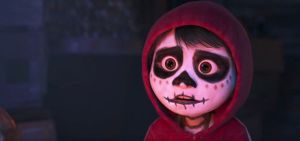
 Pixar’s Coco is about a little boy who crosses into the colourful Land of the Dead in order to resolve a family issue. To celebrate this movie’s release, and to learn a little more about the culture behind it, I visited local makeup artist Tammy Fonseca, and had my own transformation into a Catrina.
Dia de los Muertos is a national holiday celebrated in Mexico on the first two days of November. On November 1st, the boundary between the worlds of the living and the dead is believed to be thinnest. It is an occasion to celebrate your dead loved ones – not a time to be sad or scared, but to be joyous, as you would be on a birthday. Families make altars called ofrendas that are decorated with marigolds, photos, and ornate sugar skulls. They might bring gifts to their loved one’s grave, basically all the deceased’s favourite stuff. If you were visiting my grave, you’d have to pay music way too loudly, and toast with extra-dry martinis in my honour. If I was visiting my grandmother’s grave, I’d wear knit slippers and say shitty things about my mom. It’s just a nice way to remember the person you loved by doing the things they loved. You laugh and tell stories and play music.
If you get dressed up, a calaca is a skeleton, a calavera is a skull, and a calavera de azucar is a sugar skull (which is a frosted, skull-shaped treat made from sugar paste and colourfully decorated). The most famous calavera of all is “La Calavera Catrina,” a high-society skeleton lady dressed in a big flower hat, from a 1910 etching by Mexican artist José Guadalupe Posada. It was meant to remind us that money or no, we’re all the same in death. She has become the most iconic symbol of Dia de los Muertos. Since death is viewed not as an end but as the continuation of life, dead relatives are not mourned by celebrated. Painting your face as a calavera or catrina is a way of telling death you aren’t afraid.
This Mexican ritual is a loving tribute to their ancestors but is also an essential part of  keeping the old ways alive and vibrant in their culture today. So when we watch a movie like Coco, or the similarly-themed The Book of Life, we can think about where this dazzling imagery comes from, and know that each of the bold colours in Coco’s vibrant palette means something:
Yellow – Represents the sun &unity; like in death, under the sun, we’re all the same
White – Represents spirit, hope & purity.
Red – Represents blood and life.
Purple – Represents mourning, grief and suffering.
Pink – Represents happiness.
A face with lots of purples may therefore be a tribute to someone more recently passed, or gone too soon, whereas a face of pink might mean that their loved one’s suffering is alleviated in death and the family is ready to celebrate and honour their life’s accomplishments.
Tammy is an accomplished makeup artist who got her start studying architecture. Now she draws blueprints of faces before she begins painting them. It took her 2.5 hours to paint mine.
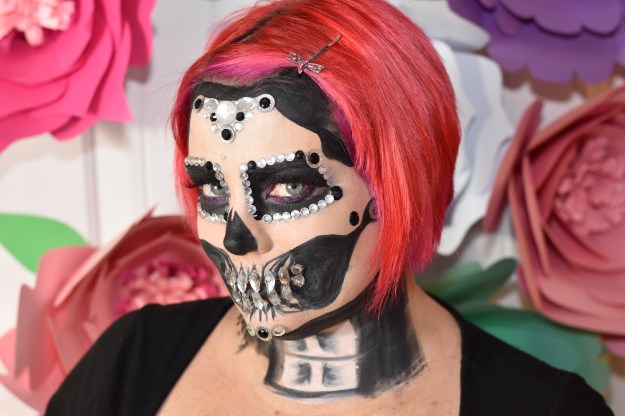
Tammy has been making people beautiful for a long time but started painting skulls when she was inspired by an episode of American Horror Story (The Walking Dead has also inspired her – guess what else she paints?). Aside from your typical horror, she’d love to get her hands on a comic book movie to really make her mark, and her dream is to work on a Cirque du Soleil production.
Tammy’s favourite celebrity makeup looks are Kate Winslet and Liz Taylor. A lover of art, she of course finds inspiration all around her, and when I asked about the temporary nature of her work, she was nonplussed: “people and bodies are my canvasses.” True, and yet I felt true sorrow when I watched it rinse down the drain of my shower. Her work has been featured in Imira and Luxe Ottawa Magazine. She looks to beauty bigwigs Lisa Elbridge, Vanessa Davis, and Argeni Pinal for inspiration.
I was really pleased to have met Tammy and to experience what it’s like to sit in the makeup chair and become someone else. Now it looks like I belong in the world of Coco, which is out in theatres this week. Feel like seeing how the sausage is made? You can watch a slideshow here.

 Brad and Dusty are in a pretty healthy place since we left them in the last movie. They’re successfully co-parenting their collective brood. But when the kids complain that two Christmases tend to halve the joy rather than double it, they plan a “together” Christmas that will likely be the death of them all – especially because their dads get in on it too.
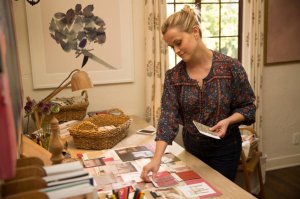 Sheen) and newly single mother to two girls who are having a hard time with their transition to L.A. Their adjustment period gets both better and worse when Alice brings home not one but three very young men on the occasion of her 40th birthday (it’s not nearly as slutty as it sounds). Aspiring film makers, they’re thrilled to crash on her couch while they take “meetings” about their “project” but even more psyched when they find out the house belonged to her father, a famous movie director, and that her mother (Candice Bergen), muse and movie star, often hangs around to make them breakfast.
 selling single of all time. It also served to “de-Christ Christmas”, restyling the birth of Jesus into a holiday about snow that also evokes nostalgia for home and for childhood, concepts we can all relate to.
 non-Pixar short is in front of a Pixar film (the first time, for Toy Story, was the Roger Rabbit short, Roller Coaster Rabbit) but like any blended family, the Disney-Pixar merger has now been solidified, and when better to spend time together than the holidays? In fact, the two do seem to be appropriate companions since they’re both about appreciating different cultures. However, audiences in Mexico were less than thrilled with the “short” (it’s 21 minutes!); impatient to get to the movie that pays homage to their country, they rebelled until theaters dumped the short altogether.
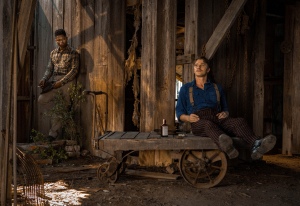 distinguish between different levels of abject poverty, but there’s no question that the white McAllan family will always be in a better position than the black Jacksons (yeah, I feel weird writing that, so go ahead and feel weird reading it). Ronsel is having trouble adjusting to this country that demands that he risk his life defending it but then will spit in his eye the moment he’s back on American soil. Tough blow.
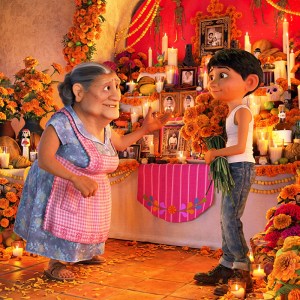 Of course, this being a movie and all, things do not go smoothly. Miguel’s pursuit of his passion means he accidentally crosses into the land of the dead himself, and he needs the help of his dead ancestors (possibly including that cur, his great, great-grandfather) in order to return home.
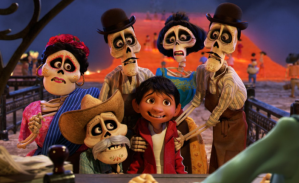 fine line between paying tribute to another culture, and appropriating it. Coco was originally set to be titled Dia de los Muertos, and of course Disney tried to copyright that name. You can imagine the uproar this caused – so much so that Pixar belatedly brought some Mexican ‘consultants’ on board just to make sure they didn’t step in any more shit, and as you can tell, they quickly made a name change. At any rate, the movie felt quite respectful to me, but I’m not really the one who gets final say on that. I will say that it feels like a nice offering by an American studio in the age of Donald Trump and his egregious wall.
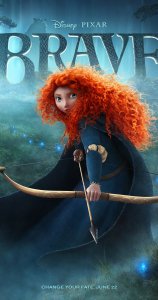 first woman to direct an animated feature from a major studio with a personal favourite of mine, The Prince of Egypt. She came aboard Pixar in 2003. There were NO women at all in the story department and they needed her to fix the one-dimentionality of the female characters in Cars (they were too far along in production for her to have much impact). Next, she conceived Brave and directed the project until they replaced her because of “creative differences.” Since they still had to give her co-director credit, she became the first woman to win an Oscar for (co) directing an animated film. She left Pixar and went on to LucasFilm and back to Dreamworks. Of her exit, she has said “I made the right decision to leave and firmly closed that door. I have no desire to go back there. The atmosphere and the leadership doesn’t fit well with me.” And I can’t help but read that “me” as “women” generally. “This was a story that I created, which came from a very personal place, as a woman and a mother. To have it taken away and given to someone else, and a man at that, was truly distressing on so many levels.”
 henceforth like a gentleman, but his next three attempts were flops – poorly reviewed, scarcely read. He was really under the gun to write his next best-seller and you know what pressure does to a writer: it blocks him. He pitched a vague idea for a Christmas ghost story to publisher and was laughed right out of the office, Christmas being a “minor” holiday and all. He determined to self-publish and gave himself the daunting deadline of just 6 weeks hence – a release just barely in time for Christmas. The only problem aside from funding was that not a word had been written.
 the book justice. And even happilier, the movie doesn’t suck, period, which was a major concern of mine. It seemed far too easy to just let it coast on its sentimentality. But while director Stephen Chbosky doesn’t have a lengthy track record to ease my worrisome nature, he does have one credit under his belt that’s all I really needed to hear: he adapted and directed
 ASSHOLES WATCHING MOVIES