
Steve Gleason was an unlikely football star: too small to do what he did, he did it anyway, for the New Orleans Saints. It was the NFL that brought him to New Orleans but it was falling in love with a free-spirited local girl named Michel that kept him there beyond his retirement in 2008. They soon found themselves expecting a baby, which would be a happy occasion except that about 6 weeks prior Steve was diagnosed with ALS.
ALS, or amyotrophic lateral sclerosis, is a neurodegenerative disease where the nerve cells that control your muscles die. The brain can’t talk to muscles, leading to a loss of mobility, loss of speech and eventually the ability 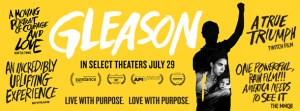 to breathe. Everything is still right in your head though, so you’re still smart and alert and you see everything happening to you, helpless to do anything about it. There is no cure. It is fatal, and will likely be so within 2-5 years of diagnosis.
Within months, Steve is walking and talking with noticeable problems. As Michel’s belly grows with their baby inside, he starts keeping a video diary so that one day his unborn child may know him.
The documentary is bittersweet; the Gleason family experiences highs and lows, and no matter what we hear the clock ticking. As hard as it is for us to watch him deteriorate so quickly on film, to see that hardship mirrored on his wife, Michel’s, face, is just agony. Steve seems determined to share his struggle honestly, even when that means admitting that he’s trying to live up to this banner of ‘inspiration’ and ‘hero’ that the media has ascribed to him and not always knowing that means.
He does, however, establish the Gleason Foundation, which focuses on service and equipment. He felt that much of what ALS takes away, like speech and mobility, technology can give back. And while that’s true to an extent, it can’t quite account for everything: not time, not life. But the foundation gives him purpose, and he’s certainly in the position to bring awareness and to raise money for this disease.
It’s sucky to watch this movie. It’s hard. But as Steve himself says, it’s sad but it’s not all sad. And maybe it’s those moments of not-sad that we need to attend to: the hope, the faith, the optimism, the acceptance, and certainly the closeness and love of this family. And as difficult as it is, it’s also an amazing piece of film. It’s raw and emotional and real. As a famous athlete and the face on a poster on many bedroom walls, many would have called him a hero. But giving a voice to those who have lost them? That’s heroic. His wife’s caregiving? That’s heroic. This film has the power to provoke the hero in all of us. I can’t recommend it enough.
 the last time I visited it was for
  2016 Golden Globe nominee Jessica Chastain plays Elizabeth Sloane, a notorious Washington anti-regulation lobbyist taking on the biggest challenge of her career when she’s asked to help take on the powerful gun lobby.
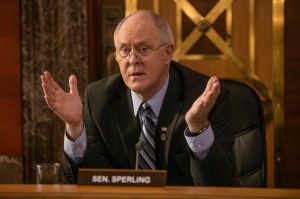 And maybe this is supposed to be the point. The only problem is that and Miss Sloane (the movie) seems to love the thrill of the chase as much as it claims to be outraged by her methods. For awhile, this behind-the-scenes look at what it takes to pass a bill in Washington (or keep one from passing) is almost fascinating and thought-provoking but the endless double crosses and Sloane’s nearly superhuman foresight make it harder and harder to take any of this seriously.
 we get into her character comes more from her performance than Jonathan Perera’s script. But even she occasionally fails to convince during some scenes where she seems to be acting more for the trailer than the actual film. I can only assume director John Madden is to blame for this given that Miss Sloane also showcases inexplicable overacting from the likes of Michael Stuhlbarg, Sam Waterston, and Mark Strong that I can’t believe made the final cut. You’d think a director of a Best Picture winner (Shakespeare in Love but still) would have done a better job of reining them in.
 Rogue One is the movie the prequels should have been. It is fresh, entertaining, and necessary. Rogue One’s humour works for adults as well as five year olds (though any self-aware Star Wars fan must acknowledge that the gap there for us is not all that wide). Rogue One links to what we’ve seen before in a way that feels natural and rewards fans who are familiar with every scene of the original trilogy, and leads into the known end point of A New Hope without any trouble whatsoever.
 occasionally feels like an awkward mix of serious war movie and hopeful space odyssey, but only rarely did I have that feeling. It definitely did not ruin the movie for me and that Star Wars feel is an overwhelming positive overall (especially an amazing Darth Vader scene during the climax that shows us the power we always knew he had).
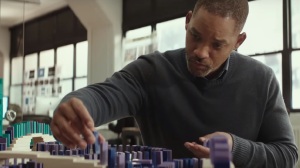 While searching for Will Smith’s filmography, I was surprised to see the pleasure with which critics are tearing this movie apart. The reason I was looking for Smith’s info was to try to figure out whether Collateral Beauty is his best dramatic performance (and I quickly realized that since I haven’t seen Ali, I’m disqualified from weighing in on that topic). With that lead-in, it probably goes without saying that I again think it’s been too long since the critics were thrown a juicy morsel, they’re searching for anything to bite down on as a result, and Collateral Beauty has been flagged as an easy target.
 has made a fantastic film about family, grief, and how easy it is to push people away when we’re hurting. It’s one of 2016’s best films not because it has any particularly new ideas or innovative style but simply because it’s refreshingly honest.
 she’s simply paying tribute to those of us who will never get enough of Edina and Patsy.
 time they’re finding that perhaps being hounded by the paparazzi isn’t quite what they’d always hoped.
 ASSHOLES WATCHING MOVIES