
Christine Chubbuck was a newswoman in Sarasota, Florida in 1974. Originally hired as a reporter, she was writing and hosting her own community affairs talk show, called Suncoast Digest. She took her position seriously and sought out important local officials to discuss the community. On the morning of July 15th, Christine changed things up. As her guest waited in the wings, she sat behind the news anchor desk to read aloud a statement to her live audience. It read:
“In keeping with Channel 40’s policy of bringing you the latest in ‘blood and guts’, and in living color, you are going to see another first—attempted suicide.”
She pulled out a revolver, placed it behind her right ear, and pulled the trigger. Her hair puffed up, as if from a gust of wind, and blood spattered everywhere. Chubbuck fell forward, hitting the desk with a resounding thud, and then slipped slowly out of sight. The show’s technical director went immediately to black, but the damage was done: anyone tuning in had just seen a suicide live on TV.
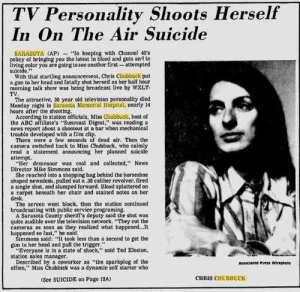 She had been depressed and spoke about suicidal feelings with her family, but never mentioned specific plans. Her mother thought her personal life was “not enough” and a recently removed ovary put pressure on Christine to find a man before it was too late and the door on her fertility closed forever.
On the bloodied desk, after Christine had been removed to hospital, was a hand-written, third-person account of her suicide, which she’d written for someone to read out as a statement. The article, written long-hand by herself, listed her condition as “critical” which makes me flinch. The prepared speech that she read out referred to the suicide as an attempted suicide. The statement lists her not as dead, but as critically wounded. Was this just an elaborate call for attention that she had every intention of surviving?
This movie is not a documentary, or at least not a straight-up one (docudrama, anyone?) and it’s the second of two films about this event that hit film festivals this year. The first, simply titled Christine, stars Rebecca Hall as Christine and Michael C. Hall as George Peter Ryan, a colleague of hers that she may have had an unrequited crush on but who was already in a relationship with Christine closest work colleague, the station’s sports reporter. This film, however, is not a straight-forward narrative. Instead, it’s more about actress Kate Lyn Sheil preparing to play the role of Christine.
Kate seems fairly genuine in her intention to portray Christine with empathy, and to not “fetishize the crazy woman” as she puts it.
The footage of Christine’s suicide has never been seen again. Lots of theories exist on where exactly this footage ended up, but it seems that the station owner Robert Nelson kept it, but removed it from the station. It seems now that his widow has passed it along to a law firm for safekeeping. No word on why it has never been destroyed. In preparing  for the role, Kate finds it nearly impossible to access any footage at all, even of the many hours in which Christine was just the normal host of a daytime talk show on local television. Christine Chubbuck has vanished. Until these movies put her into the public’s consciousness again, her death (and life) was all but forgotten.
Early on in the film, Kate muses as to whether acting is compulsive, whether the impulse to act is perhaps unhealthy for her. As the film progresses and she interviews subjects increasingly on the periphery of events, she does seem obsessive in her pursuit. But for me, it feels like this movie never becomes any one thing. It blurs all the lines but never really takes a stand. It’s a deliberately frustrating experience for the audience. When we do see random snippets from this questionable movie that they’re supposedly making, they seem disjointed and random. Were they ever really making a movie? Those parts are the least convincing in a not-very-convincing film. But watching Kate get spray-tanned and shop for thrift-store stuffed animals that Christine might have had in her own bedroom…it’s just not very edifying. I think there’s supposed to be something in here about the nature of truth, but it’s not sitting right with me. Maybe it’s because that in some disturbing way, the director is making me complicit in the society of “gawkers” which the film claims to be skewering.
Anyway, there’s a lot of navel-gazing here, so much so that this feels like a self-indulgent performance piece more than an actual movie, and the more I watch, the more I question the motives of the people making it.
 Year Old Virgin, and the fact that Jane Lynch is in both is just a painful reminder that this subject actually CAN be funny, should be funny, and in fact probably took a lot of effort to screw up this badly. How much effort, you ask? Well, by my count: there are 2 credited with “story by” and FIVE credited with screenwriting. Five! All dudes, naturally. Dudes who like visual jokes about morning wood and sneaky semen. And that doesn’t even count the guy who wrote the book, you know, the REAL guy that this actually happened to.
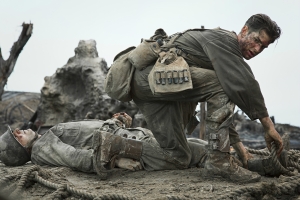 There are two main takeaways from Hacksaw Ridge: (1) even American acting jobs are now going overseas, as aside from Vince Vaughn every American soldier in this movie seems to be played by an Australian (included in that tally is Andrew Garfield, who I have since learned is British, not Australian, but still…); and (2) if the Japanese had just prayed harder they might have won the Second World War.
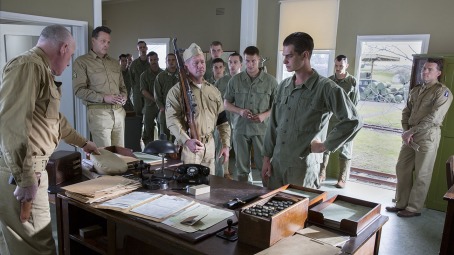 Incidentally, if the intent behind not putting Mel Gibson’s name up front in the marketing was to create some separation from those all-too-frequent racist comments in Mel’s past, it might also have been a good idea to cast at least one non-white guy. Just saying.
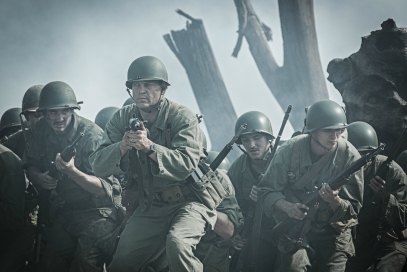 he doesn’t hold a grudge, and hauls 75 of them off the Okinawa battlefield even after they made his life so rough.
 destruction is at stake. Some kid used a ratchet rather than a wrench, and an 8 pound socket was dropped. Picture, for a moment, what this giant missile really looked like: from the bottom, you couldn’t even see the warhead, which was at the top, 8 stories up. The boys, working somewhere in the middle, dropped a big hunk of metal which made 1 bad bounce, tearing a chunk into the side of the missile which immediately began spurting oil. Nobody really wanted to own up to this possibly extinction-level fuck-up, so a half hour went by before anyone with any authority knew what was going on. And this being a government operation, a further 8-10 hours went by before anything was done about it. So the bottom fuel compartment was emptying quickly, which meant the top part was about to collapse in on itself at any moment, likely causing a huge-ass explosion even not counting the fact that a MOTHER FUCKING WMD WAS SITTING ON TOP!
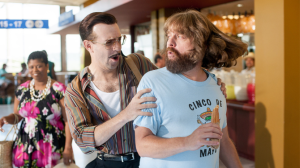
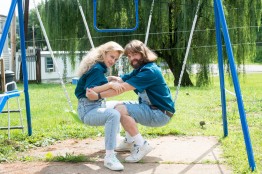 the witless driver of an armoured money truck whose terrible relationship with fiancée Kate McKinnon makes it all too easy for him to fall for coworker Kristen Wiig who manipulates him into working with her confederate, Owen Wilson, who thinks a heist is in order. Galifianakis will do all of the work under the guise of love but will receive little to no reward if Wilson has anything to do with it – he’s got contract killer Jason Sudeikis after him and only the law (Leslie Jones) has any chance of intervening.
 only laughed once the entire movie – and it was post-credits, in the blooper reel, not even at a joke that got edited out, but at Zach Galifianakis accidentally hitting his head on a swing set (I console myself that it made Kate McKinnon laugh too, before she checked that he was okay). Only babies laugh at people getting bonked on the head, but I had been in a comedy desert for the past hour and a half and I was parched for laughter.
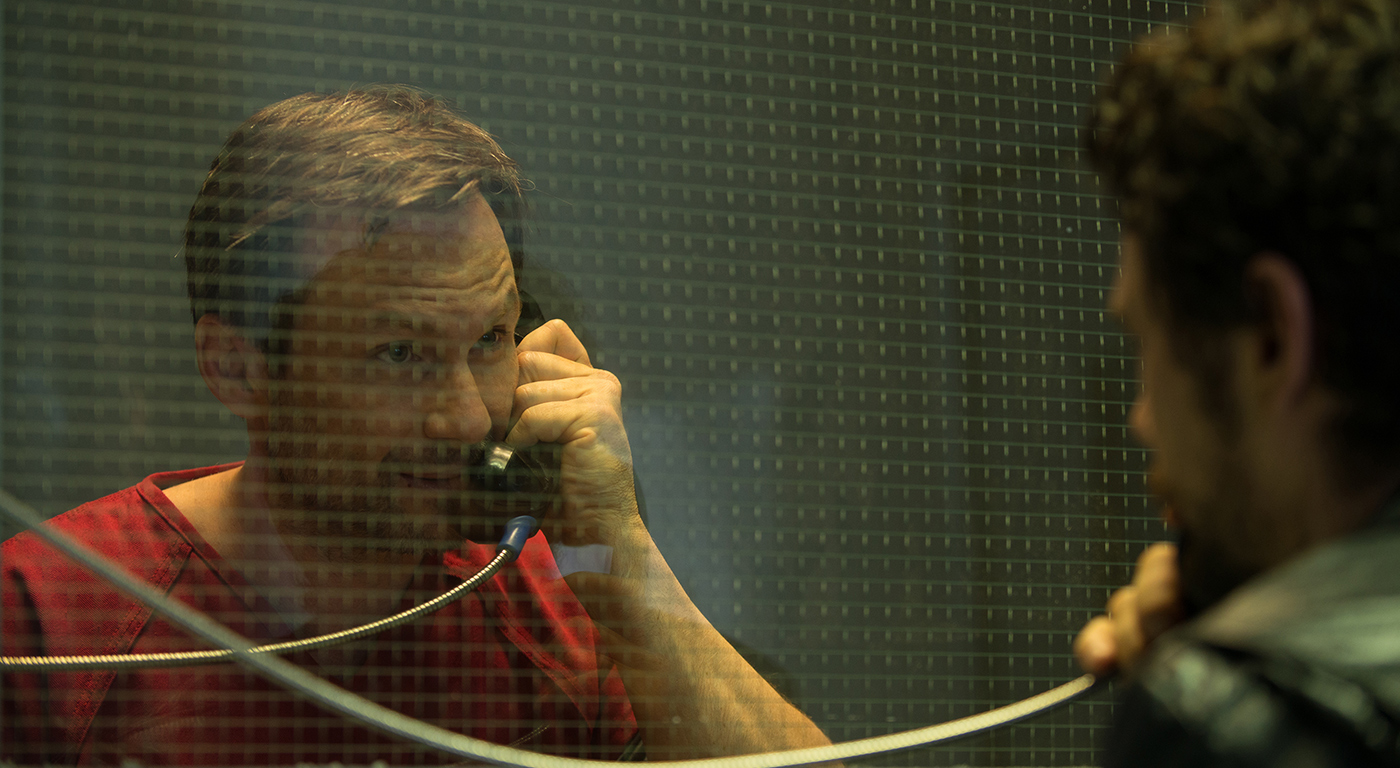
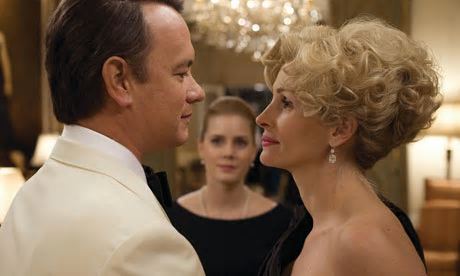
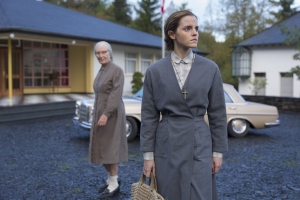 goes, putting herself at the mercy of a nutbar pedophile cult leader and his woman-beating cronies. This is the kind of movie into which you can never lose yourself entirely because you keep pulling yourself out of it to yell at the protagonists. You know in a horror movie the whole theatre is practically yelling “Don’t go in there” but of course she goes in there, even though we all knew better? And she gets diced into a million bite-sized pieces? Well this is one of those movies, except it isn’t a horror, and there’s no excuse for doing what it does. Bad writing, I suspect, and a movie that doesn’t really know what it wants to be when it grows up. With two idiot protagonists who keep making the dumbest decisions ever, you won’t care whether they live or die. And for a film that’s trying to shed some light on a pretty gruesome chapter in Chilean history, it’s also succumbing to the misplaced love story temptation. Because nothing overcomes a cruel dictator like True Love between nitwits.
 Africa. The whole point of this film is rooted in poverty. A chess club is started in Katwe because of poverty – because mothers are too afraid of medical expenses should a child break a bone during soccer. So a board game is just more appealing. One of the big draws in getting the children to come in and learn the game is that the chess is served up with a free cup of porridge.
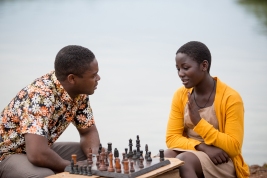 enough to represent Uganda internationally. As she begins to win, and to travel, she glimpses the life that could be hers if her chess game complies. But now that she’s playing not just to win, but to change her life, and support her family, it’s a lot of extra pressure any little girl’s shoulders.
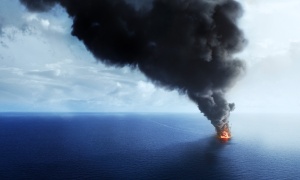 Disoriented. I walked out of the theatre disoriented. Was it the strobe light effect while the power failed? Was it the glass shards being pulled by Kurt Russell out of his own foot? Was it the bone sticking out of a redshirt’s leg? Was it that 11 people died and I wondered how the other 115 on the rig survived?
 Mike Williams (Mark Wahlberg) gets bloody. Jimmy Harrell (Russell) gets bloodier. The stand-in for greedy BP, Donald Vidrine (John Malkovitch), does not get as bloody as you’d hope. They are some of the lucky ones. Deepwater Horizon takes us into the heart of the mess. Tons of mud, oil, fire, explosions, and rag dolls flying all over the screen. It is hard to watch but not too hard to follow. We are provided with title cards and a grade school explanation of the Deepwater Horizon’s mission. They help the exposition fly by so we can get to the destruction faster.
 ASSHOLES WATCHING MOVIES