
Well, if film festivals didn’t challenge you, it would just be going to the movies. Bruce LaBruce was never going to let that happen though. He’s Canada’s queercore king, the avant-garde and unapologetic gay answer to the punk movement. He famously blends an indie sensibility with gay porn imagery, exploring taboos and limits and putting his audience through an unforgettable adventure, one way or the other.
Dominic (Félix-Antoine Duval) is a young man with an unexpected fetish – himself. His own face and flesh are the only things that turn him on. He masturbates to Polaroids of himself and has never met a reflection he didn’t like. This is one of LaBruce’s signature transgressions against cultural norms, but he pushes that button quick, and moves on to the next. Dominic was raised by his grandmother believing his mother to be dead but new information sets him on a road trip to find her. Turns out she’s a witch, or at least that’s what the locals of Saint-Narcisse call the old woman living in an isolated cabin in the woods, living with a young woman who may or may not ever age.
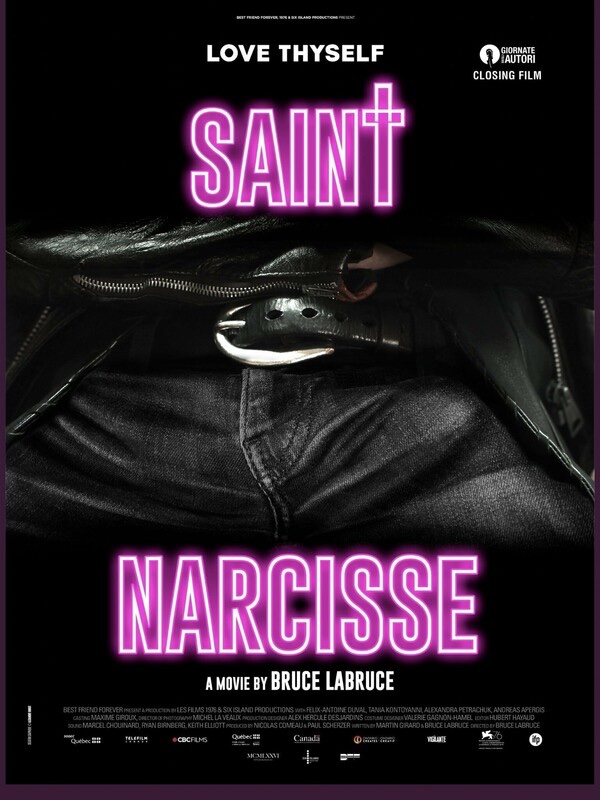
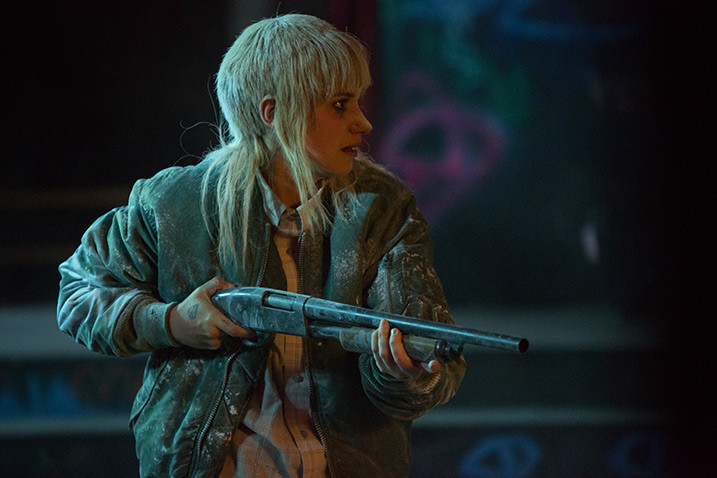
His arrival finds Beatrice away from her cabin in the woods, but young Irene (Alexandra Petrachuk) is there, brandishing a gun rather than a welcome wagon. Naturally he waits for his mother in the garden, where he gets naked and takes a shower. As you do. But either when the maybe-mother son reunion happens, Dominic’s story still feels incomplete. Beatrice’s (Tania Kontoyanni) story has some pretty big holes in it, but luckily Dominic’s already fixated on someone else – Daniel, a monk in the monastery next door, who Dominic believes is a dead ringer for himself.
Daniel the monk enjoys homoerotic romps in the river with his order of brothers, and to masturbate to flyers of underwear ads while self-flagellating.
If you thought LaBruce was going to let you off easy, you don’t know your LaBruce. He’s going to continue to shock and subvert. But he also rather consciously pushes us to recognize our own role in the voyeurism (It is Not the Pornographer That is Perverse).
The story is a vehicle for naughty and immoral things, for pushing up against explicit boundaries and seeing how far they’ll give. It is not a movie with mass appeal. LaBruce and writing partner Martin Girard have much less interest in story than in shock value. It’s as if they’re daring their audience to look away, and by god they’re going to do everything in their power to win.
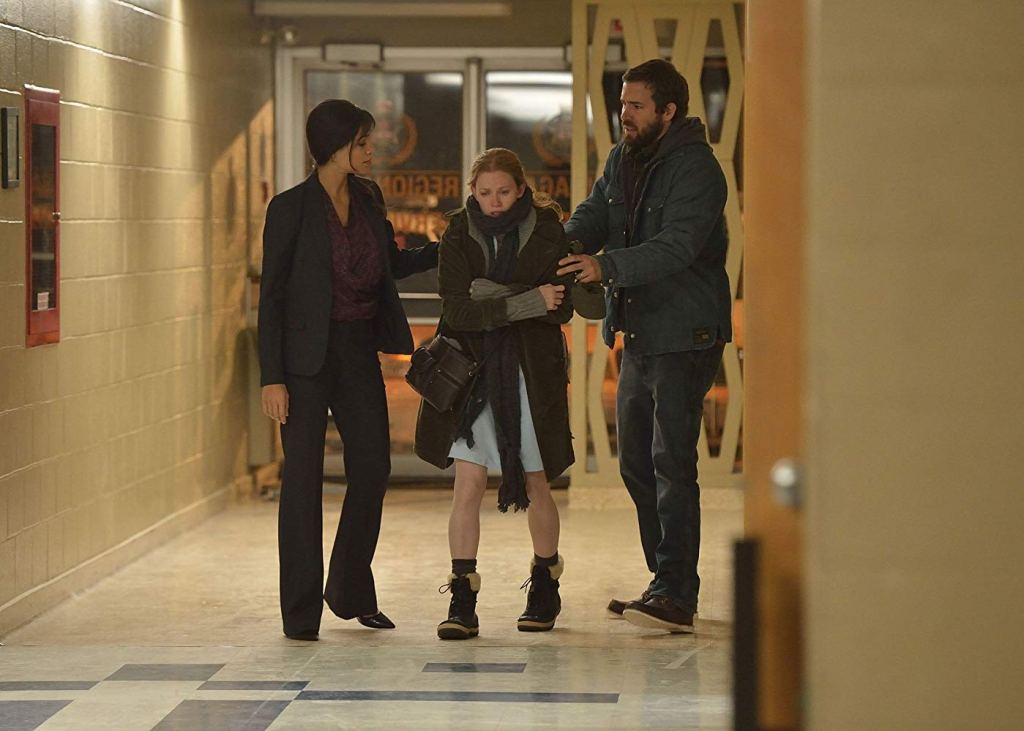
 symptoms of the caring sister who’s also sort of an enabler. Because instead of leaving him to get his shit together, she’s prepared to miss the party and spend the night driving around the dirtiest, sleaziest parts of L.A. to find her brother (Dave Franco) a detox facility, and barring that – well, something far worse.
 enough to try a dusty old board game, Game Of Death. They should have read the instructions first – once engaged, the game counts down the 24 people necessary TO MURDER in order to “win.” The game doesn’t stop until 24 are dead. When the clock runs out, if no one is killed, the game itself will execute a player. How stoned would you have to be for this to sound fun?
 cry. I assume this the same is also true of teenaged boys. I understand that some people cry under pressure, but for the sake of watchable movies, I think film makers need to dispense of this annoying soundtrack.
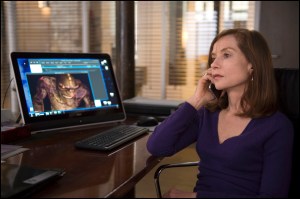 mother. She has exes, lovers, and erotic fixations. Some of them may surprise you. She reminds us that there are many ways to respond to this kind of violation, and none of them are necessarily wrong. But victimhood does not sit well with Michèle; Michèle plots revenge. Michèle’s complexity is a welcome layer to this psychological thriller, and it’s superbly executed by Isabelle Huppert. Huppert won the
  footage and deliberate storytelling that allows us to consider what documentary can do. It is urgent, imaginative and necessary filmmaking.” Meryl, love ya, but I respectfully disagree.
 was…unusual, intense, disturbing. I wasn’t even sure I wanted to see it. You may know by now that Jay and horror don’t mix. But Sean was keen despite my own warnings, so we hunkered down in the same beautiful theatre where I barely survived watching
 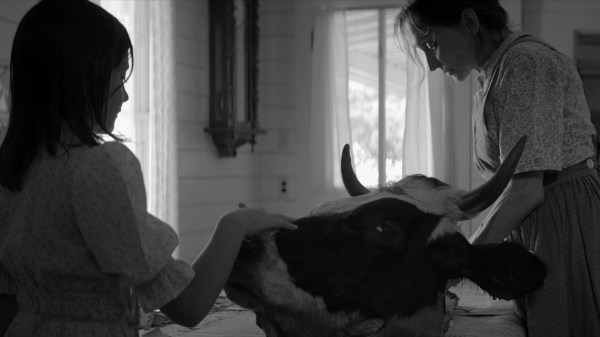 beautiful for such a twisted movie. The monochrome may lessen the impact of the gore but it only serves to heighten the intensity of the atmosphere, creating a world I was never sure of, never trusted. So while there’s little in the way of jump-scare, there’s plenty of hair-raising all the same.
 Disoriented. I walked out of the theatre disoriented. Was it the strobe light effect while the power failed? Was it the glass shards being pulled by Kurt Russell out of his own foot? Was it the bone sticking out of a redshirt’s leg? Was it that 11 people died and I wondered how the other 115 on the rig survived?
 Mike Williams (Mark Wahlberg) gets bloody. Jimmy Harrell (Russell) gets bloodier. The stand-in for greedy BP, Donald Vidrine (John Malkovitch), does not get as bloody as you’d hope. They are some of the lucky ones. Deepwater Horizon takes us into the heart of the mess. Tons of mud, oil, fire, explosions, and rag dolls flying all over the screen. It is hard to watch but not too hard to follow. We are provided with title cards and a grade school explanation of the Deepwater Horizon’s mission. They help the exposition fly by so we can get to the destruction faster.
 starts believing it, truly believing that her beauty is important and holds power over other people, that’s when things start to bubble.
 up with that head-stomping scene in Drive. And all the other scenes in Drive. I described Neon Demon to Sean as “less plot than Drive, and with super models” and also as “this year’s weird movie” to which he replied “Beasts of the Southern Wild weird?” and I answered “No, more like
  not really either of those two things. Surprise third option! I definitely didn’t hate it. Lord it has some of the coolest images I’ve seen in a film, ever. Gorgeous. Stunning. It’s one of the boldest things I’ve ever seen on film and I’m giving lots of credit to Refn’s cinematographer Natasha Braier (what! a female cinematographer??) Together, Refn and Braier create an unforgettable world that is hyper-real, extreme in both its beauty and its grit. The colour palette tells a story all on its own, progressing seamlessly from beginning to end.
 found it to be kind of empty. Like there’s obviously an allegory here, about our culture’s emphasis on female beauty, and on a certain kind of white girl skinny beauty in particular. And the dangers of narcissism. And female cattiness, which I almost hate just on principle. But this movie didn’t make me think. Like, at all, beyond “Oh, that’s gross.” So treat it like a high fashion magazine with pretty pages to flip through. I just can’t give it much more credit than that.
 ASSHOLES WATCHING MOVIES