Tag Archives: documentaries

Chef Flynn

Flynn McGarry, 15 in the documentary, has been “cheffing” since he was 10. I’m not talking about peanut butter toast, this kid is the real deal, sourcing ingredients most people wouldn’t recognize as food, preparing it in ambitious ways, plating it with finicky precision to detail. His mother Megan, once a film documentarian herself, has no shortage of home video of his meteoric rise to culinary stardom, and this film uses that footage liberally. We see him hosting a 12-course “supper club” for family friends in his home at age 13, with a kitchen full of children to do his bidding, and transitioning to professional pop-up restaurants in New York, with trained staff underneath him, just a few short years later.

Chef Flynn is replete with food porn sure to make foodies happy, but this documentary doesn’t exactly focus on the culinary side of things. Instead, director article-2269130-1733455C000005DC-923_634x422Cameron Yates focuses on the unusual relationship between mother and son. Meg McGarry allowed her son to drop out of school to focus on his passion. Now, nearing 16, he’s ready to move away to pursue his career. As a mother, we see helicoptering, permissiveness, indulgence, and an incredible amount of creative nurturing. But we also find a woman who has lost herself in her son’s shadow. Pursuant of her son’s great passions, she’s forgotten hers, and now that he’s ready to leave her behind, what will become of her?

Yates shows a little of the familial friction but that’s as far as he’s willing to go. This is otherwise about as thoughtful as any home video: with almost no input from outside the family, it’s hard to judge how good Flynn really is, or what place he has among top chefs. Plenty of pro chefs balk about even calling him a chef, but we never get to hear from the opposition. I think his talent and enthusiasm are in earnest, but the truth is, this is a privileged white kid whose parents indulged his whims and bought him his biggest dreams. His childhood bedroom housed more high-end appliances than my grown-up kitchen. He hasn’t paid any dues. He didn’t have to work for this. Chef Flynn is interesting, but it’s a one-sided story, all sweet with no salt, which any chef should know makes for a boring meal.

Tiny Shoulders

Barbie has been a controversial figure since her inception. Before Barbie, little girls played with dolls that looked like babies. These dolls encouraged nurturing, mothering instincts. But then along came Barbie, a doll that had been “sexualized” with large breasts and hips, a distinctly adult doll that inspired little girls to dream about their own futures, to project their own aspirations.

I played with Barbies as a little girl. In fact, in a family of 4 sisters, we easily had over 100 Barbies between us. Probably over 200. Sometimes we’d get gifted 2 or 3 of the exact same, which was never a problem at all: “Twins!” we’d squeal gleefully.

Despite her figure, Barbie has always been somewhat of a feminist figure, albeit one FJF70_Viewerbased on conspicuous consumption. She held jobs that real life women were still dreaming about. She wasn’t saddled with kids. She drove her own car and owned her own home, independently, without the help of Ken, who was little more than another accessory. But no matter how many astronaut Barbies existed, she was still tall, blonde, blue-eyed, thin, with impossible, top-heavy measurements. Sleepover Barbie came with a scale permanently stuck at 110lbs and a diet book that simply said “Don’t eat.” Needless to say, real-life feminists could never quite embrace her, even as their own daughters flocked to toy stores to buy her up.

My sisters loved to play “family” but I had zero interest in play-acting motherhood. I was born this way: there was never a time when I didn’t know myself to be a childfree kind of gal. So Barbie was it for me. Barbie had the life I imagined for myself – a fabulous wardrobe, a cute convertible, a handsome boyfriend, a serious profession. The only problem was, she didn’t look a thing like me.

Tiny Shoulders, Rethinking Barbie documents the 2016 launch of a line of different-sized Barbies, FJF41_01including tall, petite, and curvy. Curvy Barbie has a thicker waist and no thigh gap. It seems like a no-brainer now, but for the people working at Mattel, it was ulcer-inducing times. Would feminists finally be appeased? Would they be derided for waiting too long? Would children embrace a “fat” Barbie, one that didn’t fit into the outfits they might already own? They were anxious to steer the narrative but were wise enough to know that social media would own them – and that a Time cover story would largely dictate her early adoption or lack thereof.
I would have embraced a thicker Barbie had she existed when I was a kid. Heck, I just checked out the catalog right now to see if the Curvy line includes one with pink hair and lots of tattoos (it doesn’t). Representations matters.

Barbie has never been just a toy. She’s an icon, with a place in our culture. Even Gloria Steinem has a thing or two to say about her in this doc. Director Andrea Nevins looks at Barbie’s reinvention from every angle, seemingly missing nothing. This is a moment in time worth documenting, and she has. And it also turns the tables on Barbie’s critics. Yes, this move was probably long overdue, but seeing things from the business side makes us realize what a gutsy move this truly was, with possible million dollar repercussions. Barbie will always have it just a little tougher than most if not all of her fellow toys just by virtue of who she is, what she represents, and what we project on to her. People are keen to find fault. Today she reflects a greater diversity – not every body, and not every ethnicity, but progress is progress – and not only is that worth applauding, I also think it deserves the careful consideration granted by Nevins and crew.

The Rachel Divide

Rachel Dolezal: I bet you know her name. She’s the white woman who passed herself off as black and became the head of her local N.A.A.C.P. chapter. And in fact, she doesn’t just pretend to be black, she claims to really believe that inside, she is. She has called it transracial, perhaps to piggy-back on the recent (and limited) success of the transgendered community to gain acceptance. Transgendered people are born in the wrong body. Their biology may present as one sex but they feel very much like the other, and may even undergo reassignment surgery in the pursuit of having their bodies match their identities. But is transracial the same thing? Is it even a thing?

I definitely had opinions about Rachel Dolezal before I ever watched the MV5BYmMzZGRhMjctYTA4My00YWQ3LWJlZjUtZjZmZjU2NjI3NWMzXkEyXkFqcGdeQXVyNjc5NTc1MTg@._V1_.jpgdocumentary. It was hard not to have a knee-jerk reaction to this thing that felt wrong, felt maybe even racist, though we couldn’t quite articulate why, other than the fact that it necessarily deals in stereotypes. But on paper, it’s harder not to see her point. And in practice, it’s impossible not to feel compassion for her children who are being punished for the sins of their mother.
Laura Brownson has a fascinating documentary that really challenges your beliefs, and to me that’s the ultimate mark of a good documentary. Why did Dolezal lie? Why does she continue to hold her ground? Why does she cry about her notoriety but chase it with a book deal and now a documentary? Why was she singled out for accolades when so many actually-black women were passed over? Should her contributions to the cause be forgotten or ignored?

Brownson offers no real answers but asks enough intelligent questions that it really gets your brain juices bubbling. She doesn’t let Dolezal off the hook but does treat her like a human being, which makes her the rare exception. And I’m still not certain where my own beliefs stand, but my thoughts are a little more evolved, and a little reflection never hurt anyone.

SXSW: More Human Than Human

1977: Star Wars introduces us to helpful and humourous robots like R2-D2 and C-3PO.

1982: Blade Runner tells us that robots can be scary, and the scariest thing about them is when they’re indistinguishable from us.

1984: Terminator is a robot who’s come to destroy us all.

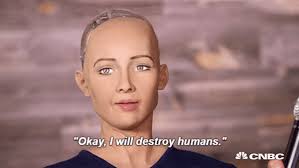
About 5 minutes after we invented robots we started predicting our own extinction at their hands. About a third of jobs that used to exist in the 1980s and 1990s have been replaced by robots. Stephen Hawking has warned us that “The development of full artificial intelligence could spell the end of the human race.” In 1998, that annoying plush toy Furby had more computing power in it than was used to put a man on the moon. Our smartphones today are MILLIONS of times faster. With a god-like lack of hubris we are driven to create these things in our own image (or at least replicate the human brain), but once we’ve recreated human intelligence, and robots capable of building other robots, then isn’t the next step SUPER human download.jpgintelligence – and then haven’t we made ourselves redundant? And yet we can’t help ourselves.
Even within this documentary that explores the dark corners of AI, the film makers (Tommy Pallotta, Femke Wolting) can’t help but wonder if they can build a robot that will replace themselves. Can they get an AI to direct a movie about AI?

I am a fan of Isaac Asimov so this documentary is like heaven to me. This must be what it’s like to ride a rollercoaster: I am sickly fascinated by the very robots that I fear. Maybe that’s why I love movies like Her (in which Joaquin Phoenix falls in love with an AI) and Marjorie Prime (in which people assuage their grief by replacing their dead loved ones with cloned AI) and Ex Machina (in which Domhnall Gleeson falls in love with an AI even as he works to disprove her humanity) but I refuse Alexa in my home, and in fact have never even asked a single question of Siri.

A.I. is not a question of the future. It’s here. The question is, what are we going to allow it to do? Take care of our aging parents? Drive our cars? Create art? If machines can do all of that, then who the heck are we? That was my favourite part of this movie: really thinking about humanity and what it means to live among these sophisticated creatures – creatures of our own making, and possibly our undoing.

The directors do in fact come up with a movie-making robot, and bring in Billy Crudup and Richard Linklater to comment upon its success. But no matter how they feel, or I feel, or you feel, robots are here to stay. And they are capable of very convincingly telling us how great they are. Could we even get rid of them, if we wanted to? Are we as fully in control as we believe? And if so – for how much longer?

SXSW: Making The Grade

My grandmother had a very old, very creaky stand up piano in her dining room. Once we’d eaten all her cookies and drawn all over her church stationery, we’d pound away on the untuned keys, convinced we were making loud, beautiful music. We were not. But lessons were for rich people and we were not that either.

This documentary acquaints us with a whole spectrum of Irish piano students, those studying for their first grade exams all the way to the 8th. Old and young are peppered randomly throughout; some have natural ability and others are a little plonkier, but they’re all more dedicated than me. The kids astound me, of course. The piano seems the antithesis of our sped-up society and I’m impressed that any of them have the chutzpah to put in adequate practice, persevere through the tough spots, and pursue an accomplishment that isn’t very well rewarded anymore. But my favourite of director Ken Wardrop’s subjects is a woman with short gray hair and colourful tunics who persists though she’s the first to admit she isn’t any good. I suppose that’s what I admire most: yes, the music sounds better coming from the fingers of someone for whom this comes easily – but it’s so much sweeter coming from the clumsy fingers of a woman who possesses not the teeniest drop of rhythm.

Making the Grade isn’t flashy. There are no stylish tricks. But you’ll find that simply pointing the camera at a bunch of people who know a secret – well, the camera loves secrets, doesn’t it? This is what documentaries are for: exposing those we wouldn’t otherwise know. Whether it’s a little girl discover power and confidence in her music, or a woman finding solace and self-care in hers, it’s moving just to see others be moved by music of their own creation. And of their teachers? This is a loving tribute.

SXSW: Take Your Pills

Oh lord – I can’t decide what I’m more relieved about: not being a kid today, or not being a parent today.

Every era gets the drug it deserves, so says the movie’s clever blurb. This generation? This generation takes Adderall. Amphetamines have been around for a long time, but it’s never been more eagerly prescribed to kids than it is today, in the form of ADHD meds, or more abused by students who just like the feeling of being “zoned in” – hence its nickname, college crack.

I’ve never heard of a drug that made me feel old. But back in my day, we took drugs to turn off and check out, but kids today are taking it to check in. And that’s a pretty MV5BNWQ5NDYxNjYtODc4Ni00NmIyLWEyMGYtNGM0N2ZmYjgzYTliXkEyXkFqcGdeQXVyNTg0MzU3NjM@._V1_damning comment on today’s hyper competitive culture in which young adults liken abusing prescribed drugs to drinking a cup of coffee. Like I said, amphetamines aren’t new: The Beatles took them, Andy Warhol took them, Vietnam soldiers took them in order to go, go, go. And then they became horribly addicted, and the drugs became controlled. Except now students are seeking them out as performance-enhancers, faking ADHD to gain an edge while taking the SATs, and getting their hands on drugs whether prescribed or not.

It’s not like this phenomenon was news to me, but being confronted by the statistics in this movie had me uttering “oh shit” with alarming frequency. And that’s what you want in a documentary: facts to open your eyes, and anecdotes to give them colour. Director Alison Klayman looks at the drug’s history, its effects, its draw, its efficacy, the truth and the lies behind it. This documentary takes an issue that may have been niggling at you for a while and makes it not just a headline but an easily digestible information bomb. There are ethics at play here, so ultimately Klayman provides the context but the judgements and decisions are still yours to make – but information is power, and if you’re willing to dose yourself a stimulant, the LEAST you can do is prescribe yourself a little reality to go along with it.

SXSW: Won’t You Be My Neighbor?

It’s a beautiful day in this neighbourhood, a beautiful day for a neighbour, would you be mine? Could you be mine?

It was in fact another beautiful day in Austin, Texas when we shunned the sunshine in favour of a SXSW venue to watch Morgan Neville’s documentary about everybody’s childhood friend, Mr. Rogers. It was the 10th day of a 10 day film festival, and Sean and I were worn down but still happy to be there, bellies full of fajitas, not minding the neighbourhood at all, except for the unfortunate fact that there was a bomber on the loose. [You may have read about this in the news – the package bombings had started MV5BMTkxNzgwMjg4NV5BMl5BanBnXkFtZTgwMDk2MDk1NDM@._V1_SY1000_CR0,0,663,1000_AL_slightly before the festival began and continued, threats shutting down an event, and police dogs sniffing the larger venues for traces of explosives. The alleged bomber died days later, blowing himself up when the cops arrived to arrest him] But the festival always felt like a safe space and we’d seen lots of great movies and done some once-in-a-lifetime things, and were not just coasting until the closing movie Isle of Dogs later that night.
Won’t You Be My Neighbor? seemed like a good way to spend an innocuous afternoon. The documentary had been well-received at Sundance, and Sean and I both had some warm, if fuzzy, memories if the cardigan-wearing man who sang his gentle songs to us through the TV.

Turns out, Mr. Rogers was a much more interesting man than I ever knew. An ordained minister, he was at the forefront of childhood development and had some very concrete ideas on how children needed to be treated in order to feel safe and secure – and how television could be a tool toward that goal, but mostly wasn’t.

The documentary has clips from old shows, ancient, that date back to the 1960s, black and white stuff I never knew existed. It’s also got archival footage of him in interviews, and clips from TV shows he did aimed at adults, which are quite another thing. But he’s the same guy, always: slow, steady speech, in that comforting tone of voice, slightly goofy, easy smile, bushy eyebrows, lean, lolloping gait. He spoke directly to children, and sometimes on very difficult, specific topics. I was floored to hear one of his puppets ask what ‘assassination’ meant – but yes, he did dare to cover such things as they made national headlines.

But what is Mr. Rogers’ legacy? This is where the documentary gets really interesting. Did he succeed in making children confident? Or, as some critics say, did he render them entitled when he told each and every one of us that we were special? He was a bit of a radical in his way, and he likely had some effect on most of us North Americans, one way or another. He’s been dead more than a decade but we’re still remembering him with some reverence, and it’s fun to look back – because his history is also our childhoods, and that’s something we can all share.

SXSW: The Director and The Jedi

the-director-and-the-jedi-sxswWhen I was a kid, I had a behind-the-scenes book detailing how they filmed the space combat in Star Wars, and I loved it. I could think of nothing better than to get to play with the spaceship models and the huge Death Star set used for the climactic scene. I found it fascinating to see how the movie was made.

And though my book did not inspire me sufficiently to pursue a career in film, my story is not much different than one that Rian Johnson tells in The Director and The Jedi, or for that matter one that Barry Jenkins told in his amazing keynote speech here at SXSW a couple of days ago about filming Moonlight in the same projects where Jenkins grew up.  Peeks behind the scenes can inspire the next generation of filmmakers, and give birth to a dream that a kid might not otherwise know to have, because it’s not immediately obvious that for every actor there are ten creative people behind the scenes, designing sets, making costumes, and on and on. But beyond that, even for someone like me who’s made a career choice that is not film, it’s just really cool to see how a huge film like Star Wars: The Last Jedi gets made.

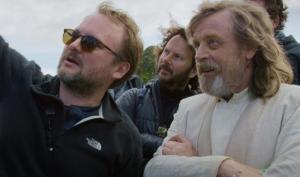
The Director and The Jedi spans the course of The Last Jedi’s creation and documentarian Anthony Wonke was clearly given full access to the production. In granting unfettered access to Wonke and his crew, Johnson seems to have been trying to pay it forward, and in doing so he’s given a huge gift to all Star Wars fans.

There are some really amazing moments captured in The Director and The Jedi, with a particular favourite of mine being the destruction of the Jedi library, especially seeing the creature designers lose their shit over meeting Frank Oz.  And really, who can blame them? After all, he’s probably the reason they got into that career, and maybe even the reason their jobs even exist!

Maybe, just maybe, one young Star Wars fan will be inspired by this film to become the next Rian Johnson or Barry Jenkins. But even if not, there will be something of interest in The Director and The Jedi for every kid who ever wanted to fly his or her own model X-Wing through the trench run.

SXSW: Social Animals

Instagram. It has 700 million users, and this documentary is the story of 3 of them.

Kaylyn Slevin is a self-discribed dancer, “beach girl”, and aspiring bikini model. She lives in her parents’ mansion and Instagrams herself rollerskating around its cavernous hallways.

MV5BYzc3YzBmM2QtNWJkNi00NDQ1LWI5YzEtNGNmN2I4YjU0N2U2XkEyXkFqcGdeQXVyMjM3NzQzNTk@._V1_Humza Deas grew up in the projects and has come into his own as an urban photographer. He discovered his passion with a broken iphone and now has a serious Insta following thanks to his beautiful images often captured with some risk and daredevil antics. But when he accidentally exposed the subculture, he got death threats.

Emma Crockett is a midwest high school student challenging boundaries and testing limits on Instagram. Her parents don’t allow dating until age 16 but that doesn’t stop her getting dozens of DMs from strangers asking for booty pics. It’s a new world with new kinds of bullying and harassment and one wrong foot meant that Emma had to leave her Christian school to escape the nastiness.

This documentary is probably must-see for anyone over 25 because OH MY GOD it’s eye-opening and panic-inducing. I do have an Instagram account but I use it for one thing and one thing only: proof of life when I have charge of my sister’s kids. That’s it. Watching this doc, I’ve discovered that there are rules to Instagram that I never knew and break flagrantly every time I use it. Never post more than one picture a day. Did you know that? Like I said, I’ll post a hundred pictures of the kids on a weekend away with them, and then nothing for the next month. Never post two selfies in a row. Did you know that? That one doesn’t apply to me since I’ve never taken a selfie and realized I don’t know how. And I suppose don’t care to know. But teenagers, they know. They take this shit seriously, looking for love, for acceptance, but also constantly comparing and dealing with jealousy and envy. And competing for likes! And followers. And fame.

Humza takes thoughtful, inspired photos and deserves to be known for his work and his artistry. Emma is a kid who needs hugs and understanding. With Instagram’s sole purpose seeming to make popularity extremely quantifiable, it’s a dangerous beast to tussle with, and has dire consequences for some. Kaylyn is also just a kid, one who has fallen head-first into the image-obsessed culture of Instagram. And this documentary really forces us to ask how self worth will be measured when how things look is the only thing that matters.


SXSW: The World Before Your Feet

Within the thousands of neighbourhoods in the five boroughs of New York City, there are 8,000 miles of streets, bridges, parks, beaches, and cemeteries to explore. For the past six years, 37 year-old Matt Green has been on a mission to walk every single one of them.

Go ahead and ask. He won’t mind. People ask him all the time. “Why?” He really doesn’t know, other than that he loves the city, wants to be doing this, and for reasons he can’t put his finger on he feels that he’s doing something important.

How does he find the time to do all this? He doesn’t have a job. “Are you like independently wealthy or something?” one skeptical onlooker asked. “No, I’m… I’m independently homeless”.

While following Green as he walks, couchsurfs, and catsits his ways around the city, director Jeremy Workman captures way too much beauty, detail, and history to be absorbed properly in a single viewing. And his documentary The World Before Your Feet will make you want to absorb every detail. That’s what Green’s journey and Workman’s film are all about. The beauty of travelling on foot, according to Green, is that you notice things. And with nothing to do but walk and take notice, he never misses a chance to stop to smell the roses, read the signs, and meet the people.

The World Before Your Feet can seem a little episodic at times but how can it not? Green has six years worth of photos, stories, and research to share and this delightful and inspiring documentary does its best to show and tell as much of it as it can. Green and Workman answer most of the hows and whys as well as they can but really this is a film about enjoying the moment which offers a whole lot of moments of its own for us to enjoy.