
When Matt and I were perusing the TIFF titles this year and came across Colette, we thought it must be this year’s Big Eyes (in which a husband, Christoph Waltz, takes credit for his brilliant wife’s, Amy Adams, paintings). We weren’t wrong, but we were giving Colette insufficient credit.
Colette (Keira Knightley) is a young country bumpkin who didn’t even know how to operate a snow-globe when she met her husband Willy (Dominic West), who dazzled her. He was a writer, worldly, enamoured with his own success and reputation. But the well is dry and they’re broke. To keep her husband happy and their household afloat, Colette sits down and writes a book about her own school girl experiences. Although Willy 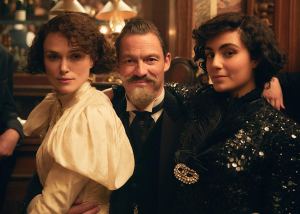 criticizes it for being too feminine and “full of adjectives” he signs his name to it and sends it off to be published. Of course it gets gobbled right up. Does Willy eat crow? He does not. He celebrates “his” success without a trace of irony and then gets mad at his wife for “implying” that she wrote it. Which, again, she did. This book does worlds better than any of his ever did so he’s eager to keep the gravy train going (imagine an actual gravy train! what a weird expression, especially since the carafe gravy is traditionally served in is called a boat). Anyway. He can’t help but lock her in a room until she produces another best-seller. It’s only logical! And she does. And when, oodles of success later, it begins to chafe and she suggests getting at least partial credit, her name alongside his, he bucks. Preposterous! Women writers don’t sell, he reminds her.
Living under those circumstances, it is perhaps not surprising that she explores her options, by which I mean, sleeps with women. She is emboldened, solely by the women in her life, to assert herself. And though the laws and the norms of the day prevent her from claiming all that she may, they also inspire her to finally break free from the leash that kept her bound to a husband who viewed her as a meal ticket, their marriage as a business transaction. Even a long leash chafes.
Keira Knightley has earned herself the crown for period films long hence, but finally she has found one that is worthy of her – or, better stated, a film that can maximize her limited gifts has found her. She sparkles here, breaking outside her box to march up a hill of empowerment. Colette is familiar but not generic. It relishes the vibrancy of the period, but it also embraces its grittiness. The messaging here is anything but subtle but it doesn’t take a gentle hand to sit back and hear her roar.

 But you know what? They should have been summoning their own self esteem instead. Nice men are fine, but it’s still assigning your own happiness to someone else. Agency, ladies!
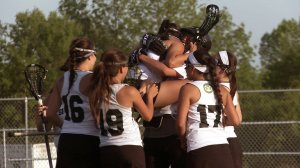 not just to their rivals, but to their own community as well. Lacrosse was born on their land, the Akwesasne Mohawk Territory, but it’s a game traditionally reserved for men. Considered a gift from their Creator, lacrosse was meant as a way for men to settle disputes among tribes. The community is split as to whether women should be allowed to play this sacred game at all. Some believe that like all surviving culture, theirs too must grow and change to meet the needs of the people. Others cling to tradition. But all agree that this game is medicinal and can be used for healing. When the girls play, they take it seriously; they too want to honour their culture. Is it really such an abomination to take up their Nation’s sport?
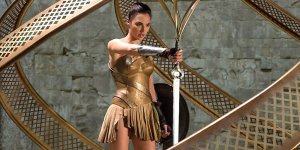 body. Her aunt Antiope (Robin Wright) is the fiercest of them all, the greatest warrior the Amazons have ever known, and she’s in charge of training. Though Diana’s mother Queen Hippolyta (Connie Nielsen) wants to protect her daughter and extend her childhood, Antiope teaches Diana in secret. Themyscira is hidden from mankind, but you never know when the enemy might arrive. Themyscira is lush and beautiful. Filmed on location in Italy, the production is fantastic. The opening scenes where the diverse population of Amazonian women are all training with Antiope are gorgeous. The fight choreography is top notch, with particular sequences slowed down to showcase athletic feats. But we all know utopia can’t last forever, and as soon as Diana (Gal Gadot) is grown, one man does penetrate their paradise: a pilot named Steve Trevor (Chris Pine) is shot down in their waters. Diana saves him from the wreckage but they’re pursued by Germans. An epic battle between Amazons and Germans unfolds on the beautiful beaches of Themyscira. The Amazons fight unlike anything anyone has ever seen, but the Germans are armed with guns and the Amazons suffer loss. Steve Trevor tells the women that the world is at war (WWI to be exact) and that millions of lives have already been lost. Aghast, Diana swears to accompany him back to where he came from so she can help bring peace, as is her sacred duty.
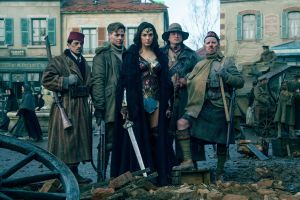 battle, there is no ego; they work together. The costumes are not sexualized as I feared, but instead they highlight muscular shoulders and toned legs. There can be no doubt that the Amazons are capable of truly anything. The fight sequences are among the best you’ve ever seen, the hand-to-hand combat precisely choreographed with as much grace as intensity. And it made me cry to see it. And I felt ashamed to cry, as a woman in 2017, ashamed that it’s taken this long to see a woman successfully take up the mantle of hero, and a woman behind the camera as well, capably directing a tentpole film. Patty Jenkins has so much unfair pressure placed on her shoulders but she’s made a movie that’s close to perfection, that far surpasses anything the DC Extended Universe has produced so far.
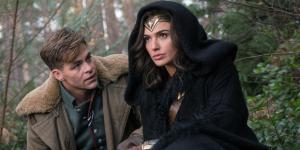 superhero. The action sequences in this film are among the best, a delight to watch, full of energy, strength and ferocity, as good and frankly better than the stuff we we’ve seen from other comic book movies lately. And arguably, the reason she’s so strong is because she welcomes her softer side. Believing in fighting honourably, while looking your enemy in the eye, Diana never picks up a gun. She runs toward machine guns with only a shield and her cuffs to protect her. And she fights from a place of love. Not duty, not fury, not patriotism or revenge. She fights because she loves. Male superheroes seem to think that love is a weakness, but Wonder Woman knows better: love is the greatest motivator you could ever have.
 And this might be the first ever case of me agreeing with studio interference, purely because the world needs more Ripleys. We admire her because she was tough and she was smart. I admire her, and Scott, because Ripley cried at work and it didn’t weaken her, didn’t sap her power.
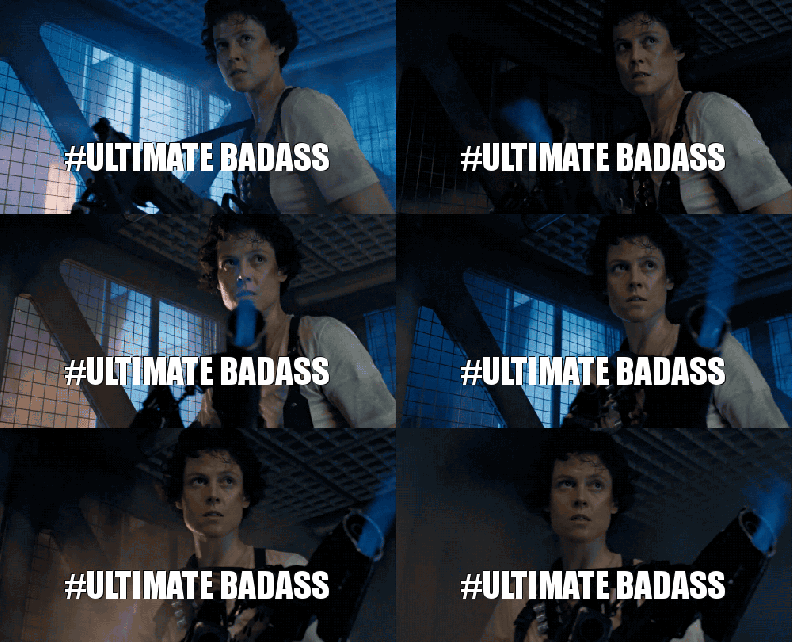 mechanisms. For many women, and many men, it’s just part of being human, part of having emotions, and most of us do not shut those emotions off at the start of our shift. 41% of women and 9% of men said they’d cried at work during the previous year and that it had made no difference in terms of their success (note: women have six times more prolactin – a hormone related to crying – than men).
 its violence. But Moana is called by the sea, and encouraged by her water-loving grandmother, she discovers that her ancestors were once voyagers who travelled the ocean in impressive “canoes” to find new islands to inhabit. With this in mind, she takes off on a self-taught sailing adventure to find the demi-god Maui and set things right for her ailing homeland.
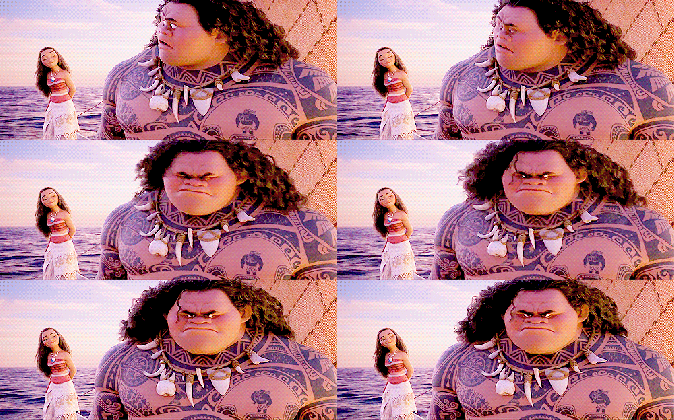 like Lilo & Stitch before it, should be celebrated for being a Hawaiian movie that actually features Hawaiian people (I’m looking at you,
  musical ventures. Jemaine Clement, playing a oversized crab, sings a song called Shiny which sounds an awful lot like something Flight of the Conchords would have done, though it is indeed written by Miranda (and performed with a David Bowie flair by Clement). And of course I’d be remiss if I didn’t mention the little girl (14 at the time of recording) who voices Moana herself, Auli’i Cravalho, who has a powerhouse of a voice, rich and full, and sounds authentic in the role too. I’m very glad to report that Disney cast this movie using a plethora of Polynesian performers, and it really pays off.
 read currents and measure the stars from the demi-god Maui, voiced by Dwayne Johnson. The animators do a really great job of bringing a few identifiable Johnson traits into Maui’s features, and Miranda carefully crafted a song that he could sing successfully, without having a traditional talent for singing (“You’re Welcome” is a heck of a song!). Maui’s body is covered in tattoos that represent acts of heroism, or particular challenges that he’s overcome. Unlike the rest of the computer-animated film, his tattoos are hand-drawn, and add an extra layer of fun to the story, as well as acting as his moral compass. Maui often pokes fun at
 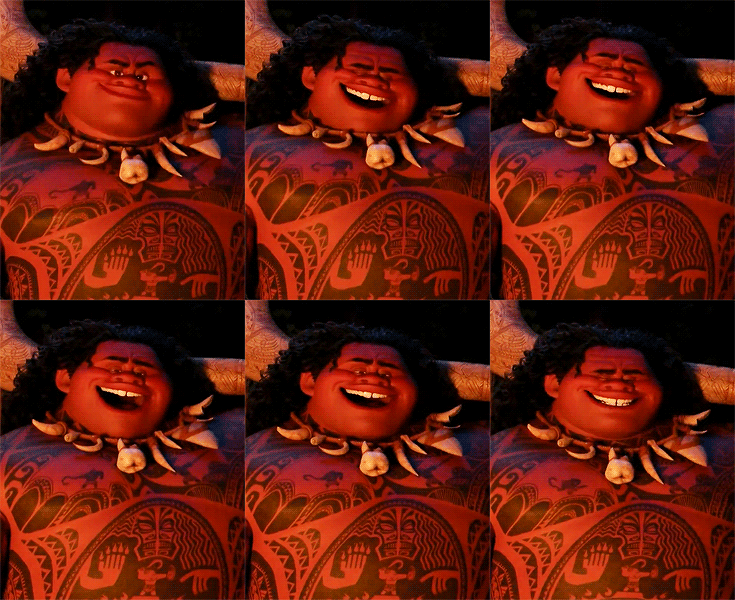 Moana’s insistence that she is “not a princess”, a self-aware bit of humour from a studio known for relying on certain formulas.
 desert and gives us female soldiers for company. Some of them have been given jobs in name only (Daffi is a “Paper and Shredding NCO” who spends most of her time beating the high score in Minesweeper) and most are counting down the days until they return to civilian life. Their officer, Rama, however, is trying to make this her career…
 The talking head interviews are culled extensively from the guest list of the 2015 festival, and include the likes of Toni Colette, Michael Moore, Patricia Clarkson, Judd Apatow, Mimi Leder, Paul Feig, Catherine Hardwicke, Angelica Huston, Jill Soloway, Mira Nair, and so many more.
 carpet when she broke out a sign reading ‘Budget the Baby’. She says “As an actor I can claim a massage or a facial but I can’t claim childcare. Actors are the most pampered people on sets. It’s the crews — the electricians, catering, camera people — who are often on set at 4am.” Hope Dickson Leach is a mother of two herself; you can imagine what a grueling 20 hour day on the set can mean to a family with young children.
 ASSHOLES WATCHING MOVIES