Tag Archives: Kick-ass!

Sunshine

50 years into the future, the sun is a dying star, and Earth will die along with it. We send a ship of astronauts to bomb the sun back into shining but the team goes awol somewhere out in the million miles of space. So we send another one, but this IS IT. Mankind’s last hope. We’ve officially mined all of Earth’s resources for this motherload. No pressure!

sunshine02The new team includes Rose Byrne, Chris Evans, and Cillian Murphy. They’re clearly already under stress when we meet them several years into their trip to the sun, but shit’s about to get a whole lot messier. Just as they’re approaching the most dangerous part of the mission, they receive a signal. It’s a ping from the lost ship. It’s been 7 years since anyone’s heard from them…they can’t still be alive, can they?

The crew debates whether they should divert their mission to find out. But this is not a democracy, the captain reminds them. They’re scientists, and he gives the decision to the person most qualified to make it, the ship’s physicist, played by Cillian Murphy. No matter what he decides, he’s fucked. No matter what he decides, his crew will hold him responsible for the lives and the mission he’s risked. Classic lose-lose scenario. Fun!

Okay, fun is the wrong word. Writer Alex Garland and director Danny Boyle are reteamed after Sunshine_spacesuitbring us The Beach and 28 Days Later. Danny Boyle has more recently done Slumdog Millionaire, 127 Hours, and Steve Jobs. Alex Garland wrote Ex Machina. These boys don’t do fun. They do: harrowing, intense, suspenseful. Sun-psychosis. The closer the ship gets to its goal, the more things fall apart. Fall apart literally and psychologically. And philosophically.
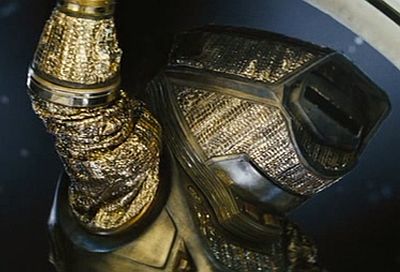
It starts out as an interesting, cerebral sci-fi adventure, on the lower end of the action scale, but not without daring stunts. But in Sunshine, getting closer to the sun is like getting closer to god. And reality unravels a bit like we’ve seen in Interstellar. Sunshine is ambitious. Boyle and Garland are asking us to consider some hot and heavy questions. Big Questions. Boyle manages to put story and character ahead of special effects, making this a very worthy, brainy, thoughtful entry into the sci-fi genre (and likely his last – he found this film to be extremely draining). The film makers actually want to make us understand what it’s like to get so close to our most glorious star. The increasingly fractured and subliminal scenes are almost reminiscent of some of the more hallucinogenic stuff from Boyle’s Trainspotting days, and the glimpses from inside sunshine-murphy-sunthe helmets of the striking gold space suits clutch at your throat. I had some very real autonomic responses to this film and I swear I could feel the heat. Boyle wisely uses actors who can take the heat and radiate some of their own. He even more wisely stays away from the love triangle cliché and sticks to things that feel very real for a set of humans staring into the sun and seeing their own deaths. There’s fear and panic and bravery and resolve.

If this movie was American, it would doubtless be a bunch of American cowboys being sent up with fireworks and catch phrases, but Sunshine includes an appropriately global response, which helps to underline the fact that in space, with human extinction on the line, there is no race or culture. It’s about those decisions to make sacrifices, to act for the greater good, to reach beyond which you think yourself capable. Sunshine stumbles in its final act – things get so weighty it seems to buckle a bit, but this remains a movie that is criminally underrated. Many thanks to my fellow film bloggers who pointed me toward this, and I hope maybe I’ve done the same for some of you.

Kubo And The Two Strings

A little dark, and a little melancholy for kids, but for me, near perfection.

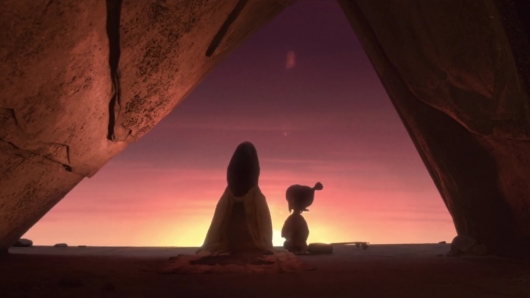
Kubo is a little boy with a magical, ancient Japanese banjo. Well, technically the banjo wasn’t ancient at the time – he lives in ancient Japan. And the banjo isn’t actually a banjo, it’s a shamisen. When he plays his magical shamisen, his origami comes to life and helps him tell awesome stories about warriors and samurai. He’s busking, essentially, and the captivated crowd rewards him with a few coins – a good thing because he provides for his sick mother, who lives outside the village in a cave.  When she’s not in a trance, she’s adamant that Kubo always return before sundown. It was surprisingly sound advice from the mentally ill because THE ONE TIME he doesn’t, hell breaks loose. Ancient Japanese hell.

kubo-and-the-two-strings-530x298Turns out, Kubo’s grandfather is some sort of Moon God. Grandfather has already “stolen” one of Kubo’s eyes and wants to get his hands on the other – in blindness, his grandson can join him in immortality, ruling the sky. He sends his 2 creepy daughters to do the dirty work while his 3rd daughter, Kubo’s mom, struggles to protect him with what little magic she has left.

The movie is a grand adventure with more beauty in any random 30 seconds than The Secret Life of Pets has in its entire running time. As usual with Laika productions (they brought you Coraline), there are darker feelings at play, a sometimes ominous and foreboding tone unusual in a children’s movie, and yet the kids in the audience seemed to tolerate it better than they did Pete’s Dragon. It’s a glorious act of story-telling that feels like something genuinely passed down for generations. Every time Kubo picks up his shamisen, be prepared for some of the loveliest music you’ll hear at the movies. It sweeps you up into the magic of his origami, and the whole thing feels alive and vibrant, steeped in a culture filled with divine tradition.

Kubo And The Two Strings is surprisingly well-balanced tonally, able to incorporate gags meant Kubo-and-the-Two-Strings-just for kids between bouts of horror, humour, and yes, tragedy. It’s quite brave, when you think of it. Suicide Squad pulled back on the Joker’s villainy, and Ben-Hur rewrote some of its savagery. This, a meticulously animated piece of art, has the backbone to trust children with some rather heavy themes. And it does it while also being the most visually arresting thing I’ve seen at the movies this year. It’s a spectacle, and a technical triumph. Having no wordly idea how they pulled some scenes off just adds to the magic. Laika is no stranger to Oscar nominations for animation, and is sure to earn another, but this movie demolishes even their own high bar. Laika doesn’t have the cachet of Pixar so politically, beating Finding Dory will be difficult. But the proof is on the big screen: it is undoubtedly the better film.

The Little Prince

A little girl has a bright future ahead of her. How do I know? She and her mother (Rachel McAdams) have her whole life planned out. A life plan so intense she’s more like her mother’s Senior VP than her daughter. Her mother’s best compliment: “You are going to make a wonderful grownup.”

But the crazy old man (Jeff Bridges) next door draws her out of her mature little shell with his fanciful inventions and his beautiful story-telling. His stories and drawings come to life in animation within the animation: the story of The Little Prince.

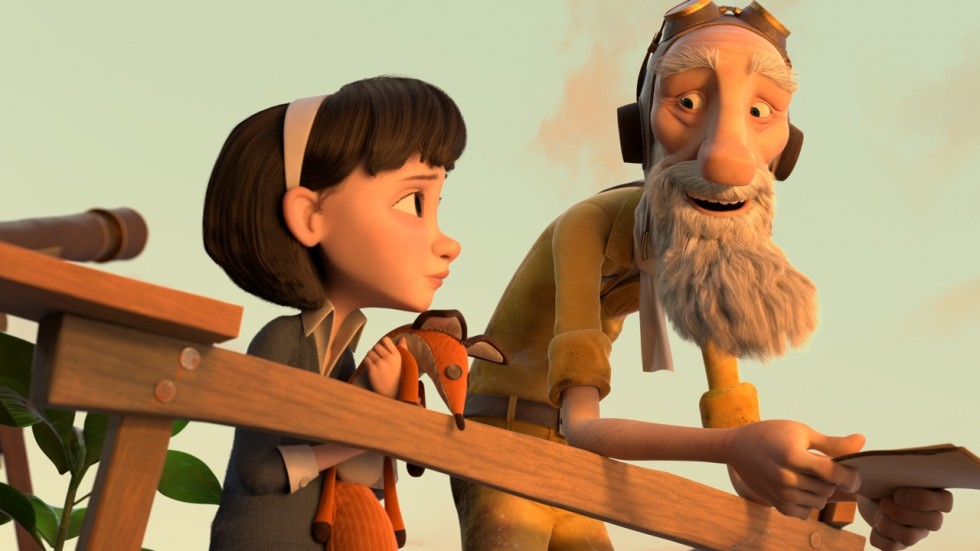
Growing up it was always Le Petit Prince to me, but even en anglais, the timeless story warms the heart. The main story, starring the little girl, and the crazy man’s story, starring the little prince, are distinguished with different styles of animation. The little girl is done in familiar CG style; the little prince is stop-motion, done not in clay but in paper. Both are lovely, 210b0b20-a7ab-11e5-88e2-828a3e695a05_1280x720but I confess a fondness for the nostalgia and simple loveliness of the latter.

The voice cast is incredible: Jeff Bridges, Paul Rudd, Albert Brooks, Marion Cotillard, Benicio Del Toro, and more. It’s a real testament to just how cherished the book is, around the world. The Little Prince is a sweet children’s book but it can be read and enjoyed by adults, with many layers of themes to interpret. The same goes for the movie, faithfully and lovingly adapted from its source.

The little girl, too grown up for her own good, rediscovers childhood lp-garden-rgb-5kthrough friendship with the batty old guy next door. But anyone who knows the story knows that along with sweetness, there is also sorrow. The first half of the movie is all poetry and imagination. The second half falters a bit when it gets further away from Saint-Exupéry’s ideas and ideals. The movie is a little less fanciful than the novella, a little more down to earth. But The Little Prince has always been the stuff of dreams, too good, too ethereal for Earth. It’s still lovely though. It’s still one of the loveliest things I’ve seen all summer.


Where To Invade Next

Michael Moore is a bit of a trial. He’s a ham who manages to insert quite a bit of himself into every documentary he makes, whether the subject warrants it or not (mostly not). I also think he’s a patriot in the truest sense of the word: he questions things, not to tear down the country he considers to be great, but to make it even greater.

Where To Invade Next sounds like another documentary about George W.’s cauv-s3ukaaf8io-1failed wars and his love of randomly selecting countries to pillage. It’s not. Moore is symbolically “invading” various European countries so that he may “steal” their best ideas and bring them home for implementation. He looks at labour rights, education, women’s reproductive health, the financial crisis, and prison systems – inarguably ALL things that the USA is currently getting wrong. Just all kinds of wrong. Moore visits countries to “pick their flowers”, not their weeds, and cherry picks the best reforms that seem workable and right.

And that’s the infuriating thing about Michael Moore. His methods aren’t exactly truthful, but he’s right. He’s not concerned about appearing unbiased. He doesn’t need to consider the other side. He presents things as he sees them, in a persuasive and personal way. Which is why Michael Moore is where-to-invade-next-body2perhaps the most well-known documentarian, at least in America. He makes documentaries that people care to watch. Hell, they sometimes even screen in theatres. Real theatres!

Unfortunately, Moore has never been good at converting people. Teaching us – sure. But he won’t convince anyone who’s not already on board. In Where to Invade Next, Moore visits 9 countries, and they’re all quite worthy. Unfortunately, some of the principles require more than 10 minutes worth of explanation. His ideas are sound, but like my math teachers would always tell me: show your work! Giving us the answers has only limited appeal. We want to know how you got there. This film is simply Socialism 101, a scratch-the-surface survey course with an affable, wheezy professor.

Nerve

No one’s more surprised than I am that I liked this movie. It received mixed reviews and I’m normally allergic to anything young adult, but for some reason, I enjoyed this movie. I’m assuming it’s because I’m much younger and hipper than my driver’s license would have you believe. Sure I don’t take selfies or speak emoji or know what “on fleek” means. I don’t constantly change my Instagram picture because I don’t have Instagram on my “new” (a year old) phone and I forgot my password anyway. I don’t bicycle ironically or wear nonprescription glasses or use a “lip kit.” I’m not saying I’m 17. But maybe a mature 21?

roberts-franco-a-scene-for-movie-nerve-05Nerve is about cool young kids who no doubt do all of the above. Emma Roberts plays Vee, the wallflower of her group of friends until she’s suddenly motivated to be bold, and signs up to play a new online game called Nerve.

The movie seems a little prescient now that Pokemon Go has swept the world off its feet. Nerve, however, is a little more intense than chasing Pikachu around a park. It basically consists of players and watchers. Players are fed increasingly difficult dares by popular vote of the watchers. The dares are good for cash, but ultimately it’s the number of watchers you attract, and your willingness\ability to hang in the game in the face of ever-escalating dares. Every dare has to be recorded live on your phone, and people anonymously peep. Vee’s first dare is to kiss a stranger for 5 seconds, and she does. It’s heart-pounding fun, exhilarating for a normally shy young woman. She’s proven her point: she’s not so boring after all. She’s ready to go home except the stranger she kissed is Ian (Dave Franco) and it turns out he’s playing too. Attracted and intrigued, they stick together long enough for the watchers to think of them as a couple and to start doubling up on their dares.

As you might have guessed, Nerve gets out of hand. How could daring teenagers to do stupid shit for money ever go wrong? And the movie takes some wrong turns too. The themes quickly become a little too on-the-nose. Teenagers are sheep. People do cruel things while hiding behind the anonymity of the Internet. Culturally we have become accustomed to witnessing the world through the filter of our phones. When shit goes down, half the bystanders will be taping, but how many will intervene?

Stylistically though, this movie is kind of beautiful. It looks sharp. And the pacing is excellent. hqdefaultThe directors do a good job of pulling us into the action and the thrills are in fact thrilling, doled out at decent intervals. And I quite liked the soundtrack, although I have no idea who any of the artists are.  The characters, unfortunately, are not quite on fleek. They’re pretty reliant on some very broad stereotypes: nerd\slut\dreamboat\jock\hacker\ wallflower.

The movie also suffers when it asks us to take one giant suspension of disbelief. The game is played on your phone. Players are constantly recording. BUT NOBODY’S PHONE EVER DIES. I call bullshit. I also don’t want to be around the morning after when everybody’s parents are hit with INSANE roaming bills.

But Nerve is a cool concept for a film and well-executed. It’s meant for a younger demographic but I think you fuddy-duddies will manage to decode its youth-speak. Just remember that by the time you finish reading this post, “on fleek” will be old news. “Snatched” is the new “fleek.” As in: SnatchedDave Franco, your short-sleeved dress shirt and skinny tie combo is SNATCHED. And if you really mean it, you add “boots” to the end, for emphasis. As in: Emma Roberts, your Wu-Tang rap skillz is dope BOOTS. And if you super duper admire something, you say “Goals AF” (AF = as fuck). As in: Dave Franco hanging over New York City on one arm? GOALS AF. “Stan” is the new word for superfan. I’m assuming it comes from Eminem’s song Stan about his crazed letter-writing fan, but since that song is roughly the same age as the characters in this movie, I could be wrong. You could call me a Stan if I’m geeking out about how much I love Meryl Streep in Florence Foster Jenkins, or you could say I’m stanning on her. And finally, you need to know about OTP. OTP is One True Pairing, as in, the couple you’re super emotionally invested in and would be devastated to learn they broke up. Like Jim & Pam. Or Pacey & Joey. Monica & Chandler. Luke & Lorelai. Zack & Kelly. Goddamn I’m old AF.

Anyway. The take away here is that this is not a terrible movie. It’s superficial but fun, a perfect Netflix and chill opportunity (technically I think if a guy asks you to Netflix and chill, he’s not planning on watching any movie, but let’s take this one at face value for now). And also feel you should remember that I am young and cool and snatched or something. You can take notes, but do not get caught reading them by anyone born 1990 or later. You’ll thank me someday. Boots.


Let us know who you’re stanning on these days, and who your OTP is.


Pete’s Dragon

Petes-Dragon-Featured-061320161I am old enough to feel like I should remember the original Pete’s Dragon (which was released in 1977). I know that I saw it as a kid but it definitely did not stick with me. Because of that, I would have had no expectations going into the 2016 version of Pete’s Dragon but for the very positive reviews it has been getting. The new Pete’s Dragon did not resonate with me to quite that degree, but it is a good family movie that I think kids will love. It also may make you wish you had a pet dragon.


Elliot the dragon is probably the best part of this movie and the reason I think kids will go head over heels for Pete’s Dragon. More dog than wild beast, he seems like the perfect companion if you’re stranded in the Pacific Northwest. Even if you’re only stranded metaphorically. Elliot can fly, he can turn invisible, and builds the best tree forts ever! What more could a kid ask for in a mythological friend?bigdragon.0

The human characters in Pete’s Dragon are far less compelling. All of them are one dimensional, existing only to contribute whatever is needed to move the story along.  Bryce Dallas Howard likes nature so she protects the dragon. BDH’s stepdaughter likes Pete so she helps. Karl Urban is BDH’s greedy and bored soon-to-be brother in law, who we know will learn a lesson by the end. Robert Redford is BDH’s father, the old guy who tells stories about the dragon and who fortunately can also drive an 18 wheeler. Wes Bentley is just kind of there because someone decided that BDH needed a fiance and the stepdaughter needed a father and Urban needed a brother.

I wanted more depth from these characters and maybe older kids will too. But ten-year-old me would not have cared one bit about character development when there’s a flying green dragon on display! A fantastic-looking, furry, CG dragon. The visuals in Pete’s Dragon are awesome, both when it comes to Elliot and when it comes to displaying the gorgeous forest/mountain vistas of the northern west coast. The combination of Elliot and the beautiful backdrops is more than enough to keep adults entertained, even with paper-thin characters at every turn.

petes-dragon-4Just don’t expect there to be a clear message. Lately, Disney (/Pixar) has been doing well at including big coherent themes in kids’s movies, from Inside Out to Zootopia to Finding Dory. There is no clear message here to be found.  There are environmental and family threads sewn but no coherent payoff is ever delivered.

Still, that’s not so much a complaint against Pete’s Dragon as a reminder that Disney (/Pixar) has given us some classics in the last year. Pete’s Dragon does not quite measure up to that high standard but it is still a good family movie and moreover, a movie that this childless adult greatly preferred to its polar opposite counterprogramming, the joyless Sausage Party.

Pete’s Dragon gets a score of seven fuzzy dragons out of ten.


Florence Foster Jenkins

Florence Foster Jenkins was a real woman, a patroness of the arts who supported almost all of New York’s musical endeavours and dedicated her life to her passion, singing. She was instructed by leading maestros and had orchestras and composers at her beck and call – her generous donations made sure of that.

Just one tiny hiccup: she couldn’t sing to save her life. Her singing was not unlike a dying florence-foster-jenkins-2016-meryl-streep.pngsquirrel’s trying to evacuate a burning building. Horrendous. But she had no flipping idea. Meryl Streep plays Florence with gusto. We all know Meryl can sing: she’s been in Mama Mia and Into The Woods. She’s got pipes. But in this movie she manages to unabashedly sound like someone took a hacksaw to those pipes and stuffed them full of gasoline-soaked rags. It’s stupendous. Her caterwauling never fails to get a laugh and it was amazing to me how long she could sustain that, how funny she could make the same joke, in slightly different, gutsy ways.
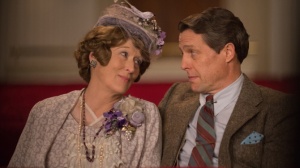
Hugh Grant plays Florence’s husband, St Clair, the man behind the “talent” who applauds her every croak and covers up the critics. Their love is tender but their relationship unique. It’s unusual to see a marriage so complex and interesting portrayed without judgement. Simon Helberg plays Mr. McMoon, the man engaged to be her accompanist. An able pianist, he struggles to attach his rising star to her pitiful performances, but it’s amazing how far money and connections will get you. Helberg, nearly unknown to me, creates a florence-foster-jenkins1memorable character of his own in the shadow of two much bigger leads, but he manages to earn his own laughs and distinguish himself.
Meryl Streep is an absolute star and she’ll be a big part of why you love this movie. She finds nuance in her tuneless moaning and clinches the laugh time and time again. I couldn’t help it, not that I must wanted to. And Hugh Grant is charming as ever, and dare I say, reaching beyond his usual repertoire to be worthy of The Streep. It works. They have a distinct, affectionate chemistry that you want to be a part of. Director Stephen Frears knows how to tell a sympathetic story without disempowering anyone.

I thought a lot about the American Idol contestants purposely selected for their awfulness so that we may bond in our mockery of them. Florence Foster Jenkins was a 1940s era William Hung. No one has ever had the courage or the temerity to tell her she’s bad, and so she persists, believing that she’s good. Maybe even great. But Streep pulls it off infectiously, plays delusional faith in herself with sweetness and not inconsiderable vulnerability.  And yet we anticipate her humiliation. Will she ever find out the truth? And who among us will be most devastated?

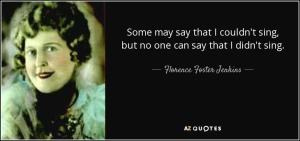
quote-some-may-say-that-i-couldn-t-sing-but-no-one-can-say-that-i-didn-t-sing-florence-foster-jenkins-78-98-56In truth, this film may not have a lot of staying power, unlike the lady herself who is remembered these 75 years later. She lived authentically, and those who loved her told the Good Lie. I was touched. Frears is careful to avoid cruelty, pushing the bounds of mockery and sincerity without ever overstepping, and so wins our respect. And frankly, so does Florence.

Indignation

Indignation is a film that demands for you to digest it.  Feeling more like a novel than a typical movie (fitting since it’s based on a book), Indignation is a story about star-crossed young lovers that’s not quite a love story.  It’s also very slow and very talky, which is apt because that mirrors freshman Marcus’ approach to life.  Marcus is a wanna-be lawyer who decides to leave Newark to attend school in Ohio.   And not just anindignation-sundance-review-logan-lermany school in any Ohio, this is a Christian school in 1951 Ohio, where attending chapel services is a required part of the curriculum.
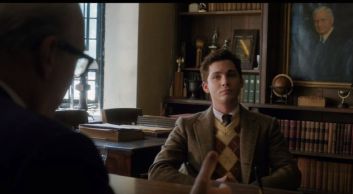
That requirement does not sit well with Marcus, because he’s not only from a Jewish family, he’s also an atheist.  Needless to say, he’s quite indignant about this whole thing, and he takes it so personally that you have to wonder why he thought attending this little Christian school was a good idea.  Perhaps it was the only school that offered him a scholarship?  Or maybe he just wanted to get as far away from the family butcher shop as possible.

Whatever brought him there, and despite his strenuous objection to the religious curriculum, he quickly warms to the school when he sees Olivia in his history class, and from there, a romance blooms.  Sort of.

This is going to sound very weird comi8-indignation-_05_2016-10_17_22ng from me, but I could have used a lot more romance than Indignation delivered.  I liked watching Marcus and Olivia deal with their issues.  It was a lot more real than what we usually get from romantic movies.  But too often, just as it was getting interesting between the pair, we’d cut to some other aspect of Marcus’ college life, seeing him ask important-sounding questions in class or arguing with the Dean or quarrelling with his two roommates.  Many of these other scenes halted the movie’s momentum without adding anything important, and as a result ended up feeling like unnecessary filler.

For anyone who has read the book (Jay?), I’d be interested in hearing whether you were more engaged by the parts of the movie that are just about Marcus, or whether they felt extraneous to you as well.

Even with that uneven momentum, there was a lot to like about Indignation and I would recommend it.  I particularly liked the film’s structure and the way the story was told.  Though it started slow, before too long Indignation engaged me and made me curious about where we would end up, especially once Marcus and Olivia met each other. I just wish the movie had been more focused on the two of them, but in the end, I got enough of their story to ensure that Indignation stuck in my head and made me think about fate and love and starry nights.


Tallulah

The last time Ellen Page and Allison Janney shared the (figurative) stage, it was in Juno: Page was the pregnant teen and Janney the surprisingly supporting stepmom. Now they’re reteamed in similarly maternal roles. Page plays a young drifter who kidnaps a baby, and Janney is the duped divorcee who believes herself to be a Grandma.

This is not a perfect movie by any means and yet you’re going to spend the next 4 minutes reading about its virtues. Why? Because this movie was written and directed by a woman Tallulah_Unit_00820R-1000x562(Sian Heder) and features three of the most complexly-written and -rendered female characters you’re going to see on the big (well small – it’s on Netflix) screen this year.

Although the movie goes through the obligatory police-crime drama, its focus is really on these 3 women and their relationship to the world. Tallulah and Margo in particular yearn to feel connected, to feel necessary to someone, but are terrified of what that means. To love so enormously is also to risk loss. Wanting to be needed can lead to feeling disposable. Carolyn, on the other hand (Tammy Blanchard), is the dismayed if distracted mother now missing one baby. Although her young child needs her very much, she neglects her in order to get those same feelings from a man. She ends up utterly alone – blamed, shamed, and full of regret.

The movie shifts tone rather abruptly – one minute Page and Janney are trading stiletto-sharp barbs, the next they’re unloading some Louis Vuitton-worthy emotional baggage. Page is a petite powerhouse and Janney an exceptionally talented opponent and the film is never better than when the two are struggling to find a path between their fierce independence and the need to show someone else their pain. Theirs is about as fucked up as a mother-daughter dynamic can get, but they come from such a real and honest place6840c860-4efc-11e6-86d5-59965f7b75f9_20160721_Tallulah_Dead you can’t help but be drawn in. I am so proud to tell you about a movie in which women are taking care of themselves, and taking care of each other, and finding strength, not weakness, in accepting help from others. It’s heartening, just fucking inspiring, to see women taking this leap on behalf of all of us: reach out. Connect. It’s scary and risky and worth it.


Editor’s note: this post was not intended as an endorsement of kidnapping. Back away from the baby.

Seoul Station

Standing outside Seoul’s central subway station, two young men are having a nice liberal chat. “I think there should be universal welfare,” one says  to the other. As if on cue, an old homeless man who is covered in blood comes staggering by. Concerned, one of the two men run to check on him but is quickly recoils from the smell. “I thought he was bleeding but he was just homeless,” he tells his friend.

So begins Seoul station, the first Korean animated zombie movie that I’ve ever seen. Though I was unsure of what to expect at first, it became immediately clear that this hilarious yet disturbing picture would have a lot more to say than the average episode of The Walking Dead. Because acclaimed director Sang-ho Yeon’s version of the zombie apocalypse seems to start with those who rely on the Seoul Station subway tunnels as a place to sleep, no one really seems to care at first and the infection is allowed to spread quickly. Unlike most zombie movies I’ve seen, we see the fall of civilization entirely through the eyes of pimps, prostitutes, and the homeless.

There aren’t many Zombie Kills of the Week in Seoul Station but the animation alone- surreal enough to be unique but realistic enough to keep it grounded when it counts- makes it stand out. As much as it has to say about the struggles of Seoul’s marginalized, this is not a movie without it’s guilty pleasures. There are enough close calls, creatively claustrophobic suspense, and hilariously over-the-top voice acting to work as a fun popcorn movie. It’s only unsettling once you let it sink in.