
You have to hand it to the patriarchy: they set up an entire society designed to oppress women, to deprive them of any meaning or purpose in their lives, and then they act all surprised when it drives them crazy.
Of course, Eugénie (Lou de Laâge) isn’t actually crazy, but she does speak to the dead. But even just nonconformity is reason enough to lock her up, and in the not-so-long-ago (1885), all you needed was one male relative to want to get rid of you, and a woman could be imprisoned in an insane asylum for life. Eugénie is in Salpêtrière, a Parisian asylum, where she befriends wins over a skeptical nurse, Geneviève (Mélanie Laurent). This nurse no-nonsense and scientifically inclined, but when her dead sister starts sending messages through Eugénie, even she must admit that this woman doesn’t belong here. Together, they plan Eugénie’s escape under the cover of Le bal des folles, the mad women’s ball.
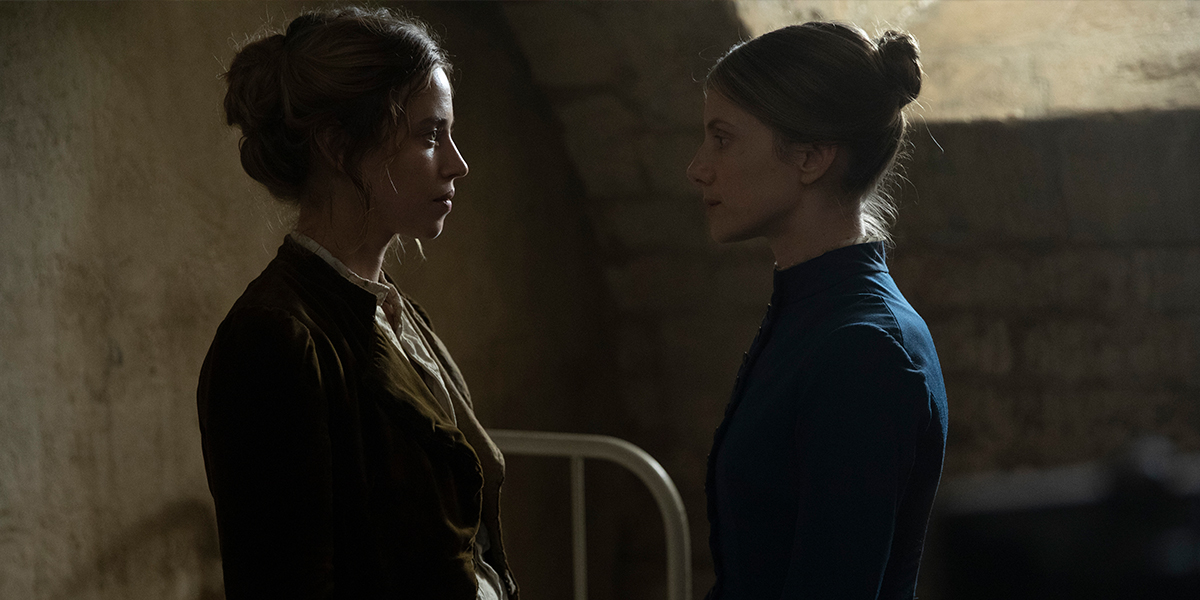
Unfortunately, though not surprisingly, this film is based on real events. Salpêtrière was a real asylum that locked up women and threw away the key based on some very flimsy excuses – and any who were actually crazy were mostly driven that way by the very men who committed them. The women were subjected to barbaric experiments, abused by staff, and the film (and the book upon which it is based) exposes the misogyny inherent in medicine at the time (not all of which has been eliminated today).
Thomas Jefferson once said “The measure of society is how it treats the weakest members,” a scathing indictment of himself, a slave owner, and every psychiatric hospital ever. The Mad Woman’s Ball was indeed a real event hosted ever year, inviting Paris’ high society to come and gawk at the mentally ill, all dressed up in cast-offs and costumes.
Mélanie Laurent writes and directs a story she makes seriously cinematic and strikes a timeless chord, showing the universality of society’s most interesting women being silenced, in board meetings or at the stake, but always one way or another. At the time, women were diagnosed “hysterical” for having an opinion; today she’s called “shrill” or “feminazi” or “sjw.” Bottom line: yes, there’s a message, a grimly timely one, but it’s also just a beautiful film that’s well-acted by an asylum’s worth of talented actresses, with a story to remember.
The Mad Women’s Ball (Le bal des folles) is an official 2021 selection of TIFF.
Look for it on Amazon Prime!

 Malkin (Oscar Isaac) and company manage to pick up Eichmann (Ben Kingsley) thanks in part to his indiscreet son who still hates Jews all the way from Argentina. They sweat it out in a safe house. For safe travel they require Eichmann’s signature, and Malkin vows to get it. The interrogation is heated; Eichmann is emotionally manipulative and he knows exactly which buttons to push. The agents have agreed to bring him back to Israel for a public trial, but not killing him proves to be a very big challenge for almost every single one of them. Eichmann knows this trial is not likely to rule in his favour, so he delays endlessly, which is also to the benefit of the Nazi rescue party determined to find him.
 of a biracial teenage girl struggling to survive in Nazi Germany, starring Amandla Stenberg and George Mackay.
 and hopefully plot some revenge. Of course, Roy’s zero-fucks lifestyle is not quite as becoming now that he’s got a ready-made family, but forgiving-and-forgetting isn’t really in Roy’s repertoire, or his boss’s, for that matter.
 shortage, they explore urban agriculture, microfarming, and permaculture. As to our reliance on fossil fuels, they visit places that are moving successfully toward renewable resources, cities declaring themselves carbon neutral. They also tackle some of the big things holding us back: economy and government. Since democracy runs on the steam of big business, how can we ever move away from consumerism?
 ASSHOLES WATCHING MOVIES