
If you’re looking for a spoiler-free review of the film, please see Matt’s excellent offering. I don’t want to ruin the movie for anyone, but if you’ve seen the film, then you understand the need to discuss it. It’s deeply affecting and disturbing and it’s one of the best things I’ve seen this year.
When Lee’s brother dies, the reclusive janitor reluctantly returns to his hometown to help out with the arrangements. He’s kept there longer than expected when he’s revealed to be his nephew’s new guardian.
Casey Affleck stars as Lee, a spook more than a man, a ghost still barely among the living, haunted by his past, carrying a huge burden of guilt, grief, and regret that we can almost physically see sitting atop his slumped shoulders. His performance is really restrained, as befits an emotionally blunted character. He manages to be subtle and to find lots of power in quiet moments. His performance will almost certainly be rewarded with an Oscar nomination, if not a win. What do you think his chances are? Did you see anyone out-act him this year? And what part do you think the allegations of sexual harassment against him will play in whether or not he wins?
Lee has a new life in a new town, though it’s pretty clearly only a half-life at best, given his physical and emotional isolation. During his questioning by the police, it’s clear that Lee feels he should be punished, and directly after he tries to take his own life. While clearly still trying to punish himself, do you think Lee is still suicidal? When he tells Patrick “I can’t beat this thing” – is he talking about depression, guilt, grief? His reputation? Or something else?
I thought the movie started off pretty slow, but looking back on it with context, I wonder if the lethargy was deliberately representative of Lee’s depression. The movie never says the D-word, but certainly exhibits all the Hallmarks: violent outbursts, hopelessness, emptiness, the inability to enjoy life or take pleasure from thinks you used to enjoy, pushing people away.
The idea for the story didn’t originate with writer-director Kenneth Lonergan: in fact, it was Matt Damon and John Krasinski who came to him with the idea and asked him to develop the script. Damon would star and direct. But conflicts with The Martian prohibited him from doing so, and they turned control of the movie over to Lonergan. Do you think Lonergan stands a chance for best screenplay, or for that matter, best director?
The script is often praised for its “masculinity” which rubs me the wrong way. I don’t think Lee’s refusal to deal with anything should be lauded in any way, and his continued self-torture isn’t exactly gender specific. But the story is told in a refreshingly sparse sort of way, where the lead character speaks only under duress, and as a little as possible. And so much is implied rather than spoken outright: the unspeakable things his ex wife said to him, the town’s rejection of him, his own struggle with addiction, his attachment to pain, his father’s death, the legal proceedings\media scrutiny that must have surrounded his case. Was there anything you felt the film missed? Any glaring holes you needed to see filled?
Some people felt the score was sufficiently bad to pull them out of some of the movie’s most impactful scenes (the house fire, in particular). Did you notice the score being good, bad, or ugly? Were there any stand-out supporting performances for you? Did you think the nephew, Patrick, was a realistic character? He really showcases the dark humour of the film, but sometimes I thought it odd how adult he seemed for a 15 year old.
We see Patrick trying to reconnect with his mother, who seems to have sobered up and carved out some sort of life with her new conservative Christian husband. But she’s not stable. She can’t handle things not going well. What purpose do you think this subplot served? Was it jarring or distracting for you to have Matthew Broderick in the role of her husband? Did you feel sympathy for the mother?
In the scene where Patrick’s girlfriend’s Mom comes out to Lee’s car to invite him for dinner and he says no, she responds that if he changes his mind in the next 10 minutes, “we’ll all be here”. The night of the fire, Lee remembered about the fireplace grate 10 minutes into his walk. He could have changed his mind, gone home, and his wife and kids would have all still been there. But he didn’t, and that scene is such a brutal reminder. What scene was the most emotionally engaging for you?
I think when Joe makes Lee the guardian, Joe is telling him: “You’re a good dad. I trust you with my kid. It’s not your fault.” And Lee can’t handle that. It’s too much like being absolved, and Lee cannot stand to be forgiven. In some ways, the guilt might be his only connection to his girls, and he’s unwilling to give it up. He doesn’t believe he deserves a second chance. Do you think there’s any hope for Lee?
Lee’s common refrain, uttered when things get too intense, is “Can we talk about this later?” only there is no later. We never see Lee deal openly with his emotions. He never lets us in. The audience is denied closure: how well has this film sat with you? Were you able to connect with a character who is so detached?
 I noticed that in flash back scenes with the 3 Chandler men aboard the boat, there was a big white pole stretched across the back of the craft, but in more recent scenes where just Lee and Patrick take to open waters, the pole is noticeably absent. Do you think this loss of a safety net is symbolic of anything else?
I felt like the film really addressed the ways in which we can judge parents. Clearly the town blames Lee for the accident that took the lives of his children. This is hammered home when he has a close call making dinner – he passes out and wakes up to an angry fire alarm. Some may see this as further evidence of his negligence, but who among us hasn’t made a similar mistake? Either way, it seems to be a catalyst for him giving up guardianship. Maybe it’s that his own self-doubt will never abate. One mistake proved fatal to his young family, and it’s clear that society has judged him harshly for it, perhaps because it makes us feel more insulated from our own mistakes. What really slapped me in the face though was when Lee is trying to make awkward conversation with Patrick’s girlfriend’s mother. I think she knows what is most likely going on in her daughter’s bedroom and she says something like “At least we know where they are.” Lee, however, knows damn well that kids are not necessarily safer in their own homes. No wonder he couldn’t get the conversation back on track. Even the most banal things paralyze him with fear. Remember how he overreacts when his nephew tries to exit the truck at the hospital when Lee thought he was meant to drive off? He admits that he just “gets scared” and his mind immediately goes to the worst possible scenario. In part, parenting often means confronting those fears. We try to keep our children safe but have to come to terms with the fact that we won’t always be there. Lee could have changed his mind just 10 minutes into his walk; 30 minutes later, his kids were dead. When he gets the phone call about his brother, he rushes to the hospital only to discover that Joe died an hour ago. He didn’t make it back on time. He wasn’t there. He couldn’t save him. There are so many near misses. But his reaction here is so real and raw. Do you think this sets the tone for the film? Does it foreshadow some of the later revelations?
One thing that I found very profound and very interesting is that the movie levels diseases. Three main characters suffer from disease: Kyle Chandler’s character from congenital heart disease, Casey Affleck’s from depression, and Gretchen Mol’s from addiction. None of them can “beat it.” But just as in real life, sympathy is usually only given to physical illness, whereas mental illness is stigmatized, and certainly here Joe is practically remembered as a saint whereas the other two are vilified.
We’re used to happy endings, or at least hopeful ones, but this one does little to console us. The ending is a bit abrupt, and just as bleak as the rest of the movie. Lee has sentenced himself to returning to the prison cell he’s built for himself. The only difference is that now he’s maybe possibly open to visitation. But could it have ended any other way?
In addition to discussing these points in the comments, feel free to ask your own questions, and to link to your own reviews.
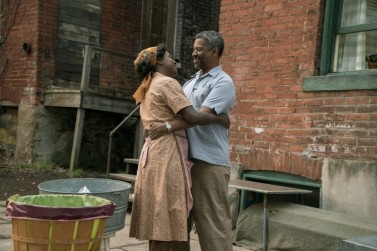 locations, but a movie doesn’t have such limitations. This one sticks closely to its confines, however, and as director, Denzel Washington uses a series of tight shots to further the exposition. The characters, and Washington’s in particular, are talky, prone to excessively lengthy essays that explore 1950s racial tensions in relation to their lives.
 has made a fantastic film about family, grief, and how easy it is to push people away when we’re hurting. It’s one of 2016’s best films not because it has any particularly new ideas or innovative style but simply because it’s refreshingly honest.
 Moonlight is the quietest tour de force I’ve probably ever seen. Never have I rooted for a drug dealer in this way, and never have I sympathized so much with a kid who wanted to follow in that drug dealer’s footsteps. Moonlight is spectacular in its simplicity. It is also entirely different than the movie I expected.
 Chiron’s adolescence is the subject of three tightly focused vignettes. It’s a wonderful storytelling choice that perfectly explains Chiron’s choices as he grows up, without having to engage in any exposition. Moonlight is brave in many ways but to me it’s the choice to let us figure things out for ourselves that makes this film great. It makes the journey more fulfilling, the experience more real, and greatly increases our empathy for Chiron. Moonlight helps us understand Chiron to a degree that I would not have thought possible. Regardless of your race, wealth, or sexual orientation, we are all a lot like Chiron.
 Alex Hibbert, Ashton Sanders and Trevante Rhodes each take remarkable turns as Chiron and the extent to which they feel like the same person is incredible. Mahershala Ali is not the only other actor deserving of mention (the supporting cast is consistently great) but for my money his performance as the aforementioned drug dealer shapes Chiron’s life and makes us understand his growth to a degree that is virtually unmatched in film.
 . Really, really good.
 I struggle to communicate what it is that works so well about American Honey. My writer’s block was so bad that I went to see it a second time, quite a commitment with its 163-minute running time. All I’ve really learnt from two sittings is that writer-director Andre Arnold creates a believable world around these characters and makes it easy for the audience to feel like they’re a part of it. (Well, maybe I should just speak for myself. At my first screening, the film had lost over half its audience by the end).
 any number of traditions and rituals that are often somehow both unsettling and charming. Their favourite songs, games, and chants serve the film well in helping create a subculture that we can believe and relate to. Beautifully naturalistic performances from an exceptionally well-chosen cast, great choice of music, and some terrific (though sometimes elf-indulgent) cinematography help bring their world to life.
 A tired old Sheriff is flooded with disturbing memories at the site of an old accident. Can he bear it? Can you?
 Lion tells the true story of a 5 year old Indian boy named Saroo. Separated from his brother one night, he falls asleep on a train and wakes up miles away from his home, his family, from people who speak his language. He survives on his own for weeks before being thrown into an orphanage and then shipped down to an Australian family who adopt him.
 task but Saroo is miraculously lucky. Off he goes to India, to see if he can locate any family near the place he once called home.
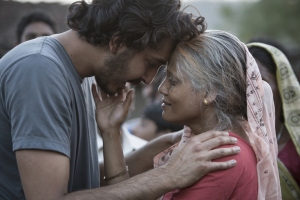 the screen. It literally is just a guy staring a screen night after night for weeks, months, years. He’s moody and emotional in between, throwing his relationship (with Rooney Mara, in an underwritten role) onto the rocks. Nicole Kidman gives an admittedly strong and stirring performance as his mother and helps bridge the gap, but there’s a marked lag until Patel goes back to India.
 aliens, she’s the one who listens well enough to actually crack the code. And it’s a hell of a code, unlike anything our puny human brains can really comprehend. This deep gulf of understanding makes plenty of people nervous – people with their fingers hovering over big red buttons. Annihilation-type buttons. Dr. Banks puts her own life at risk to keep things from escalating to an out-and-out global (universal? galaxal?) war.
 arresting. It works in synchronicity with a hauntingly beautiful score by Jóhann Jóhannsson. Twinned together they remind you that though the plot feels startlingly realistic for a sci-fi film, there’s something otherworldly at play. Young’s work is atmospheric, Jóhannsson’s is pulsating.
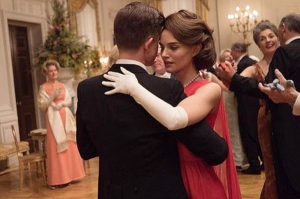 Larrain thought to himself, what if it was the other way around. What if he was sitting beside her? And in that thought was born a beautifully conceived film that puts its female character front and centre.
 precise and offers up tantalizing looks behind the closed doors of Camelot.
 ASSHOLES WATCHING MOVIES