Keanu is not just a dark haired, sunglasses wearing Canadian. He’s also a kitten with a rare disease: cuteness. Or so we are led to believe by Comedy Central duo Key and Peele, playing cousins who would do anything to get Keanu back after he’s kitten-napped by a gang of street toughs led by the one and only Method Man. And so goes Keanu, a film that takes the two cousins from one life-threatening situation to the next, in pursuit of a cat.
Being a dog owner, I am duty bound to object to the whole premise. This movie would have been a million times more believable if Keanu was a dog. Cats are too cold and cranky for you to want to chase one all over Los Angeles. Deep down you know that cat doesn’t care about you at all. So if you lose a cat in real life, you just put up a poster and call it a day. But for a dog, that’s different. If your dog gets lost you don’t look for an hour and then call it quits. You get your ass out there and you find that fucking dog!
Poor pet choice aside, Key and Peele’s adventure is an entertaining one. While there are not a ton of belly laughs, there are a lot of memorable scenes, including a fantastic George Michael singalong and some hilarious movie-themed cat pictures.
There is also something refreshing about seeing these normal guys (who happen to be black) play with stereotypes, not only with their choice of music but also with their attempts to fit in with a plethora of cat-loving gang members. That element of satire is a welcome improvement on Hollywood’s usual reliance on racial tropes.
Writers Jordan Peele and Alex Rubens deserve a ton of credit for departing from that formula. Keanu successfully subverts the usual tropes and shows that the stereotypes we cling to are an unconscious attempt to fit into a role rather than being innate characteristics. And that’s why this dog-lover enjoyed a movie about a kitten, because it’s not really about a kitten at all.
Melissa McCarthy was given the coveted Comedic Genius popcorn statue at the MTV movie awards this weekend, the first female to ever take home the honour. Of her historic status, she said “I am certainly, certainly not the first one to deserve it.”
McCarthy is, in fact, a tour de force, and “not afraid to be the butt of the joke” according to her speech (invaluable advice from her mother). She’s a frickin national treasure who keeps making very mediocre movies. What gives?
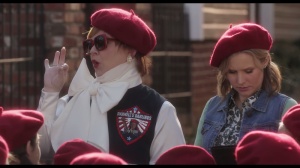
Paul Feig knows how to handle McCarthy – he directed her to breakout success in Bridesmaids, replicated it with The Heat, and wrote for her beautifully in Spy. But McCarthy keeps sneaking in movies between those triumphs, movies she ostensibly has a hand in writing herself, along with husband Ben Falcone, and those ones tend to crash and burn with big fat flames. That said, Melissa McCarthy has never had a flop. Of her worst-reviewed films, Tammy made $85M, and Identity Thief took in $135M. The Boss will likely nestle among them critically, but it was McCarthy who finally unseated Batman v Superman at the box office this weekend. Someone’s buying tickets.
I am buying tickets. I love her. I’ve loved her since her stint on Gilmore Girls (and am thrilled that she’ll return for the reboot). But falling in love with her on Gilmore Girls means I like her at her bubbly, beautiful best, not as the slob who falls down stairs. And I tend to think that Paul Feig, and most of the film going public, agree with me. The gags and the prat falls are beneath her. We’re tired of such juvenile physical comedy. She’s already proven that she’s better than it, and capable of so much more.
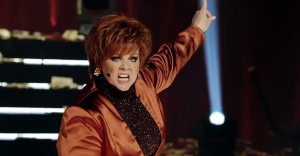
I can’t tell you that The Boss is a great movie, because it’s not. It’s totally uneven. But the thing about “uneven” is that it’s not universally bad either. In fact, it gave me the giggles (Her opening number? A delight. She had me at T-Pain). But then she’d get launched across the room again, her face splat against some unforgiving surface, and I’d be shaking my head again.
Melissa McCarthy is charming and lovable. She’s got great timing and she recruits some very talented co-stars (Kathy Bates being a particular favourite of mine). She’s not a buffoon, and any movie that attempts to make her into one isn’t going to cut it for me. I needed a little taste of McCarthy to get me through this godforsaken, unending winter (I know it’s spring, but try telling that to my home underneath 3 feet of snow) and I got it. The Boss is unsatisfying, leaving me doubly impatient for this summer’s Ghostbusters reboot – luckily, with Paul Feig at the helm. I have every confidence that she’s going to deliver exactly what I’m hoping for, and here’s why. The big, brash McCarthy character? It’s being played by Leslie Jones. Melissa taking on a straighter character, and I bet that will suit me just fine.
My first encounter with the life of Frank W. Abagnale, Jr. was accidental. I was about 5 or 6, poking around the house, when I came across a book cover that instantly imprinted on me:
I didn’t read it then, because I couldn’t read a 50 page book before my short little attention span made me want to “look at” ants through a magnifying glass or something similarly fun. And I never ended up reading it at any time in the next three decades. It’s probably still sitting in my parents’ bookshelf, and as a kid I would have read it ten times over if I had just read a different page every time I picked it up instead of just looking at the creepy faceless man on the cover over and over again. But really, the cover was enough for me to draw my own conclusions about how this “amazing true story” turned out. And it was not until this week that I learned how wrong I was all these years.
My biggest mistake was thinking that this story centred around the fact that this guy actually had no face and that’s why he needed the pilot mask. Symbolism was lost on me then (and probably still is to this day). It turns out that this guy had a normal face, wrote a lot of bad cheques, and for some reason the key to his scheme was pretending to be a pilot.
I found that part of the story absolutely amazing. Most of all because I feel like it’s probably true. Pilots in the 1960s were gods among men. They were the paragon of success and reliability. So much so that a pilot’s uniform changed Frank Jr.’s cheque scams from fruitless endeavours to an avalanche of other peoples’ money. Can you imagine this happening today? It seems as likely as an apparently successful model taking a cheque in exchange for turning tricks. Which, as I learned, also happened in this true story.
Incidentally, that successful model was played by Jennifer Garner. Catch Me If You Can is full of soon-to-be-stars making cameos, including Amy Adams, Elizabeth Banks and Ellen Pompeo. Add Christopher Walken, Tom Hanks, Martin Sheen, and Leonardo DiCaprio, and you’ve got a pretty impressive cast. And the director, Steven Spielberg, is no slouch either.
Maybe all these young faces are the reason that watching Catch Me If You Can felt doubly nostalgic. As only a movie set in the good old days can, the movie puts a bright sunny face on $2.5 million worth of cheque fraud, where if you go big enough then inevitably the FBI will negotiate your release from prison so they can offer you a job. And those good old days now seem to be either the 1960s, when this movie is set, or the early 2000s, pre-financial crisis, when this movie was made.
Catch Me If You Can is an entertaining movie that remains enjoyable mainly because it fully embraces its ludicrous premise. If it took itself more seriously, it may still have worked in those good old days but by now probably would have lost its luster, as I think we are now too jaded to be charmed by ultra-rich assholes who think the rules don’t apply to them (with Donald Trump being an obvious and unfortunate exception).
But Spielberg and DiCaprio didn’t ask me to like Abagnale. Instead, they gave me a kid who figured out how to do one thing really well but who was terrible at every other aspect of life, a guy I almost felt sorry for, and that was a brilliant choice. Add Tom Hanks as an opponent/father figure who by the end of the movie sees right through Abagnale, and you get a movie I should have watched long before now, especially when it has been sitting on our DVD shelf since Jay and I moved in together. Things might have been different if the DVD cover had a man with no face – because then I would undoubtedly have picked it up long ago. That was Dreamworks’ one misstep.
Catch Me If You Can gets a score of nine giddy stewardesses out of ten.
Just when you thought the title of this movie was as pretentious as it could get, Zack Snyder delivers a pre-movie PSA on spoilers. I was offended. What else is the internet for aside from spoilers and porn? And since Snyder and crew spoiled some key parts about this movie in the title (namely the Batman VERSUS Superman part) and trailers (revealing the big bad guy), it was doubly ridiculous to waste time on a PSA that I could have spent watching a post-credits scene (SPOILER ALERT: THERE ISN’T ONE).
There’s really not much to spoil anyway. Batman v. Superman: Dawn of Justice is exactly what you’d expect. The script is so cookie cutter and routine that the writers could skip exposition or backstory whenever convenient (and they take full advantage). But don’t worry, Batman fans! SPOILER ALERT: you will get to see Thomas and Martha Wayne get gunned down outside a movie theatre. Because we haven’t seen that often enough…
At least we don’t rehash Superman’s origin (thank Krypton). But (SPOILER ALERT) we don’t get any hint of Lex Luthor’s origin or his motivations, other than (SPOILER ALERT) he’s evil and crazy and rich and smart and an orphan. It’s the same way with Wonder Woman – the no-origin part, not the evil crazy rich smart orphan part (as far as I know). That left me to guess as to why Lex hated everyone to the point he was willing to cause the destruction of Metropolis and Gotham (which, SPOILER ALERT, are right next to each other in a very lazy move by the writers), and why a literal greek goddess (I’m assuming) is conveniently hanging out in these twin cities waiting for an opportunity to (SPOILER ALERT) don her metal bathing suit.
One final SPOILER ALERT: despite all its issues, Batman v. Superman is actually fun in its brainless way. Batman’s costumes look great, the much-anticipated fight between the two titular characters is awesome, and the stakes are suitably high by the final battle that Wonder Woman’s participation feels like a necessary deus ex machina (and seeing all three on screen together was worth the price of admission).
So if nothing else, Batman v. Superman accomplishes its objective. It made me want to see the Justice League movie. A lot. And despite my griping, Batman v. Superman is not nearly as bad a film as many critics would have you believe. I mean, it’s your typical trashy comic book movie but it delivers exactly what it promised. Judge it as art if you want, and on that scale it fails, but so does every Marvel movie! Genre fatigue is the only reason I can think of to explain the backlash, and to that I say: if you are tired of superhero movies, you will not enjoy this film. But you also won’t enjoy any “critically acclaimed” superhero movies past, present or future. And if you are still up for more, well, see this one, and then start saving your money for May’s double feature of Captain America: Civil War and X-Men: Apocalypse. Both of which will probably be much better reviewed EVEN THOUGH THEY WILL BE THE SAME EXACT MOVIE AS BATMAN V. SUPERMAN. Critical scores are so meaningless.
And on that note, Batman v. Superman: Dawn of Justice gets a score of seven holy trinities out of ten.
You may have heard that Sean Parker is hoping to get his latest venture, Screening Room, into your living room sometime soon. What is it? It’s a little black box that you’d have to purchase for, say, $150, and that box would enable you to spend yet more money! Sound good?
For about $50, you’d get to watch a new movie in your home on the day it’s released in theatres. No more waiting for months for it to be out “on video”. Throw a few bucks at the problem, and there you are, eating snacks you bought for a reasonable price at the grocery store, pressing pause to pee, with all the elbow room you can finagle from your spouse and your dogs, and even a faux-fur throw to keep you cozy on the couch. You don’t even have to wear pants!* (presumably – no guarantee)
But don’t worry: if you love the experience of sitting in a theatre with a few hundred gassy strangers, that option is still open to you, because cinemas aren’t going anywhere. So either way, you’re covered.
Unless James Cameron has a say, and since he believes he does, he’s already said it. Cameron, along with his producing partner Jon Landau, have said they’re “committed to the sanctity of the in-theatre experience” which sounds a little creepy seeing how we’re talking about a dark room with sticky floors and seating that I’m afraid might have lice. “We don’t understand why the industry would want to provide audiences an incentive to skip the best form to experience the art that we work so hard to create.”
You seriously don’t understand it? You don’t understand that $50, while pricey, is still a bargain compared to an average night out at the movies? That inflated prices are keeping people away from your precious “art” and that with the rise in quality of home theatres, your sacred blue people will view just as well at home, and more comfortably. I’m sure Van Gogh isn’t thrilled that his most famous paintings are reproduced on coffee mugs, but do you hear him complaining? No. Because not everyone can afford a trip to New York City to the Museum of Modern Art, where The Starry Night is currently displayed (price of admission: $25). So now the masses can enjoy works of Van Gogh just about everywhere – on shower curtains, on umbrellas, on postcards, and Google. If Van Gogh can be a big boy about it, James Cameron, so can you.
Steven Spielberg, Martin Scorsese, Brian Grazer, Ron Howard, J.J. Abrams, and Peter Jackson all support the technology, becoming stakeholders in the company. So this is causing quite a rift in the film community, a real Hollywood civil war, if you will. And what gives – don’t Spielberg and Abrams direct the same kind of blockbuster movies that demand big screens?
Sure they do. And tent pole movies like Star Wars: The Force Awakens will continue to see lots of people swarming to cinemas to have their bones rattled and their eyeballs go dry. But smaller movies struggle to get any theatre release at all. Often I’ll mention a movie I think is great and people write “sounds good, but that will never come to my small town!” and that’s true – if your small town has a 6-theatre Cineplex, chances are, 4 of those screens are playing the super hero movie, one is playing an animated film for families, and then you have just 1 screen left to divide up between all the worthy films.
M. Night Shyamalan, who nobody asked but still likes to pretend he’s relevant in the world of movies, came down decidedly against the startup. “I am completely against the Screening Room. Film is one of our last communal art forms. There are other ways to experience art on your phone and laptop. But cinema is a group of strangers sharing stories and it belongs in a theater. Once filmmakers and theater owners open the door to this idea, there is no going back. The movie going experience is something to fight for! Watching a movie by yourself & watching a movie in a theater are two very different experiences. Film is meant to bring people together.”
The worst thing is, I don’t even really disagree with him. That’s why I still go to movies, like all the frickin time. But “bring people together?” C’mon, man, let’s be real, unless by “bring people together” you mean communally shushing someone, because how dare some random movie goer talk over an important plot point of Transformers? I’ve been to movies that are made funnier because the whole audience is laughing together. I’ve been to movies where the audience spontaneously burst into applause at the end because we were so moved. But I’ve been to too many movies where I’m disturbed by someone’s candy wrappers, hacking coughs, crying kids, deep abiding need to state obvious, observable facts, and an increasing inability to sit for 90 minutes without checking their goddamned phones. Is that part of your “art”, M. Night?
Movie attendance is down, way down, and all theatre owners can think to do is keep jacking up prices without offering a more pleasant experience. The people are already downloading the movies illegally just to avoid overpaying for a subpar experience – why not offer a legal service that will fill the need? Peter Jackson feels that while he opposed other similar ventures, he’s behind Screening Room because it doesn’t “cannibalize” theatres – “Screening Room is very carefully designed to capture an audience that does not currently go to the cinema.” And that’s a pretty big audience. Because movie watchers aren’t just people who prefer theatres or not, they’re also made up of people who don’t have a choice. I missed a bunch of movies when I had back surgery and was attached to too many machines to travel. I still miss them intermittently (and always have, and always will) when my back is acting up and I don’t want to risk those shitty chairs. Parents with young kids who can’t get a babysitter will rejoice. Canadians who get snowed in or iced out will benefit. And people who are immobile, and families that deal with all kinds of physical and mental health problems who just aren’t able to tolerate a public theatre. Shouldn’t they have a venue for great “art” too?
Adam Sandler is not everyone’s cup of tea. His movies tend toward the juvenile and so lots of people give him a wide berth at the box office. But to know Adam Sandler is to love him; in actors’ circles, he’s known as the nicest guy in Hollywood.
A little shy, Sandler does as little press as he can get away with, almost no print, and only very occasional talk show appearances, which he usually does in character. As the head of his production company, Happy Madison, things are a little different. He’s the affable and humble centre of an awful lot of industry, loyally employing friends and family on projects skewered by critics but beloved by audiences. Sandler’s movies haven’t been box office juggernauts in years, but they are consistent earners, and his name has continually if quietly stayed among the top earners of Hollywood for the past two decades.
Sandler’s early success meant he could start doing things his way, and he’s surrounded himself with the same cast of characters, working with the directors and writers he trusts, to say nothing of the famous faces appearing in his movies. Always grateful to Saturday Night Live as his diving board to fame (he was discovered by Dennis Miller), he employs not just the SNL alums he worked with (David Spade, Rob Schneider, Chris Rock, Norm MacDonald) but many besides (Will Forte, Andy Samberg, Dan Aykroyd, Kevin Nealon, Rachel Dratch). He attracts big names to his movies (Jack Nicholson, Harvey Keitel), but always finds room for old friends (Allen Covert, Peter Dante), Sandler mainstays (Henry Winkler, Kevin James, Steve Buscemi), and his own wife and daughters.
One such person who can never get enough is Drew Barrymore. In her 2015 memoir Wildflower, Barrymore describes begging for a chance to meet him after her good friend Tamra Davis (director of Billy Madison) raved about him. Barrymore was certain of his “goodness” and felt they should pair up despite them being complete opposites in their early 20s, “like a preppy and a punk set up on a bad blind date.” Her pitch worked: pretty soon he came calling with a little movie called The Wedding Singer in his pocket. Written by Sandler groupie Tim Herlihy, it was given an uncredited polish by Sandler’s friend and former roommate, Judd Apatow (another guy famous for working with a loyal crew, including Sandler himself of course, most notably on Funny People) and Carrie Fisher, to give equal weight to the feminine side. The movie was a hit, with Drew certifiably falling in love with the Sandler crew, calling them “real, no-bullshit friends” which I take is a high compliment in Hollywood.
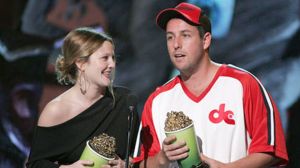
People loved The Wedding Singer for many reasons – the 80s nostalgia, the cheesy music, but above all, the incredible chemistry between Adam and Drew (she refers to him as her “cinematic soulmate”).
Always intending to work with Sandler again, Barrymore knew they couldn’t settle for anything less than the greatness they’d already achieved. But life moved on. Drew worked intensely on a Penny Marshall movie called Riding in Cars with Boys, and it was around that time that she came across a romantic script that she thought was a great fit for her production company, Flower Films. Unfortunately that script was a hot commodity, and it kept changing hands, with big directors and stars attached, never becoming available to her, despite numerous attempts. Until one day she heard that it had landed at Adam’s studio, Happy Madison. By this time they each had an office just a few hundred feet apart on the Sony lot (she was doing Charlie’s Angels), so he was easy to hound. Sandler was already turning it into a comedy but welcomed Drew on board not only as a co-star but also as co-producer, and she’s responsible for keeping the important elements of the love story, the parts that turned us all to mush.
Adam and Drew took the Seattle drama and laid it out in Hawaii instead, each bringing their production families to paradise and basically turning the island into a happy party (so happy that her Angels co-star Cameron Diaz came to visit and never left). 50 First Dates opened on Valentine’s day, and I was there, butt in the seat, and actually watched it twice (the projector broke down half way through, and we had to star the thing over from the beginning). They broke records that opening weekend; I’m not the only one who finds these two irresistible.
It would be another decade before they reunited on-screen again, with The Wedding Singer director Frank Coraci back at the helm for a movie about modern families called Blended. This movie would be proof of how far they each had come, personally and professionally, since first meeting as successful, hard-partying kids in the 90s. Sandler, once a “bad boy of SNL” now has a reputation for being a family man. He has always been quick to attribute credit to his parents (his highest-grossing comedy album named for them, Stan & Judy’s kid, and even one of Chris Rock’s albums a tribute to Sandler’s late father). By this time Adam and Drew had 3 daughters between them and the whole crew headed to Africa, families in tow. Barrymore has downshifted on her acting career since becoming a mother, finding it hard to strike the balance, but an Adam Sandler film “celebrates wives and kids” and she was able to make a family adventure out of it, even discovering on her last day of shooting that she was pregnant with a second daughter.
Still the best of friends, Adam and Drew now attend each other’s kids’ birthday parties (2 daughters apiece – Sadie and Sunnie for him, Olive and Frankie for her) and talk about their next project, whatever that may be, joking that they’ll still be making romantic comedies when they’re old and gray. (In fact, during press for the movie Blended, Adam made a very pregnant Drew cry when he sang the precious The Wedding Singer song to her “I Want to Grow Old With You”).
No matter what it is, I know I’ll be in line to see it. These two are cute as can be when they’re together, and Drew knows why: “I once knew a boy named Adam. And I hoped that we could be a team, but what I found was a true partner. I now know a man named Adam, and trust me when I say, he is as great as you want him to be.”
In 2006, Disney purchased Pixar for the equivalent of $7.4 billion dollars. It’s becoming more and more clear how good a deal that was for Disney. Every Disney animated movie since has been amazing, from Wreck-It-Ralph to Frozen to Big Hero 6. Not only is Zootopia another success for Disney, it may be the best of the bunch since John Lasseter and Pixar came on board, and that’s probably the best endorsement I can give.
The best part of Disney Animation’s renaissance is that these movies aren’t just for kids. They’re as enjoyable for adults as for little ones. Zootopia, for example, includes a spot-on reference to Breaking Bad! Striking that balance must be incredibly hard but Disney has picked up the torch from Pixar in that area and is doing it as well as Pixar ever did. Zootopia is literally a movie that all ages will enjoy. So it’s one up on LEGO!
Most importantly, Zootopia’s underlying message is timely and may be more important for adults than kids at this point, given the horror that is theU.S.Republicanparty’snominationprocess. We as Canadians dealt with some of the same terribleness in our recent election so it’s not just an American tactic. Fortunately, enough of us were able to reject fear and demonization of minority groups to choose someone who wants to bring us together instead of tearing us apart. We really, really, really want to believe American voters will do the same (just like they’ve done in the last two presidential elections). Please don’t let us down!
As for Zootopia, it is a movie that will definitely not let you down. It’s smart, funny and deep and you should totally see it. I give Zootopia a score of ten sly rabbits out of ten.
I have been trying to make sense of 10 Cloverfield Lane for months, from the moment I saw the title of this movie at the end of its trailer. And after seeing the movie I’m still searching for answers.
Hinting at a connection between this movie and Cloverfield was probably not the best idea that J.J. Abrams has had. Cloverfield massively disappointed me. It seemed like a great concept, putting the camera in the middle of monster-created chaos, but Cloverfield ended up being your typical found footage crapfest from start to finish. So to suggest this is a sequel or prequel or some other form of spinoff was a weird choice, especially because the trailer for 10 Cloverfield Lane contained no hint of a connection between it and Cloverfield other than the similar name (and thankfully also contained NO FOUND FOOTAGE).
[SPOILERS AHEAD]
The common name is not a coincidence but it was a terrible idea. It ruined what might otherwise have been a nice twist two-thirds of the way through 10 Cloverfield Lane. To paraphrase Shakespeare, this same movie by a different name would have been just as mediocre, but at least the title wouldn’t have tipped off the audience that there was more outside the bunker to be afraid of than a lady with a melted face.
So if you’re making this movie, why tip your hand in the title? Does the Cloverfield brand really have that much value? Am I the only one who disliked that movie? I mean, I totally hated The Visit and others apparently thought it was good. So I’m open to the possibility that a similar thing happened with Cloverfield, but I would be surprised. Tell me whether or not you’re with me in the comments but know that I’m judging you based on your response.
[END SPOILERS]
It felt good to get that out of my system and now I think I can focus on 10 Cloverfield Lane as its own movie. In two words: don’t bother. The group of 13 year old girls sitting behind us couldn’t take it seriously and neither could I. There are way too many disparate elements at work and as a result the movie is disjointed from beginning to end. There’s nothing remotely redeeming or original here.
If end-of-the-world movies were drinks, 10 Cloverfield Lane would be a glass of three random types of bar-rail liquor, served to guests without a taste test. So it’s only fitting that 10 Cloverfield Lane gets a score of three bottles of cheap scotch out of ten.
“Hey everyone.” With those two simple words, the latest trailer for Captain America: Civil War reminded me that Spider-Man is my all-time favourite superhero, hands down, and made it clear that I have to drag Jay to yet another superhero movie.
My love of Spidey started as a six year old who could not stop watching the 1960s cartoon, the one where Spider-Man would swing across the same three weirdly coloured sky backgrounds with no real need for anything to swing from (he swung across the Everglades at one point, above all the trees)! I am humming the theme song right now and hopefully so are you. I truly can’t imagine a better intro to a cartoon or a better gateway drug into the world of comic book consumerism.
Then came the comic books themselves. I still remember getting my first Spider-Man comic like it was yesterday. My parents bought it for me and it was, of course, a battle between Spidey and Doctor Octopus, where Spider-Man ends up saving Doc Ock at the end, because that’s what Spidey does.
From there, I was hooked. As I got older and realized that comics cost money, I supported my habit with paper route earnings. I wasted a bit of time buying Superman comics but quickly wised up and returned to Spider-Man. Though not quickly enough, as by the time I started buying Todd McFarlane-era Spider-Man comics, it was the height of the comic book speculation boom and some of them cost $20 each (which was a lot to a paperboy).
Of course, the market crashed soon afterwards but by that time I had moved on to playing sports, though occasionally I still drew my own comics until I got suspended from high school for it (seriously).
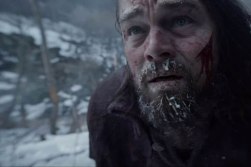
The nominees for the 2016 Academy Award for best makeup and hairstyling are few: Love Larson & Eva von Bahr for The 100-Year-Old Man Who Climbed Out the Window and Disappeared; Lesley Vanderwalt, Elka Wardega & Damian Martin for Mad Max: Fury Road; and Sian Grigg, Duncan Jarman & Robert Pandini for The Revenant.
The Revenant:
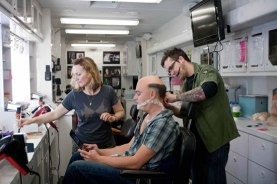
Jarman: Sian and I were working on “Suffragette” — we were actually doing the scene outside the Houses of Parliament at the time. She mentioned that she had been given the script for “The Revenant” and would I be interested in doing the prosthetics. She has been Leo’s make-up artist since “Titanic,” and I have made prosthetics for him since “The Aviator.” We flew out to L.A. a week or so later to have our first meeting with [director Alejandro G. Iñárritu]. I have done a lot of blood gags on films like “Saving Private Ryan” and “Band of Brothers.” But it was the idea of taking that out of the studio environment and into some really harsh terrain and temperatures that really interested me.
Grigg: I have to say the whole film was a huge challenge, knowing that the make-up was so integral to explaining (fur trapper Hugh Glass’) journey and recovery. If his make-up was not convincingly natural, then it could undermine the film. You have to believe he has been savagely attacked by the bear, that his wounds have turned gangrenous, that they recover in the sweat lodge and that he has real ice in his beard — not paraffin wax — and frost nip on his face and lips — not prosthetics pieces. If it starts to look like make-up at any time, you could take the audience out of the immersive quality of the film; it’s staggering how Alejandro and (D.P. Emmanuel Lubezki) manage to make you feel like you are there in the film with Glass, not just watching him on the screen. You even start to feel cold so the naturalism of the make-up is integral and essential.
Inarritu insisted that the wounds not only look realistic, but also appear to bleed freely – and then be stitched up by actors in the same long take. Impossible you say? To make this happen, the makeup artists used copious amounts of fake blood, created silicone neck equipment that could “bubble and bleed” and added wig lace that could be “stitched” back together by Leo’s cast mates. Poor Leo had to lie in freezing mud connected to dozens of blood lines, covered in cold blood for hours. But it looks damn real in the movie.
The 100-Year-Old Man Who Climbed Out the Window and Disappeared:
The 100 year old man is portrayed in the film by a well-known comedic actor less than half that age. Larson & von Bahr were apprehensive about taking on the task. “When they called us, we thought, ‘Thank you so much for asking us, but no thank you,’” said Larson. “It’s such a hard thing to do with a character in daylight. It’s a suicide mission. If we failed, we would never get a job again.”
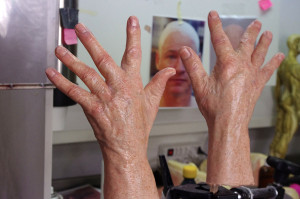
It took four and a half hours to get the actor into 100-year-old mode. “We started off with a back of his neck,” she explained, “a front piece, a neck piece, silicone baldcap, which covered his whole forehead and eyebrows. The edge included parts of his upper eyelids. We added cheek pieces, an upper lip, a chin, a nose piece and ear pieces, as well as lace eyebrows that were laid and lace sideburns. The whole baldcap was punched with strands of hair individually. We didn’t use any lace pieces on the baldcap. He had contact lenses made by the Reel Eye Company in the U.K. and vacuum-form pieces for his teeth that looked more gray and old-ish – really thin but pretty much like dentures with a 0.2mm thick plastic layer. It doesn’t affect his speech and you can tint and color them.”
“All the pre-paint was mainly done with silicone paint mixed with oil paint and a Paasche brush utilizing spackling techniques, layers and layers,” Larson stated. “In the trailer, I added castor oil, airbrushed with a Paasche airbrush. If you add castor oil to the Illustrator colors, it becomes a bit more flexible. Then, we added all of the fine details and sealed it with silicone caulking.” Silicone caulking guys – imagine sitting through that! (Well, technically, Matt and I almost can – if you missed the piece where we sit through our own makeup ordeal, check it out.)
Mad Max: Fury Road:
In total the makeup, hair and special effects personnel were a 35 strong crew, headed by Lesley Vanderwalt who knew she wanted Damian Martin as her prosthetics guy. A typical day on the set meant doing “60-120 of the background ‘War Boys’, mainly stuntmen, and about 8-10 close-up War Boys in prosthetics in the tent. We would allow 2.5-3 hours for prosthetics and two hours for the background boys, stunt doubles and picture doubles.” The make-up team actually taught the War Boys actors how to do their own makeup as director George Miller wanted them to be able to individualize their own looks. It must have been grueling to do so many looks on so many people, but the real challenging was getting the make-up to stand up in the desert conditions without getting lots of gritty sand stuck in it – keeping the War Boys white in such a dirty environment was near-impossible, she insists.
You may remember from the movie that the Max\Furiosa team encounter lots of different tribes during their trek out in the desert, and Vanderwalt remembers being inspired by “the oil fields in Angola, the workers of Salgado, the rubbish heaps in the Philippines, and other bleak environments. I also looked at African tribal and Indian religious festivals and Polynesian and Maori scarification.” All the tattoos sported by Max and the like are obviously makeup applications as well, not to mention the horrific genetic anomalies that many characters sport. The most time-consuming of all the characters was the old lady who was covered in tattoos, Miss Giddy. It took a 6 hour application to get her fully coated, done the day before, and the actress (Jennifer Hagan) would have to sleep in them – very carefully! Now that’s dedication.
Which team would you give the Oscar to?
Check out our spotlight on the costume design race, and be sure to follow us on Sunday as we live-tweet our Oscar party @assholemovies .

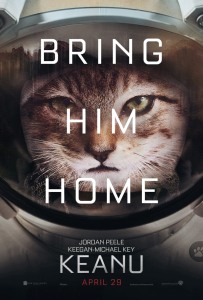 Keanu is not just a dark haired, sunglasses wearing Canadian. He’s also a kitten with a rare disease: cuteness. Or so we are led to believe by Comedy Central duo Key and Peele, playing cousins who would do anything to get Keanu back after he’s kitten-napped by a gang of street toughs led by the one and only Method Man. And so goes Keanu, a film that takes the two cousins from one life-threatening situation to the next, in pursuit of a cat.
 in real life, you just put up a poster and call it a day. But for a dog, that’s different. If your dog gets lost you don’t look for an hour and then call it quits. You get your ass out there and you find that fucking dog!


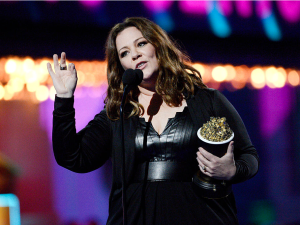 McCarthy is, in fact, a tour de force, and “not afraid to be the butt of the joke” according to her speech (invaluable advice from her mother). She’s a frickin national treasure who keeps making very mediocre movies. What gives?
 (and am thrilled that she’ll return for the reboot). But falling in love with her on Gilmore Girls means I like her at her bubbly, beautiful best, not as the slob who falls down stairs. And I tend to think that Paul Feig, and most of the film going public, agree with me. The gags and the prat falls are beneath her. We’re tired of such juvenile physical comedy. She’s already proven that she’s better than it, and capable of so much more.
 I can’t tell you that The Boss is a great movie, because it’s not. It’s totally uneven. But the thing about “uneven” is that it’s not universally bad either. In fact, it gave me the giggles (Her opening number? A delight. She had me at T-Pain). But then she’d get launched across the room again, her face splat against some unforgiving surface, and I’d be shaking my head again.
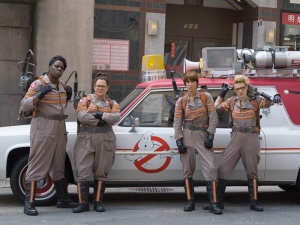 I got it. The Boss is unsatisfying, leaving me doubly impatient for this summer’s Ghostbusters reboot – luckily, with Paul Feig at the helm. I have every confidence that she’s going to deliver exactly what I’m hoping for, and here’s why. The big, brash McCarthy character? It’s being played by Leslie Jones. Melissa taking on a straighter character, and I bet that will suit me just fine.
 Just when you thought the title of this movie was as pretentious as it could get, Zack Snyder delivers a pre-movie PSA on spoilers. I was offended. What else is the internet for aside from spoilers and porn? And since Snyder and crew spoiled some key parts about this movie in the title (namely the Batman VERSUS Superman part) and trailers (revealing the big bad guy), it was doubly ridiculous to waste time on a PSA that I could have spent watching a post-credits scene (SPOILER ALERT: THERE ISN’T ONE).
 At least we don’t rehash Superman’s origin (thank Krypton). But (SPOILER ALERT) we don’t get any hint of Lex Luthor’s origin or his motivations, other than (SPOILER ALERT) he’s evil and crazy and rich and smart and an orphan. It’s the same way with Wonder Woman – the no-origin part, not the evil crazy rich smart orphan part (as far as I know). That left me to guess as to why Lex hated everyone to the point he was willing to cause the destruction of Metropolis and Gotham (which, SPOILER ALERT, are right next to each other in a very lazy move by the writers), and why a literal greek goddess (I’m assuming) is conveniently hanging out in these twin cities waiting for an opportunity to (SPOILER ALERT) don her
  So if nothing else, Batman v. Superman accomplishes its objective. It made me want to see the
  agle from your spouse and your dogs, and even a faux-fur throw to keep you cozy on the couch. You don’t even have to wear pants!* (presumably – no guarantee)
 they’re “committed to the sanctity of the in-theatre experience” which sounds a little creepy seeing how we’re talking about a dark room with sticky floors and seating that I’m afraid might have lice. “We don’t understand why the industry would want to provide audiences an incentive to skip the best form to experience the art that we work so hard to create.”
 the rise in quality of home theatres, your sacred blue people will view just as well at home, and more comfortably. I’m sure Van Gogh isn’t thrilled that his most famous paintings are reproduced on coffee mugs, but do you hear him complaining? No. Because not everyone can afford a trip to New York City to the Museum of Modern Art, where The Starry Night is currently displayed (price of admission: $25). So now the masses can enjoy works of Van Gogh just about everywhere – on shower curtains, on umbrellas, on postcards, and Google. If Van Gogh can be a big boy about it, James Cameron, so can you.
 cinema is a group of strangers sharing stories and it belongs in a theater. Once filmmakers and theater owners open the door to this idea, there is no going back. The movie going experience is something to fight for! Watching a movie by yourself & watching a movie in a theater are two very different experiences. Film is meant to bring people together.”
 where the audience spontaneously burst into applause at the end because we were so moved. But I’ve been to too many movies where I’m disturbed by someone’s candy wrappers, hacking coughs, crying kids, deep abiding need to state obvious, observable facts, and an increasing inability to sit for 90 minutes without checking their goddamned phones. Is that part of your “art”, M. Night?
 Screening Room because it doesn’t “cannibalize” theatres – “Screening Room is very carefully designed to capture an audience that does not currently go to the cinema.” And that’s a pretty big audience. Because movie watchers aren’t just people who prefer theatres or not, they’re also made up of people who don’t have a choice. I missed a bunch of movies when I had back surgery and was attached to too many machines to travel. I still miss them intermittently (and always have, and always will) when my back is acting up and I don’t want to risk those shitty chairs. Parents with young kids who can’t get a babysitter will rejoice. Canadians who get snowed in or iced out will benefit. And people who are immobile, and families that deal with all kinds of physical and mental health problems who just aren’t able to tolerate a public theatre. Shouldn’t they have a venue for great “art” too?
 One such person who can never get enough is Drew Barrymore. In her 2015 memoir Wildflower, Barrymore describes begging for a chance to meet him after her good friend Tamra Davis (director of Billy Madison) raved about him. Barrymore was certain of his “goodness” and felt they should pair up despite them being complete opposites in their early 20s, “like a preppy and a punk set up on a bad blind date.” Her pitch worked: pretty soon he came calling with a little movie called
  The Wedding Singer in his pocket. Written by Sandler groupie Tim Herlihy, it was given an uncredited polish by Sandler’s friend and former roommate, Judd Apatow (another guy famous for working with a loyal crew, including Sandler himself of course, most notably on Funny People) and Carrie Fisher, to give equal weight to the feminine side. The movie was a hit, with Drew certifiably falling in love with the Sandler crew, calling them “real, no-bullshit friends” which I take is a high compliment in Hollywood.
 moved on. Drew worked intensely on a Penny Marshall movie called Riding in Cars with Boys, and it was around that time that she came across a romantic script that she thought was a great fit for her production company, Flower Films. Unfortunately that script was a hot commodity, and it kept changing hands, with big directors and stars attached, never becoming available to her, despite numerous attempts. Until one day she heard that it had landed at Adam’s studio, Happy Madison. By this time they each had an office just a few hundred feet apart on the Sony lot (she was doing Charlie’s Angels), so he was easy to hound. Sandler was already turning
 it into a comedy but welcomed Drew on board not only as a co-star but also as co-producer, and she’s responsible for keeping the important elements of the love story, the parts that turned us all to mush.
 broke records that opening weekend; I’m not the only one who finds these two irresistible.
 wives and kids” and she was able to make a family adventure out of it, even discovering on her last day of shooting that she was pregnant with a second daughter.
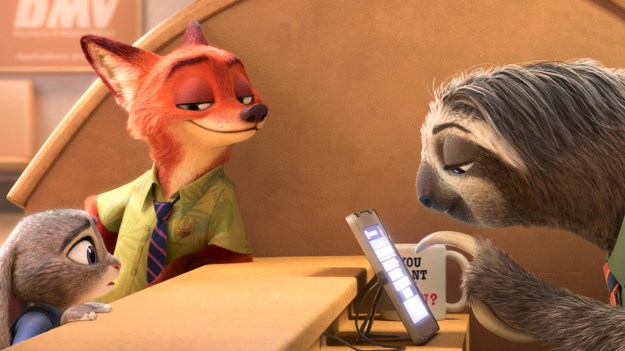 In 2006, Disney purchased Pixar for the equivalent of $7.4 billion dollars. It’s becoming more and more clear how good a deal that was for Disney. Every Disney animated movie since has been amazing, from Wreck-It-Ralph to
  Not only is Zootopia another success for Disney, it may be the best of the bunch since John Lasseter and Pixar came on board, and that’s probably the best endorsement I can give.
 Disney has picked up the torch from Pixar in that area and is doing it as well as Pixar ever did. Zootopia is literally a movie that all ages will enjoy. So it’s one up on LEGO!
 choose someone who wants to
 h no real need for anything to swing from (he swung across the Everglades at one point, above all the trees)! I am humming the theme song right now and hopefully so are you. I truly can’t imagine a better intro to a cartoon or a better gateway drug into the world of comic book consumerism.
 Jarman: Sian and I were working on “Suffragette” — we were actually doing the scene outside the Houses of Parliament at the time. She mentioned that she had been given the script for “The Revenant” and would I be interested in doing the prosthetics. She has been Leo’s make-up artist since “Titanic,” and I have made prosthetics for him since “The Aviator.” We flew out to L.A. a week or so later to have our first meeting with [director Alejandro G. Iñárritu]. I have done a lot of blood gags on films like “Saving Private Ryan” and “Band of
  Brothers.” But it was the idea of taking that out of the studio environment and into some really harsh terrain and temperatures that really interested me.
 lodge and that he has real ice in his beard — not paraffin wax — and frost nip on his face and lips — not prosthetics pieces. If it starts to look like make-up at any time, you could take the audience out of the immersive quality of the film; it’s staggering how Alejandro and (D.P. Emmanuel Lubezki) manage to make you feel like you are there in the film with Glass, not just watching him on the screen. You even start to feel cold so the naturalism of the make-up is integral and essential.
 Impossible you say? To make this happen, the makeup artists used copious amounts of fake blood, created silicone neck equipment that could “bubble and bleed” and added wig lace that could be “stitched” back together by Leo’s cast mates. Poor Leo had to lie in freezing mud connected to dozens of blood lines, covered in cold blood for hours. But it looks damn real in the movie.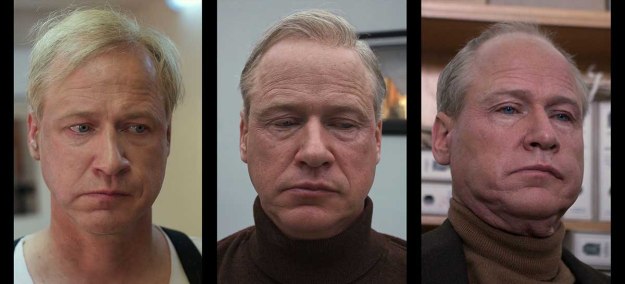
 added cheek pieces, an upper lip, a chin, a nose piece and ear pieces, as well as lace eyebrows that were laid and lace sideburns. The whole baldcap was punched with strands of hair individually. We didn’t use any lace pieces on the baldcap. He had contact lenses made by the Reel Eye Company in the U.K. and vacuum-form pieces for his teeth that looked more gray and old-ish – really thin but pretty much like dentures with a 0.2mm thick plastic layer. It doesn’t affect his speech and you can tint and color them.”
 stated. “In the trailer, I added castor oil, airbrushed with a Paasche airbrush. If you add castor oil to the Illustrator colors, it becomes a bit more flexible. Then, we added all of the fine details and sealed it with silicone caulking.” Silicone caulking guys – imagine sitting through that! (Well, technically, Matt and I almost can – if you missed the piece where we sit through our own makeup ordeal,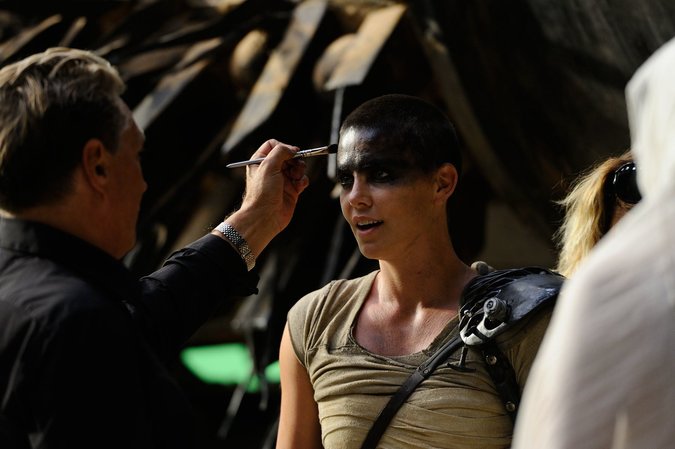



 ASSHOLES WATCHING MOVIES