Tag Archives: queer cinema

Inside Out Film Festival

hr_1986_IO_2015OttawaFestival_websitebannerNot to be confused with the latest Pixar offering, Inside Out is a not-for-profit film festival that runs in both Toronto and Ottawa and showcases movies from around the world that are made by or about the LGBT community. Access to queer cinema is a big draw in the community, as evidenced by a packed house at the Bytowne and the enthusiastic applause that ended the night. Inside Out screened The Girl King earlier this week, which you may know we took in a few days ago at another film festival. That’s right. We hit up two film festivals this weekend alone.

We did catch a screening of Fourth Man Out, about a small-town car mechanic who comes out to his best friends on his 24th birthday. They promise him that their relationship won’t change…famous last words. Because things fucking change. Of course they do. The quartet of young actors are greatfourth-man-out together, but I’m not going to call this a bromance because I think that word cheapens and mocks friendship between men. They are good friends, and Adam’s coming out does mark a big transition for the group – although it’s someone on the outside who has to remind them that this is not really about how hard it is for them. The movie is legitimately funny and accessible, but as Matt pointed out, feels a bit dated. “It’s okay that our friend is gay” feels like something that should have been made 15 years ago, and if it’s taken this long for a movie like this to get made, that’s a sad commentary indeed and even more justification for festivals like this to exist.

Another movie that we haven’t begun to talk about yet is Mississippi Grind, which Sean and I saw at the New Hampshire Film Festival (a third festival, but that was last week, keep up!). Mississippi Grind is about a chronic gambler (Ben Mendelsohn) who meets a human good luck charm, or so he MSGbelieves (Ryan Reynolds), who bankrolls his new loser buddy on a redemptive road trip. They scheme to travel the country together raking in the big bucks, but let’s remember that gambling is a serious addiction, and these people never know when to quit, and, voila: you know this isn’t going to get a happy ending. Ben Mendelsohn is great, and as much as I loved him in Animal Kingdom, it’s nice to see him in such a nuanced role; he seems quite comfortable straddling the line between pathetic and hopeful. Ryan Reynolds is at his best, which is nowhere near what Mendelsohn is doing, but he’s in his comfort zone so this odd pairing works on a strictly chemistry level. The script is loose and leisurely, maybe too leisurely for its genre, but I enjoyed its unpredictability and defiance of the expected arc.

TIFF 2015: Closet Monster

closet monster 2

The world premiere of Closet Monster, which screened on Sunday as part of TIFF’s Discovery program, was a heart-wrenching experience and I don’t just mean the film itself. Director Stephen Dunn wept openly when asked whether his first feature film was auto-biographical in any way and recounted the story of a hate crime that happened in the Newfoundland town that he grew up in and the fear of his own sexuality that it instilled in him.

Described by the TIFF website as “a coming-of-age (and out-of-the-closet) story”, this small Canadian drama is as much about living with trauma as it is about coming out. Oscar (Connor Jessup) witnessed a brutal hate crime growing up similar to the one described by Dunn and the memory has haunted him ever since. As he is terrified to discover that he himself may be gay, every sexual impulse triggers graphic flashbacks of the incident. His crisis comes to a head when a cute male Montrealer shows up in town for the summer.

Closet Monster is not a perfect film. Most of the problems seem to come from Dunn’s inexperience as a feature filmmaker. A plot device involving a talking hamster (voiced by Isabella Rossellini) is needlessly bizarre and goes nowhere. I found this easy to forgive though given the director’s obvious passion for the project. I got the sense that making even a single cut from material that he was so close to would wound him deeply.

There’s plenty to admire. Oscar’s anxiety about being true to himself is beautifully depicted, both through conventional drama and surreal fantasy sequences. And Jessup, who impressed me at the Festival three years ago in another small Canadian film called Blackbird, continues to be a young actor to watch out for.

Closet Monster isn’t always easy to watch but it is mostly very effective and moving and, if you’re up for it, I hope you’ll seek it out.

TIFF 2015: About Ray/3 Generations

about rayI was absolutely blown away by the trailer for Gaby Dellal’s new family drama about a teenager (Elle Fanning) who seeks signatures from both parents allowing her to begin the process of sex reassignment surgery. My only concern going in was how the currently trending topic of anything trans would be dealt with. Would it be sensationalized or exploitation? Would it struggle so hard to stay PC that it wouldn’t say anything at all? Would Dellal take advantage of all the press surrounding the subject matter to produce shameless and obvious Oscar bait?

All my fears were laid to rest almost immediately. Dellal introduced the film saying that About Ray was not a story about someone who was transgender. It’s a story about family. This turned out to be absolutely true. The three leads (including Naomi Watts and Susan Sarandon as Fanning’s mother and grandmother) don’t play one-dimensional symbols of courage. These characters- as well as their house-  look completely lived-in. Having to adjust to thinking of their (grand)daughter as a (grand)son is only a small part of the story of this family’s bond and conflicts. Fanning, Sarandon, and Watts are more than up for the challenge. They even look like a family.

About Ray is complex and always entertaining (eliciting laughs from Sunday morning’s audience in almost every scene) and never preachy. See it.


Note: when we saw this movie at TIFF, it was called About Ray. Now that it’s finally hitting theatres May 5, it has been renamed ‘Three Generations.’

Freeheld Premieres at TIFF to an emotional audience

It’s really exciting to be at the Toronto International Film Festival and very cool to be in the audience for the world premiere of a movie like Freeheld. Julianne Moore, Ellen Page, and Michael Shannon all walk the red carpet before addressing the audience to introduce the film, and then sit down to watch it themselves. It’s a special thing to share a movie theatre with the very people who have made the movie but it is very moving, and a profound honour to share it with the person who inspired it. Last night, Laurel Hester’s widow, Stacie Andree, was in attendance.

Packets of tissues were given out to us as we gained entrance, and as I made liberal use of mine, I wondered what this experience was like for her.

I hope it was cathartic. I hope it was empowering. I hope it was a fitting tribute.

I’ll write an actual review on this later; for now I want to reflect on what it means to have been part of this.

Laurence Anyways

I don’t have much to say about the whole Caitlyn Jenner-break the internet thing. I hope she’s happy and getting happier with her transition. I’m not a fan of the Jenner-Kardashian machine, and it feels weird to me to take something so intimate and personal and seek to profit from it, but I guess she’s only following the family business model. I just hope it doesn’t cheapen the real struggle that less privileged people go through with their own transitions every day, out here in the real world.

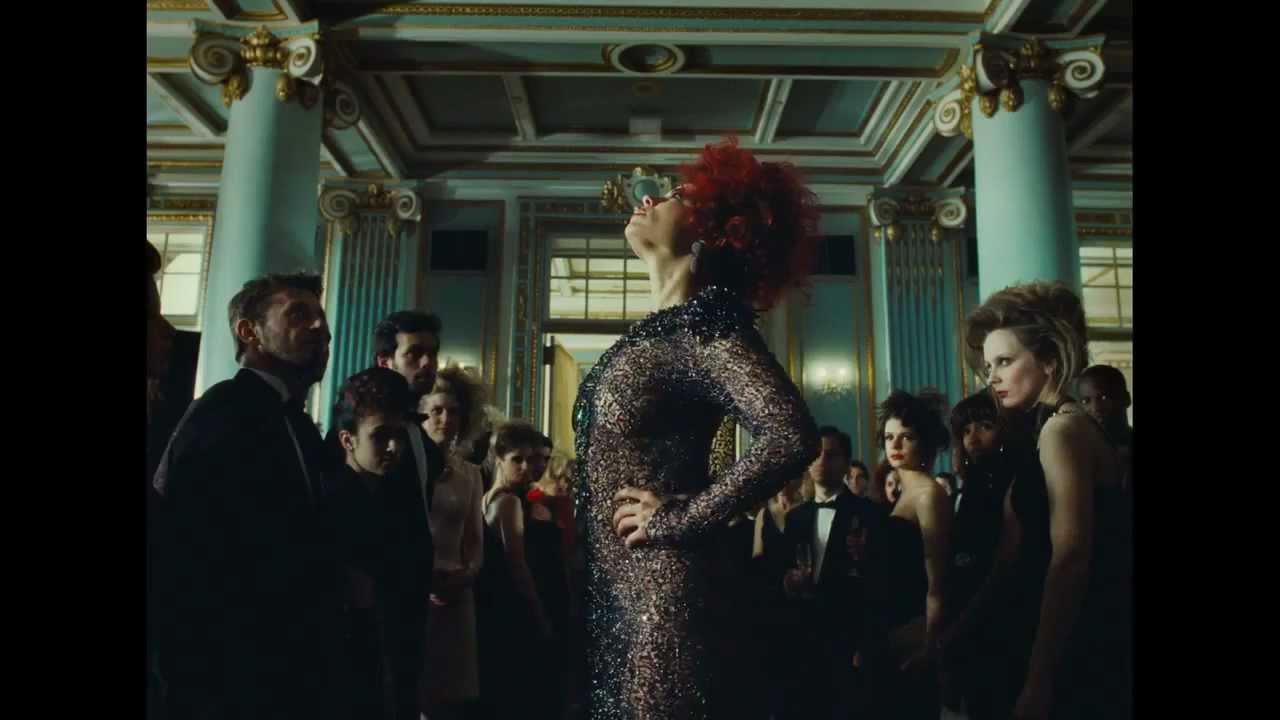
Laurence-AnywaysLaurence Anyways is a 2012 movie by talented Canadian director Xavier Dolan. It’s about a man, Laurence (Melvil Poupaud) who, in the late 80s and his early 30s, decides he must live as the woman he’s always known himself to be. Hurdle number one: breaking the news to his girlfriend Fred (Suzanne Clement), who goes through the predictable knee-jerk reactions – are you gay, have you ever worn my panties, I’m leaving you. But she can’t really leave him. Leave her, I should say, and soon becomes his biggest supporter.

Dolan is a young director who’s still finding his way with this film. There are some crazy set pieces that don’t always Laurence-Anyways-Xavier-Dolan-2012work, but are still admirable and some quite memorable. He’s clearly got a visual talent beyond your average director. But he brings this movie in at nearly three hours, and it just doesn’t need to be that long. In fact, the film’s first 20 minutes are probably the most editable. And the interview framework feels forced and unnecessary.

Poupaud and particularly Clement are masterful here. I really enjoyed scenes between Laurence and his ice-bitch mother, played wonderfully by Nathalie Baye. There’s a lot this film is telling us in sideways glances and throwaway remarks. Poupaud’s quiet moments work like magic. The maxresdefaultfirst day Laurence wears a dress to his job (as a college professor) is a minute in film that needs to be studied. The silence is crafted beautifully. Clement, meanwhile, gets to be the explosive one, her red hair accenting her passionate missives like fireworks.

There are some mis-steps here but Dolan presents his flamboyant film with confidence, if a little too much music, a little too stylized. But it’s something to behold, and this kid just keeps getting better and better.


Savage Grace

At this year’s Oscar ceremony, Julianne Moore took home the statuette for her work in Still Alice while Eddie Redmayne won best actor for The Theory of Everything – but did you know the two savagegrace1-1295283680were once co-stars in a twisted little mother-son movie that didn’t quite make it to Matt’s list, or, I’m guessing to anyone else’s.

Let me ask you a question, straight up: have you ever seen an incestuous threesome (with Hugh Dancy in the middle!), and if not, do you want to rectify that?

Answering yes to that question is probably the only reason you should ever watch Savage Grace.

I suppose the acting’s fine, or very fine, but the subject matter is stilted and nobody quite knows 3673_10_screenshotwhat to do with it. We’re talking about the real-life story of of Barbara Daly, who married above her station to Brooks Baekeland, the dashing heir to the Bakelite plastics fortune. They have exactly one child, a son, Tony, who becomes not just her son but also her replacement-husband. They become…close. Uncomfortably close, by anyon’e standards, ever. She tries to cure his homosexual tendencies by…unconventional means that are also illegal and immoral and explicitly forbidden in the Bible. Ahem.

This can’t possibly end well, can it?

Father-Son Movies

This week’s Thursday Movie Picks theme is father-son relationships. The challenge is to list 3 movies that highlight the theme. I didn’t have to think too hard because this theme seems to be explored exuberantly in so many intriguing ways, so here are 3 off the top of my head:

BEGINNERS-articleLargeBeginners – Matt has a strong and pervasive dislike of Ewan McGregor so I know he’s disapprove of this pick, but I can’t help it. After the death of his wife, an older man (Christopher Plummer) comes out as gay to his son. There is a real relationship here, a shakiness between dad and son that feels genuine. But the honesty seems to breed closeness and the two embark on a new relationship, late in life, one with understanding and humour. The story is told cleverly and shows a bravery we don’t often see on screen. It’s not necessarily about being gay, it’s about a father teaching his son about what is possible when you open your heart.

Catch Me If You Can – Christopher Walken is the shit. I just love the layered performance in this 002CMY_Leonardo_DiCaprio_013movie. Frank Abignale Sr. is obviously a huge influence on Frank Jr. Clearly this is where his charm comes from, but it’s also where he learns his seething resentment for the world. Even when his father makes for a rather pathetic picture, Frank Jr. idolizes him and chooses a life of crime not just to make his father proud, but restore his father to his former glory.

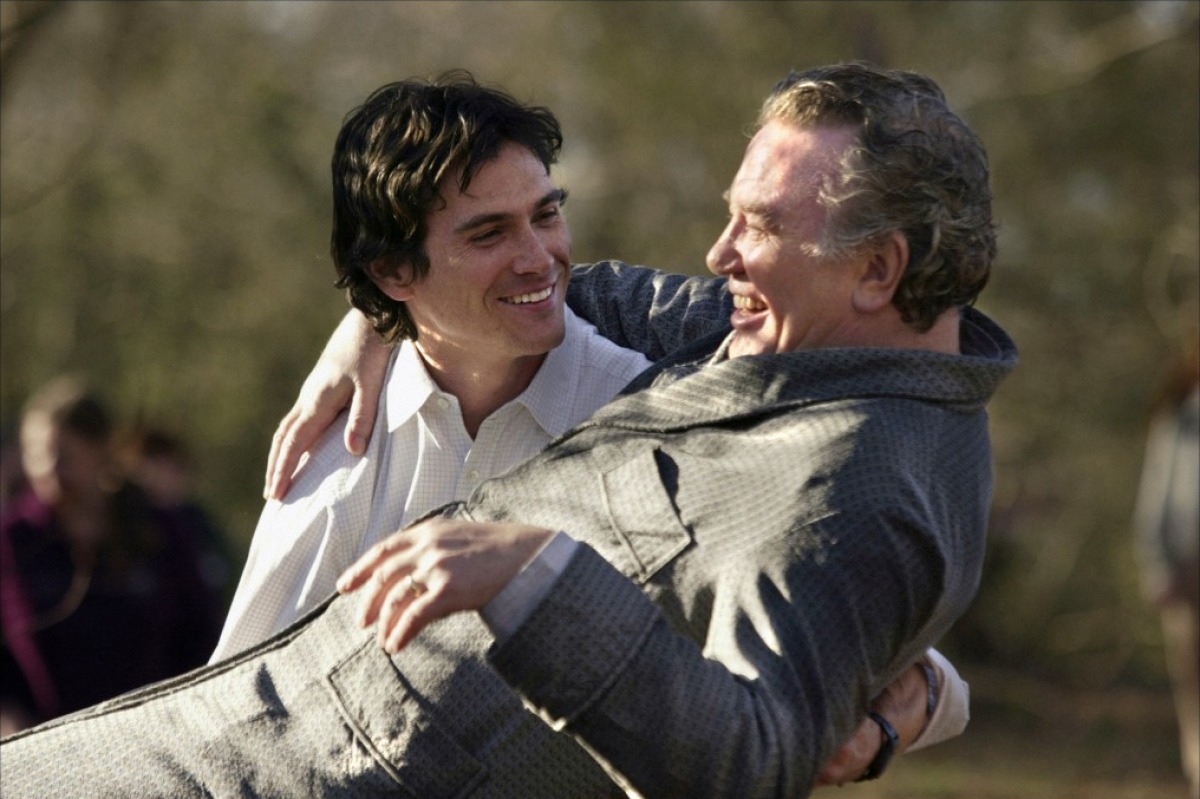
big-fish-2004-77-gBig Fish – This is one of my all-time favourite movies (sorry, Matt – how did Ewan McGregor end up here twice?). The relationship here is complex – a son is called to his estranged father’s deathbed. He wants to be able to say goodbye to him, but isn’t sure if he even knows him. His father has told grandiose tall-tales his entire life, and those stories have gotten in the way of their relationship. The son thinks they are lies that put distance between them, and the father feels they are essential truths meant to serve as legend. They are his legacy. As the stories are retold, the son (Billy Crudup) comes to understand that the exact facts are not the point. His father (Albert Finney) is a story-teller, each story is infused with heart and meaning, and it’s not what they tell so much as how they’re told, and to whom.

What are your favourites?

Love Is Strange

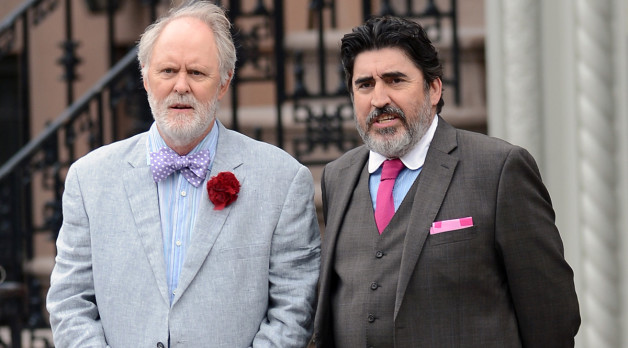
Film Set - 'Love Is Strange'Ben & George have been together forever but are newly married. Their wedding is small and joyous, and also the catalyst for George’s dismissal from the catholic school where he teaches music. They can’t afford their home on Ben’s pension alone, and the two suddenly find themselves homeless. Friends and family scramble to take them in but this being New York City, where no apartment is bigger than a breadbox, Ben and George are separated. This is a love story that shows us how patient and enduring love must be. With no prospects in sight, people who were happy to toast them at their wedding are less happy to share their homes. There’s chafing on both ends (Ben clashes with his nephew’s wife, played by Marisa Tomei, when they’re both trying to work from a cramped home every day). They feel displaced and disoriented; their hosts feel increasingly put-upon. It’s sad and sweet and melodic – the soundtrack is divinely full of Chopin.

Director Ira Sachs is slow and meandering. It’s painful to watch the tenderness and the intimacy lithgowloveisdecline into homelessness and despondency. Just when they’ve vowed to share their lives with each other, they can no long afford to share so much as a bed. This is a pretty bittersweet movie, more universal than you may think. The husbands grapple with their emotional health, and aging, and navigating the strange and complicated NY housing market, which is what finally made me realize how mis-titled this movie is. Their love is a lot of things, but it is never strange.

Pride

“There’s a long and honourable tradition in the gay community. When somebody calls you a name, you take it… and you own it”.

Ever since I’ve started reviewing movies, I’ve been surprised how often a character says something in a movie that reviews the film perfectly. Mark Ashton (played by Ben Schnetzer) seems to sum up Pride’s philosophy. Some have criticisized it as “formulaically cheery” and “gushy”. Seeming to have anticipated this response, Pride wears labels like “crowd-pleaser” and “feel-good movie” like a badge of honour. Its unapologetically sentimental, unashamedly light, and undeniably manipulative. And I LOVED it!

In 1984, a group of London-based lesbian and gay activists formed a small group in support of the miners strike called Lesbians and Gays Support the Miners. This is a tough side for both sides at first. Some gays and lesbians question why they should help the kind of guys that used to beat them up in school. And the miners in the small Welsh town that the group focuses on are about as pleased to accept help from homosexuals as Billy Elliot’s dad was to discover that his son was learning ballet. Soon though, the initial culture shock gives way to an alliance that builds friendships that last even after the miners strike is over.

Pride is based on a true story although I’m not sure how much of this actually happened. The bonds between the two groups come a little too easy and the atmosphere of homophobia may be a little watered down to fit the lighter comedic tone of this movie. But the fact that any of this happened is actually kind of amazing- that two groups of activists with different agendas would work side by side, daring to see their struggles not as “gay rights” or “worker’s rights” but simply as human rights, fighting injustice that they see done to others even as they have their own injustices to deal with.

Pride tends to keep things light but isn’t afraid to touch on some pretty serious themes as members of LGSM deal with coming out, hate crimes, and AIDS. Its filled with likeable performances from an ensemble cast that contribute to a very funny and moving film that I highly recommend.

The Kids Are All Right

First of all, of course the kids are fine. Kids are resilient, not that having two loving parents has ever been a problem in the history of the world.

But it’s the parents we should be keeping our eyes on. Nic and Jules have been together a long, long time – since Nic (Annette Bening) treated Jules (Julianne Moore) in the ER for a sex injury. And that’s how their coupling goes: Nic is the serious, perhaps even controlling one, while Jules is free-spirited. In their years together, each has given birth using the same unknown sperm donor. Nic gave birth to Joni (Mia Wasikowska), who really takes after her (biological) mother, while Jules gave birth to Laser (Josh Hutcherson), who mostly takes after his. With Joni about to depart for college, Laser talks her in to searching for their biological father, the sperm donor. Enter Paul (Mark Ruffalo).

Now, Nic’s and Jules’ relationship has been stale for a while. Jules is in the middle of MV5BMTY2MDU4Mzg3N15BMl5BanBnXkFtZTcwMjQyNDk1Mw@@._V1_SX1759_CR0,0,1759,999_AL_starting up yet another business (landscape design) and Nic is barely tolerating the effort. But Paul’s arrival is completely destabilizing. Not only is their daughter moving away, they also feel like they’re losing their kids to a new, cool parent who has never had to discipline them or hurt their feelings. When Jules goes to work for Paul, it’s kind of the last straw. No wait: when Jules sleeps with Paul, that’s the very last straw.

Like any marriage,theirs has highs and lows. There are no histrionics; Nic is too staid, too reserved, too in control of her own emotions. Everyone is very, very sorry. So this is not about the drama, this is about who they are now, as people, as a couple. Julianne Moore and Annette Bening are such excellent actors that they can convey a 20 year marriage with an ease between the two of them that feels real and also effortless. Bening gets to show real range here, though her character plays things a little close to the chest. Moore is luminous as Jules and seems to really enjoy the freedom of playing someone so open and available.

Director Lisa Cholodenko is excellent at showing you a slice of life and making you feel like you’ve had the whole cake. An exceptional ensemble comes together to give this film emotional resonance. The couple is going through their own unique problems but their struggles of love, commitment, friendship, and family – those are universal. And in The Kids Are All Right, they’re memorably, endearingly executed.