
Have we made Steve Coogan an honourary asshole yet? He’s at his best playing someone despicable, and they don’t come more despicable than retail fashion billionaires, who’ve “earned” their fortunes by exploiting third-world workers and the “rules” of corporate governance. Coogan’s character, Richard McCreadie, is not a real person but is clearly inspired by the owners of Zara and H&M, both of which are running the same scheme in the real world as McCreadie does onscreen.
Having come under some scrutiny for his business practices (though not as much as he deserves), McCreadie hopes to gain some more favourable press by throwing an extravagant 60th birthday party for himself, shelling out for numerous celebrities to attend, and building a plywood colosseum in which a rented lion and McCreadie’s aides will put on a spectacle worthy of Caesar. It is all too real, this game of distraction that McCreadie plays, and having gladiator games as entertainment sets up a good parallel between the ancient Roman slaves who died in service of their emperor and the factory workers who are suffering in service of McCreadie’s business empire.
 Greed’s comedic and satirical elements work well, with Coogan ably and expertly leading the way. I am sure Coogan could play this role in his sleep but he’s not phoning it in at any point. He clearly relishes the chance to play this type of character and he delivers a wonderfully over-the-top take on a selfish billionaire (though really, is there any other kind?).
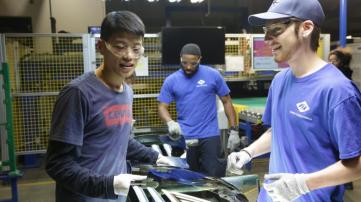
But outside of the scenes featuring Coogan, Greed seems to lose its way. It felt like Greed was too ambitious. In addition to the party scenes, Greed also shows McCreadie’s early days, both in private school and as he first sets up his business, factory scenes that are filmed documentary-style at real locations featuring real workers, and a large number of side stories involving McCreadie’s ex-wife (Isla Fisher), their three kids (Asa Butterfield among them), McCreadie’s biographer (David Mitchell), and one of McCreadie’s top staff (Sarah Solemani). There’s just too much going on, and it seems impossible for one movie to combine so many disparate parts into a cohesive whole.
Undoubtedly, Greed’s failure in that regard is due to Michael Winterbottom having too much to say about the increasing divide between the rich and the poor, and it’s hard to fault him for being so ambitious. But I have to think Greed would have been more effective, both in delivering its important message and in delivering its comedy, if it had taken a more focused approach and left a few side stories (including the story featuring McCreadie’s younger self) on the cutting room floor.
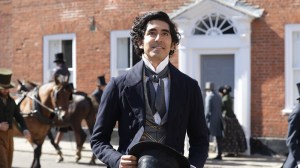 cuppa, not by a long shot. As an introduction to this film’s premiere at TIFF, Iannucci informed/assured us the two films could not be more different. And while I’m not sure that’s true, I was relieved and elighted to find myself really enjoying it.
 this fall. Of course, these threats are not really to the countries themselves; they are threats to consumers, who will inevitably bear all these increases in the form of higher priced goods.
 Josh Ostrovsky, better known as @thefatjewish, is the king of displaying himself for the enjoyment of others. Often naked, nearly always disgusting, he became famous for stealing other people’s funny memes and making loads of money off them.
 the surface world is attacking them to obtain enough votes to attack the surface world. Turns out, one of the Atlantean human-shaped leaders had hired the black guys to steal the sub and fool another Atlantean human-shaped leader. Except then it also turns out that the leader who seemed to be fooled by the sub attack was actually aware it was fake news the whole time and went along with it anyway (and in case it is not clear, all the human shaped Atlanteans we see are white men, every last one, other than Aquaman’s love interest and Aquaman’s mom who are white women).
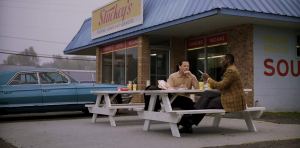 manners are as impeccable as his dress. But when Tony boasts that he’s “blacker” than Shirley, who doesn’t know Aretha Franklin or fried chicken, he’s only showing what a narrow understanding of race he has, because when Shirley is repeatedly subjected to racist indignities and abuses, Tony is shocked while Shirley is not. The “Green Book” to which the title refers is an actual motorist’s handbook, which, for $1.25 teaches people how to navigate segregation and not get lynched while traveling down south. I feel that I might have sold a Red Book for $1.50 that simply said: don’t go. But Dr. Shirley’s going on purpose, knowing it will be hard, but feeling a responsibility to do his part in challenging the system. And white people play their part, paying to enjoy\appropriate his culture while refusing to dine with him in the same room.
 bowler hat. They have a fun, flirty road trip, ambling toward their destination, taking their time, getting to know each other. And we’re treated to these beautiful countrysides and colourful images that make us feel like we’re on vacation with them. Nona is fleeing a very hard and dangerous life, but once she’s on the road, it’s clear she feels free. She’s a different person.
 Monsters and Men is that conversation piece. Moreover, it is one of the finest cinematic conversation pieces I have ever seen. What makes it stand out from the rest is that it tries so very hard to stay impartial (and succeeds), to the point that a black cop at a dinner party (
 ASSHOLES WATCHING MOVIES