

According to a classification system that goes unexplained in the film, a close encounter of the first kind would be a UFO sighting. The second kind is finding proof of alien life. The third kind, as you likely know, is making actual contact with aliens themselves. A fourth kind has since been named and might have applied had Spielberg known of it; the fourth involves alien abduction.
Close Encounters very nearly featured what would have been early attempts at CGI. Director Steven Spielberg hired animator Colin Cantwell to create a CGI test of three UFOs floating over a stadium. The single-shot test took three whole weeks to complete, which immediately ruled it out in terms of the film, but it was one of the first computer generated images ever created for a film.
Spielberg’s next idea was even crazier. He wanted his aliens to have a gliding mobility (easily distinguished from human bi-pedal walking). So the obliging production team rigged up a grey spandex suit, slapped it on an orangutan, and put that orangutan on roller skates. What could go wrong? Well, turns out, it was a pretty smart monkey who knew a bad idea when it was strapped to his feet, so he sat down, removed the skates, and deliberately crawled to his handler.They never even got a screen test out of him.
After the monkeys came the mimes: they filmed the aliens mingling among human technicians played by mimes moving in slow motion so that when the film was sped up, the aliens appeared to be moving really fast while the technicians appeared to be moving at normal speed. They scrapped this too.
Finally the resorted to kids. It’s 6 year old elementary school girls (who move more gracefully than boys, Spielberg thought) in those costumes made especially for them and heavily backlit to achieve the proper silhouette. Cinematographer Vilmos Zsigmond overexposed the scenes so they would appear fuzzy and diffuse, and this helps them not look like little girls in rubber suits. Although, some of the shots in the climatic scenes are miniatures: the bright light coming out of the ship was created by a set of Christmas lights strung up on the back of a metal plate, behind little tiny alien figures. This was composited into a shot with real-life actors.

A special 9-foot version of the mothership was built for that one spindly-legged alien which appears briefly, spreading its arms in a peaceful gesture. That was a marionette prototype made by puppeteer Bob Baker. The marionette idea was nixed but “Daddy Long Legs” made it into the film.
But what about that final farewell where the alien signs the musical notes back to the humans? For that, Spielberg recruited a special effects artist by the name of Carlo Rambaldi who created a fully articulated steel, aluminum, and fiberglass animatronic puppet that Spielberg nicknamed “Puck.” Puck’s expressions were based on photos of Cary Guffey, the child actor who plays little Barry. The puppet was operated by a crew of seven puppeteers, with Spielberg himself controlling the final articulation before the alien leaves to go to the mothership.
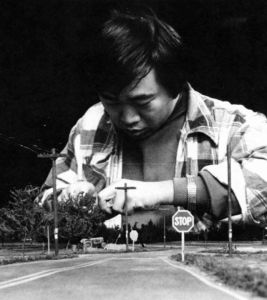
Greg Jein
Incidentally, the aliens were meant to appear to be floating around in their ship, it being zero gravity or thereabouts. Even Roy was supposed to be seen to float into it as he approached. But the crew just couldn’t hide that many wires. They did, however, achieve weightlessness for Richard Dreyfuss in an early scene in his pick up truck. the truck was put on a turntable and flipped 360 degrees!
[During filming, Spielberg kept ruminating on Puck and wondered “What if this little guy didn’t get back on the mothership?” – that, of course, was the germination of E.T., whom Rambaldi would also go on to design.]
A note on those musical notes, which aren’t really a practical effect per se, but are such an iconic but humble sequence, we can’t not talk about composer John Williams’ brilliance for just a moment. Williams and Spielberg worked together a year before shooting even began to make sure they had the perfect sequence. Williams was originally working with 7 notes but since they wanted a simple greeting, they pared it down to 5 notes. Williams whipped up 100 permutations based on the Solfège system of musical education and together they whittled it down. Tuba player Jim Self is the “musical voice” of the mothership in the final edit.
A second note on how to get a great performance out of little Cary Guffey who’d never acted before. Spielberg has of course gone on to work with loads of child actors, but Guffey is among the youngest. Spielberg would unwrap presents just out of view of the camera so that Guffey would smile and point (you can also hear him excitedly shout “Toys! Toys!”). To get him to show fear, he had two crew members dress up in costumes. A false cardboard wall would drop, revealing a clown, and the poor kid would frown in surprise. Then a second wall drops, revealing a gorilla, and that was pretty scary. So the gorilla whips off his mask, revealing friendly makeup man Bob underneath and ta da – you got yourself a performance, or at least a series of emotions that look very real on tape.
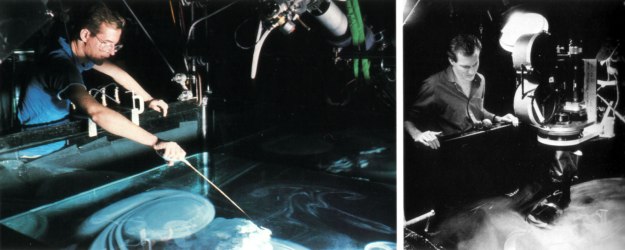
Douglas Trumbull was the visual effects supervisor on Close Encounters of the Third Kind who came up with techniques for this film that would lead to advances in motion control photography, which is how you combine pictures of miniatures with pictures of full-scale elements.
The mother ship was designed by Ralph McQuarrie and built by Greg Jein. Its aesthetic was inspired by an oil refinery Spielberg saw at night in India. Instead of the metallic hardware look used in Star Wars, which was coming out the same year, they emphasized a more light-heavy, luminescent look for the UFOs (Dennis Muren, who’d just finished up with Star Wars, put a tiny R2-D2 on the underside of the mothership). One UFO model was an oxygen mask with lights attached to it. They experimented with all kinds of ordinary objects that had interesting shapes. The miniatures were filmed in dark, smoke-filled rooms so their lights would cut through the fog and look super cool.
Douglas Trumbull created the cloud effects by injecting white paint into tanks half filled with salt water and half filled with fresh water.
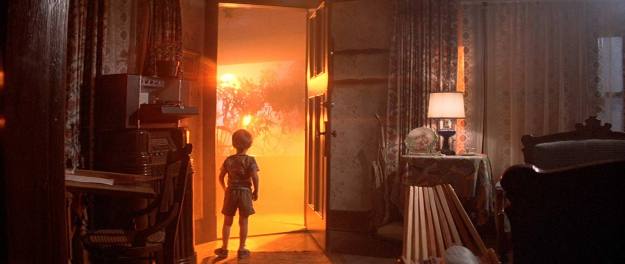
When asked in 1990 to select a single “master image” that summed up his film career, Spielberg chose the shot of Barry opening his living room door to see the blazing orange light from the UFO. “That was beautiful but awful light, just like fire coming through the doorway. [Barry’s] very small, and it’s a very large door, and there’s a lot of promise or danger outside that door.”
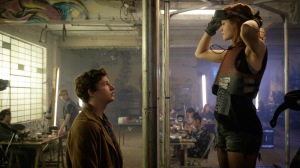 means 300k of the festival’s attendees were vying for just 1000 seats in the venue. Some people may be discouraged by those odds, but not Sean! He gamely spent hours lined up outside (while I watched
  to find a Gremlin long after he’d already approved the scene, and he’ll continue to be surprised by Easter eggs (how fitting, for this weekend!), as will we. In subsequent viewings, you could easily play a drinking game with friends, or a Bingo game would be fun, just spotting all the cool things the brilliant art department and visual effects people slipped in there – it’s like the hoarders of movies with so many layers it’ll take forever before you reach the dead cat layer.
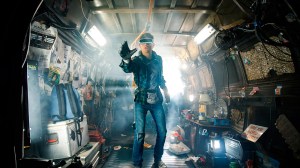 There are very few immutable truths in this world, but here’s one: if you don’t like Steven Spielberg’s movies, then you don’t like movies. The brilliance of Ready Player One (and it is brilliant) is that it’s a Spielberg movie through and through, only because its source material references Spielberg repeatedly, the result is something exponentially more Spielberg than you could ever have though possible. Ready Player One is a true blockbuster and a worthy addition to Spielberg’s list of classics.
 being in charge. She’d never had another job. She was naturally meek, and kind of nervous. She was surrounded by assertive men, some of whom weren’t crazy to have her among their midst and certainly didn’t see her as an equal never mind a boss, and none of whom were shy about voicing their opinions. She was, however, an accomplished socialite, which in the city of Washington, means she counted many prominent politicians among her friends – and the particular politician at the epicenter of this scandal was among her closest. These facts are not to diminish her but to illustrate just how courageous she truly was to take the stance she did.
 Spielberg lost that battle but he normally has a pretty keen eye for casting the right kid in his movies. Drew Barrymore recalls auditioning for him for Poltergeist: “lied my face off. I told him I was in a rock ‘n roll band. I was a drummer, of course, because drummers are the coolest, and that I was a cook.” He didn’t think she was right for Poltergeist but kept her in mind for something else…and that’s how she landed E.T.
 about being, not about performing, the way that children often do in school plays, making something bigger. It’s not always the noisy kids that we’re looking for; it’s the quiet kids at the back.” That was very important when Weir was casting for Room, in which a 5 year old boy and his mother escape their rapist-captor. One of those quiet kids was 7-year-old Jacob Tremblay, who caught her attention fairly early in the casting process. He had the interiority Weir and director Lenny Abrahamson wanted to see. “It was very evident how gifted Jacob was,” Weir says. “He’s a really bright and inventive child.”
 play games, and we took our acting coach Miranda Harcourt, who’s amazing with kids, with us. We had an interpreter, obviously, and from those groups of 10, we narrowed it down to the final list and called them back again. It was a very thorough process. It was about four months from the time they started putting people on tape in India to when they started doing callbacks, and it was long and very intense every day, with another 100 or 200 tapes coming in. You can’t miss anybody.” Eventually they paired their top two youngsters with the top two adolescents would would play the older brother, and found the right chemistry. Anyone who’s seen Lion will know that little Sunny Pawar was a particularly bright spot in the film and he really livened up the red carpets during awards season, just as Jacob Tremblay had done the year before.

 Watch it, and let us know what you think. Does Beymer make a good Tony, or would Elvis Presley (the director’s first choice) have done better? And how will Captain America fill the role?
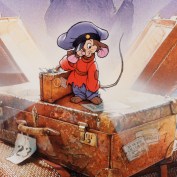

 I’m fascinated by this immigrant story, an allegory in the vein of Animal Farm, but geared toward children. It was personal for producer Steven Spielberg; some scenes were taken directly from stories of his own grandfather, not coincidentally named Fievel.
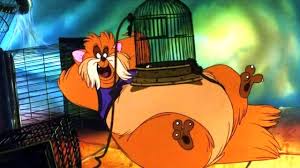 for radio by Linda Ronstadt and James Ingram at the behest of Spielberg, who knows a good pop tune when he hears one. It went on to win Song of the Year at the Grammy as was nominated for an Oscar (but lost to Take My Breath Away, from Top Gun). We remembered this song in particular when
  gave it two thumbs down, calling it “gloomy”, “downbeat”, and “way too depressing for young audiences.” The numbers proved them wrong, and never had children so gleefully sang about Cossacks and oppression before. The film’s success inspired Steven Spielberg to pursue this cartoon making, eventually developing DreamWorks Animation, the studio behind Shrek, Madagascar, and How To Train Your Dragon. An American Tail has held up pretty well over time, in part because of its deliberate old-fashioned animation style, hearkening the glory days of 1940s Disney, a huge nostalgia factor for baby boomers. Finally this
  was a film they could not only share with their children, but enjoy it as well.
 ASSHOLES WATCHING MOVIES