
Full disclosure: I own a unicorn named Mindy. She’s magical. She’s a goddamned magical creature. She’s also inflatable but don’t you DARE call her a pool toy. You can, however, call her the centre of attention, which is exactly what she was when I threw a goddamned magical unicorn party earlier this summer. I sent unicorn invitations. I had unicorn party hats, a unicorn pinata, and unicorn names for all the guests. I even made a unicorn cake. No, that’s not true. I actually made TWO unicorn cakes because Sean smashed the first one about 30 seconds after I finished it. And when you throw a unicorn party, people bring you unicorn presents, which is why I own unicorn slippers and a unicorn tape dispenser named Stuart and briefly had unicorn-coloured hair. This either makes me uniquely qualified to review this film, or I should recuse myself for the glaring conflict of interest.
I’m not actually obsessed with unicorns, but you know who is? Kit. Kit (Brie Larson) has literally been obsessed with unicorns her whole entire life. And after painting yet another unicorn-as-self-portrait, she’s unceremoniously flunked out of art school and returns home to mope in her parents’ basement (Joan Cusack, Bradley Whitford). In an effort to Not Be A Disappointment to them, she takes an uninspired job with a temp agency and just when it seems the world might be ready to beat the whimsy right out of her, the universe sends her a pop-up store that only sells unicorns, and only to her, run by a tinsel-afroed Samuel L. Jackson, of naturally. Turns out that owning a unicorn is something you have to earn, so Kit sets about getting her life unicorn-ready, and that’s going to take some major changes. But is unicorn ownership really the cure to what ails a directionless, fully grown woman who seems stuck in a perpetual unicorn phase? Isn’t there more to life than glitter and rainbows?
Samantha McIntyre’s script is winkingly funny. For some odd reason neither Sean nor I had gone into this expecting it to be funny, and yet the audience was in stitches. McIntyre has a very quirky style that endeared itself to me immediately. She creates sparks in the smallest little details. I also have to send a shout-out to costumer Mirren Gordon-Crozier who must have combed the known universe to find THE most fanciful pieces of clothing ever produced. Kit wears her personality on her body. Her shirt collection is all blue skies and rainbows. It reminded me of Kimmy Schmidt in that way, who is always seen in sunshine yellows and bright fuchsias. Their clothing is a reflection of who they are. That said, it might be Samuel L. Jackson’s suits that make the biggest and brightest wardrobe impression in this movie.
But the real rock star here is Brie Larson, who makes her directorial debut. She’s just finding her voice as a director so her style isn’t quite as quirky as the tone of the movie, but considering how much it shifts around, I think she handles it well, and I already can’t wait to see what other stories she’ll tell. She assembles a really great cast who are a lot of fun to watch. Cusack and Whitford are everyone’s embarrassing parents, and Mamoudou Athie as The Guy Who Will Build a Unicorn Stable Even Though He’s Not A Carpenter is a particular stand-out.
I really enjoyed Unicorn Store; it’s a sweet reminder that growing up doesn’t necessarily mean giving up on childhood dreams. Underneath the glitter there’s a message about conformity and how women are told to pull away from “girlish” things in order to fall into one of two male-approved categories: the drab, grim businesswoman, or the oversexualized dreamgirl. Anything seen as overtly feminine is assumed to be less serious, and even women themselves can internalize this notion. Not Kit. Brie Larson flexes her comedic chops by playing her as earnest but not naive. In a world where every man’s inner child is constantly catered to with movies about super heroes, robots, pirates, and zombies, this one, finally, is just for us.
 Lexi is a white South African millennial who has recently inherited a ridiculous amount of farmland in the middle of nowhere. She is fully aware that her family stole this land from some black people and she gets a little touchy whenever the subject comes up. Which it often does when she brings her three black South African millennial friends on a camping trip on her family’s land.
 tough and the tender, the blurring of the line between the two. Adi (Adrian Schiop) is a fish out of water, and Alberto (Vasile Pavel), rough as heck around the edges, provides interesting if skewed insight. Soon their companionable partnership turns into something sexual, quasi-romantic. It’s a quite modern gay love story from behind the poverty line and director Ivana Mladenovic’s lens is intimate and gritty.
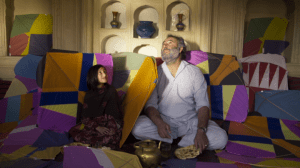 Afghanistan is the last place I’d expect to find a kid flying a kite. After watching Black Kite and seeing kites be such a prominent part of life, bringing a tiny bit of joy to those who are trapped in this war-torn land, it seems strange that I ever had a presumption on kites one way or the other. The smallest of assumptions, something taken for granted without basis, led me to think I knew more about another’s circumstances than I do. Being wrong about kites reminded me that actually, I know absolutely nothing about what it’s like to live in Afghanistan! I have Black Kite’s writer/director Tarique Qayumi, a Canadian who came from Afghanistan as an eight-year old refugee, for brilliantly and effortlessly challenging my preconceptions.
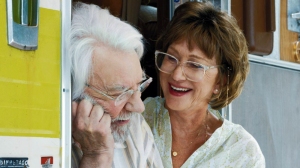 beloved RV, and this road trip is designed to trigger memories of happier times – their young family at play, their former selves in love. It’s obvious that the ‘in love’ part has never really faded for Ella and John, and maybe this is why it’s so hard for her to cope when he can’t remember who she is.
 McDonagh uses lyrical language peppered with inspired cursewords; his heavy-weight cast punches it up with a surprising mixture of gravitas and black comedy.
 are safe, the schools are good, it’s a great place to raise a family. Except if you’re the Meyerses, who just moved in. They’re not welcome (being black and all). They’re apparently the very people all these “nice” white folk have moved away from the cities to avoid. The Meyers don’t do a darn thing to incur the slightest ill will, except have a darker skin tone, but still the wrath of the townspeople is rained down upon them. Determined to force them out, their white neighbours harass them and abuse them and generally make such a ruckus that no one notices the neighbours directly behind them.
 ASSHOLES WATCHING MOVIES