Tag Archives: tiff

The Shape of Water

What did we ever do to deserve Guillermo Del Toro? The man is willing to crack his head open and allow his most beautiful dreams to spill out, onto the big screen, for our viewing pleasure. The Shape of Water, a delicious period piece with fantasy elements, is just about as sumptuous and satisfying as it gets at the movies.

Sally Hawkins, an inspiring casting choice, plays Eliza, a mute woman working as a cleaner at a top secret government facility. She and her cleaning partner Zelda (Octavia Spencer in a role she was born to play, because between Hidden Figures and The Help, MV5BZDU0NmU1NDUtNjMyNi00YTMyLTgwNWUtNTVmMzQ3NzJjNTJmXkEyXkFqcGdeQXVyNTk1MzcwNTI@._V1_she already has) stumble upon agent Strickland’s (Michael Shannon) latest capture, a humanoid sea creature reportedly worshiped as a god by the Amazonians. Set against the Cold War era, the Americans hope this scaly curiosity will give them a leg up against the Ruskies are and prepared to torture the secrets out of their prisoner – and worse. But sweet Eliza spots the creature’s humanity and her kind heart urges her to save him. She enlists a scientist at the facility (Michael Stuhlbarg) and her neighbour Giles (Richard Jenkins) in her daring escape plan, but Strickland isn’t going to let this career-defining prize slip through his rotting fingers.

The Shape of Water is poetic and beautifully stylized. I fell in love during the opening shot, an ethereal scene that establishes the fairy-tale quality of the story. The whole film is richly textured; it feels like a story book you’ll want to step inside. Full credit to production design and art direction for creating a living, breathing piece of art that feels grounded in reality but often has this other-wordly, heightened reality feel to it that you just don’t find in your average film. The script, a Guillermo-Vanessa Taylor hybrid, is a phenom. It so smartly sets up all that is to come with careful, quiet nods. This is a movie with many small pleasures, many delights to savour. Because our heroine is non-speaking, the score plays a major role, and composer Alexandre Desplat is more than equal to the task. Del Toro weaves magic into threads of monster movie – love story – musical – spy thriller – comedy. I’m not sure which of these is more surprising, but all are very welcome. You may hear from others that this is Del Toro’s best since Pan’s Labyrinth, but they’re lying. I believe this is his best, full stop.

The Shape of Water wouldn’t be nearly so special without Sally Hawkins’ grace and measured precision. She’s wonderful, full of light, communicating much with little. Eliza is a woman of small parameters. Her life is ordered and banal. She’s suffering in her loneliness when she meets her merman, and her outsider status allows her to view him not as a monster but as a kindred spirit. Richard Jenkins meanwhile is restrained as the starving artist next door. Michael Shannon is anything but as the man who gets the job done at any cost – unless his vanity gets in the way. He’s awfully fond of the trappings of success. You might be starting to get an idea of what makes this script so lush: all the characters are brought fully to life. This is the clown car of movies, a film filled to the gills with interesting ideas and perfect little moments and scene-stealing details.

You don’t just watch a movie like The Shape of Water, you feel it, you experience it. We saw its world premiere at the Venice Film Festival this week but it’s coming to a cinema near you this December, and you won’t want to miss it. Hawkins’s name will be on the Oscar ballot and I’m guessing Del Toro’s will be too – maybe even twice.
Downsizing

downsizingThe world is overpopulated and in the very near future it will become untenably crowded: fact. We don’t have enough space to comfortably house all these people, we don’t have the ecosystem to support them, or enough resources to fund the lifestyles to which we have become accustomed. The rate at which these 7 + billion people consume means we are making waste and pollution like there’s no tomorrow – and if we continue doing so, there won’t be.


Luckily for fictional Matt Damon, a Norwegian scientist will come up with a revolutionary bit of science that’s going to sound nutty at first, but hear me out. He calls it downsizing. A medical procedure will taking a willing human being and shrink him down, to about 5 inches. These small people will live in small towns – dollhouses, practically, taking up little space, generating little waste. A typical person might liquidate all his assets, pay off all his debts, and find that the $150 000 he’s left with is equivalent to about $12 million in the small world. Live like a millionaire by becoming a fraction of your former self!

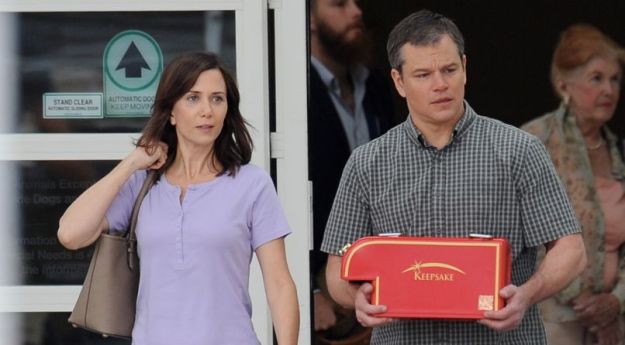
Occupational therapist Paul (Matt Damon) and his wife Audrey (Kristen Wiig) are the kind of people to whom this kind of deal appeals. They work but never seem to get ahead. Sure this downsizing is billed as a way to save the earth, but it’s also a way to personally wipe the slate clean, and live the life you could only dream of as a normally-sized person.

As you can imagine, being only 5 inches tall comes with perks, but also some drawbacks. As writer-director Alexander Payne imagines it, there are social and economic impacts to all these people retiring from “normal” society. Illegal immigration and terrorism are facilitated. Downsizing can be used as punishment, against someone’s will. And even if you’re one of those people living in luxury, you’re suddenly vulnerable to insects, birds, even high winds.

Downsizing is a well-timed satire, science-fiction that manages not to feel too fictiony. Credit Payne’s wit for packing as much detail as he does, and if sci-fi feels a little outside the wheelhouse of the guy who did Sideways and Nebraska, he actually manages it with a lot of humour and humanity. Though the film is at times unabashedly absurdist, it stays away from easy sight gags. This is a thinking film that abounds with ideas – you’ll need to digest afterward. It’s an indictment of the American dream, people so disenfranchised that they’re willing to undergo a risky procedure just to find fulfillment. But miniaturization isn’t really the answer it’s cracked up to be, with people’s problems seeming shrinking down to follow them.

Matt Damon is perfectly cast as a nice guy who’s just a bit of a loser. But for Sean, it was Christoph Waltz as his playboy neighbour who really stole the show. He plays a Serbian sleazeball who figures that what the small community needs is a small black market, and he’s there to profit. I, on the other hand, was blown away by Hong Chau as his cleaner, Gong Jiang, a one-legged Vietnamese dissident who shows Paul there’s more to life than just keeping up with the Jason Sudeikises (he’s the classmate at his high school reunion who inspired Paul to go for the Big Shrink). When Oscar season starts heating up, I hope her name is mentioned.

Downsizing is a unique film with a lot of style. Despite being the opening night film here at the Venice Film Festival, it likely won’t be a best-picture contender for me, but it’s a film full of ideas that I found immensely enjoyable.

Julieta

“I don’t make motion pictures. I make EMOTION pictures”.

I can’t promise that the great Pedro Almodóvar actually said this but this quote was how my film teacher introduced me to the filmmaker’s work before showing us All About My Mother. As a 19 year-old college student, the only EMOTION I felt with any sincerity while watching Almodóvar’s 1999 classic was boredom.

julieta

I’m glad I gave him another chance. I’ve seen many (though certainly not all) of his films and have re-watched Mother at least twice and have come to appreciate the focus on genuine human emotion that make up his films as well as the beautiful colours that are signatures of his cinematography.

It’s a beautiful thing when a work of art can transport you back to your youth and Julieta is that rare film. It’s the kind of film that reminds you what it’s like to be 19 and bored beyond belief by a Pedro Almodóvar film. So bored that I was willing to risk the glares of my fellow theatergoers by momentarily turning on my cell phone just to see how much more of this I had to sit through.

julieta-2

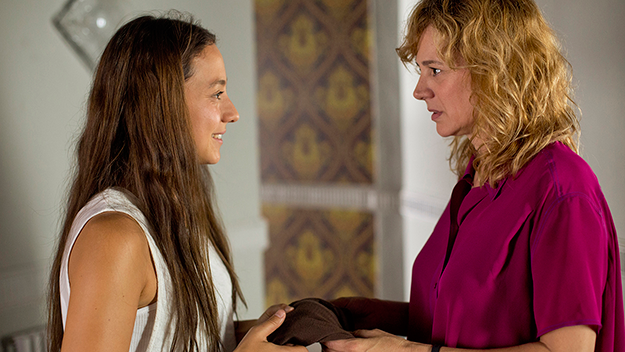
Which isn’t so say that Julieta is a bad movie because it’s far from it. It’s script is inspired by three interconnected short stories from renowned Canadian writer Alice Munro, a fact that I am somehow irrationally a bit proud of as a Canadian. As a teenager, Julieta has a flirtation and affair with a mysterious man on a train. As a young mother, she visits her parents only to discover her mother doesn’t seem to be getting the care that she needs. And as an aging widow, she tries to reunite with her estranged daughter who left in search of spiritual enlightenment and never returned.

julieta-3

The mother-daughter segment is the strongest of the three stories and Almodóvar is smart to use his somewhat non-linear structure to tease it throughout the film. As usual, he favours emotion over motion and the feelings always ring true and the film is always lovely to look at. Despite his fascination with the feelings and inner lives of his characters though, he’s usually much more generous with plot. While my favourite Almodóvar films tell riveting and unpredictable stories, there isn’t enough to connect the three parts of Julieta to feel like one story. Ironically for a film with three stories, there doesn’t seem to be enough story in Julieta to fill a full movie. It’s not bad but I’ve come to expect better.

La La Land: Discussion

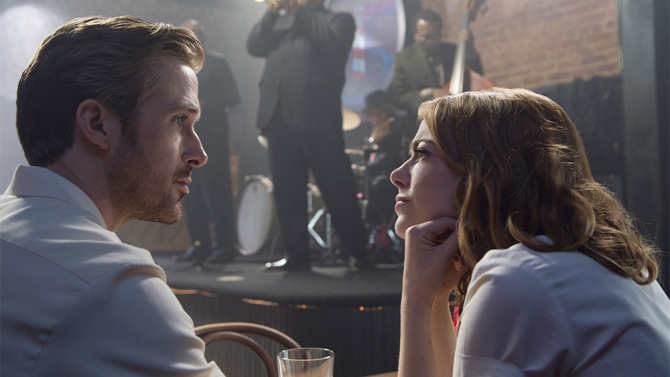
If you’re looking for a spoiler-free review of the film, please check it out over here. I wrote it all the way back in September, fresh from seeing it at TIFF, and I’ve been waiting all this bloody time just to talk about what for me is the best film of the year. I was absolutely giddy for this movie, how it made me feel, how it made me think, how it whisked me away into something both surreal and familiar. We exited the theatre from La La Land and rushed on to the next (I think it must have been Lion) but between the two, I wept. I wept for heartbreak, and for beauty, because La La Land  is brimming with both.

If you’ve kept reading, then you know by now that La La Land, for all of its romance, does not have a traditionally happy ending. But are the characters unhappy? Mia and Seb separate in part because their ambitions overshadow their love. Was this the right move? Do they have regrets? Certainly they’ve both gone on to achieve the success they so coveted. Mia is married, la-la-land-1with children. When she sits in Seb’s club at the end, we are treated to an alternate version of events in which they manage to stay together. Do they wish that this was so? Do they still love each other? Have they moved on?

One of Chazelle’s unspoken themes must be “Is it worth it?” – is it?

During their courtship, the movie takes cliches about love and makes them true: love lifts them, they dance on air, they sing from rooftops. Did this feel organic to you in the movie? I often felt that when things felt intense to them, they broke out into song as a metaphor for feelings that are too fervent to verbalize. When words fail, they’d sing, or dance, which is often the way we feel in our excited little hearts when we’re first falling in love (reminds me of a certain scene in 500 Day of Summer).

Sean noticed that when the relationship got rocky, the movie got a little more ordinary, and frankly, a little repetitive. The songs are reused. But in time he felt like that was sort of the point: that the newness and wonder of the relationship had worn off, that they were beyond the first crush and settling into patterns and habits and less passion. The film itself reflects it. Did you find new meaning in songs as they were revisited? During the second half of the film, during the relationship’s demise, there is noticeably less music, which means less joy, less intensity. Their world goes a little drab when the shine has worn off. Did you miss the music when it was gone? Certainly when it returns in that final scene, it’s a heart breaker.

Originally Chazelle imagined that Miles Teller and Emma Watson would fulfill the lead roles. I can’t picture Teller ever being right for the part. Watson left the project so she could do another musical, Beauty and the Beast. Ryan Gosling ended up turning down the opportunity to play the Beast so he could do this instead, with frequent collaborator, Emma Stone. Chazelle has stated they were hired together intentionally, because they’re a modern-day version of an old-Hollywood couple, frequently working together and already having an established chemistry. Do you think anyone else could have pulled off these roles? Do you think either of them has a legit chance at an Oscar?

Seb states that jazz has to be experienced. He’s disgusted by people who use it as ‘background music.’ It’s a special language that he teaches her and she comes to appreciate. He takes full advantage in the final scene, telling her he still loves her using only his music, and he plays so passionately that she can see how he wishes things had been different. However, there’s an interesting part in the movie, the “sellout” phase where Seb is playing jazz in the background during a scene. Is this where it all went downhill? What would you say was their final straw?

Chazelle has deliberately taken this musical off the backlots and grounded it in modern-day Los Angeles. The opening number helps set the tone. This is the world in which they live, but both are outsiders amongst that set. At the end of the number, Gosling gives Stone the finger before driving off. The offramp used in this number is the same one they used in Speed, where they had to jump the gap. Lots of real locations were used in the film – even Seb’s apartment is an actual apartment, not a set. Let’s not forget that the movie isn’t called Mia or Seb, it’s called La La Land: the city is also a character. City of stars, city of dreams. Did the locations help give the movie a sense of reality to you?

The one criticism I’ve heard of this movie is that it never addresses the true roots of jazz: does La La Land “whitesplain” jazz? Is it racist in its portrayal? Did Damien Chazelle fail us by casting white actors in a movie about jazz? Then I wondered – wouldn’t Whiplash have faced the same controversy? It’s another movie about jazz starring two white dudes, but I don’t recall hearing any hooplah over it [turns out the criticism was there all along]. Of course it’s not for me to say, but I can understand how it might sting a little to have an art form that was “invented” by African-Americans, music by Black people for Black people, be told by white people. Not to say that jazz belongs to any one people, but if these are the only stories being told about jazz, then maybe the stories belong to the people who truly wrote them. And it does feel regressive in 2016 to see a white man play jazz, and a white woman dance to it, while people of colour make up the blurry background characters surrounding them, out of focus, besides the point. What do you think – is there cultural misappropriation going on here? Is Ryan Gosling a “white man saviour” in his quest to save jazz?

Mia and her friends are resplendent in primary colours because they’re young, and they dream in technicolour. She’s dressed in emerald, saphire, yellow. At the end of the movie though, she’s wearing white. She’s supposedly made her dreams come true, but she’s leached of colour. What’s that about?

American Honey

American Honey is one of those rare American movies that are so beautiful that even Shia LaBeouf couldn’t ruin it.

I’m not exaggerating. It really is that good. In fact, Shia’s in it. And he’s really goodamerican-honey-3. Really, really good.

American Honey works neither in spite of or because of his performance. Instead, he is just one of many important parts of an impressive cast of mostly non-actors with not a single weak link in the bunch. Jake (LaBeouf) leads a team of about a dozen runaway youths who earn their living by travelling across the United States selling magazine door-to-door. Their newest recruit Star (Sasha Lane) isn’t so sure that she is comfortable with the lies that her new colleagues use to sell their product but, having seemingly nowhere else to go and having quickly fallen for Jake, she starts to feel at home with them anyway.

american-honey-2I struggle to communicate what it is that works so well about American Honey. My writer’s block was so bad that I went to see it a second time, quite a commitment with its 163-minute running time. All I’ve really learnt from two sittings is that writer-director Andre Arnold creates a believable world around these characters and makes it easy for the audience to feel like they’re a part of it. (Well, maybe I should just speak for myself. At my first screening, the film had lost over half its audience by the end).

To keep from getting too bored or discouraged while on the road, Jake’s team engage in american-honeyany number of traditions and rituals that are often somehow both unsettling and charming. Their favourite songs, games, and chants serve the film well in helping create a subculture that we can believe and relate to. Beautifully naturalistic performances from an exceptionally well-chosen cast, great choice of music, and some terrific (though sometimes elf-indulgent) cinematography help bring their world to life.
It’s hard to describe what works about American Honey because it works mostly on an emotional level. Intellectually, I’m not sure if it’s really “about” anything other than an unusually honest and surreal coming of age story but the power of the filmmaking gave me chills.


Before The Flood

I learned two major things watching Before The Flood:

  1. Leonardo DiCaprio’s parents really should have sprung for an interior decorator for his nursery.
  2. (North) Americans are goddamned hypocrites.

We all know the Earth is dying, and we’re the murderers. This is pre-meditated, Murder One, capital stuff. There won’t be any plea-bargaining at the end of the world because we’re guilty as sin.

We’ve seen this coming for 20 years or more. Unfortunately, climate change is accelerating at a greater rate than even predicted. We have very real, very frightening present-day consequences as it is. But we’re still not making changes. Oh sure we’re willing to do the small stuff, like recycling, or using lower-watt light bulbs, or bringing reusable bags to the grocery store. But the big stuff? Oh man. Don’t ask us to change our lifestyles! We’re very attached to those.

I’m attached to it. I’ll admit it. I treasure my back yard, which is why I live nearly 40km away from my work, so my car guzzles gas to make that daily round trip. I also live away from my family and my in-laws, so we’re either travelling 272km or 840km roundtrip to visit them – or 2646km if it’s my baby sister. And that doesn’t begin to include the 3 or 4 trips I take every year by air. It feels almost commonplace now to be able to get on a plane and land anywhere in the world, but it’s a luxury in how absolutely wasteful it is, how much energy we consume to travel long-distance. I know this. I feel guilty about it. But I’m still going to Hawaii in 3 weeks.

As privileged North Americans, we create 13 times as much ecological damage as someone in Brazil. One American consumes as many resources as 35 Indians, and 53 times more goods and services than someone from China. The sad fact is, we depend on the poor staying poor. If the people of India, China, and Africa caught up to our before-the-flood-leonardo-dicaprio-imageconsumption rates, the Earth would already be dead, and so would we. “Luckily”, poverty has stopped them from even accessing the kinds of resources that we have at our fingertips. If everyone had a light bulb in their home, a washing machine, a car in the driveway, a heat source for cooking…well, we’d be doomed. But the thing about developing nations is that they are in fact developing. They are making headway. They’re getting closer and closer to attaining our level of lifestyle everyday, and we’re PANICKING. We know it spells our demise. So we plead with them: don’t bother with coal or fossil fuels, go straight to solar power, India! Hey Kenya – why not go solar? Why not? Well, because those things cost more. Which is why we still haven’t adopted them ourselves. We’re the wealthiest countries and the most able to absorb those costs, but we haven’t.  We do not practice what we preach.

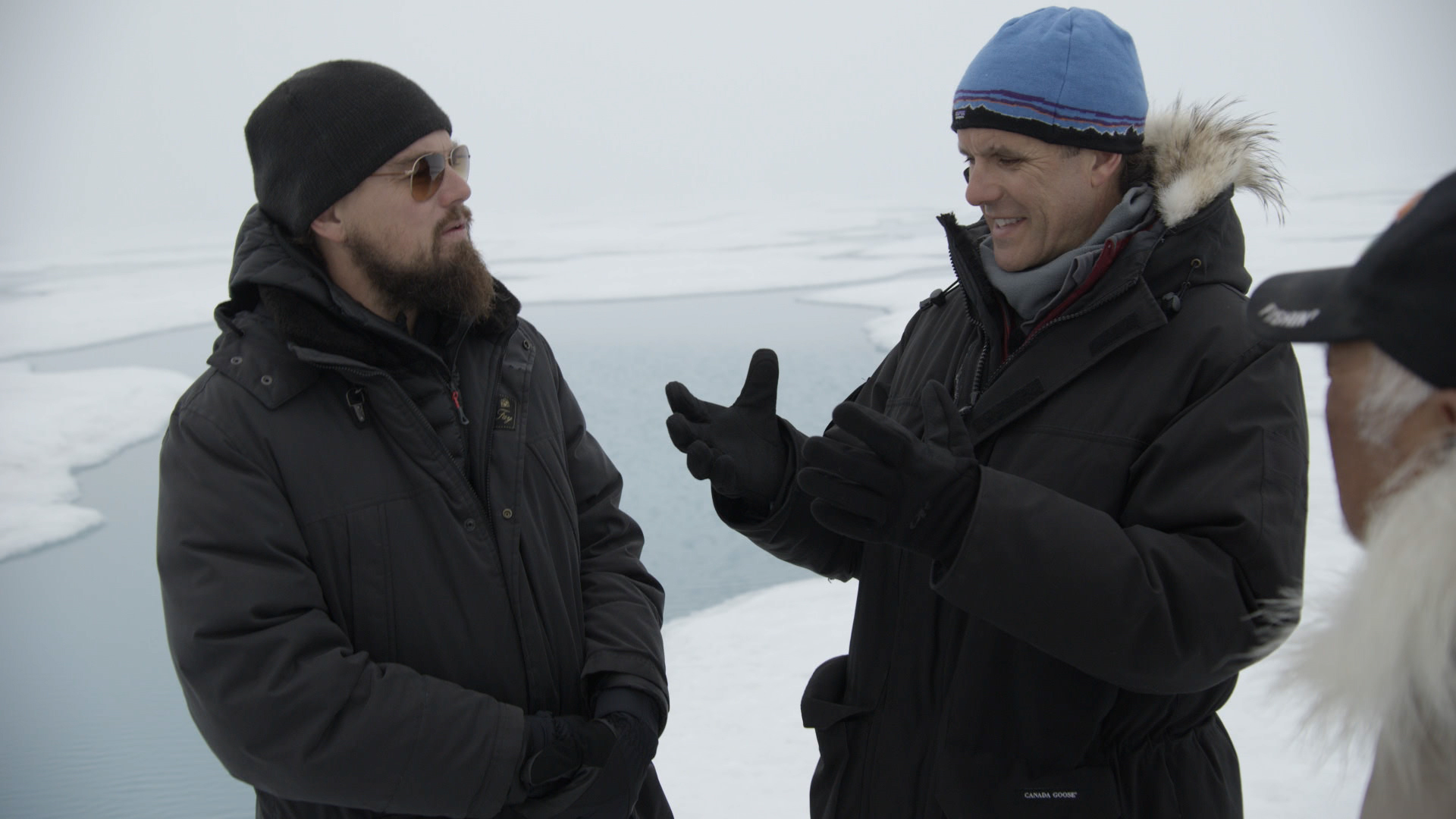
Fisher Stevens directs an urgent but humble documentary that keeps climate change advocate Leonardo DiCaprio front and centre, even as he questions his own credentials, and laments his carbon footprint.

Just a decade ago we saw America start a war over oil. In a not very distant future, those same wars could be fought over water. We’re already seeing climate change refugees – people forced to leave their homes because flooding or other “natural” disasters prompted by global warming. This won’t just be about the environment. This will quickly become an issue for national security.

There is hope. There are things we could and should be doing. You and I share a responsibility to lead by example. We need to start making wiser choices now, because we will be judged by future generations, and we need to decide whether we want to be lauded by them, or vilified.


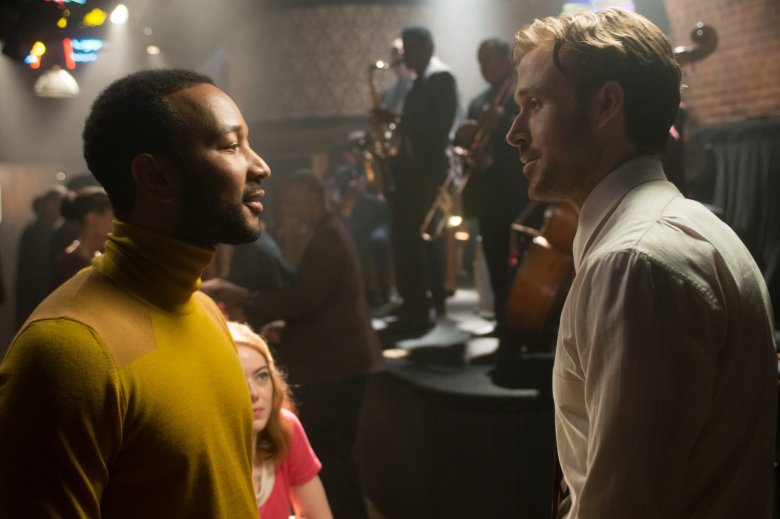
TIFF: Sing

What do Scarlett Johansson, Reese Witherspoon, and Matthew McConaughey all have in common? They’ve all got pipes. And boy do they use them in the new animated movie, Sing.

Picture this: a cute and cuddly koala, fuzzy in all the right places, adorably attired in a bowtie and sounding an awful lot like Matthew McConaughey. His name is Buster and his theatre is his passion. It is not, however, much of a sing-animation-movie-wallpaper-02living. The theatre’s bankrupt. He hasn’t had a successful show in – well, maybe ever. The bank’s about to swoop in and take it from him, so in a last ditch effort to save it, he plans a singing competition.
Because his secretary is a bit of a dunce, the $1000 prize is advertised as much more, so people desperate for money as well as those desperate for fame all show up to auditions. From a talented pool he selects a chosen few: Ash, a punk porcupine with a penchant for writing her own tunes (Johansson); Johnny, a gentle gorilla trying to escape his dad’s gang (Taron Egerton); 300773_m1455639411Gunther, a flamboyant dancing pig (Nick Kroll) partnered with Rosita, a shy momma pig with a big voice (Reese Witherspoon); an arrogant crooner of a mouse (Seth McFarlane); and a timid teenaged elephant with stage fright (Tori Kelly).

We saw an “unfinished” version at TIFF, as a sneak peak, but to my eye Garth Jennings’s oeuvre looked pretty near polished. The truth is this film is generic and formulaic. The animation is nothing to write home about. But the songs are catchy as hell, and the talent backs it up. It’s fun. It’s fluff but it’s fun. Your kids will like it. And you may resist, but your toes will be tapping too. It’s that kind of infectious.

TIFF: Their Finest

London, 1940: most have gone to war but a few are left behind to entertain the people in this bleak time. The department of war is demanding that happy-ending war movies be churned out for morale.

At any rate, Lone Scherfig’s Their Finest was indeed a boost to my morale. Of course I love Bill Nighy, and he’s at his Nighest, with his signature gestures and snorts. He plays a very vain actor who can’t quite believe he’s perhaps aged past leading-man status. Luckily a diplomatic new writer, theirfinestCatrin (Gemma Arterton) hired to write “slop” (ie, the female dialogue) appeases him by enlarging the role of the drunk uncle just for him. Convincing her boss Tom (Sam Claflin) to let her do this is as infuriating and degrading as you’d imagine – until he starts to fall in love with her, of course.

Keep in mind that though they’re writing about the Miracle of Dunkirk, the war is still raging, and Catrin must decide whether to risk losing the thread of her story every time the air raid sirens go off. The cramped office remains nearly a sanctuary but outside the city is badly bruised.

The war was a time when, with young men absent, older gentlemen and women stepped up to get the work done. Catrin is constantly reminded, however, that her employment status won’t hold up when the boys return. untitledShe mustn’t get too attached to feeling useful or creative. The war makes everything tenuous.

But despite this sounding rather dire, it is very much a comedy, and a bit of a love letter to film making. The laughs are plentiful, robust. The stars are endlessly charming. I haven’t much cared for Sam Claflin and don’t have much of an opinion on Gemma Arterton, but both are excellent here. Nighy of course, is a prize scene-stealer, and he deftly makes away with every one he’s in. Sometimes the war is seen through rose-tinted glasses (a nostalgic effect?) but when the war does assert itself, it leaves a crater. This one’s not to be missed.

TIFF: Lion

I was a little caught off guard by audience reaction to this movie at TIFF. I’d read the book and liked it well enough but the movie didn’t strike me as particularly must-see. Boots on the ground at TIFF though had me hearing something different. In fact, had me hearing that it was giving La La Land a run for its money as People’s Choice. People’s Choice! So I did what any sane woman would do: I gave up my tickets to I Am Not Your Negro and secured tickets to a last-minute additional screening of Lion.

mv5bndjimtnhmgmtntewzs00zdazlthhmdutngm4nzfhnjzhy2rjxkeyxkfqcgdeqxvymtexndq2mti__v1_Lion tells the true story of a 5 year old Indian boy named Saroo. Separated from his brother one night, he falls asleep on a train and wakes up miles away from his home, his family, from people who speak his language. He survives on his own for weeks before being thrown into an orphanage and then shipped down to an Australian family who adopt him.

Once grown, Saroo finds himself thinking about the mother he disappeared from, who might very well still be looking for him. So he uses the only tool he has available to him: Google Earth. With little information to go on, he scans the internet every night for signs of his childhood home. It’s an impossible mv5bmdu4zgi4yjgtywzlns00nte2ltg1mmutytk2njflnzhjotrjxkeyxkfqcgdeqxvymtexndq2mti__v1_task but Saroo is miraculously lucky. Off he goes to India, to see if he can locate any family near the place he once called home.
Sunny Pawar will quickly win your heart as 5 year old Saroo. His big, adorable eyes immediately indicate his innocence and vulnerability. His half of the movie is gripping and heart-wrenching because Pawar easily elicits our sympathy. While a lost child living on the streets would surely be attended to here, in India it is unfortunately all too common a sight. His pleading is ineffectual. I felt ready to shout at the movie screen myself. And such a tiny thing navigating the streets of Calcutta – it’s an indelible image that speaks directly to your heart.

When Saroo is sent to his new Mummy (Nicole Kidman) in Australia, it becomes a new movie: a fish out of water experience for a little boy who probably didn’t even know that such a country existed. But for all intents and purposes, Saroo grows up Australian. His brown skin gives him away, but he feels a fraud among other immigrants, his culture and background a mystery to him. Dev Patel plays grown-up Saroo, a man searching the Internet not just for his hometown but really also for himself. He doesn’t want to hurt his adoptive mother though, so he pulls away to protect her.

Unfortunately, Google Earth isn’t all that interesting or cinematic. Garth Davis chose to stick with Saroo’s real-life methods but it’s not thrilling or sexy on mv5bndu0mgqxndmtndc5zc00otm4lwe0zmqtndjmzdiwmju1zjezxkeyxkfqcgdeqxvymtexndq2mti__v1_the screen. It literally is just a guy staring a screen night after night for weeks, months, years. He’s moody and emotional in between, throwing his relationship (with Rooney Mara, in an underwritten role) onto the rocks. Nicole Kidman gives an admittedly strong and stirring performance as his mother and helps bridge the gap, but there’s a marked lag until Patel goes back to India.

The Indian scenes are triumphant, but they also raise a lot of questions. Where was Saroo better off? What happens to kids adopted outside their culture? Which one is his real home, his real mother?

I worried that Lion was garnering attention at TIFF because the audience, who skews older, might have felt good about watching something multi-cultural while still safely ensconced in a white lady’s movie. The film, however, won me over. Maybe it tries a little hard to be upbeat, but a feel-good ending is hardly a negative. Davis acquits himself well in his first directorial feature. The chapters are perhaps a bit uneven but the victory is not.


On a TIFF sidebar: While La La Land did end up receiving the People’s Choice award (Lion was the runner-up), the tickets I gave up, I Am Not Your Negro, would have had me watching the People’s Choice documentary winner. Ah well. You win some, you lose some. I can’t regret much since I was watching a great movie either way.

TIFF: The Journey Is The Destination

This is supposed to be the inspiring biopic of photojournalist/artist/activist Dan Eldon. But something is lost in the translation between his real-life journals that inform the story, and its appearance on the big screen. Namely, the inspiring part.

Supposedly Dan Eldon was an activist from a young age, raising money for various good causes. British-born but raised in Nairobi, he had a silver-spoon life, having the best in x9kbt0q2zcmaybswkkqklezuxi3education, the ability to visit over 40 countries while still in his teens, and loads of opportunity. He sprinkled his good fortune with charitable acts for others. But in the movie we don’t see a lot of Dan Eldon, activist. Rather we see Dan Eldon, purveyor of white privilege, with a side of white saviour to further sour the milk.

The film is brought alive under Bronwen Hughes’s able direction. She attempts to turn the film into a literal scrap book of sorts, travel-logging his adventures to honour creative source material, though this conceit is used sporadically. And it’s also not a great fit for the film, tonally. By the movie’s end, The Journey Is The Destination will have brought you to some very dark places. Cutesie scribbles and doodle a la Diary of a Wimpy Kid don’t really belong somewhere that ultimately ends up more Hotel Rwanda.

I want to believe in Dan Eldon, good person. It’s just that this movie keeps showing me Dan Eldon, man of many advantages and almost no self-awareness. The cast is strong: Ben Schnetzer is charming as Eldon, plus the likes of Maria Bello and Kelly Macdonald in particular are welcome additions, but they can’t do much with material that’s inconsistent and contradictory. In fact, in researching this guy, I’ve learned that most of what we see in the movie is just plain wrong. And the edits they’ve made, perhaps to make him seem less flighty, more substantial, also make him less sympathetic.

If you’re truly interested in the man, reading his writings is likely the better bet.