
Pain and suffering. No, those aren’t themes in the movie, it’s just what I felt while watching Werner Herzog’s narrative feature film at TIFF this year. The man is a legend, an icon, a talented film maker. A talented documentary film maker. His stab at narrative cinema was an atrocity worse than the one detailed in the film.
Salt and Fire’s premise: Some corporation is wreaking havoc in South America. 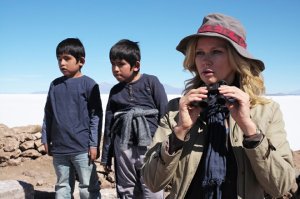 The landscape has significantly changed, the salt flats growing exponentially. A volcano that runs underneath shows signs of erupting as a result, which would mean a global disaster. Like a wiping out of humanity disaster. So, in a strange bid to fix things, a misguided man (Michael Shannon) kidnaps a scientist (Veronica Ferres) and abandons her on the salt flats along with two blind boys.
It’s such a flimsy excuse of a story it’s hard to take it seriously. Gael Garcia Bernal plays another scientist in the delegation, but his character is given massive diarrhea and written out of the script 5 minutes in. Yes, you read that right. We were flabbergasted too.
The film has worse symptoms than just an unbelievable premise and a bad case of the runs. It’s also got the worst dialogue I’ve ever heard in my entire life. At first I wanted to chalk it up to Herzog not being an Anglophone (still, I believe there are things you can do about that, such as hire writers). The “dialogue” (I loathe to even call it that) sounds suspiciously like the narration of a documentary. It’s textbook and stilted and has no business coming out of a person’s mouth.
Salt and Fire was billed by TIFF as an “ecological thriller” but we got it straight from the horse’s mouth that this was not the case. Boy was it not the case. To 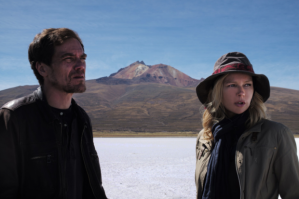 suggest that there is a thrill to be had here (other than the panicked state of Bernal’s panties) is laughable. Most of the film is just unending shots of salt. There’s a good 10 minutes just watching the kids play Trouble (the board game) for the blind.
I wondered why in the hell Michael Shannon, celebrated and usually reliable actor, would sign on to such an abortion. I have a sneaking suspicion it might for the same reason I attended the screening – to get close to Werner Herzog. And the truth is, seeing him in person was everything I hoped it would be. He was very Herzogian. He’s a man full of fire and passion. He is animated and dynamic and tireless. And as it turns out, he claims that the things I hated most about the movie are things he did on purpose.
He called the dialogue “highly stylized” (check out the comments for segments from his Q&A). Highly stylized! My highly stylized ass. He also called the film “a daydream that doesn’t follow the rules of cinema.” Which is admittedly a nice way of saying “I have no idea what I’m doing.” The story is so passive that it fails to engage its main theme. We never feel ignited. We never really even understand what’s going on. Does the movie have a purpose? Do the characters?
Werner Herzog is unapologetic, and I like him that way. But in the future, he and I should both stick to his documentaries.
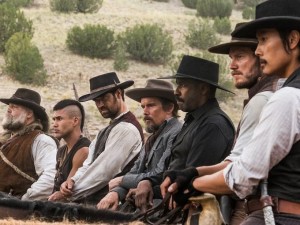 This is a western where the good guys wear black. Where you cheer for the outlaws, where a woman shoots better than most of the men, and where a black man can be the unquestioned leader of the posse. It is a more multicultural west than we are used to seeing, and it feels natural, like this is how it always should have been.
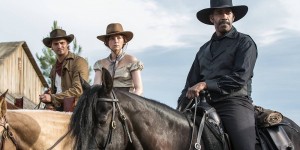 All the outlaws he recruits fall into line and work with him and for him, to save a little town that a gold baron has taken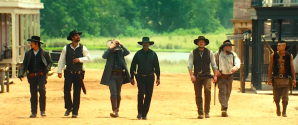
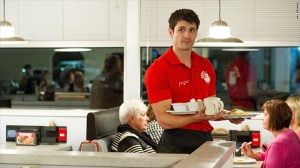 resume thrown out of places from carpet fitters to mechanics. Only a chicken and waffle restaurant will take him, where he’ll fall under the tutelage and benevolence of grill man Danny Glover, who insists on being called Waffle Daddy.
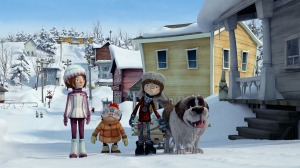 territory, the whole school would assemble into our tiny gym, and one of the few movies screened for us on a 24-inch TV was La guerre des tuques. It was a movie about a bunch of kids who wage an all-out snowball fight in the vicinity of a huge snow fort during their winter break. La guerre des tuques literally translates to war of the tuques, but the English version was called The Dog Who Stopped The War.
 yes there are hockey sticks, but also lacrosse sticks and curling brooms.
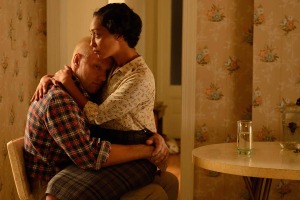 The movie’s success lies in what a small, personal story this is. We never feel like the whole south is against them – but it feels worse that it must be one of their neighbours who keeps ratting them out. The police come, guns drawn, to break down their door in the middle of the night in order to catch them in a crime – that of sleeping next to itch other in marital bliss.
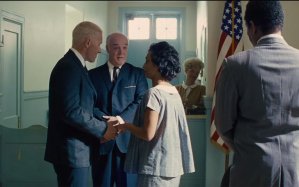 reserved. There’s not a lot of grandstanding. In fact, he turns his back (and his camera) away from the big, sweeping court scene in order to keep it once again in the heart of the family. Easily eliciting a flood of emotions, it’s actually a relief to see them played out so superbly on Negga’s face, and in Edgerton’s shoulders, rather than some melodramatic speech. The restraint here is a credit to Nichols’ directing, but also to this wonderful casting.
 not going to query studios or go to auditions, they’re done with doing it the Hollywood way. Now they’re desperate enough for the lowest kind of fame: Internet fame.
 underground tape X-V, literally a supercut of every fantastically horrific, violent, gory thing that has ever happened on film, set to some delicious pop. It’s nauseating good fun.
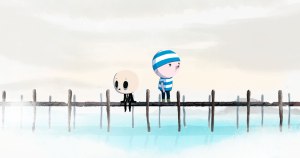 Psiconautas finds beauty in unusual places: decimation, addiction, and poverty, to name a few. In a word, the art is stunning. It feels like a throwback in its hand-drawn aesthetic, and yet feels modern in subject matter and futuristic in its setting.
 Like why a mouse’s stepfather is a human dressing up as a mouse, why her “fake brother” is a bulldog wearing a luchador mask, and why her bird boyfriend is possessed by horrific crows.
 in a good way. All of it has meaning, all of it is a blurry reflection of our society, from our proclivity to make trash to our struggles with addiction to police brutality. I left the theatre wanting to immediately watch Psiconautas again to see what other threads could be tied together.
 The talking head interviews are culled extensively from the guest list of the 2015 festival, and include the likes of Toni Colette, Michael Moore, Patricia Clarkson, Judd Apatow, Mimi Leder, Paul Feig, Catherine Hardwicke, Angelica Huston, Jill Soloway, Mira Nair, and so many more.
 carpet when she broke out a sign reading ‘Budget the Baby’. She says “As an actor I can claim a massage or a facial but I can’t claim childcare. Actors are the most pampered people on sets. It’s the crews — the electricians, catering, camera people — who are often on set at 4am.” Hope Dickson Leach is a mother of two herself; you can imagine what a grueling 20 hour day on the set can mean to a family with young children.


 world, praised him for his quick thinking and skill. His maneuver saved every soul on board. It was quickly labelled “The Miracle on the Hudson.” He made the rounds of late night talk shows, smiling politely as hosts feted him, but that smile was a facade.
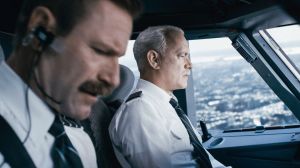 lives on the line, his own included. Aaron Eckhart plays Skiles, the right-hand man with an equally formidable mustache (what is it with pilots and mustaches?). Laura Linney has is relegated to an even smaller part, as the wife on the other end of a telephone. Both are fine, but this is clearly Hanks’ show, and Sully’s story. He’s the one not just with his reputation on the line, but his career and pension and ability to support his family in flux too.
 ASSHOLES WATCHING MOVIES