
Note: when this film premiered at Tribeca, it was called Geezer.
Perry is the Geezer in question, a middle-aged suburban dad with edgy hair and a family he loves, but he’s just a little bit checked out of his ordinary life. As he turns 40 he’s stewing in what-ifs, foremost among them, what if I hadn’t left my punk rock band just as it was maybe about to take off?
He’s no semblance of a musician now. He works in a hardware store and only manages to sneak in a few chords around his kids’ morning routine. But on the occasion of this milestone birthday he decides to treat himself to the wildest party a has-been can muster before noon and he runs in to an old flame who reignites old dreams.
 It’s not exactly ground-breaking material but here’s the gimmick that’ll put butts in theatres: it’s Green Day’s Billie Joe Armstrong playing Perry. And is it pretty effing cool to see him play the guy he might have been had his own post-punk outfit not taken off when it did? Yes, yes it is.
So then the question you’re next going to ask is: Holy shit, can Billie Joe act? And the answer is no, no he can’t. I mean, the director, Lee Kirk, told us he was a great actor, but the movie seemed to indicate that the Kirk’s pants were on fire. Sean thought he was okay – inoffensive, but he never forgot for a  moment that he was watching Billie Joe Armstrong. I, on the other hand, thought it was a scootch worse than that. Unnatural. Self-conscious. Very “you can tell I’m acting because my hand is over here on my hip, which means I’m going through some internal conflict I’m not subtle enough to convey any other way.” And yet I’m not going to condemn him because the movie really is a vehicle for him. He’s what makes it cool and relevant, makes the movie rise above the other mid-life-crisis\path-not-taken meditations. Plus, Kirk pads the cast with some better talent: Judy Greer as the old flame, Selma Blair as the current wife, Chris Messina as the scowling brother, Fred Armisen as an ex-bandmate.
The theme may be familiar, but I still admired the writing. Kirk tries to take a fresh perspective, never blaming the wife and kids for Perry’s lack of success. 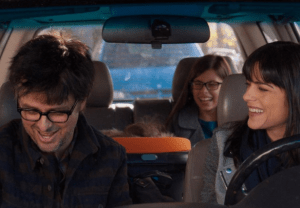 The regret without resentment shows maturity I’m surprised to see in a character like Perry. Billie Joe never quite transcends the role, but there is an honest vulnerability there that’s a little charming. And Billie Joe is not just a casting liability, he’s an asset to the soundtrack because he’s written some original music for it, and the movie is never more confidant than when Armstrong is performing. In this he excels. The songs he wrote are great and I imagine they’ll be invading your radio waves sometime soon, lending the movie some major credibility.
I can be certain about the music because we were treated to a concert immediately following the screening. Billie Joe had Green Day drummer Tré Cool backing him up and Jesse Malin on rhythm guitar. They launched into the film’s first song, Devil’s Kind, with  an energy that defies the fact that Armstrong is in fact a middle-aged father of two. They played a couple of Green Day tunes as well, Scattered and then American Idiot, which morphed into Bad Reputation. Oh, did I not mention that Joan Jett was in the house? Yeah, she has a small cameo in the film but she got up on stage and showed the boys what a scene-stealing badass she still is. Her voice hasn’t aged a single minute and the woman’s still sporting leather pants. Armstrong closed the night with Ordinary World, the film’s acoustic ballad, and I couldn’t help but wonder at the twinkly goodness of my life. In the movie of my life, there is no path not taken.
Note: Geezer has since undergone name change. Now known as Ordinary World, it will see a release October 14 2016 – on DVD\streaming and in select theatres.
 Frank, the dashing and charismatic reporter while Ricky Gervais plays his lackey, Finch. Finch is a clumsy and oblivious guy with a beautiful but disloyal wife (Vera Farmiga) whose ineptitude causes he and Frank to miss their career-making flight to Ecuador just as a war is breaking out.
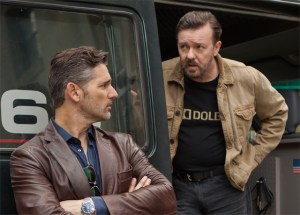 anything intelligent or funny or worthwhile or clever. It’s flimsy. Like, paper-thin. And the characters are so one-dimensional that while we can’t really believe that there is not one but two Hottie McHottersons willing to bed Finch, we also don’t really care. This feels lazy and phoned-in and at times it also looks downright cheap, and I don’t just mean that it was filmed in pretend-NY Toronto (although it was. Sidebar: Gervais’s father is Ontario-born and French-Canadian).
 J.R. Brinkley was a doctor in small town Kansas who, through the grace of his revolutionary goat-testicle transplant surgery, cured many men of impotence and infertility while bringing vitality and prosperity to the town. Brinkley had to build hospitals just to deal with the growing demand, and almost accidentally became a radio pioneer simultaneously, broadcasting ads for his services and answering write-in medical questions between blasts of good ole country music. Despite exponential interest and a horde of faithful followers, the American Medical Association accused Brinkley of “quackery.” Just as they set out to discredit him, he came out with an elixir just as
  effective as the goat-testicle procedure but with much less risk. And then he ran for governor, with a slogan borrowed from a laxative commercial. True story.
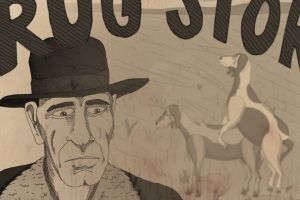 used for each segment, but there’s a uniform style that injects a lot of kinetic energy into a story hilariously but dryly narrated. You won’t believe how quaint goat fucking can look.
 This film is actually a dramatic reenactment of a documentary of the same name, by G.J. Echternkamp. And his parents are undoubtedly larger than life, which in this case is a kind euphemism for colourfully pathetic, hopeless losers. Rene Russo and Oliver Platt play the titular characters and you’ve got to admire their abandon. They each give strong performances, and you’ve got to give props to Russo in particular for her willingness to throw herself into such an unflattering role.
 to stick to the source material means this movie has no real backbone. It ambles but doesn’t amount to much. And weirdly, GJ seems to be the least developed character – it’s his story but he’s a pretty passive player. And that feels ironic since Echternkamp himself helped bring this script to life, and he’s also sitting in the director’s seat, although at times he seems to forget about the advantages of feature vs documentary – he could make the scenes look amazing yet seems to enjoy filming in dank little corners.
 exaggerated facial features on his favourite cartoon characters. One day Owen’s father is able to hold his first conversation with him in years simply by pretending to be Iago, the talking parrot from Aladdin.
 can express their love and see it reflected back, even if it’s a line originally quoted by Belle to the Beast. What I do know is that this film opens a lot of doors. This isn’t just a talking-head piece, we actually get to visit with Owen in his new situation, and his family as they continue to take on new challenges. We get to see autism in action, impacting a family and influencing a community. And we get to see that Owen is a guy with wants and needs like any other. He expresses them differently, and once you get the hang of his language, it’s not necessarily even worse, it’s just different.
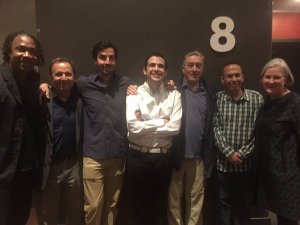 interesting and watchable is Owen himself, a very dynamic individual. He’s at his best at the helm of his Disney Club, where other learning-disabled young people gather to watch and discuss Disney animation. They may even run lines afterward, or play the score, and once in a while Jonathan Freeman, voice of Aladdin’s villain Jafar, drops in to lend a hand, and even Gilbert Gottfried, voice of Iago himself, has attended, but nobody knows the lines better than Owen himself.
 the lines. Many of the film’s crew were on hand, as well as the entire Suskind family, to launch this movie into orbit. There’s a lot of love and care gone into this work, and some of the best bits are when Owen’s own stories are beautifully animated (by Mac Guff). Owen identifies more with the sidekicks rather than the heroes of his beloved films, and he brings them to life in a very moving way.
 Spider-Man. Ant-Man. Falcon. Black Panther. These are the top four characters, in order, in Captain America: Civil War. You might think it’s a bad sign that neither Captain America nor Iron Man is on that list, but you’d be wrong! Although you would be right in thinking I wish this had been a Spider-Man movie with a Captain America/Iron Man cameo, rather than the other way around.
 lauded career after being launched in the theatre playing Sigrid, a sizzling ingénue. Now, years later, the playwright and her mentor has died, and there’s interest in re-staging the play, and Maria is approached to star. The catch? This time she’d of course be playing the role of the older woman, Helena, in a complicated May-December lesbian office unrequited romance (whoa, that’s a mouthful).
 I didn’t find the story-telling in this movie to be quite satisfactory, but the performances were top-notch. There’s an intense, almost sexual chemistry between Binoche and Stewart that makes their rehearsals a rare treat to watch. Not often are two such strong female characters allowed to shine on the screen together with such naked feeling.
 believably deliver a line about acting in blockbusters.
 In Cheer Up, we meet Finland’s second-worst cheer leading squad. On the heels of a humiliating loss, Garland explores what it takes to keep going in the face of defeat. Where will the girls find motivation? The documentary follows three of the women in particular – coach Miia, and team members Patu and Aino. We soon realize that their struggles and failures are not just confined to the gym. Miia’s personal life is on the rocks, Patu is grieving her mother while her father impregnates a new girlfriend, and Ainu follows the highs and lows of first love, and all the teenage angst that comes with it.
 tears, tumbles, and bloodshed. Miia travels to the cheer leading mecca of the world, Texas, to seek inspiration but finds that their aggressive, winner-takes-all spirit just doesn’t translate back home.
 pep and ponytails. It’s refreshing to remember that not everyone goes home with a trophy. For these women, and many others, success will have to be defined elsewhere.
 ASSHOLES WATCHING MOVIES