Author Archives: Jay

Midnight Sun

Another day, another dying teen. Hollywood loves to kill off teenagers. Movies are the #1 leading cause of 30 year olds playing 15 year olds dying prematurely.

In Midnight Sun, Katie has xeroderma pigmentosum, or XP, a rare genetic condition that means the sun is literally poisonous to her and could kill her in seconds. As you can imagine, she’s led a sheltered 17 years, sleeping by day, hanging out with her protective dad by night. But give a girl an ounce of outside contact, and she comes home with a boy, from whom she keeps her illness a secret.

This movie takes its cues from last year’s dying teen girl movie, Everything MV5BNTNkOTQ4ZjUtMjhiMC00MWNkLWJlMjQtYmY4ZmQ4ZDhkOTVkXkEyXkFqcGdeQXVyNTc5OTMwOTQ@._V1_Everything, in which the girl is also confined to her house, but she wasn’t allergic to the sun, she was allergic to everything. Possibly including the sun. And she didn’t have a dead mother, she had a dead father. And she didn’t fall in love with the boy next door. Oh wait, she did. So yeah, beautiful teen girls with terminal diseases just waiting to die up in their castles until a boy comes along who’s handsome enough to make her risk it all. So she can die on her front lawn instead.

Why do teen girls want so badly to watch themselves die? I wonder if movies made to be watched while you’re on your period is a genre: movies that invite tears and ice cream binge-ing while making young women feel seen. But high school romance doesn’t need to have life or death stakes, and your first boyfriend shouldn’t be your last. I’m about 15 minutes past 17, which is way too old to sympathize with what’s going on here. Featuring Bella Thorne, star of all the straight-to-Netflix runners up, and Patrick Schwarzenegger, son of Arnold and Maria Shriver, with all the genetic talent you’d assume.

It’s astonishing, really, that a movie can work this hard at being this bad. Midnight Sun puts the jerk in tearjerker.

Angus, Thongs, and Perfect Snogging

I suppose it’s inevitable that I’ve failed to relate to this coming of age comedy about a young girl in high school who’s utterly obsessed with snogging. More alienating than the age difference is my absolute distaste for the word snogging, which is repeated so often in the film that my stomach acid has stripped away the mucus lining of my throat after throwing up in my mouth so frequently.

In fact, I do not care at all for kissing in films because I really cannot abide the sound effects attributed to it. You can hear the spit. It’s all spit. It’s slurpy and damp and you can just hear the strings of saliva between open, bacteria-ridden mouths. It grosses me the fuck out. Which is weird because I don’t really mind it in person. But as in many things, real-life kissing is almost nothing like movie kissing, and if done reasonably well, and MV5BMTM0MDQ2MDgyMF5BMl5BanBnXkFtZTcwMzc2NDkxMw@@._V1_SY1000_CR0,0,1503,1000_AL_with the avoidance of too much tooth contact, it’s never nearly as noisy. So I already know that I hate kissing scenes in movies. And poor Georgia wants nothing more than kissing all the time. Scratch that. She wants snogging, because she’s British and therefore had to come  up with a gross word for it that ruins it for the rest of us. I mean, first of all, snogging has always sounded to me like rather more than just kissing. In fact, it pretty much sounds like the whole enchilada. The whole kit and caboodle. But no, snogging is what twerpy little teenage girls do to the backs of their hands at sleepovers and such. Georgia is sadly snog-free at this stage in her life, but she’s devoted herself (at the expense of school, friends, and family, naturally) to correcting this void. And wouldn’t you know it: the eminently dreamy Robbie moves to town, and is the perfect target for all her lusty fantasies (which mostly involve running uphill???).

Angus is just about the only thing that I don’t despise in the film. Angus is Georgia’s long-suffering cat. Normally I don’t go in for cats, but Angus tolerates dog-levels of indignity – tea parties, costumes, even getting pretend-lost so that Georgia and cat-loving Robbie can share a moment or two searching for him.

The other thing that director Gurinder Chadha gets right is casting a very young, very floppy-haired Aaron Taylor-Johnson (who of course isn’t going by that yet) as dreamboat Robbie. It is quite arresting to see him so young and smooth-faced in this film after so recently having seen him waggle his penis about in A Million Little Pieces, and bare the madness of his soul in Outlaw King. I know I complained about all the brutal horse murder in the latter, but it turns out that the slaughter of innocent animals is easier for me to cope with than the sound of perfect snogging.

All I Wish

Senna is an aspiring fashion designer who struggles professionally and romantically. What better time to drop in on her and assess her life than once a year on her birthday? Birthdays are a time to reflect, to take stock, to celebrate, and to mourn. We meet Senna (Sharon Stone) on her 46th birthday and follow her into her 50s. She doesn’t believe in marriage but wouldn’t mind finding love. She does believe in career, but hers hasn’t found her yet. Don’t worry about judging her too harshly – that’s what mothers (Ellen Burstyn) are for.

MV5BZDhiODdhOGUtMTMyMC00NGI3LThkY2UtNmI0MWUzZDRlZGFmXkEyXkFqcGdeQXVyNzQ0MDUyMzg@._V1_SY999_SX1776_AL_On one of these occasions, we (and she) meet Adam (Tony Goldwyn), a straight-laced lawyer with a foot or two in his mouth. They seem like a classic case of opposites attract until one too many birthdays go by without a ring, and Senna’s carefully composed facade cracks, exposing all her inner most birthday wishes – and they aren’t exactly what she’s been espousing this whole time.

Do you make a wish as you blow out your candles? People say that we have to hold our wish dear, keep it secret, or else it won’t come true. Perhaps that’s just a convenient way we have of not exposing ourselves, because, as Senna’s best friend Darla (Liza Lapira) puts it, wishes are an admission that something’s missing, that there’s a hole that needs to be filled.

Senna is a grown-ass white lady with a pretty cushy life, but no, not all of her wishes have come true. If she hasn’t learned that about life by her 46th birthday (*coughSharonStoneis60cough*), then there isn’t much hope for her. Now we’re just going through the motions to see what clever yet subtle way her mother has of lightly insulting her while pretending to lift her up.

Sharon Stone is kind of delightful, in a way that makes you miss her even as you’re watching her in this subpar rom-com, if that’s what this is supposed to be. It would be nice if she was given a vehicle more worthy, but All I Wish (also known as A Little Something For Your Birthday) isn’t it. She does her best to tongue the clunky dialogue and pave over the plot holes with her effervescence, but Sharon Stone alone is not enough frosting to make up for this disappointing piece of cake.


The Rebound

Like any good sports movie, The Rebound has an impressive training montage. The men push themselves to be stronger, go longer, play harder. They are fast, they are dedicated. They get up at ungodly hours to work out, and their grocery bills reflect their need to ‘feed the machine.’ But the stars of The Rebound aren’t your usual athletes.

In basketball, a rebound is when a player regains control of the ball after a shot is missed. It’s the second chance play. In the NWBA, the players contend with a different kind of rebound. It’s how a man picks himself up after a life-altering accident has left them paralyzed. The W stands for wheelchair.

This documentary follows a few key players on the Miami Heat Wheels as they push toward a national championship. But for the Wheels, it can never be as simple as playing well. Funding, for them, will always be an issue. The county gave them $2500 for the season when a trip to nationals alone will cost 11 grand. So between playing, traveling, and training, they’ll also be fund-raising.

Some of these men will discuss their accidents, and since many are a result of GSWs, they discuss, by extension, the need for gun control. Some of them are hoping to earn athletic scholarships for school. One is trying to break into the music industry. But they’re all really passionate about basketball, which is good, because when you’re strapped into a chair and careening at high-speeds on a court, the game looks brutal and dangerous. But they make it look easy. Physical, yes, but sometimes also surprisingly elegant.

Like lots of movies about sports, this documentary is about triumph over obstacles – it’s just that these athletes encounter challenges both on and off the courts.

Let The Sunshine In

Juliette Binoche is extraordinary, really. Behind those gorgeous, liquid brown eyes, there’s a bit of a mystery. There’s a natural sensuality to her, but under the direction of Claire Denis, that turns into a raw eroticism, and Denis knows just how to turn that up.

Isabelle has many lovers but no loves. And maybe she’d like one, a true love, a forever love, but the truth is, she can barely manage the one night stands. She’s exceptionally MV5BNWJhY2UwOTEtMjMzYi00MjBkLWEwNDgtY2QzYmVkNzllNDQzXkEyXkFqcGdeQXVyNjk1Njg5NTA@._V1_bad at choosing men. They’re all unavailable. Her best effort is a married man who’s bad in bed AND rude to waiters. Nothing going for him! He’s not even cute! And he’ll never be hers. So why then is she so hurt when he continues to never leave his wife, as promised? Why does she cry over men who don’t deserve it? She’s a beautiful woman, a tender, open artist. Everyone is entitled to one bad boyfriend. But a string of them starts to look like a pattern, and you’re the one picking the wallpaper. So what the hell is wrong with Isabelle?



She cries at night, every night. She’s miserable. She’s suspicious of men. She moves too quickly and is even quicker to anger. She’s ricocheting between men, wracking up a score, but she never wins the prize. As much as I can dislike Isabelle, Binoche gives her a vulnerability that is hard to hate entirely. She tries too hard, she wants it too much. She’s so desperate she goes to see a psychic (Gerard Depardieu) for advice. And she’s the type who wants so badly to believe him. Her tears guide him into saying exactly what she wants to hear. We all have that friend who just keeps screwing up her love life – we can see it coming a mile away, so why can’t she, an otherwise intelligent woman? Isabelle is that woman and Claire Denis knows her intimately.


Top 10 Female-Directed Movies 2018

10. The Land of Steady Habits: Nicole Holofcener directs some layered, complex performances, especially from Ben Mendelsohn, who plays a man flexing his cringe-worthy mid-life crisis. The film ends up achingly authentic and deeply bittersweet.

9. Blockers: Kay Cannon is the woman behind one of the few comedies I laughed at in 2018, and its box office makes clear I wasn’t the only one. It’s both a teen comedy and an empty-nest one, and manages to be funny, irreverent, and modern about both. Cannon’s cast is loose, and the jokes land handily, the script smart and quick.

tenor

8. Outside In: Lynn Shelton gets some moving and tender performances out of Jay Duplass, who plays a man just released from prison, and Edie Falco, who plays his high school teacher who hastened his release. Their story is absorbing and empathetic, and Shelton teases some naked tension out of it, keeping us in her grip.

7. Private Life: Tamara Jenkins sneaks us behind closed doors to see witness adulthood and marriage as they are rarely seen. In the throes of fertility struggles, Kathryn Hahn and Paul Giamatti give truly fine, heartbreaking performances.

6. What They Had: Elizabeth Chomko delivers a film that’s hard to look away from. Blythe Danner plays a woman with Alzheimer’s while her family (Robert Forster, Michael Shannon, Hilary Swank), swell and melt around her. It’s a real family drama that’s familiar and necessary.

5. The Kindergarten Teacher: Sara Colangelo justifies her American remake by packing a real punch and eliciting a wonderful performance from Maggie Gyllenhaal. This is one film that kept unfolding itself even after it was over, as it stayed in my thoughts for days.

4. A Wrinkle In Time: Ava DuVernay bravely adapted a beloved children’s book and ended up modernizing it, giving it relevance, and making an enduring, beautiful film that can be enjoyed by audiences of all ages.

tumblr_p58tlvY40B1tu7563o2_540

3.You Were Never Really Here: Lynne Ramsay deals us a real swift punch with her gutsy, bold film, and proves she has a bracingly unique cinematic eye. Joaquin Phoenix’s performance is riveting.

2. Leave No Trace: Debra Granik dares to mold this dramatic story into a quiet, low-key film that demands little yet accomplishes much – everything. Leads Ben Foster and Thomasin McKenzie have terrific chemistry that sprinkles the film in authenticity.

1.  Can You Ever Forgive Me: Marielle Heller promises a lot with her premise, but manages to deliver even more. This movie worked for me on so many levels. The story is compelling. Melissa McCarthy is at her very best. It’s frequently laugh-out-loud funny. It’s a platonic LGBTQ love story with the unlikeliest, unlikable heroine, yet she’s always treated with dignity and empathy, and we can’t help but adore her, even in her crankiness.


I’ll Be Home For Christmas

It was the best of times, it was the worst of times. Well, it was 1998, and we thought they were pretty good, but looking back, it’s 100% cringe. What were we thinking?

It’s hard to even imagine a world in which Jonathan Taylor Thomas, the middle brother from Home Improvement, could break out into movie stardom, but Disney did right by its ABC stars, making Tim Allen the voice of Buzz Lightyear and Thomas the voice of Simba. In fact, if you watch I’ll Be Home For Christmas, also a Disney movie, closely, you’ll see some similarities to Lion King. Thomas plays Jake, a college kid who’d rather go to Mexico with his girlfriend than home for the holidays. His girlfriend Allie (Jessica Biel), however, is more family-minded, and Jake’s father (Gary Cole) bribes him with a Porsche. So suddenly Jake is motivated to get home for Christmas, but a rival for Allie’s affections gets in the way of things. Jake comes to in the middle of a desert, and the scene closely mirrors Simba’s own desert scene, down to the turkey vultures squawking at him.

Jake is wearing a Santa suit, and finds that his beard and hat are glued to him. He has no Jake-Wilkinson-763712money, and since it’s 1998, no cell phone. He does know people’s phone numbers though, which is weird, so he’s able to call people collect from a gas station payphone. Nobody comes to his rescue. So now he’s got a cross-country road trip to make, relying on the kindness of strangers, in order to get home by 6pm on Christmas Eve and claim the keys to the Porsche.
Thing is, Jake is not exactly the kind of guy who inspires kindness from strangers. He’s well known for his sweet-talking but he’s a flake and he’s selfish, so he wears out his welcome quickly. Jonathan Taylor Thomas does his best Christian Slater impersonation throughout the movie, and it never, not once, works for him. But since the rest of the cast is also rather talentless and annoying, I guess it blends in?

This isn’t exactly a classic Christmas movie, and it probably won’t win any new fans – basically, unless you had JTT centrefolds from Tiger Beat magazine on your walls as a kid, you’ll probably never get around to this movie, and that’s totally fine. On the other hand, it’s probably the only Disney movie with the world ‘butthole’ in it, so maybe that’s something?


Mr. Magorium’s Wonder Emporium

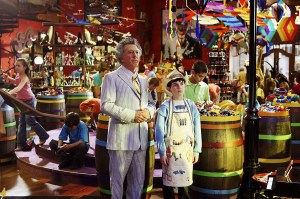
Molly Mahoney (Natalie Portman) was a child prodigy, but now that she’s 23, she’s just a woman who hasn’t made a musical mark yet. She’s the manager of Mr. Magorium’s Wonder Emporium, which Mr. Magorium claims to have owned for 114 years. The toy store is frantic with happy children – like FAO Schwartz given the Toy Story treatment. The toys are nearly alive with magic. The store is filled with the strange and the fantastic.

Molly’s right hand man is Eric Applebaum, a kid who struggled to make friends his own age, but shows up the toy store every day in one of the many hats from his impressive collection. One day, Mr. Magorium (Dustin Hoffman) realizes, in his 243rd year, that Magorium3perhaps it is time to get his affairs in order. He hires a very straight-laced accountant named Henry (Jason Bateman) to set things right before he dies. His lifetime supply of shoes is on its last pair, so his death is imminent, if not quite predictable. Unable to decipher the difference between important documents and doodles, Mr. Magorium’s files are intimidating, even to an ultra boring accountant like Henry. And Molly is not keen to inherit if it means the death of her friend.

The toy shop itself seems to be suffering from some affliction; it too is in mourning, sulking over its fate, and the magic is seeping out in a fit of rebellion.  With Mr. Magorium gone, from whence will magic come?

I’ve never understood how this movie isn’t more watched and applauded and beloved. Yes, it tries hard to be wonderful and whimsical. And just where, exactly, is the criticism in that? It’s about a magical toy shop, for the love of dragon scales! Isn’t maximum effort appreciated anymore? My inner child adores this movie. My grown up self adores this movie! It’s the good kind of cutesy, filled with moving pieces and primary colours. But with themes of belief and inspiration, this isn’t just for kids. It’s for anyone with a little sparkle in their hearts, or the space for some.

Tough Guy

After a year of getting beat up, the Detroit Red Wings “drafted big”, big guys across the board, which landed Canadian novice Bobby Probert was on the team. Bob Probert wasn’t just big, he was tough, and he had a reputation as a fighter. You know, to “protect his teammates.” As you do. This was the 80s, so hockey was rougher and refs were scarce. On-ice brawls were a lot more common than they are today, and Probert was only too happy to oblige. But Probert’s lack of restraint wasn’t just on the rink; off-hours, he drank heavily and did drugs. When stories of DUIs and police altercations hit the papers, the NHL forced him into treatment, and a lot of good that did – he hooked up with one of the counselors and brought her home. He must have been a charming schmuck because not only is that a huge breach of professionalism, it’s also pretty hard to overlook his chronically missing teeth.

The documentary shows the Red Wings management selfishly slapping bandaid solutions on the troubled kid. Their franchise was having a couple of difficult seasons, and if there weren’t any goals to get the hometown crowd excited, a fist fight would do it, and “The Bruise Brothers” (with Joey Kocur) became marketing gold. The coach kept indiscreetly mouthing off to the press, and Probert was now skating high, a cocaine-fueled rage machine waiting for a target.

Back and forth between Detroit (USA) and Windsor (Canada), it was only a matter of time before border patrol found drugs in Probert’s possession. Sure jail was a possibility, but so was deportation, and that was a threat to his career. The NHL failed him in more than one way: he was constantly told that he played better (meaner) when he was drinking than sober, but a contract with serious money was the best incentive for sobriety, and for a time, it worked.

Tough Guy interviews former teammates, former rivals (Tie Domi!), family members, even Don Cherry. It’s a Canadian wet dream, except it tells a dark tale with a mean downward spiral.

The Favourite

Yorgos Lanthimos tells stories about relationships. He clearly finds us human beings fascinating, but the way in which he carves his observations out of us us with such surgical precision makes me feel like Lanthimos isn’t quite one of us.

In The Lobster, he imagined that single people were so desperate to pair up, they’d agree to do so under duress, and under deadline, with failure to find love transforming you literally into an animal. In The Killing of A Sacred Deer, a man watches the innocent pay for his sins until he can not only admit them, but make a sacrifice to atone. These films strike a unique tone; Lanthimos’ voice is absurd but bold and unwavering.

In The Favourite, Abigail (Emma Stone) is a former lady fallen quite low. She’s at the MV5BYzUzNzg5ZmUtMzAwNC00NjA0LTkzOGYtMmViNzAzZmY1NjhhXkEyXkFqcGdeQXVyMjcwODY0NTE@._V1_palace to beg for a job from her cousin, Sarah, Queen Anne’s trusted lady in waiting. Queen Anne (Olivia Colman) is mentally and physically frail. Between painful attacks of gout and a nervous disposition, she leads a lonely life on her throne, often bedridden, frequently deranged with pain or paranoia. Her only friend and companion is Lady Sarah (Rachel Weisz), who basically rules the country in her place. Sarah is a strict go-between, acting as a buffer between Queen Anne and the demands of her royal position, and if she uses that position to exert her own will and influence, well…of course she does. Wouldn’t you?

But Abigail is way more wily than Sarah first gives her credit for. Abigail’s had to do some shitty things in order to survive, and she’s prepared to do what it takes to make sure she never has to suffer again. She throws her charm into overdrive, ,and soon Sarah realizes she’s competing with her cousin for Queen Anne’s attention.

In The Favourite, Yorgos Lanthimos’s gift to us is a power struggle between the three that is never dull, never less than captivating. Emma Stone is fresh-faced but  clever and calculating as Abigail, the servant with major ambition. Olivia Colman is desperately lonely and deeply insecure, but her queen has learned to wield her power to get what she needs. Rachel Weisz is brilliant, as ever. Insanely brilliant. Sarah has made a deal with the royal devil. She has goals and knows they don’t come cheap. Pretty soon there’s an insane transactional triad going on that you’ve got to see to believe – and to some extent, admire. Obviously, women in the 18th century weren’t exactly in the best position, not even if you were queen, but these 3 are making choices and bargains. They are driven by necessity, and desire.

This period piece is soaking in, nay, fermenting in, rich tapestries, both actual and metaphorical. You eyes will drip with colours and patterns and lush landscapes, but despite the beautiful 18th century dressings, this feels like Lanthimos’s most relevant, most contemporary work. Witty, naughty, and sometimes disturbingly dark, The Favourite is stunning, and an absurd amount of fun.