Author Archives: Jay

Bird Box

Imagine threatening very small children with their lives. Imagine threatening your own children with their deaths, their painful deaths, by your own hands if necessary. Can you even imagine a situation so dire that you would tell your kids you would kill them IF?

If you’re a fan of Josh Malerman’s post-apocalyptic horror novel, Bird Box, the good news is,  you can always reread it. Netflix has adapted this “unfilmable” book (how many books have we said that about now?), and turned it into something bibliophiles will scarcely recognize. But that doesn’t meant it’s bad.

Malorie (Sandra Bullock) is in the impossible situation. She’s pregnant at the end of the world. This particular nightmare is the inverse of The Quiet Place – they had to stay silent in order to not die, and in Bird Box, they have to not see. The sight of something is causing people to almost immediately become homicidal and ultimately, suicidal. It’s a plague killing millions, killing billions, killing everyone around the world. The only way to survive is to not see, to never see. But food and water and resources inside are finite. MV5BMjE5Nzk1ODgwMV5BMl5BanBnXkFtZTgwMjU5MTE2NjM@._V1_SX1500_CR0,0,1500,999_AL_Malorie is living with a small group of people, strangers, really, who don’t always agree on the best way to exist together, or how to stay alive. Malorie’s not even the only pregnant one – Olympia (Danielle Macdonald) is expecting too, right around the same time. The house’s other inhabitants (Trevante Rhodes, John Malkovich, Jacki Weaver among them) will have to make all kinds of hard choices to ensure the group’s survival. As you probably guessed, ultimately, Malorie will need to leave the relative safety of their shared home – and worse than that, she may have to sacrifice one child to save another. Doesn’t that sound like a fun little jam to be in?
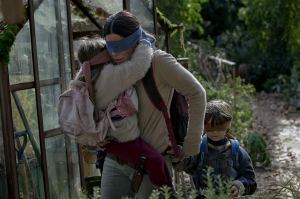
Yeah, this is a horror movie, in case you’re not picking up on the obvious. The unknown, horrible, unseeable things remain unseen by us, but they’re a constant threat. Director Susanne Bier understands it’s way creepier to only suggest the worst, and let our own imaginations prey on our fears. A newborn baby is of course the most vulnerable creature in the world. What else could heighten a dangerous situation like a helpless baby? But what else would pose a greater danger? A baby, unable to look away, unable to understand, a baby who will only need need need, and take take take, and attract attention while putting everyone at risk. A baby, two babies, normally a blessing, but in this scenario, the worst possible thing.

Bier creates a tense atmosphere and Bullock keeps us riveted. Rather than jump scares, Bier gives us a character study, and Malorie’s humanity and the children’s inherent weaknesses gives some real meat to the film’s anxiety. But the film strays quite far from the book, and to no real advantage. Since this film streams for “free” on Netflix, it’s a no-brainer if you can take the heat (or rather the chill, the frisson). Squeeze your eyes half shut.
Welcome to Marwen

Mark Hogancamp was beaten nearly to death by 5 men outside a bar where he’d casually mentioned enjoying wearing women’s shoes. When he awoke from his coma 9 days later, every memory of his life over the last 38 years was gone. Just gone. His life was changed forever. Formerly a talented artist and illustrator, Mark could no longer wield a pencil well enough to write his own name. Not that he remembered his art anyway; looking at his own stuff was no different than looking at a stranger’s. Imagine how sad, how profoundly sad it would make you to know that you had been capable of such beauty and now you don’t even have the memories.

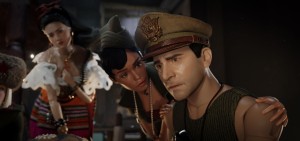
So that broken man is who Mark is when we first meet him in Welcome to Marwen. He is crippled with PTSD. He lives in fear. He’s over-medicating. Mark (Steve Carell) has an ingenious coping mechanism, though. Unable to do art the way he used to, his innate MV5BMTg5Y2M2YWEtNzU5OS00MzlkLWE5YWItZDliZGE1NzhjOWY4XkEyXkFqcGdeQXVyNTc5OTMwOTQ@._V1_abilities are leaking out however they can, and now Mark is a photographer, and his subjects are quite unusual. Hogancamp has constructed a village in his backyard, a village called Marwen, which is inhabited by dolls. He sets the dolls up in war-time scenarios, and each one represents someone special to him in real life, namely the women who care for him. Living among Marwen’s women is Captain Hogie, the stand-in for Hogancamp, a tough soldier who lives his life fearlessly. And so he should, because as invariably as he is captured and beaten by the Nazis hiding on the outskirts of town, his lovely ladies come to his rescue, time and time again.

Carell has made it his business to understand the outsider, and Mark is more wounded, more vulnerable than most. But he’s not defeated. He’s fighting back in small ways, in brave ways. He is a complex man and Carell embraces that. I’m just not sure his director does. Robert Zemeckis prefers to stay away from the tricky stuff. He’s made a feel-good movie where perseverance triumphs over adversity. I suppose that’s nice, but I’m not sure it’s a good fit for the story, or true to Hogancamp’s experience. Likewise, Zemeckis seems puzzled about how to treat the women of Marwen. The movie incorporates some truly incredible animated sequences as we see the dolls come to life and act out the scenarios that Hogancamp devises for them. The animation is informed by motion-capture and it looks really, really cool. Voiced by some very talented actresses (Janelle Monae, Leslie Mann, Merritt Wever, Eiza González, Gwendoline Christie), the dolls are absolute bad-asses. In real life, Hogancamp’s photography of them has resulted in gallery shows around the world. But they’re also comfort items. The dolls are how he deals with his fear, they’re talismans, protectors, therapeutic symbols of safety and security. Zemeckis seems more interested in treating them like sex dolls, which is a creepy impulse, and one that is not reflected in the dialogue, so it’s like the story disagrees between what it shows us and what it tells us, and that discord can be quite distracting.

I think the actors involved in this project strove for an authenticy that perhaps Zemeckis overlooked, or failed to value. Which is too bad, because this movie had real oddball possibilities. It’s still a pretty incredible story, and I don’t mean to discourage anyone from seeing it, because Hogancamp’s story is worth being told (although there is a book and a documentary that may do it better). The way Hogancamp’s experience informs and describes trauma is unique and real and complicated, but I don’t think Zemeckis trusts us to get it, or else he doesn’t get it himself. He gets such a stiffie from all his special effects that he robs the movie of what actually may have made it special. We shouldn’t be dissecting a man’s trauma just to give it the syrupy Hollywood treatment. There was an opportunity to be real, to be honest, to show life’s ugliness and be brave and bold about it, but Zemeckis took the road too frequently traveled. He played it safe, and disappointing, and the movie just can’t live up to the truth.

Mary Poppins Returns

Mary Poppins Returns is practically perfect in every way. It looks wonderful, whimsical, fanciful, a dreamscape. The animated sequences are next-level. The choreography is lively and polished. The costuming, by genius Sandy Powell, makes me tremble, its candy colours and hand-painted detailing an absolute riot. It’s wearable happiness.

And the cast. The cast! Ben Whishaw and Emily Mortimer play Michael and Jane Banks, the original kids from the first Mary Poppins, all grown up. Julie Walters tinkers in the kitchen as the hard-working maid, Ellen. Lin-Manuel Miranda plays Jack, the effervescent but largely ineffective lamp lighter (he might light 3 lamps total during the course of a 2 hour movie because his song and dance breaks are so frequent; the lamp lighter’s union must be fabulous). Together, they’re already a dream cast, but then MV5BY2I4NTRiM2UtYzIxYS00MTkyLTk4Y2ItYmNjNWNlMzZiYzdjXkEyXkFqcGdeQXVyNTc5OTMwOTQ@._V1_director Rob Marshall plunks down Emily Blunt as the iconic nanny, Mary Poppins. Ho-lee shit. I mean, every ounce of credit to Julie Andrews, but since she’s vacated the seat, Emily Blunt is absolutely the perfect choice to carry the carpet bag. Anyone else in the role is simply unimaginable. And Colin Firth and Meryl Streep are BONUSES? Ex-squeeze me? Pure casting heaven.

But here’s the deal: despite there not being a single smudge dirtying up the glass, the magic just wasn’t there for me. I wanted to love this movie. Maybe I wanted it too much. It has all the right ingredients, but the pinch of disappointment is all I can taste.

Michael Banks is in a spot of trouble. His wife died a year ago, leaving him in charge of the house and the kids. All are neglected. His adorable children aren’t just raising themselves, they’re taking care of him too. Just about the only thing they can’t do is save the house from foreclosure. Michael and Jane can’t do it either – neither has any money. Where or where are those stock certificates their father left them? They’ve only got a few days to save their family home from the evil banker, Colin Firth. Cue Mary Poppins. Nominally, she’s taking care of the children, but I think her main ambition is just to allow them to be children again. And ideally, force Michael to act like the father again. So that’s the plot, and then we continually interrupt the plot to do some wild Mary Poppins shenanigans. The dancy, singy, cartoony musical numbers are incredible, or they would be if the songs weren’t so negligible, but they grind the plot to a halt and don’t relate to the rest of the movie at all. It’s not cohesive; I feel like I was watching two different movies, part depression-era family tragedy, part nostalgic stuff and nonsense. There are some wonderful call-backs to the original film, but I feel like Mary Poppins returns relies too heavily on its predecessor and our forgiveness. I wanted so badly to be carried away by this, but I remained firmly in my seat, butt against leather, popcorn in the cracks (of the recliner, not my ass). Translation: perfectly ordinary in every way.

A Simple Favor

Emily (Blake Lively) is effortlessly cool and glamourous. She works a high-profile job in the city and has a handsome husband and an air of mystery. No one is more surprised than Stephanie (Anna Kendrick), a single mom and mommy blogger, when Emily befriends her. Their boys are friendly in school and now the mums are friendly over martinis.

But just weeks after an unlikely friendship blossoms between Emily and Stephanie, Emily calls her with a request for a simple favor: a work emergency has popped up, could Stephanie pick up her son from school? Two days later, the son is still in Stephanie’s care, and no one had heard from Emily.

As the investigation into Emily’s disappearance deepens, Emily’s secrets unravel. Her MV5BMTUzNDc3NTM4M15BMl5BanBnXkFtZTgwMzYxNTM0NTM@._V1_SX1777_CR0,0,1777,999_AL_husband Sean (Henry Golding) is very revealing. Turns out, Emily was a pathological liar and her past was very closely guarded. Stephanie doesn’t know what to think about her friend, but her doubts don’t exactly stop her from getting cozy with Sean…and eventually moving right in. Which seems like a bitch move from a grieving best friend, but then, the recent widower isn’t exactly objecting. Why is Sean not objecting?

Anna Kendrick is very good at being a pathetic loser, and Blake Lively is extraordinary at being a clotheshorse. This movie is exceedingly stylish. Blake Lively’s menswear-inspired wardrobe is to die for, but I swear I’m not the one who killed her. But no matter how you dress this thing up, it’s no Gone Girl, but that’s exactly what it wants you to mistake it for. Unfortunately, it can’t quite embrace any one genre. It often looks noir but goes for the easy laugh. Which one is it, truly? I admire that Kevin Feig went for a blend of both, but I don’t think he quite pulled it off. However, if you’re a fan of the Kendrick-Lively duo, they’ve never been Livelier or more Kendricky. They each know their strengths, and Feig gives them a beautiful stage on which to drip their special sauces.

Adrift

Tami (Shailene Woodley) is a grass-smoking, pukka-shell-wearing rootless wanderer, working odd jobs from one port to the next just to avoid going home. In some marina she meets Richard (Sam Claflin), and he cooks her a vegetarian “version” of fish, which turns out to be salad, fyi.

I don’t care for Sam Claflin, and he’s not gaining any ground with his lackluster performance here. I felt rather neutrally about Shailene Woodley before today, and I can MV5BYWI2NzA3YTgtZjZjMS00MmM3LThkY2QtYmQ3Nzg2YmIwZmY0XkEyXkFqcGdeQXVyNDE5MTU2MDE@._V1_tell you with certainty she’s dipped into the negatives with this film, in which she over-relies on a screechy giggle she mistakes for endearing, even while narrating a letter she’s handwriting to her mother, which apparently was peppered with LOLs even though the movie takes place in 1983, and I doubt LOLs existed then. They just had to let mothers find something funny, or not, on their own back then. It was the dark ages.
I’m biased. I hate making heroes out of stupid white people who take needless risks and do dumb shit and then expect us to drop everything to rescue them when they inevitably get into trouble. We cannot manage to feed and house all the children in our society, but we’ll spend a million dollars to rescue a couple of people nature was trying to survival-of-the-fittest on the top of a mountain, or in this case, out to sea. I don’t have a lot of sympathy for these two, and was frequently and quickly so bored-slash-agitated with this movie, I wished them dead.

I don’t know if this movie is based on a true story, and if it is, I suppose I don’t actually wish them dead. Probably. I mean, on the one hand, it must be a true story, because how else did they name her Tami? I mean, Tammy is bad enough, but Tami? But on the other hand, who would pay for such a generic story? I mean, it doesn’t take a genius to be like, lost at sea bad, not enough food, etc. It does, however, take a special brand of moron to be starving but still refuse to hurt innocent fish by killing them for food.  I mean, after a few hungry days, some people will eat their own mothers, but she clings to her vegetarianism like she hopes to die a self-righteous twat. Meanwhile, Richard loafs about with a gruesome injury, doing an annoying self-pitying routine that gets so annoying you’ll want to throw him overboard yourself.


Green Book

Tony Lip was a tough guy bouncer at the Copa, Copacabannnna, the hottest spot north of Havana. But in the fall of 1962, the Copacabana closed for renovations, and Tony Lip was temporarily out of work with a wife and two kids to feed at home. Some wise guys seem to imply they might have some “work” for him, but he avoids that by taking work with Dr. Don Shirley, a world-class piano player embarking on a tour of the Southern United States. Tony isn’t thrilled that Dr. Shirley is a black man – he’s not too fond of them generally, but the money is too good to turn down, even if it takes him away from his family in the two months before Christmas.

Tony (Viggo Mortensen) and Dr. Shirley (Mahershala Ali) are an odd couple on a road trip. Tony’s crude and crass and unrefined; he’s rarely left the neighbourhood where he grew up. Dr. Shirley is a gentleman in every respect. He’s cultured and educated. His MV5BZDE1N2U2MGUtM2JiNi00OTMzLTk2MjAtMmM0ZmQyNGZhNjg0XkEyXkFqcGdeQXVyNjUwNzk3NDc@._V1_SX1777_CR0,0,1777,882_AL_manners are as impeccable as his dress. But when Tony boasts that he’s “blacker” than Shirley, who doesn’t know Aretha Franklin or fried chicken, he’s only showing what a narrow understanding of race he has, because when Shirley is repeatedly subjected to racist indignities and abuses, Tony is shocked while Shirley is not. The “Green Book” to which the title refers is an actual motorist’s handbook, which, for $1.25 teaches people how to navigate segregation and not get lynched while traveling down south. I feel that I might have sold a Red Book for $1.50 that simply said: don’t go. But Dr. Shirley’s going on purpose, knowing it will be hard, but feeling a responsibility to do his part in challenging the system. And white people play their part, paying to enjoy\appropriate his culture while refusing to dine with him in the same room.
It’s a tough subject matter that director Peter Farrelly makes palatable with humour and a gentle approach. Mostly, though, he relies on the magnificent chemistry between Mortensen and Ali, who are both wonderful. Ali has the bearing to makes Shirley’s multiple doctorates feel plausible, and the physicality to make his piano-playing feel real (it’s not, but it’s the best we’ve seen on screen thanks to Kris Bowers, his incredibly talented double). Together, Ali and Mortensen are magic, their scenes positively crackling. And when Dr. Shirley plays, there’s so much energy, the music wells up inside you.

It’s inspiring to see a time of social change reflected in one relationship, how we really can make a difference on an individual level. It’s unsettling to watch the worst racism unfold and understand that 2018 is not exactly beyond this stuff – in fact, we may need this reminder now more than ever. However, there are some problems that I have with the movie. Namely, that the story is Tony’s to tell. That he’s a hero because he consented to drive a black man, while the black man who has a litany of actual accomplishments is quite literally relegated to the back seat, a supporting character in what should have been his film.  Why are we still telling black stories through white eyes? Why is racism only safe to talk about when it’s a white experience? Why do I know how Tony launders his underwear but know so little about Dr. Shirley, a highly educated genius musician who has traveled the world but whose only meaningful relationships come from hired help? Dr. Shirley learned to play piano from his mother, whom we know nothing about. His only living relative is an estranged brother, whom we know nothing about. Dr. Shirley had to be above reproach at all times, constantly turning the other cheek even after he’d run out of cheeks; he had to be perfect just to exist in white spaces, just to be invited into them, briefly, under strict, inhumane conditions, on white people’s terms, and then to leave again as soon as they stopped having use for him, and to smile and pretend to be grateful about the whole thing. This is a white person’s black movie, the kind of movie white people can feel superior watching because they manage to be less racist than Alabamans in 1962. Pat ourselves on the back! Meanwhile, this is the white guy’s story, written by a white guy, directed by another white guy, with Oscar buzz somehow reserved for the white actor who dropped the n-word at a screening for the film. This is the kind of Best Picture nod meant to appease diversity problems, but it’s more about white comfort than black experience. Movies like Sorry To Bother You, Blindspotting, Blackkklansman, and even Black Panther, are better movies with more to say, and they’re told with black voices, which is why they’re more easily overlooked. But fuck white comfort. This shit should make us uncomfortable. If you’re talking about racism and worried about hurting white people’s feelings, you’re doing it wrong, and it’s time to stop.

The Wrong Todd

Todd’s girlfriend Lucy accepts a job in Seattle, whether he’s prepared to follow or not. Todd (Jesse Rosen) doesn’t react particularly well. The next day, Lucy (Anna Rizzo) storms out mid-fight and then the doorbell rings. Todd answers. It’s Todd. Another Todd, a doppelganger, or evil twin, or future Todd from another dimension. At any rate, New Todd has arrived to make things right, and he wrestles Regular Todd into a time machine (ish) and sends Todd to some sort of alternative universe.

Once there, Regular Todd is out of his depth. Someone else lives in his house. His best friend Dave (Sean Carmichael) has a mustache, and a baby (and we’re not sure which one is more surprising), and Lucy is dead. Everyone living thinks this Todd is crazy.

Meanwhile, back in the original timeline, New Todd is the perfect boyfriend who of course would go anywhere for the girlfriend he loves, and lights candles for, and dances in the living room with. If stealing someone’s girlfriend is the best way you can imagine to exploit parallel universes, you’re a pretty lame dude.  And this guy’s gone to great lengths – extraordinary lengths to steal Lucy away from Regular Todd, but the script goes to no lengths at all to establish Lucy as the kind of woman who’s worth all that. I’m not  sure I’d split a plate of nachos with Lucy, if we’re being honest.

Directed by first-timer Rob Schulbaum, the film is relatively low on production values but stuffed with questions about identity and relationships and taking things for granted. And about the rules of the universe(s) too of course – this wouldn’t be a sci-fi dramedy without them!

Hope Springs Eternal

Hope is a high school student dying of cancer. She’s got a Make-A-Wish boyfriend, an F-average, and a social media presence that’s based solely on her disease. None of that matters because she’s terminal. But being terminal gets her attention, and flowers, and cupcakes. It means the popular girls at school know her name. So when she suddenly goes into remission, can you really blame her if she’s reluctant to tell people? She’s been Cancer Girl since she was 12; Hope doesn’t know how to navigate the world as a normal person. She wasn’t supposed to need to.

It turns out, things get kind of murky when you allow people to believe that you’re dying hope3-e1532546746939when actually, you aren’t. And things are already a little slippery because Hope attended school like she never had to worry about graduating, and now suddenly, she does. And her boyfriend committed to her like it was a very short-term commitment and now that it’s open-ended, the passion has pretty much fizzled out.
The thing about all these movies about young, cancer patients is, they tend to make heroes out of the dying. But cancer doesn’t make you a good person, or smarter than your peers, and it doesn’t magically bypass those awkward teenage years. Hope Springs Eternal gets this right. It’s not trying to fuck you up with forced tears and emotional manipulation. Hope is a nice enough kid, but cancer has made her selfish. She is not a saint, and that’s a powerful cinematic temptation. Cancer has also become her only real identity, so I don’t blame her for being disoriented when that’s taken away. Although remission is usually a positive thing, for Hope it’s a little more complicated. High school is such a vulnerable time, especially for young girls, and there isn’t exactly a manual on how to survive surviving.

Mia Rose Frampton, daughter of Peter Frampton, is luminous and very watchable. The rest of the cast is a little more hit and miss, but oh the whole it’s a sweet little movie, a touch of Eighth Grade and a touch of The Fault In Our Stars, a smidge of Mean Girls, but mostly its own little thing, post-cancer, full-life.

Nancy

Nancy is as complicated a protagonist as we’ll meet in a movie, and perhaps only an indie movie like this could pull it off. Between online forums and meeting strange men in diners, Nancy weaves a story about lost and/or current pregnancies, and it’s unclear if (and perhaps unlikely that) any of it ever happened.

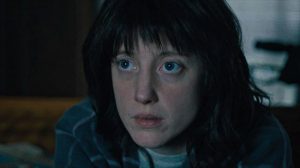
After years of taking care of her mother, Nancy (Andrea Riseborough) is at odds when she dies suddenly, leaving Nancy alone in a house she hates, and shards of a life she andrea-riseborough-im-nancy-1mostly resents. One night, she hears a story on television about a little girl, Brook, who disappeared 30 years ago. An inkling is all it takes, and soon Nancy is contacting and visiting Leo (Steve Buscemi) and Ellen (J. Smith-Cameron), the little girl’s parents, believing or half-believing or half-willing herself to be the kidnapped child, now grown up.
The only person who wants it to be true more than Nancy does is Brook’s mother, Ellen. Leo is much more skeptical, and admits they’ve had false hopes before. A DNA test is quickly procured but as they await the results, Nancy movies in and cozies up and Ellen can’t help but get attached. Ellen has been a mother without a child for 30 long years; she’s got a spot underneath her wing that’s Nancy-sized, to say nothing of the hole in her heart.

The psychology of this movie is fascinating. It really explores the depths and nature of intimacy. Riseborough is fantastic. She’s got a haunted look about her; there’s a back story that’s simply implied in her downcast eyes, her uncombed hair. Smith-Cameron is also exceptional. Her shakiness and fragility are evident in every quaking breath. Her need is enormous. A talented cast really makes this story, well-crafted by writer-director Christina Choe, come alive.

The Mercy

Donald Crowhurst is hawking navigational tools for sailing that nobody really wants. When a contest is announced that would reward the fastest sailor to navigate the globe without stopping, Crowhurst decides it’s the perfect way to showcase his product, generate press, and make himself known. He’s the last man in the water, but he hopes to make up for it by speed. The problem is, he’s just a hobbyist, an amateur sailor, and he’s going up against the world’s best.

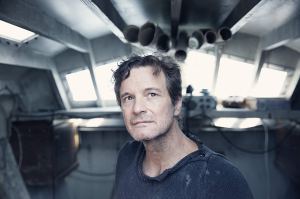
Of course, sailing around the world is the kind of competition that’s very solitary, and MV5BMjMwMTE2Mjc5NF5BMl5BanBnXkFtZTgwNzk5NTAyOTE@._V1_SX1500_CR0,0,1500,999_AL_difficult to measure. The irony is that though he’s a master of navigation, sailing-wise, it’s being away from his family that is disorienting to him. Out on his boat, alone for months, never seeing land, rarely hearing the voices of his children, Donald (Colin Firth) goes slightly mad, as one would. It’s a test of endurance, but also of mental fortitude. Though the sea and the elements thwart him at every turn, he himself is his biggest obstacle, and every day is a struggle not to quit.

At home, his wife Clare (Rachel Weisz) tries to keep the family afloat while putting on a cheery face for the children even though she frequently doesn’t know if her husband is dead or alive.

Because they’ve bothered to make a movie out of this ‘incredible true story,’ I thought I knew how it would go. I was wrong. The Mercy doesn’t exactly break new ground cinematically, but thematically it’s as crushing as it is absorbing. Colin Firth is astonishing. Frequently on screen alone, his descent into madness is magnetic. It glues your eyeballs to the screen. Rachel Weisz is no slouch, of course, but as the little woman back home, she’s given much less to do other than look fetching in a head scarf. However, when the film does call on her to be something more, you know she answers is as only she could.

The Mercy is a big lungful of salt water. It’s a surprise. It gives you a jolt. If Colin Firth is the film’s compass, Rachel Weisz is its buoy.