
Danny Lee Harris, 1984: a American track and field athlete who ran the 400-meter hurdles and won silver medals at the Summer Olympics in Los Angeles. He was the guy who always finished behind Edwin Moses, a track and field phenom, known as the guy who never loses – and he never did; he had a decade-long winning streak of over 100 races, and never lost until 1987 in Madrid, where he was unseated by Harris.
Danny Lee Harris, 2004: arrested in Santa Monica, he’s charged with the kidnap and robbery of a 75 year old woman. He faced life in prison.
Crossing The Line covers the ground between these two formative events, and what led from one to the other. Hint: cocaine.
David Tryhorn’s documentary explores the highs of sports achievements, and the lows, especially comparatively, that come after it. There’s not much that competes with winning a medal for your country, but I suppose cocaine is close. An athlete almost has to have an addictive personality in order to keep that single-minded discipline required for elite training. But what happens when that career is over and the sport just doesn’t consume you the way it used to? There’s a void. Tryhorn uses interviews with Harris’s track and field colleagues and with addictions counselors to give a fuller picture of that post-race deflation effect.
For Harris, the more cocaine he did, the more raced he need to run and to win in order to fund his habit. But running meant exposing himself to drug tests. Eventually he was caught and banned for 4 years, effectively ending his career (at the time, steroid use, an actual performance enhancer, would have only gotten him 2 years). Harris’ downward spiral feels almost inevitable, but Tryhorn is careful to paint a wider picture in which he is only one of many athletes to trace that trajectory. Crossing The Line is a well-made film that shows the flip side to sporting fame and glory.
 pay off. I suppose the story was too generic to get greenlit when played forward, but for future purposes, I’d appreciate it if Netflix could release movies in their natural order, and I’ll use my rewind button if I feel a particular need to bedevil my brains. Without proper introductions, I couldn’t even keep the character names straight. One of the film’s running jokes has its punchline right at the beginning but then we have to watch it get set up one morning at a time. It’s the kind of movie that might require some note-taking but it’s not good enough for me to be motivated to go rummage around in the drunk drawer for a pen.
 War is hell, but returning from war is really rough too. As we’ve realized the devastating effects of PTSD and how severely it has affected an entire generation of American soldiers, war movies have more frequently shown us the human effects of conflict. In my view, that is a welcome and long overdue change. I was somewhat apprehensive going into Megan Leavey, because I feared that it would try to glorify or justify the invasion of Iraq. That’s a non-starter for me because there was no legal basis for the invasion or occupation, and no glory to be had over there. You will never convince me that it was a good idea for the U.S.A. (and not just them) to send hundreds of thousands of troops to a no-win situation in the Middle East. Many of those troops didn’t come back and those that did were never the same.
 an artist who can’t sell her stuff because it’s bleak and full of rage. The two meet up years and years later, as Ashley is passing hors d’oeuvres for her caterer wife (Alicia Silverstone) at a fancy event Veronica attends with her husband. They are immediately hostile. Things escalate to the point of – you guessed it – a catfight. It’s pretty fucking brutal and it has some life-changing consequences.
 on this earth as anyone will ever be. He isn’t just going through a physical hardship, but a psychological one as well. Occasional glimpses of the rescue effort reminds us just how bleak his situation really is. Dae-kyoung (Dal-su Oh) is the only member of the rescue team truly dedicated to Jung-soo’s survival. Politicans are turning their backs and resources are drying up – are being redirected, in fact, to the construction of yet another tunnel. Meanwhile, Jung-soo’s wife, Se-hyun (Doona Bae) treads the fine line between hope and realism. This trio of actors give very fine performances. Tunnel ends up being more character-driven than action movie, and that’s a good thing. When the script demands it, the visual effects are there, but it’s Jung-woo Ha and co-stars who drive the story forward. It’s a story we’ve seen and heard before but writer-director Kim Seong-hun injects this with satirical elements that bring renewed interest to the genre.
 LY against wearing suits that they would rather take a job as a New York City bike courier and earn next to nothing ($30 for an hour and a half ride from one side of Manhattan to the other).
 not just to their rivals, but to their own community as well. Lacrosse was born on their land, the Akwesasne Mohawk Territory, but it’s a game traditionally reserved for men. Considered a gift from their Creator, lacrosse was meant as a way for men to settle disputes among tribes. The community is split as to whether women should be allowed to play this sacred game at all. Some believe that like all surviving culture, theirs too must grow and change to meet the needs of the people. Others cling to tradition. But all agree that this game is medicinal and can be used for healing. When the girls play, they take it seriously; they too want to honour their culture. Is it really such an abomination to take up their Nation’s sport?
 injustice, and people’s pain, and she decided to do something about it. She was threatened and abused because she was exposing some very dirty secrets covered up by some very powerful people. The only help she ever got was from the adoptees themselves, all of them different shades of broken, harbouring the wounded children within. The real Margaret was awarded the Medal of the Order of Australia in 1993, and Commander of the British Empire in 2011 for her work, but as this film can attest, life was not made easy for her.
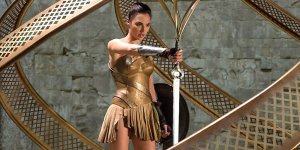 body. Her aunt Antiope (Robin Wright) is the fiercest of them all, the greatest warrior the Amazons have ever known, and she’s in charge of training. Though Diana’s mother Queen Hippolyta (Connie Nielsen) wants to protect her daughter and extend her childhood, Antiope teaches Diana in secret. Themyscira is hidden from mankind, but you never know when the enemy might arrive. Themyscira is lush and beautiful. Filmed on location in Italy, the production is fantastic. The opening scenes where the diverse population of Amazonian women are all training with Antiope are gorgeous. The fight choreography is top notch, with particular sequences slowed down to showcase athletic feats. But we all know utopia can’t last forever, and as soon as Diana (Gal Gadot) is grown, one man does penetrate their paradise: a pilot named Steve Trevor (Chris Pine) is shot down in their waters. Diana saves him from the wreckage but they’re pursued by Germans. An epic battle between Amazons and Germans unfolds on the beautiful beaches of Themyscira. The Amazons fight unlike anything anyone has ever seen, but the Germans are armed with guns and the Amazons suffer loss. Steve Trevor tells the women that the world is at war (WWI to be exact) and that millions of lives have already been lost. Aghast, Diana swears to accompany him back to where he came from so she can help bring peace, as is her sacred duty.
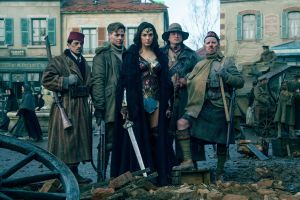 battle, there is no ego; they work together. The costumes are not sexualized as I feared, but instead they highlight muscular shoulders and toned legs. There can be no doubt that the Amazons are capable of truly anything. The fight sequences are among the best you’ve ever seen, the hand-to-hand combat precisely choreographed with as much grace as intensity. And it made me cry to see it. And I felt ashamed to cry, as a woman in 2017, ashamed that it’s taken this long to see a woman successfully take up the mantle of hero, and a woman behind the camera as well, capably directing a tentpole film. Patty Jenkins has so much unfair pressure placed on her shoulders but she’s made a movie that’s close to perfection, that far surpasses anything the DC Extended Universe has produced so far.
 superhero. The action sequences in this film are among the best, a delight to watch, full of energy, strength and ferocity, as good and frankly better than the stuff we we’ve seen from other comic book movies lately. And arguably, the reason she’s so strong is because she welcomes her softer side. Believing in fighting honourably, while looking your enemy in the eye, Diana never picks up a gun. She runs toward machine guns with only a shield and her cuffs to protect her. And she fights from a place of love. Not duty, not fury, not patriotism or revenge. She fights because she loves. Male superheroes seem to think that love is a weakness, but Wonder Woman knows better: love is the greatest motivator you could ever have.
