
George Clooney and Julia Roberts were enough to sell this movie to me, and in the end, they were enough to save it from itself.
The truth is, Money Monster teeters between a comedy and a socio-political thriller and suffers tonally. George Clooney plays Lee Gates, a slick and smug TV show host who makes stock  market recommendations in between hip hop dance moves, obnoxious hats, and lots of gimmicks. One day, live on the air, a young man (Jack O’Connell) shows up with a bomb, ready to hold him and the CEO of a certain company (Dominic West) accountable for the loss of his life savings. Julia Roberts, playing the show’s director, is stuck in the booth directing the hell out of a show that is now being broadcast worldwide to billions, while keeping her colleague (who suffers from foot in mouth disease) alive.
The problems start with Kyle, the young man who’s just lost everything. Kyle is the audience place holder. We’re not millionaire TV hosts, or billionaire CEOs. We’re the people who work hard for our money, and are subject to the whims of Wall Street. But there’s a problem with the character when he’s just not relatable – and not because he’s brought a bomb to a TV studio. In fact, I think I am more likely to start making revenge bombs than I am to ever lose everything in the stock market. You know why? Likely you do: because you never put EVERYTHING in the stock market! The stock market is NOT free money. It’s a gamble. Sometimes you win, 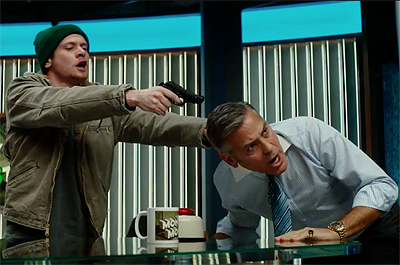 sometimes you lose. And if, like me, you know very little about this mysterious money market, you have to take advice from strangers. I tend to avail myself of the type of strangers who sit behind ornate desks with gold nameplates, but I take everything they say with a margarita-rim’s worth of salt and skepticism. Kyle preferred to go with the smarmy guy on TV who has a weekly “pick of the millennium” which is kind of like trusting Judge Judy to try your murder one charge – but who am I to judge? Kyle gambled his whole kit and caboodle and lost the kitty in no time. And did Kyle get mad at himself for being so rash? Of course not! Kyle is a dumb millennial who feels entitled to everything but responsible for nothing and so Kyle goes looking for someone else to blame, and brings a bomb as his sidekick. Nice one, Kyle.
So we don’t really feel badly for Kyle, but nor do we root for Lee Gates. He’s making a fat paycheque doing his thing on TV, and it’s pretty clear he’s forgotten that his words have real-world repercussions for people with far more to lose than he does. He’s a self-involved guy who hasn’t questioned anything until a bomb strapped to his chest forced him to. Between Kyle and Lee, it’s unclear to the audience just who the protagonist is. There aren’t any characters to really invest in – and yes, I’ve been dying to make that financial pun for 500 words now.
So maybe this is why some critics are calling this movie empty\hollow\vacuous. Sean certainly felt that the film’s final moments were jarring, and maybe inappropriate. I had a different read on them though.
 The movie is kind of a fun ride, with an almost real-time hostage situation, and we feel like we’re experiencing it along with the rest of the world. Imagine if this was happening in real life: you’d be glued to your TV or your tablet or your laptop or your phone. Where were you when President Kennedy was shot? When OJ fled in the Bronco? When the twin towers fell? Where were you when Lee Gates was held at gunpoint on live TV and made to account for his mistakes? Wouldn’t that be a Big Deal? But in the movie, the minute our characters hit a point of resolution, the whole world switches channels. They go back to their sandwiches and their IKEA catalogs. The immediacy with which it’s forgotten is arresting. Sean thought that was disgusting, and I thought it was brilliant social commentary.
So yes, I can understand why people are leaving this movie frustrated. But I also thought that was kind of the point.
 man, which is exactly what Steven Stelfox (Nicholas Hoult) is. It’s the height of Britpop, and business is booming. If you find the next Oasis, or hell, the next Spice Girls, you’re made. But one misstep can also mean career suicide. It’s a super competitive industry, and both the screenwriter (John Niven) and the director (Owen Harris) have decided to bonk you over the head with this fact. And when, after the first 10 minutes or so, you’ve been completely bludgeoned with this theme, they yank open your jaw and force-feed it to you for 90 minutes more until you’re veritably choking on it.
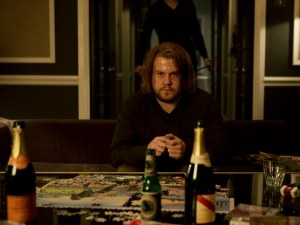 entirety, so nothing sticks out. The bitterness is unending. Kill Your Friends aims to be the blackest of comedies, but when everyone is horrible all the time it really dulls your senses. It’s a grueling film to slog through without a single redeeming character so you can’t emotionally invest. Stelfox is pushed to further and further extremes but you won’t care an iota because nobody deserves to get out of this with their dignity intact.
 To their credit, they spared zero expense on the soundtrack: Blur, Prodigy, Radiohead, The Chemical Brothers, Oasis. It reminds you what a good time it was to be alive in the late 90s. It also makes you angry that they’ve failed to live up to these bands. Almost certainly there’s an interesting tale here to tell. Kill Your Friends has no idea what it is though, and hopes you’ll be impressed with blood and cursing instead, which is almost the same as story, right?
 fault. It’s received some fairly positive reviews so I had hope that it wasn’t as bad as my gut was telling me. But now I know the truth: either the movie-going public are idiots, or they talk up a bad movie in order to trick others into paying to see it too, thus assuaging their guilt and annoyance at having sat through it themselves.
 animals is that they’re still cartoons. They’re very accurate, very expensive cartoons, but it’s just some fancy animation that makes it harder for me to anthropomorphize but doesn’t stop them from breaking out into song. The tiger is so menacing looking you can practically smell the rotting meat caught between his yellowed 3-inch teeth, yet he has the velvety smooth voice of Idris Elba. Bill Murray was a nice choice for the more playful Baloo, but let’s remember that Baloo is still a bear. A sloth bear, sure, but a bear’s a bear. Sloth bears are usually known to be docile for a bear, but they’ll still attack humans who encroach upon their living space, and Mowgli doesn’t just encroach, he fucking rides him! And
  then there’s King Louie, the big-ass scary mother fucking ape. Modeled after Apocalypse Now’s Colonel Kurtz, King Louie is a gigantopithecus, an ancestor of the orangutan, who in real life would have been about 10 feet tall and over 1000lbs. He’s hostile AF but he’s oddly voiced by Christopher Walken. Now, I love Walken almost as much as his mother does, but it was a weird and jarring choice. King Louie is scary, but Walken’s voice is far from it. He’s got the voice of a stand-up comedian or a jazz band leader, it’s one of the most recognizable voices out there, and it didn’t belong to this ape. And then he breaks out into a show tune, which is NOT something Colonel Kurtz would be caught dead doing, so the tone of the movie just falls apart like the chain falling off of a bicycle, and the whole thing just stinks. Stinks! And not just because it’s a temple full of monkeys.
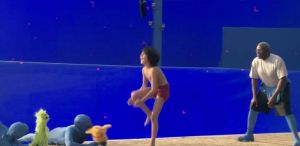 a black panther makes most adults want to scream “Run you little idiot!” In fact, Jim Henson’s Creature Shop was brought in to make puppets for Sethi to act against, but those were completely replaced with CGI versions later. And as for the lush Indian landscape, it’s 100% phony too. The whole thing was filmed on a back lot in smoggy Los Angeles with a blue screen and some Styrofoam painted to look like jungle.
 give me talking animals, that’s fine, but they’d better also have careers and pants and fart jokes. If an animal looks real and normally eats people, I don’t want to see him dancing around with a man-cub. I have zero tolerance for this movie and as far as I’m concerned, King Louie can kiss my ass.
 It’s not exactly ground-breaking material but here’s the gimmick that’ll put butts in theatres: it’s Green Day’s Billie Joe Armstrong playing Perry. And is it pretty effing cool to see him play the guy he might have been had his own post-punk outfit not taken off when it did? Yes, yes it is.
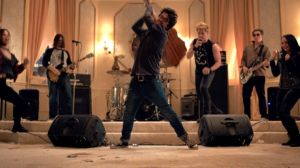 moment that he was watching Billie Joe Armstrong. I, on the other hand, thought it was a scootch worse than that. Unnatural. Self-conscious. Very “you can tell I’m acting because my hand is over here on my hip, which means I’m going through some internal conflict I’m not subtle enough to convey any other way.” And yet I’m not going to condemn him because the movie really is a vehicle for him. He’s what makes it cool and relevant, makes the movie rise above the other mid-life-crisis\path-not-taken meditations. Plus, Kirk pads the cast with some better talent: Judy Greer as the old flame, Selma Blair as the current wife, Chris Messina as the scowling brother, Fred Armisen as an ex-bandmate.
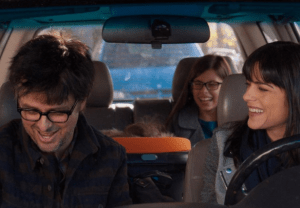 The regret without resentment shows maturity I’m surprised to see in a character like Perry. Billie Joe never quite transcends the role, but there is an honest vulnerability there that’s a little charming. And Billie Joe is not just a casting liability, he’s an asset to the soundtrack because he’s written some original music for it, and the movie is never more confidant than when Armstrong is performing. In this he excels. The songs he wrote are great and I imagine they’ll be invading your radio waves sometime soon, lending the movie some major credibility.
 an energy that defies the fact that Armstrong is in fact a middle-aged father of two. They played a couple of Green Day tunes as well, Scattered and then American Idiot, which morphed into Bad Reputation. Oh, did I not mention that Joan Jett was in the house? Yeah, she has a small cameo in the film but she got up on stage and showed the boys what a scene-stealing badass she still is. Her voice hasn’t aged a single minute and the woman’s still sporting leather pants. Armstrong closed the night with Ordinary World, the film’s acoustic ballad, and I couldn’t help but wonder at the twinkly goodness of my life. In the movie of my life, there is no path not taken.
 Frank, the dashing and charismatic reporter while Ricky Gervais plays his lackey, Finch. Finch is a clumsy and oblivious guy with a beautiful but disloyal wife (Vera Farmiga) whose ineptitude causes he and Frank to miss their career-making flight to Ecuador just as a war is breaking out.
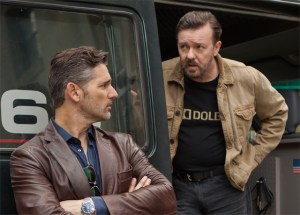 anything intelligent or funny or worthwhile or clever. It’s flimsy. Like, paper-thin. And the characters are so one-dimensional that while we can’t really believe that there is not one but two Hottie McHottersons willing to bed Finch, we also don’t really care. This feels lazy and phoned-in and at times it also looks downright cheap, and I don’t just mean that it was filmed in pretend-NY Toronto (although it was. Sidebar: Gervais’s father is Ontario-born and French-Canadian).
 J.R. Brinkley was a doctor in small town Kansas who, through the grace of his revolutionary goat-testicle transplant surgery, cured many men of impotence and infertility while bringing vitality and prosperity to the town. Brinkley had to build hospitals just to deal with the growing demand, and almost accidentally became a radio pioneer simultaneously, broadcasting ads for his services and answering write-in medical questions between blasts of good ole country music. Despite exponential interest and a horde of faithful followers, the American Medical Association accused Brinkley of “quackery.” Just as they set out to discredit him, he came out with an elixir just as
  effective as the goat-testicle procedure but with much less risk. And then he ran for governor, with a slogan borrowed from a laxative commercial. True story.
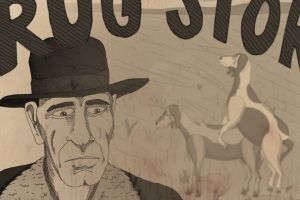 used for each segment, but there’s a uniform style that injects a lot of kinetic energy into a story hilariously but dryly narrated. You won’t believe how quaint goat fucking can look.
 This film is actually a dramatic reenactment of a documentary of the same name, by G.J. Echternkamp. And his parents are undoubtedly larger than life, which in this case is a kind euphemism for colourfully pathetic, hopeless losers. Rene Russo and Oliver Platt play the titular characters and you’ve got to admire their abandon. They each give strong performances, and you’ve got to give props to Russo in particular for her willingness to throw herself into such an unflattering role.
 to stick to the source material means this movie has no real backbone. It ambles but doesn’t amount to much. And weirdly, GJ seems to be the least developed character – it’s his story but he’s a pretty passive player. And that feels ironic since Echternkamp himself helped bring this script to life, and he’s also sitting in the director’s seat, although at times he seems to forget about the advantages of feature vs documentary – he could make the scenes look amazing yet seems to enjoy filming in dank little corners.
 exaggerated facial features on his favourite cartoon characters. One day Owen’s father is able to hold his first conversation with him in years simply by pretending to be Iago, the talking parrot from Aladdin.
 can express their love and see it reflected back, even if it’s a line originally quoted by Belle to the Beast. What I do know is that this film opens a lot of doors. This isn’t just a talking-head piece, we actually get to visit with Owen in his new situation, and his family as they continue to take on new challenges. We get to see autism in action, impacting a family and influencing a community. And we get to see that Owen is a guy with wants and needs like any other. He expresses them differently, and once you get the hang of his language, it’s not necessarily even worse, it’s just different.
 interesting and watchable is Owen himself, a very dynamic individual. He’s at his best at the helm of his Disney Club, where other learning-disabled young people gather to watch and discuss Disney animation. They may even run lines afterward, or play the score, and once in a while Jonathan Freeman, voice of Aladdin’s villain Jafar, drops in to lend a hand, and even Gilbert Gottfried, voice of Iago himself, has attended, but nobody knows the lines better than Owen himself.
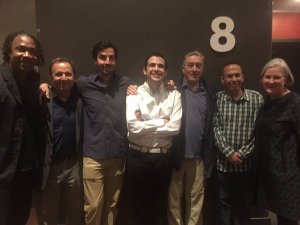
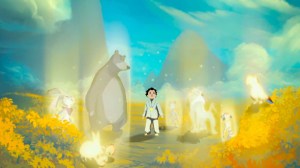 the lines. Many of the film’s crew were on hand, as well as the entire Suskind family, to launch this movie into orbit. There’s a lot of love and care gone into this work, and some of the best bits are when Owen’s own stories are beautifully animated (by Mac Guff). Owen identifies more with the sidekicks rather than the heroes of his beloved films, and he brings them to life in a very moving way.
 ASSHOLES WATCHING MOVIES