
The trailers for White Boy Rick deceived me. I expected a frenetic, over-the-top throwback full of 80s excess, rollerskating, and outlandish behaviour as fifteen year old Ricky (Richie Merritt) breaks into the Detroit crime scene in 1984, assisted by his gunrunning dad (played by the madcap Matthew McConaughey). I expected a dark comedy. I hoped for Scarface, the teenage years, with lots of action and quotable dialogue. I would have settled for half-assed ripoff of Boogie Nights, with a naive rising star breaking into a criminal enterprise.
But instead, I got a melancholy family drama about a group of deadbeats with whom I had no interest in spending any time at all. Not as friends, not as neighbours, and certainly not as the subjects of a two hour feature. Ricky’s story is not a story that deserves to be told on screen, and that’s fatal. I never could bring myself to care about him or his family, not even a little bit. That is in no way the fault of Merritt or McConaughey. It is also not an issue arising from the screenplay or the direction. It’s more basic than that: there was no saving these characters. They were simply irredeemable.
It’s unfortunate because there is a story underlying White Boy Rick that does deserve our attention: the fact that the 80s “War on Drugs” was primarily a scheme to keep America’s prisons stocked with young black men. And, as a bonus in many states, strip them of their right to vote once convicted of a felony, which many might even plead to if they were locked up and mistreated for long enough prior to trial.
That is a story that has been much better told by Ava DuVernay’s 13th (which is definitely worth your time). That is also a story that should probably not be told from a white family’s perspective, as doing so suggests that mandatorylife sentences without the possibility of parole for crack dealers are only a problem when white people start getting locked away too.
Yet, here we are. Ricky’s life is onscreen for you to shake your head at, if you so choose. But you have much better options available to you in the coming weeks (such as The Predator and Life Itself, to name two I saw this past weekend at TIFF). Then again, if you are about bad choices, like choosing White Boy Rick over either of those, then maybe you will find the movie more enjoyable due to having something in common with little Ricky and his family, who never met a bad choice they didn’t like. Yes, I just went there, but it’s for your own good.
 Laura (Vera Farmiga) loves her son, and her pets, and against all odds, her father. Her son is a sensitive, gym-hating, naked-picture-drawing type (Lewis MacDougall) who’s just been permanently expelled from school. Her rescued pets are a rag-tag, flea-ridden circus of mange, as pathetic as they are cute. Her dad (Christopher Plummer) is a drug dealer and a rapscallion through and through, and terminally charming.
 the book justice. And even happilier, the movie doesn’t suck, period, which was a major concern of mine. It seemed far too easy to just let it coast on its sentimentality. But while director Stephen Chbosky doesn’t have a lengthy track record to ease my worrisome nature, he does have one credit under his belt that’s all I really needed to hear: he adapted and directed
 inserts herself into cramped dynamics like she’s determined to put the Wicked back into Step Mother. Both throw out the red carpet when favoured son Matthew (Ben Stiller) makes a reluctant appearance. Harold has fostered a competitive streak between his children by different mothers but they otherwise aren’t close. So when their father’s life and career necessitate them pulling together, it’s a little awkward. Actually, it’s extremely awkward and kind of heart breaking. Because they aren’t bad people, they’ve just been starved of their father’s love and have no idea how to act like a family now that there’s no real chance that things will ever be different.
 Nick’s marriage isn’t quite so solid. He and Alyssa (Chloe Sevigny) have been together a decade and there have been cracks before, so we learn from Alyssa’s sister Gwendolyn (Mary-Louise Parker). Plus, Nick’s life is so, so boring (SO boring he can’t help but repeatedly describe it as ‘thrilling’, without a trace of irony, and it never fails to break your heart).
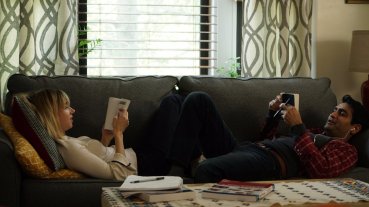 doesn’t want a commitment, his fate involves an arranged marriage, sooner rather than later if his mother gets her way. They go their separate ways, and that might have been that had Emily (Zoe Kazan) not fallen ill with a life-threatening illness that left her in a coma. Her friends all busy with finals, they call him in to sit at her bedside while her parents fly across the country to be with her.
 family dynamic between Lynskey, Ellis, and Jackson. I always feel chuffed to see Lynskey in anything; she’s the Queen of indie movies and I bow down before her. Ellis was strong right out of the gate, but I struggled to place him. It was the voice that tipped me off: I knew him from somewhere. It took until the last scenes of the movie before I had my light bulb moment – True Blood (he played the cook, Lafayette). Even the kid is good, and I’m of the opinion that child actors can make or break your project. Too many directors don’t spend near enough time finding a kid who’s more than just cute. I’m happy to report that Jackson earns his spot in the Burns trifecta. They make a family you’ll fall in love with immediately, which is what makes it so effective when they hit a rough patch. Their disharmony transfers to us.
 Summer- is a 7 year-old math prodigy named Mary. Mary (Mckenna Grace) has been doing just fine being home schooled by her uncle Frank (a bearded Chris Evans) and hanging out with their neighbour (Octavia Spencer) until Frank decides she needs friends her own age and sends her to public school. It doesn’t take long for her first-grade teacher (Jenny Slate) to discover that she’s a genius and word travels fast to Mary’s estranged but suddenly very interested British grandmother Evelyn (Lindsay Duncan).
 Screenwriter Tom Flynn doesn’t handle complex problems quite as well as Mary does. Because the question of how best to raise any child, never mind such an unusual one, can’t be as easy as his script seems to think. The drama unfolds at a tense custody battle between Frank (who just wants Mary to have a normal childhood) and Evelyn (who wants her to go to some fancy school and dedicate herself to reaching her full potential). There are interesting questions to be had here but Flynn comes up with enough sneaky screenwriting tricks and twists to get out of having to have any of them.
 ASSHOLES WATCHING MOVIES