
Quick question: How do you feel about cardboard?
Unless your name is Fuyuki Shimazu, the subject of this documentary, your honest answer would probably have to be “I don’t have strong feelings about it either way’. Until today, it was virtually impossible for me to imagine anyone responding any differently. Well, Fuyuki Shimazu loves cardboard.
It all started when he was a poor student wanting a wallet of his own but not able to afford one. Left with only two choices- do without for awhile or get creative- he made himself one out of cardboard. I can’t remember offhand if he made it from cardboard he found in the garbage or if he started doing that later.
Fuyuki’s outside the box thinking turned into a passion and eventually a career. Searching the warehouses and dumpsters all over japan, he began to collect cardboard that caught his eye and began to make a living off of making and selling wallets. And they’re nicer than you might think. Seen through Fuyuki’s eyes, yeah, I can sort of see it. I wouldn’t have noticed before but there are a lot of cardboard boxes out there with eye-catching designs.
It’s not easy to know what to make of Fuyuki at first as he travels the country to various factories to learn the stories and inspirations behind his favourite cardboard boxes. he worked at a prestigious advertising firm for 3 years as an art director where his colleagues said things like “Whenever you talk, it’s always about cardboard”, “He’s a different kind of species”, and “We have all sorts of employees so he was not the only weird one, but…”. He’s a likable guy though and seems to be able to make friends with anyone. His enthusiasm, if not exactly contagious, is endearing, inspiring, and unquestionably genuine. He’s a great subject for a documentary and director Ryusuke Okajima is smart to keep the focus mostly on him.
There’s a more universal point to all this, of course, about upcycling. With Earth’s resources dwindling as they are… Oh never mind. Just watch the movie. I promise it’ll be worth your time. And if you’re as burnt out on documentaries about the environment as I am, you’ll be relieved to know that Okajima doesn’t belabor this point and only mentions it in any detail towards the end. Fuyuki Shimazu and his wallets are fascinating and From All Corners is wise to keep the focus mostly on them.
 assert themselves sexually. All the usual bullshit about female virginity is thrown into the gutter with other outdated notions like the earth is flat, and bloodletting as a cure-all. These ladies are real, raw, and raunchy when it comes to sex, which, sure, is refreshing, and that’s nice and all, but the truth is we wouldn’t give a damn about myth-busting if it wasn’t entertaining, and this movie captures that elusive comedy magic and makes its audience howl with laughter.
 happening, it’s clear this family was quicker than most to adapt. They appear to be among the only survivors. But even if you can manage to never speak, to never laugh – can you also manage to never knock over a glass of water? To never sneeze? And what about the poor mother, visibly nearing the end of a pregnancy. Can she labour in silence, and what about the newborn – won’t his first act be to cry? In fact, this movie keeps you so on edge I despaired as the mother doled out fish and veggies for dinner. Were the vegetables suitably soft? A particularly crisp cucumber could spell certain death.
 The criminals are surprised how south this has gone, and how quickly. How are the cops already here? The tellers reluctantly tell them: the bank is haunted. The ghosts are the victims of another bank heist, an extraordinarily bloody and cruel one, and they’re not about to let another one go down if they can help it. Of course, you can warn the people in a horror movie all you want; they never listen. They never listen!
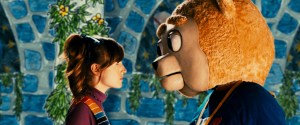 when he learns that it was Mark Hamill making the 700+ episodes all along, his main takeaway is: anyone can make a movie! So why not him? Unfortunately, the cop (Greg Kinnear) isn’t keen to turn over the confiscated equipment, and his therapist (Claire Danes) isn’t keen on the idea, period. But this is the only thing giving a grown man comfort now that he’s out in a world he never knew existed, let alone how to exist in it.
 on and a standout) because, honestly, they’re almost always really stupid. The Strangers: Prey at Night is a very good example of “really stupid”, and that is about the nicest thing I can say about it.
 depressed people can retain a sense of humour, where sadness and happiness often coincide, are two sides of the same debit card (who carries coins anymore?). Second, there are some very humane performances, particularly by JK Simmons. Writer-director Kurt Voelker manages to respect each of his character by giving them each an arc of their own. He manages to traverse some shaky ground by transcending the genres and making a film that is uniquely his.
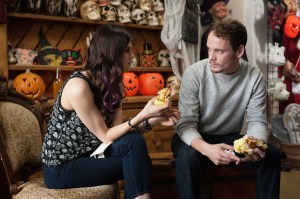 had made a promise on the devil-genie to love Evelyn forever, and she takes that shit seriously. So seriously that she digs herself out of her cold, dark grave and returns as a horny little zombie. Which may sound appealing until you account for the slipping flesh and her commitment to making Max’s life a living hell. And that’s before her cravings for brains start!
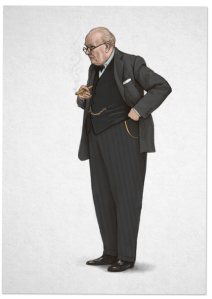 From there she was assistant costume designer on 2001’s Lara Croft: Tomb Raider and 2002’s
  that were then tailored to fit Gary Oldman in a fat suit. She was able to consult old photographs of him to get the details just right. He was pretty fastidious in his wardrobe and a bit of a “dandy” according to Durran. She had a replica of his watch and watch chain made by the original watchmaker, Breguet. She also sourced hats from Churchill’s preferred company, Lock & Co. All of these wardrobe foundations allowed Oldman to look the authentic part while still making the character his own. For Durran, the most fun was probably in dressing Churchill’s wife, Clementine, played by Kristin Scott Thomas. Clemmy was a bit of a fashion risk-taker and was once a milliner, so her wardrobe choices were a bit eccentric and she nearly always had a fabulous hat. You can imagine the kind of fun a costumer can have with that kind of starting point.
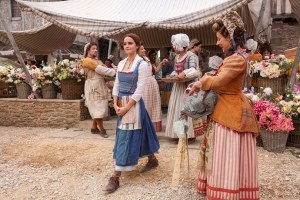 Durran chose not to recreate costumes in exact detail (which of course are lacking in simple line drawings). “My favorite bit of the whole movie is when Belle wakes up in the village, the window opens, and she says, ‘Bonjour!,’ and then you go into the song. You see the whole world of color and pattern—that’s how I wanted the village to be. That was created from an 18th-century reference: a collection of prints of French regional costumes,” says Durran. Emma Watson, who played Belle, informed a lot of the costume choices. Watson wanted Belle to seem like a more modern kind of princess, and her famous blue dress was made to be functional, allowing for movement and activity. The yellow dress, of course, is where the big time and money were spent. “In the end, it came down to the fact that, really, whatever you want to do with the dress, there is an expectation based on the animation. If you stray too far, it feels like you’re not giving the
 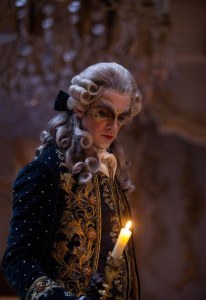 audience the dress they’re expecting. . . . But if I had actually produced the animated costume, it would have been quite simple and flat and lacking in detail. It’s not a very detailed drawing, when you get down to it. So, I looked to 18th-century France as an inspiration—the historical date and location of the movie. Also, Disney and everybody involved wanted Belle’s dress to be different from the Cinderella dress [in the 2015 live-action movie]. Emma didn’t want to be corseted. She was a more modern princess.” Not to leave out the Beast. Durran had painstakingly recreated the Beast’s costume down to the very last detail but in the end, the studio went with a CGI beast instead, and Dan Stevens ended up wearing one of those monstrous CGI motion capture suits instead. Durran sent her costumes to the animation lab where they studied the fabrics to capture the form and motion. But when he’s not the Beast, the costume work is incredible: “An amazing amount of work went into the prince’s costume in the opening ball sequence, which you don’t really see. It’s got a whole custom embroidery of different kinds of grotesque animals stitched into the pattern. It’s embellished with 20,000 Swarovski crystals that took five days to stitch on.”
 ASSHOLES WATCHING MOVIES