Monthly Archives: May 2018

TJFF: Another Planet

Over 70 years later, we’re still trying to make sense of the horrors of Auschwitz. Architects, historians, game designers, and prosecutors have started using 21st century virtual reality technology to help see history in new ways but, to paraphrase the great prophet Jeff Goldblum, just because you can do something doesn’t mean that you should.

I’m not necessarily saying that you shouldn’t. I am saying that it’s unnerving to see VR Auschwitz. We begin with a tasteful black and white recreation designed by an architect and a historian for a VR museum exhibit. They mention that the museum wanted it to be in black and white so that it doesn’t look like a comic book.

Cut to an unsettling full-colour model designed to aid in the prosecution of a Nazi war criminal. The defendant claims, as many apparently do, that he didn’t actually know what was going on at the camp and that he worked as a cook. Using this fancy new technology, forensic experts can estimate what he was likely to be able to witness from his position in the kitchen. They say that they are sure to make sure that their model doesn’t fall into the wrong  hands. What if, for example, someone were to want to make a game using their replica? Wouldn’t that be in bad taste.

Cut to an actual escape from Auschwitz virtual reality game. And this is where things get really weird.

To be fair, everyone interviewed in the film, including the video game designer, has an explanation for how their work is respectful to victims of the Holocaust and none of them are unconvincing. It’s just a little jarring. And it’s fascinating to think of technological advances can change the way we look at the past. It’s a great subject for a documentary that is sure to start some lively conversations.

The Cakemaker

One day, a handsome man named Oren walks into Thomas’s German bakery, looking for cake and coffee, and possibly a gift suggestion for his  young son. By the end of the day, Oren and Thomas are lovers, but their affair must be put on hold as Oren returns to Jerusalem to see his son and wife. A month, he tells Thomas as he walks reluctantly out the door, trying to make it sound insubstantial. One month.

Only Oren never does return, and Thomas’s calls go unanswered. There’s been an accident in Jerusalem, and Oren was killed. He isn’t coming back, to Thomas or to anyone. Grief-stricken, Thomas travels to Israel to feel close again to his ex-lover, MV5BZWRjODFhZGYtYzI4NC00M2M0LWI4MmQtZjQ4ODk5ZWIwNjQzXkEyXkFqcGdeQXVyNTUwNDQ4NQ@@._V1_SX1777_CR0,0,1777,744_AL_wrapping himself up in the city where he last knew he was alive, and he finds himself in the cafe of Oren’s widow, Anat. Thomas (Tim Kalkhof) takes solace by inhabiting different aspects of his dead lover’s life, and it’s not long before he’s helping out in Anat’s cafe, and erm, doing other things for Anat (Sarah Adler) besides. Of course, Anat is unaware of the relationship her husband had with Thomas, so it’s only her grief pushing her into Thomas’s strong but unfamiliar arms.

The Cakemaker is slow and deliberate. It feels a bit like a recipe, with ingredients lovingly chosen and carefully measured, and everything kneaded together with slow, sensuous strokes. There are no surprise ingredients, but the way they’re blended makes for a very interesting movie, equal parts delicate and passionate. Writer-director Ofir Raul Graizer stirs his creation in a way which suggests that our identities, religious, political, sexual, whatever, they’re fluid. And grief is complicated. It’s sad of course, because love is inevitably sad, but it’s the journey more than the destination, the story of survival, the getting there, and the rest is just cake crumbs.


The Cakemaker screens as part of the Toronto Jewish Film Festival and if you’re lucky, you can catch it tonight, May 9, 8:30pm, at the Cineplex Cinemas Empress Walk 9.

Humor Me

Nate, a prize-winning playwright, has been writing his most recent play for the last four years. When his wife leaves him, taking his adorable son and his ability to pay rent with her, he’s forced to do the thing he’s always sworn he’d never do – move in with his father, who lives in a retirement community called Cranberry Bog.

Of course, Bob (Elliott Gould) thinks his son is a lazy, stagnant fool who’s wasting his Harvard education, so he puts him to work fluffing and folding towels in the Cranberry Bog laundry. And Nate’s talents are further wasted by producing a portion of a musical number with the local community players, ie, old ladies who are unequal parts cranky humor-me-stilland horny. Nate (Jemaine Clement) would like to reconnect with his father, but the two have been distant since the death of Nate’s mother – and he was always closest to her. Other people think Bob is very funny, but since his answers to all of Nate’s very serious questions are always jokes, the two men remain separate in their grief.

I have loved Clement since his days on Flight of the Conchords. His performance in Humor Me is more grounded in reality than usual, infusing this sad-sack with some quirks and personality tics that give Nate some real warmth. Of course, I have loved Elliott Gould for much, much longer, and his diverse professional background is evident in every line, not all of which are truly worthy of him, but he never lets them down. In fact, I’d say the casting and performances in this film are its greatest asset. Ingrid Michaelson, Maria Dizzia, Priscilla Lopez, Joey Slotnick, Willie Carpenter, Le Clanché du Rant, Rosemary Prinz, Annie Potts, and Bebe Neuwirth fill in the gaps between Bob and Nate, creating a living, breathing community not easily conveyed through film.

Humor Me manages a delicate balance that often errs on the side of comedy. It’s light, and if it’s not exactly fresh, it has a lot of talent backing up the retreads.


Humor Me is screening at the Toronto Jewish Film Festival tonight, 8pm, at the Cineplex Cinemas Empress Walk 5, and May 10, 9pm, at Hot Docs Ted Rogers Cinema. Check it out, and bring your dad.


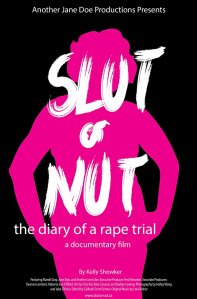
Slut or Nut: The Diary of a Rape Trial

Mandi Gray was raped. She is one of the very rare few to speak up, to pursue criminal charges, to undergo a brutalizing justice system process that seems built for the benefit of perpetrators, not victims. I want to call Ms. Gray strong and courageous for doing so, but I don’t want to imply that women who do not are not. I think Ms. Gray knows better than anyone why women choose to stay silent, or are silenced, and this documentary puts us squarely in her shoes, so we can understand it too.

Only 3 of 1000 sex assaults result in conviction. Most go unreported because even in the era of #metoo, women are categorically not believed. But for the small percentage who do bring an accusation to the police, one fifth will be dismissed as MV5BNzJiY2ZmMWItOGI4My00ZGVlLTljOWMtZGZjNjZhZjBiNjUyXkEyXkFqcGdeQXVyNzQ3MjI5NzM@._V1_SY1000_CR0,0,658,1000_AL_“unfounded” which seems to be a fancy word for the police not believing her, which is hard not to take personally when ‘unfounded’ is used exponentially more often in sex assault cases than for any other crime. If you’re a woman of colour, disabled, or a sex worker, your word is all but meaningless. But if you’re one of the small sliver of people not dissuaded yet, you may find, as Gray did, that your body is now a crime scene. A rape kit is a must for conviction, yet there aren’t enough rape kit nurses to go around. You’ll have to offer yourself, body and soul, as evidence, because for some reason it’s your responsibility to help catch the rapist. But the fun doesn’t stop there: next you’ll be revictimized in court in a discouraging, dehumanizing procedure that never grants any real justice because it’s the victim who seems to be on trial.

This is the reality in which we live, and there’s no dearth of documentaries, well-made, well-researched, passionate, rally-cry, stoke-the-fire documentaries, that point out the inadequacies of this oppressive system. And yet we need another. And another. Because as often as women have said it before, it’s clearly still not sunk in. The system is broken.

Kelly Showker puts together a documentary that doesn’t just plead for social change and justice, it shows us quite plainly just how badly it’s needed. Ms. Gray could be your roommate or your sister or your friend. Stand beside her as she relives the worst night of her life, followed by the worst year. This documentary doesn’t preach, because it doesn’t need to. It shows you the callous reality of a rape trial, and watching it, there’s really only one conclusion you can draw. Seek out this documentary. Watch it, share it, talk about it. Change only happens when we unite, and a documentary such as this has the power to make advocates of us all.


This documentary screens as part of the Hot Docs film festival; this review was first published at Cinema Axis.


Cornered in Molenbeek

Few things are more ubiquitous than a group of old men chatting about life in a local barbershop.  Cornered in Molenbeek starts innocently enough as it drops us, seemingly randomly, into one of those barbershops.  Sure, the customers are speaking Arabic, but they are also speaking about things that I might talk about with my barber (sorry, stylist).

The shop closes for the day and then, in an instant, everything changes.  News breaks of a terrorist attack on Paris.  It’s November 13, 2015 and when the cornered_in_molenbeek_1dust settles, 130 people are dead and 413 more are injured in a series of coordinated attacks at a number of locations throughout the city.  The investigation quickly determines that the attackers are from Molenbeek, Brussels, the very neighbourhood where this barbershop is located.  Of course, the attack becomes the main topic of conversation here, just like it was everywhere else.

Not surprisingly, this barbershop collective has no real answers as to what made the attackers do what they did.  Because guess what?  I have no real answers either.  The lack of answers here is revealing, though, particularly as the collective’s attempt to find an explanation weaves through a wide variety of possible causes, often looking for someone or something to blame, such as government, poverty, and the attackers themselves, with one notable exception: these people do not try to place blame Muslims as a group for these attacks, because they are Muslims themselves.  Contrary to the torrent of right-wing nationalist propaganda that is so often shouted at me online by a host of faceless idiots (oh, and also by the President of the United States), this group of Muslim acquaintances in this barbershop are just as innocent, just as angry and just as confused about the attacks as the rest of the world, and maybe more so because their religious and geographical association with the attackers draws them personally into the aftermath, exposing them to significant consequences that most people don’t have to worry about.

The phenomenon of terrorism is worthy of examination, and it was a refreshing approach to do so through the familiar lens of this barbershop, which otherwise would be functionally closed to me as a uni-lingual white Canadian (Arabic and French are the only two languages being used in these conversations).  The film’s structure serves to enhance the fly-on-the-wall feeling by letting us experience the barbershop’s normal environment before the attack happens.  The stark contrast in what is being discussed before the attack as opposed to afterward clearly shows that these types of attacks affect everyone regardless of their religion or native language, and really, we all need to be involved in this discussion on terrorism in order to stop it.  Cornered in Molenbeek does its part to start the conversation, and it’s up to us to keep it going.

Chef Flynn

Flynn McGarry, 15 in the documentary, has been “cheffing” since he was 10. I’m not talking about peanut butter toast, this kid is the real deal, sourcing ingredients most people wouldn’t recognize as food, preparing it in ambitious ways, plating it with finicky precision to detail. His mother Megan, once a film documentarian herself, has no shortage of home video of his meteoric rise to culinary stardom, and this film uses that footage liberally. We see him hosting a 12-course “supper club” for family friends in his home at age 13, with a kitchen full of children to do his bidding, and transitioning to professional pop-up restaurants in New York, with trained staff underneath him, just a few short years later.

Chef Flynn is replete with food porn sure to make foodies happy, but this documentary doesn’t exactly focus on the culinary side of things. Instead, director article-2269130-1733455C000005DC-923_634x422Cameron Yates focuses on the unusual relationship between mother and son. Meg McGarry allowed her son to drop out of school to focus on his passion. Now, nearing 16, he’s ready to move away to pursue his career. As a mother, we see helicoptering, permissiveness, indulgence, and an incredible amount of creative nurturing. But we also find a woman who has lost herself in her son’s shadow. Pursuant of her son’s great passions, she’s forgotten hers, and now that he’s ready to leave her behind, what will become of her?

Yates shows a little of the familial friction but that’s as far as he’s willing to go. This is otherwise about as thoughtful as any home video: with almost no input from outside the family, it’s hard to judge how good Flynn really is, or what place he has among top chefs. Plenty of pro chefs balk about even calling him a chef, but we never get to hear from the opposition. I think his talent and enthusiasm are in earnest, but the truth is, this is a privileged white kid whose parents indulged his whims and bought him his biggest dreams. His childhood bedroom housed more high-end appliances than my grown-up kitchen. He hasn’t paid any dues. He didn’t have to work for this. Chef Flynn is interesting, but it’s a one-sided story, all sweet with no salt, which any chef should know makes for a boring meal.

The Hollars

I’m really struggling to write this review. I’m even struggling to tell you why I’m struggling with the writing. The thing is, I quite liked the movie, liked it a lot for a movie that is perhaps not meant to be ‘liked.’

It’s about a family that comes together awkwardly when things go bad. Matriarch Sally (Margo Martingale) falls ill – a tumor in her brain requires surgery. Her husband Don (Richard Jenkins) thought symptoms including numb extremities and partial blindness were due to her weight, and sent her to Jenny Craig. Their son Ron (Sharlto Copley) has just been fired from the family business where his dad was his boss, and is living in his parents’ basement. John (John Krasinski) leaves his job and pregnant girlfriend (Anna Kendrick) to be by his mother’s side but it’s immediately obvious why this family doesn’t come together more often. The dynamic is a MV5BMjIwMTEzNjY3OV5BMl5BanBnXkFtZTgwNjg2OTY1OTE@._V1_SX1500_CR0,0,1500,999_AL_little…sticky. And perhaps in the days before a serious surgery, The Hollars could use a little less hollering and a lot more making amends.

You’ll already have noticed that this movie has a super stellar cast, and everyone’s acting like their jobs depend on it (haha – movie joke). But this could easily have just felt a little light-handed and a little familiar, but between writer Jim Strouse and director Krasinski, they manage to keep it light but not superficial.

What I adored about the film is its characters – every single one flawed. And yet even Don is sympathetic, perhaps not caring for his wife as he should but absolutely terrified of life without her. These people feel real. I feel like I’ve sat in waiting rooms with them. Crises do not bring out the best in them. They still do the wrong thing and say the wrong thing and they don’t have picture-perfect moments around the old hospital bed. Real life doesn’t work like that, and neither does this movie.

So that’s what I liked about The Hollars: the connection. Somehow it opened a creaky door to my dusty heart and beamed a bittersweet chunk of real life straight in. Dysfunction doesn’t magically iron itself out just because someone has a brush with death, but in hospitals round the globe you’ll see families trying their best to muddle through, putting on brave faces, eating vending machine junk food instead of dinner, navigating the complicated familial fault lines of in-laws and exes, making good decisions and bad decisions, wiping away secret tears, hassling doctors, re-reading the same page of a magazine twice, three times. It’s what we do. It’s not particularly dignified or graceful or entertaining, and it’s not usually the stuff movies are made of. But once in a while they sneak one through, and it’s how we know we are not alone, that other people look just as bad in bathrobes, that other families have embarrassing conflicts, that other sons have survived seeing their mothers vulnerable and scared, and lived to tell the tale.

Tiny Shoulders

Barbie has been a controversial figure since her inception. Before Barbie, little girls played with dolls that looked like babies. These dolls encouraged nurturing, mothering instincts. But then along came Barbie, a doll that had been “sexualized” with large breasts and hips, a distinctly adult doll that inspired little girls to dream about their own futures, to project their own aspirations.

I played with Barbies as a little girl. In fact, in a family of 4 sisters, we easily had over 100 Barbies between us. Probably over 200. Sometimes we’d get gifted 2 or 3 of the exact same, which was never a problem at all: “Twins!” we’d squeal gleefully.

Despite her figure, Barbie has always been somewhat of a feminist figure, albeit one FJF70_Viewerbased on conspicuous consumption. She held jobs that real life women were still dreaming about. She wasn’t saddled with kids. She drove her own car and owned her own home, independently, without the help of Ken, who was little more than another accessory. But no matter how many astronaut Barbies existed, she was still tall, blonde, blue-eyed, thin, with impossible, top-heavy measurements. Sleepover Barbie came with a scale permanently stuck at 110lbs and a diet book that simply said “Don’t eat.” Needless to say, real-life feminists could never quite embrace her, even as their own daughters flocked to toy stores to buy her up.

My sisters loved to play “family” but I had zero interest in play-acting motherhood. I was born this way: there was never a time when I didn’t know myself to be a childfree kind of gal. So Barbie was it for me. Barbie had the life I imagined for myself – a fabulous wardrobe, a cute convertible, a handsome boyfriend, a serious profession. The only problem was, she didn’t look a thing like me.

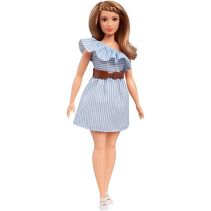
Tiny Shoulders, Rethinking Barbie documents the 2016 launch of a line of different-sized Barbies, FJF41_01including tall, petite, and curvy. Curvy Barbie has a thicker waist and no thigh gap. It seems like a no-brainer now, but for the people working at Mattel, it was ulcer-inducing times. Would feminists finally be appeased? Would they be derided for waiting too long? Would children embrace a “fat” Barbie, one that didn’t fit into the outfits they might already own? They were anxious to steer the narrative but were wise enough to know that social media would own them – and that a Time cover story would largely dictate her early adoption or lack thereof.

I would have embraced a thicker Barbie had she existed when I was a kid. Heck, I just checked out the catalog right now to see if the Curvy line includes one with pink hair and lots of tattoos (it doesn’t). Representations matters.

Barbie has never been just a toy. She’s an icon, with a place in our culture. Even Gloria Steinem has a thing or two to say about her in this doc. Director Andrea Nevins looks at Barbie’s reinvention from every angle, seemingly missing nothing. This is a moment in time worth documenting, and she has. And it also turns the tables on Barbie’s critics. Yes, this move was probably long overdue, but seeing things from the business side makes us realize what a gutsy move this truly was, with possible million dollar repercussions. Barbie will always have it just a little tougher than most if not all of her fellow toys just by virtue of who she is, what she represents, and what we project on to her. People are keen to find fault. Today she reflects a greater diversity – not every body, and not every ethnicity, but progress is progress – and not only is that worth applauding, I also think it deserves the careful consideration granted by Nevins and crew.

The Rachel Divide

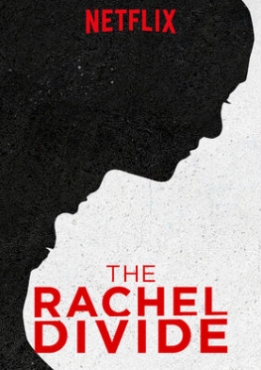
Rachel Dolezal: I bet you know her name. She’s the white woman who passed herself off as black and became the head of her local N.A.A.C.P. chapter. And in fact, she doesn’t just pretend to be black, she claims to really believe that inside, she is. She has called it transracial, perhaps to piggy-back on the recent (and limited) success of the transgendered community to gain acceptance. Transgendered people are born in the wrong body. Their biology may present as one sex but they feel very much like the other, and may even undergo reassignment surgery in the pursuit of having their bodies match their identities. But is transracial the same thing? Is it even a thing?

I definitely had opinions about Rachel Dolezal before I ever watched the MV5BYmMzZGRhMjctYTA4My00YWQ3LWJlZjUtZjZmZjU2NjI3NWMzXkEyXkFqcGdeQXVyNjc5NTc1MTg@._V1_.jpgdocumentary. It was hard not to have a knee-jerk reaction to this thing that felt wrong, felt maybe even racist, though we couldn’t quite articulate why, other than the fact that it necessarily deals in stereotypes. But on paper, it’s harder not to see her point. And in practice, it’s impossible not to feel compassion for her children who are being punished for the sins of their mother.

Laura Brownson has a fascinating documentary that really challenges your beliefs, and to me that’s the ultimate mark of a good documentary. Why did Dolezal lie? Why does she continue to hold her ground? Why does she cry about her notoriety but chase it with a book deal and now a documentary? Why was she singled out for accolades when so many actually-black women were passed over? Should her contributions to the cause be forgotten or ignored?

Brownson offers no real answers but asks enough intelligent questions that it really gets your brain juices bubbling. She doesn’t let Dolezal off the hook but does treat her like a human being, which makes her the rare exception. And I’m still not certain where my own beliefs stand, but my thoughts are a little more evolved, and a little reflection never hurt anyone.

Marvel’s 10th Anniversary: A Yearbook

I feel a little bit dirty even saying this, but Marvel Studios has recently celebrated its 10 year anniversary, which began with Iron Man back in 2008 and culminated with Avengers: Infinity War only recently. The Marvel Cinematic Universe has comprised 19 films in the past decade, which has made it the highest-grossing film franchise, bar none.
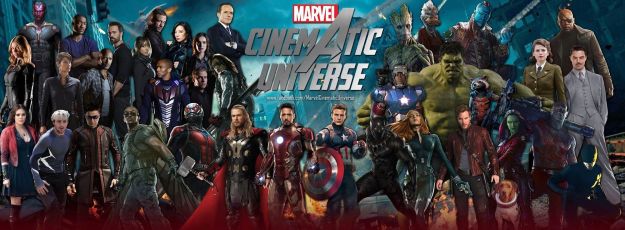
Marvel-Cinematic-Universe.jpg

For those of you who maybe got a little lost along the way:

Phase One – Iron Man (2008), The Incredible Hulk (2008), Iron Man 2 (2010), Thor (2011), Captain America: The First Avenger (2011), and Marvel’s The Avengers (2012)

Phase Two – Iron Man 3 (2013), Thor: The Dark World (2013), Captain America: The Winter Soldier (2014), Guardians of the Galaxy (2014), Ant-Man (2015), Avengers: Age of Ultron (2015)

Phase Three – Captain America: Civil War (2016), Doctor Strange (2016), Guardians of the Galaxy Vol. 2 (2017), Spider-Man: Homecoming (2017), Thor: Ragnarok (2017), Black Panther (2018), Avengers: Infinity War (2018)

Nineteen! Anyway, Marvel thinks 15 billion dollars is worth celebrating, so they’ve gathered all the actors responsible for our comic book fetish into this class picture, which you’ll need a magnifying glass in order to appreciate (luckily, with not one but TWO Sherlock Holmes among the cast [Robert Downey, Jr and Benedict Cumberbatch] those should be easy to get your hands on).

mcu_class_photo_w5.0_small-h_2018.jpg

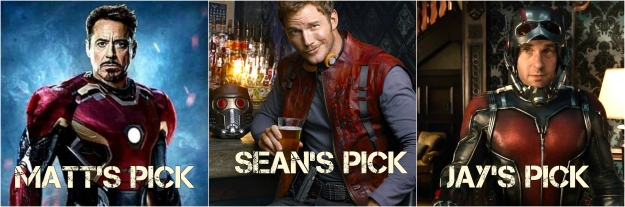
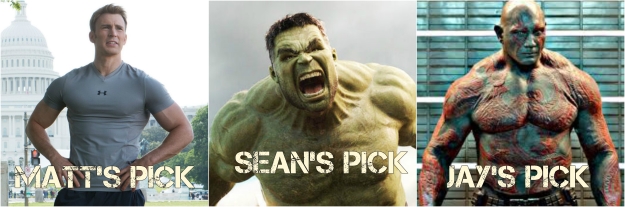
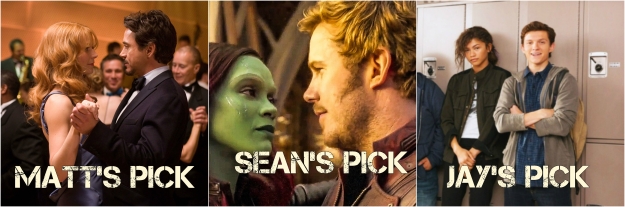
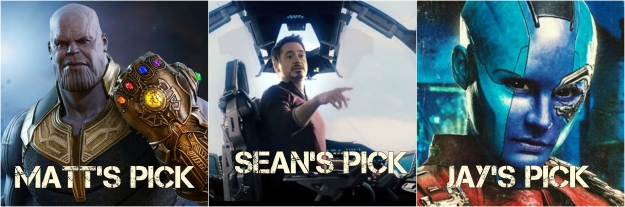
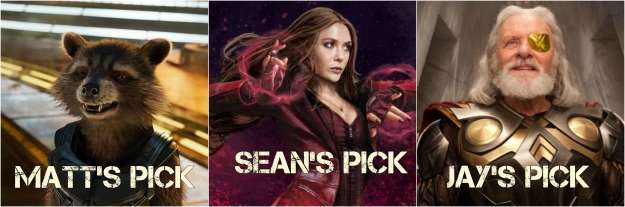
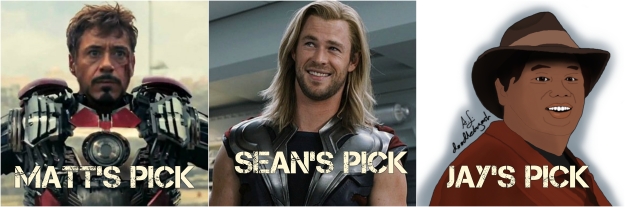
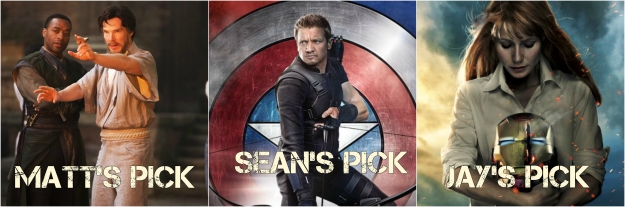
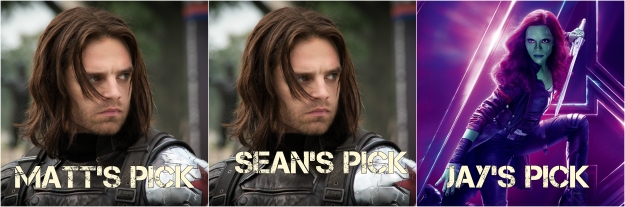
In order to do a little celebrating of our own, the 3 Assholes got together to vote on yearbook superlatives for our favourite super heroes.

Best Eyes:
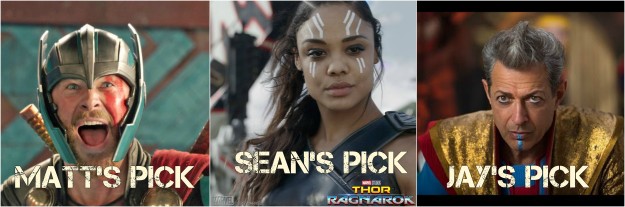
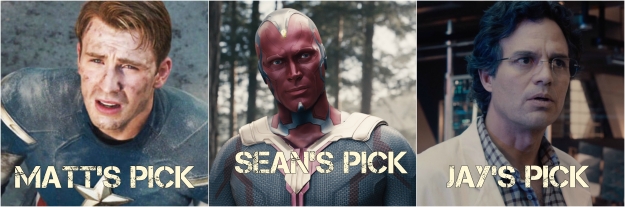
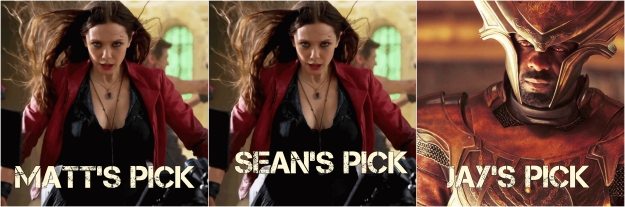
besteyesHey, we all picked from the same movie!


Best Dressed:
bestdressed.jpg
 Class Clown:
classclown
Most Athletic:
athletic.jpg
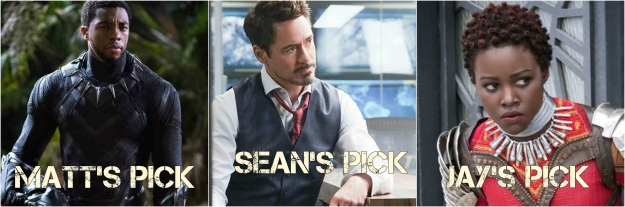
I wondered who really had the edge here, so I took to Twitter to find out what popular opinion is. Out of 41 people surveyed, an overwhelming 76% agree with Matt. 12% side with Jay. Nobody sided with Sean, as usual. And the rest wrote in Black Widow, Spider-Man & Black Panther.
Quietest:
marvel-guardians-of-the-galaxy-groot-life-size-figure-hot-toys-feature-903025
By unanimous decision, and likely unsurprisingly, we’ve got Groot!
Cutest Couple:
cutestcouple--------.jpg
Most Ambitious:
ambitious.jpg
We probably should just concede the point to Matt, as Thanos clearly wants to rule the entire universe – but Nebula wants Thanos, so isn’t that one better?
Teacher’s Pet:
teacherspet.jpg
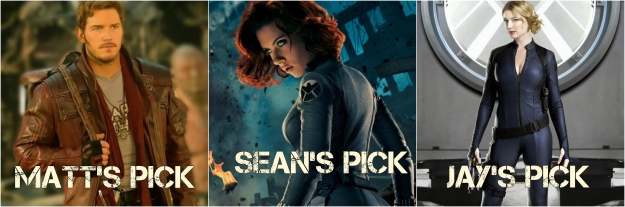
Matt went with the ultimate brown-noser, Sean went with the know-it-all, and I went with the guy who seems like he’s still living in his parents’ basement, working on his 3rd PhD just to avoid the real world for another decade.
Best Smile:
bestsmile.jpg
Honestly Matt, if Googles Images is to be believed, Black Widow has NEVER smiled!
Best person to be stranded with on a desert island:
desertisland.jpg
Sean says: “Because he’s a magician! He could get me anything i wanted!”
Biggest Gossip:
gossip.jpg
Most likely to be found in the library:
library.jpg
 Biggest Drama King/Queen:
drama.jpg
Who’s the most fun at recess:
recess.jpg
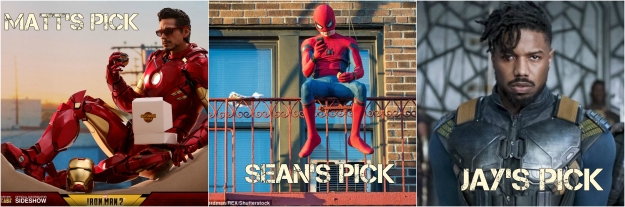
Most likely to have perfect attendance:
attendance.jpg
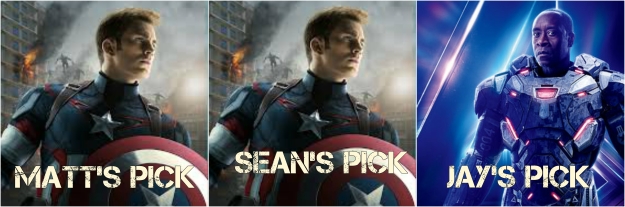
We all know Captain America’s a real goody two-shoes, but I think War Machine is just a little insecure, and he wants it more. Poor Rhodey.
Most likely to get the teacher off topic:
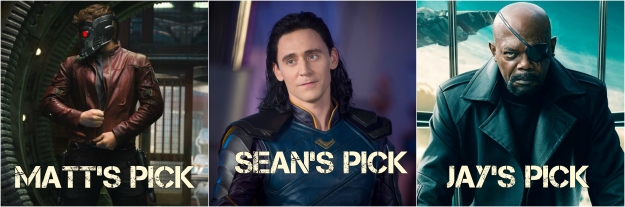
offtopic.jpg

 Best bromance:
bromance.jpg
Worst driver:
driver.jpg
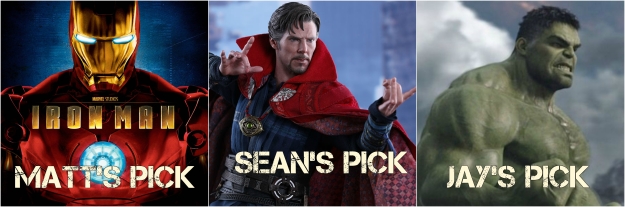
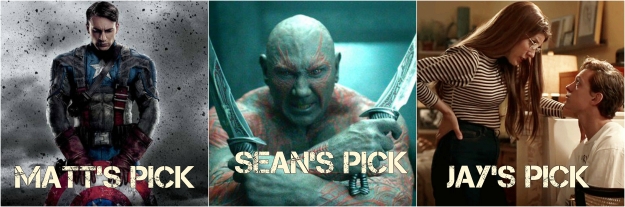
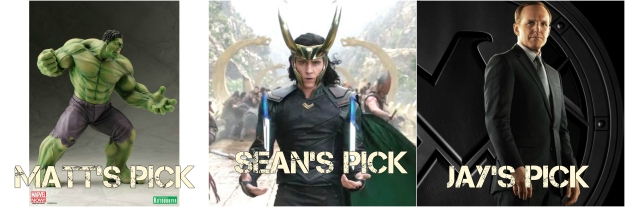
Sean, I have a feeling  you’re being very literal with your pick. Too soon? Matt’s vote is actually for “the driver in the first scene in Iron Man that gets Tony captured.” And I went with Hulk because they don’t let people drive if they have seizures…surely whatever Bruce has is worse.
Most Likely to be catfished:
catfished.jpg
Biggest Flirt:
flirt.jpg
Most likely to be late to graduation:
late.jpg
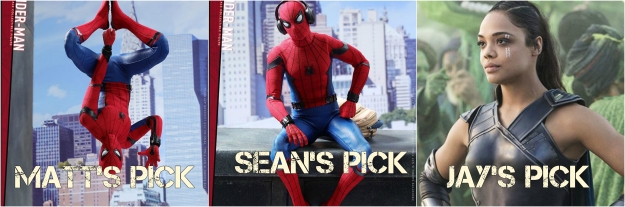
I realize that his chronic lateness is part of Peter’s charm, but may I remind you that a) it takes time to look as good as Valkyrie does and b) she woke up hungover.
Most likely to star on a reality show:
reality.jpg
Life of the party:
party
Ned & his party hat!
Biggest Nerd:
nerd.jpg
Most likely to own too many cats:
cats.jpg
He just seems a little lonely to me.
Best Hair:
hair.jpg
Really, guys?
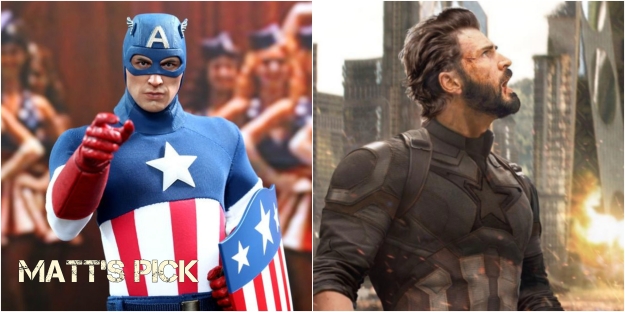
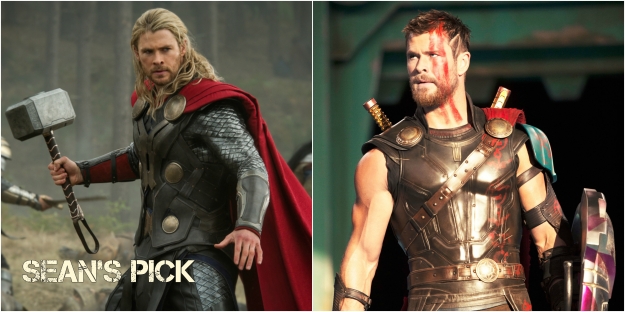
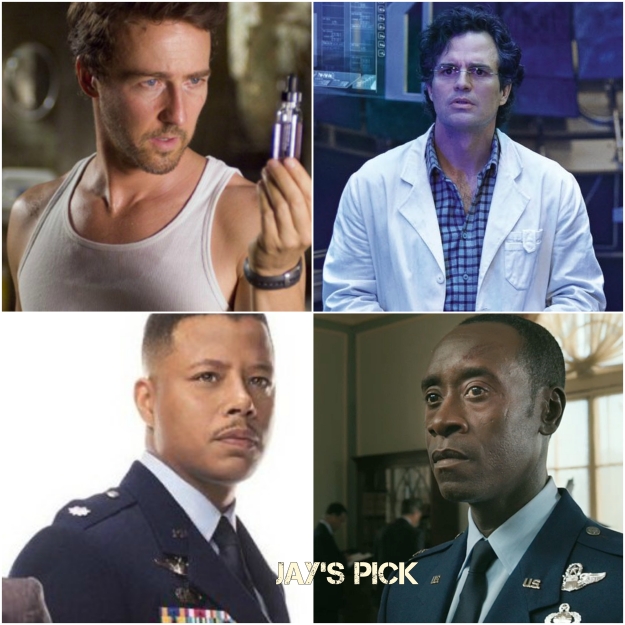
Most changed since freshman year:
captainamerica.jpg
Talk about a glow-up!
thor.jpg
I’m definitely into the haircut. Thanks, Taika!
hulk.jpg
I was feeling more inclined to remind us of this.
And finally, which character in the MCU would we personally most like to eat lunch with:
lunch.jpg
There’s little doubt you’ll find we go a lot wrong, so be sure to correct us in the comments!