
Audrie & Daisy is a documentary on Netflix that provides an in-depth look at the effects of cyber-bullying on two teenaged girls in the aftermath of their sexual assaults.
We live in a fucked up world. I was sick, and sad watching this. Sick that this is the world we’ve made for teenagers today, and it’s goddamned horrible. These little girls (14, 15 years old), nearly comatose with alcohol poisoning, are being 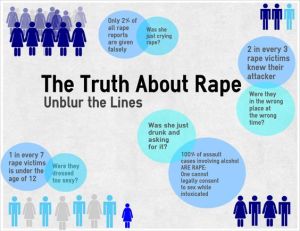 not only sexually assaulted by gangs of their peers, but that assault is being recorded. Welcome to the digital age. These photos and videos are widely and quickly disseminated and before the bell even rings on Monday morning, everyone knows. The public shame feels overwhelming, all-encompassing. It’s nearly impossible to convince such a young girl that in fact things won’t always be this way, won’t always feel this bad.
Hearing Audrie Pott’s story made me ask Sean – was this the Canadian case, the one out in Nova Scotia? It wasn’t. Her name was Rehtaeh Parsons but the case was strikingly similar: rape, pictures, bullying, suicide. How often has this pattern repeated? OFTEN. So, so often. Daisy faced not just bullying after her attack, but open disbelief and derision from a whole town when she attempted to face the perpetrator in court. The mayor of Maryville, Jim Fall, and sheriff Darren White will make you see red. It wasn’t their sons who committed this crime, but it could have been. These are the disgusting individuals raising young men to be so crass and so entitled that they will boast about rape and take pictures for evidence. And these are the men who turn their backs on the victim, and the law, when such a crime occurs.
I was livid watching this movie, and you will be too. Good. We need to get riled up about this. Because we are endangering our daughters and quite obviously  failing our sons in some very basic way. Two of them, sentenced to testify on camera for this documentary, have learned nothing. No remorse, no responsibility. One young man volunteers that the only thing he’s taken away from this is that “girls gossip.” And these boys are free – to graduate, attend college, rape again, whatever. Free, and alive, unlike Audrie, unlike Rehtaeh, unlike so, so many.
There is something broken in our culture if something like this is a trend. Directors Bonni Cohen and Jon Shenk don’t condemn the Internet, they sensibly promote it as a tool for these girls to band together, to realize they are not alone. But it clearly has far-reaching implications that we need to take more seriously. Sending or sharing a video of a 14 year old girl getting raped isn’t just taking part in the sexual assault, it’s disseminating child pornography. Penetration isn’t the only crime here. Social media is making all the looky-looks culpable. As Daisy so eloquently quotes in the film, the words of our enemies aren’t as hurtful as the silence of our friends. It takes a whole community to do the right thing. This isn’t just a bad apple scenario, it’s a blight on the whole damn orchard.
 education, the ability to visit over 40 countries while still in his teens, and loads of opportunity. He sprinkled his good fortune with charitable acts for others. But in the movie we don’t see a lot of Dan Eldon, activist. Rather we see Dan Eldon, purveyor of white privilege, with a side of white saviour to further sour the milk.
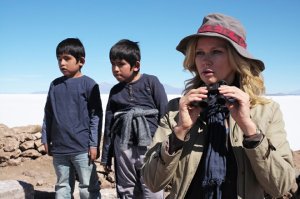 The landscape has significantly changed, the salt flats growing exponentially. A volcano that runs underneath shows signs of erupting as a result, which would mean a global disaster. Like a wiping out of humanity disaster. So, in a strange bid to fix things, a misguided man (Michael Shannon) kidnaps a scientist (Veronica Ferres) and abandons her on the salt flats along with two blind boys.
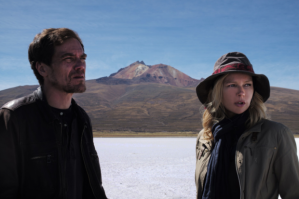 suggest that there is a thrill to be had here (other than the panicked state of Bernal’s panties) is laughable. Most of the film is just unending shots of salt. There’s a good 10 minutes just watching the kids play Trouble (the board game) for the blind.
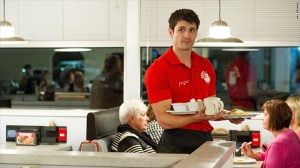 resume thrown out of places from carpet fitters to mechanics. Only a chicken and waffle restaurant will take him, where he’ll fall under the tutelage and benevolence of grill man Danny Glover, who insists on being called Waffle Daddy.
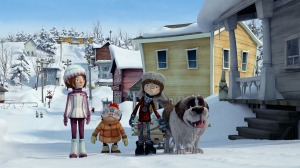 territory, the whole school would assemble into our tiny gym, and one of the few movies screened for us on a 24-inch TV was La guerre des tuques. It was a movie about a bunch of kids who wage an all-out snowball fight in the vicinity of a huge snow fort during their winter break. La guerre des tuques literally translates to war of the tuques, but the English version was called The Dog Who Stopped The War.
 yes there are hockey sticks, but also lacrosse sticks and curling brooms.
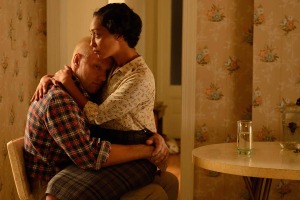 The movie’s success lies in what a small, personal story this is. We never feel like the whole south is against them – but it feels worse that it must be one of their neighbours who keeps ratting them out. The police come, guns drawn, to break down their door in the middle of the night in order to catch them in a crime – that of sleeping next to itch other in marital bliss.
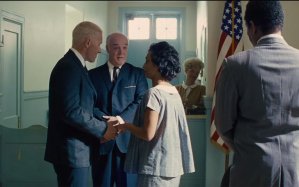 reserved. There’s not a lot of grandstanding. In fact, he turns his back (and his camera) away from the big, sweeping court scene in order to keep it once again in the heart of the family. Easily eliciting a flood of emotions, it’s actually a relief to see them played out so superbly on Negga’s face, and in Edgerton’s shoulders, rather than some melodramatic speech. The restraint here is a credit to Nichols’ directing, but also to this wonderful casting.
 not going to query studios or go to auditions, they’re done with doing it the Hollywood way. Now they’re desperate enough for the lowest kind of fame: Internet fame.
 underground tape X-V, literally a supercut of every fantastically horrific, violent, gory thing that has ever happened on film, set to some delicious pop. It’s nauseating good fun.
 The talking head interviews are culled extensively from the guest list of the 2015 festival, and include the likes of Toni Colette, Michael Moore, Patricia Clarkson, Judd Apatow, Mimi Leder, Paul Feig, Catherine Hardwicke, Angelica Huston, Jill Soloway, Mira Nair, and so many more.
 carpet when she broke out a sign reading ‘Budget the Baby’. She says “As an actor I can claim a massage or a facial but I can’t claim childcare. Actors are the most pampered people on sets. It’s the crews — the electricians, catering, camera people — who are often on set at 4am.” Hope Dickson Leach is a mother of two herself; you can imagine what a grueling 20 hour day on the set can mean to a family with young children.
 world, praised him for his quick thinking and skill. His maneuver saved every soul on board. It was quickly labelled “The Miracle on the Hudson.” He made the rounds of late night talk shows, smiling politely as hosts feted him, but that smile was a facade.
 lives on the line, his own included. Aaron Eckhart plays Skiles, the right-hand man with an equally formidable mustache (what is it with pilots and mustaches?). Laura Linney has is relegated to an even smaller part, as the wife on the other end of a telephone. Both are fine, but this is clearly Hanks’ show, and Sully’s story. He’s the one not just with his reputation on the line, but his career and pension and ability to support his family in flux too.
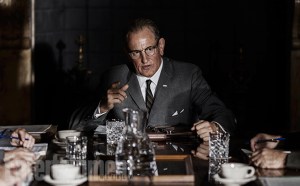 Rob Reiner, a venerable talent who hasn’t directed anything of note in a couple of decades. As he introduced this film to the TIFF audience, however, it was clear that this movie really meant something to him. He talked of being a young man during LBJ’s time in office, and hating him because he was the man who could send you to your death in Vietnam. Only with time, age, and political engagement could he look back at Johnson as something more. He was the president who had to shoulder the burden and responsibility of John Kennedy’s legacy. He took over lots of the civil rights work that JFK had begun, and LBJ is the one who pushed it through, though history sometimes forgets to give him credit for this.
 the way Jackie does. That said, I still found it to be quite enjoyable. The film neglects to give us a complete picture of the man, but does focus interestingly on LBJ’s rivalry with JFK, allowing Harrelson to swing between cockiness and shame and a whole presidential gamut in between – it’s refreshing to watch him flexing so readily after a string of second-banana performances. He’s playful bordering on hammy, showing us wit, vulgarity, searing intelligence, and frustrated ambition.
