
Despite never having read the book(s?) upon which this movie is based, it still felt all too familiar to me while watching Miss Peregrine’s Home for Peculiar Children. Could it be that we’ve finally seen the bottom of Tim Burton’s bag of tricks, and now we’re just watching the shadow of his talent?
Miss Peregrine (Eva Green) keeps the wards in her charge safe by keeping them in a 24 hour time loop, the 24 hours before their beautiful home is to be bombed by the Nazis, circa 1943. Neither she nor her peculiar children age while in the time loop, but to step  outside of it would have time catching up to them in a hurry. Inside their cozy little loop, they can be as peculiar as they like without repercussion. Or they could until a peculiar gone rogue (Samuel L. Jackson) invents monsters to hunt them. That’s why Abe (Terence Stamp) chooses to live outside the loop – true he has to leave behind his love, but he keeps her and everyone else safe by hunting the monsters in turn. But in his old age, Abe meets an ugly demise and his eyeless body is discovered by his teenaged grandson, Jake (Asa Butterfield ), the only one suspicious enough (or peculiar enough?) to avenge his grandfather’s death.
Once Jake discovers the time loop and the peculiars, Tim Burton is in his element. He’s excellent at creating worlds, giving them texture and meaning and magic, and populating them with loads and loads of white people. Oh, haven’t you heard? Tim Burton’s a racist now. Well, not so much “now” as always, it’s just that only now are we really paying attention. Tim Burton is visionary; he can conjure ghosts in cheap suits, demon barbers and talking caterpillars – but cast a person of colour as one of his peculiars? That would just be weird. That is too much of a stretch of Burton’s imagination.
If it was just the Peculiar Children who suffer from his pale proclivities, we might forgive him, but a cursory glance over his IMDB list has me horrified. Samuel L. Jackson is the first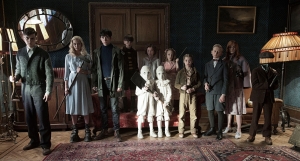 black man he’s cast in a leading role EVER, and you know he’s playing a villain. Jackson aside, Tim Burton’s casting takes on a very pale shade of white. His sets may be designed in technicolour but Tim Burton himself only dreams in caucasian. And it’s not really Tim Burton’s fault. We’re the dummies who have accepted this unthinkingly for years. He’s had huge ensemble casts with not even a tan among them and I for one haven’t even thought to question it.
We’re awake now, though, and the cat’s not getting back into the bag, no matter how many claw marks Tim Burton accrues trying to stuff the fucker back in. His words, you see, have proven even more damning than his pasty casting choices. “Things either call for things, or they don’t” he’s said, meaning, if a script says “African American”, he’ll cast an African American. But if a script says “person”, Burton reads it as “white person.” And that’s exactly the kind of inherent bias we most especially have to watch for. White tends to be the default far too often in Hollywood (and in life). But audiences are not. Audiences are made up of real people, a whole rainbow’s worth. And in 2016, we demand to see that reflected on the screen.
Tim Burton is just another old white dude defending the old guard. He wants things to stay the same. Dude with scissors for hands? Sure. Obsessive candy man? Why not. Orphan in a rubber suit playing god? As long as he’s not black, have at it!
“I remember back when I was a child watching “The Brady Bunch”and they started to get all politically correct, like, OK, let’s have an Asian child and a black — I used to get more offended by that than just — I grew up watching blaxploitation movies, right? And I said, that’s great. I didn’t go like, OK, there should be more white people in these movies.”
-Tim Burton, ladies and gentelmen
Of course his ignorant comments have done nothing but confirm the need for the very thing he’s eschewing. The truth is, for as long as this white default exists, we need to fight it consciously by countering it at every turn. If a script doesn’t demand it, society should. There is no room for lazy racism like Burton’s in 2016; it’s time to stop casting movies like they’re segregated.
Never mind that Blaxploitation movies were born in response to systemic racism and preached empowerment. Let’s just take his statement for what it is: white privilege, white ignorance, and an embarrassing amount of #alllivesmatter racist thinking. Tim Burton needs to pull his white head out of his white ass, and we all need to hold him accountable. And maybe while he’s at it he might also make a movie not so nakedly derivative of his old work. 😉
 Africa. The whole point of this film is rooted in poverty. A chess club is started in Katwe because of poverty – because mothers are too afraid of medical expenses should a child break a bone during soccer. So a board game is just more appealing. One of the big draws in getting the children to come in and learn the game is that the chess is served up with a free cup of porridge.
 enough to represent Uganda internationally. As she begins to win, and to travel, she glimpses the life that could be hers if her chess game complies. But now that she’s playing not just to win, but to change her life, and support her family, it’s a lot of extra pressure any little girl’s shoulders.
 starts believing it, truly believing that her beauty is important and holds power over other people, that’s when things start to bubble.
 up with that head-stomping scene in Drive. And all the other scenes in Drive. I described Neon Demon to Sean as “less plot than Drive, and with super models” and also as “this year’s weird movie” to which he replied “Beasts of the Southern Wild weird?” and I answered “No, more like
  not really either of those two things. Surprise third option! I definitely didn’t hate it. Lord it has some of the coolest images I’ve seen in a film, ever. Gorgeous. Stunning. It’s one of the boldest things I’ve ever seen on film and I’m giving lots of credit to Refn’s cinematographer Natasha Braier (what! a female cinematographer??) Together, Refn and Braier create an unforgettable world that is hyper-real, extreme in both its beauty and its grit. The colour palette tells a story all on its own, progressing seamlessly from beginning to end.
 found it to be kind of empty. Like there’s obviously an allegory here, about our culture’s emphasis on female beauty, and on a certain kind of white girl skinny beauty in particular. And the dangers of narcissism. And female cattiness, which I almost hate just on principle. But this movie didn’t make me think. Like, at all, beyond “Oh, that’s gross.” So treat it like a high fashion magazine with pretty pages to flip through. I just can’t give it much more credit than that.
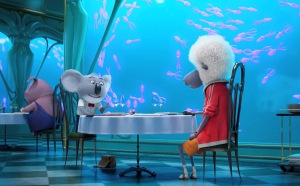 living. The theatre’s bankrupt. He hasn’t had a successful show in – well, maybe ever. The bank’s about to swoop in and take it from him, so in a last ditch effort to save it, he plans a singing competition.
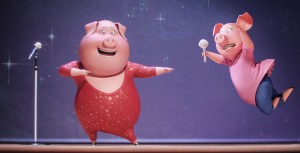 Gunther, a flamboyant dancing pig (Nick Kroll) partnered with Rosita, a shy momma pig with a big voice (Reese Witherspoon); an arrogant crooner of a mouse (Seth McFarlane); and a timid teenaged elephant with stage fright (Tori Kelly).
 Catrin (Gemma Arterton) hired to write “slop” (ie, the female dialogue) appeases him by enlarging the role of the drunk uncle just for him. Convincing her boss Tom (Sam Claflin) to let her do this is as infuriating and degrading as you’d imagine – until he starts to fall in love with her, of course.
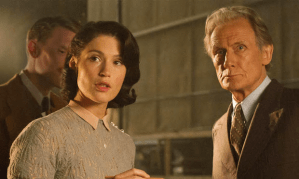 She mustn’t get too attached to feeling useful or creative. The war makes everything tenuous.
 The good news is, it’s on Netflix now, and you can satisfy your curiosity as to how Norwegians handle disaster flicks. The easy answer: a lot like us. Sure they sound a bit like the Swedish Chef (yes I really am this ignorant!), but they’re privy to all the same tropes that we are:
 geologist who knows what’s coming, only no one will believe him. Classic case of ignored scientist syndrome. His wife Idun (Ane Dahl Torp) and son Sondre (Jonas Hoff Oftebro) are at a resort hotel in town. He and his young daughter Julia (Edith Haagenrud-Sande) are of course elsewhere so of course when the alarm finally does sound, it’s too late for most, and this family will have to further test the odds by dividing them.
 Lion tells the true story of a 5 year old Indian boy named Saroo. Separated from his brother one night, he falls asleep on a train and wakes up miles away from his home, his family, from people who speak his language. He survives on his own for weeks before being thrown into an orphanage and then shipped down to an Australian family who adopt him.
 task but Saroo is miraculously lucky. Off he goes to India, to see if he can locate any family near the place he once called home.
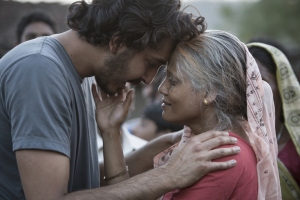 the screen. It literally is just a guy staring a screen night after night for weeks, months, years. He’s moody and emotional in between, throwing his relationship (with Rooney Mara, in an underwritten role) onto the rocks. Nicole Kidman gives an admittedly strong and stirring performance as his mother and helps bridge the gap, but there’s a marked lag until Patel goes back to India.
 As you may know, Pixar started the trend of releasing shorts before their films. It was a great way to showcase some stellar work that often gets overlooked. Disney has taken a page from the Pixar handbook and saw lots of success with its Frozen short, Frozen Fever, which aired before Cinderella. Inner Workings is slated to debut before their November release of Moana.
 and his heart. From the moment he wakes up, we see the interplay between his two most boisterous organs, and the way they direct the others as well. The organs have been properly Disneyfied – they are cute, they are funny, but they are never gross or full of blood and guts. Paul is just a regular guy who’s got to get to work. His brain marches him toward the office while his heart is distracted by the many other tempting options. The pace is jaunty, the jokes are clever, the short is colourful.
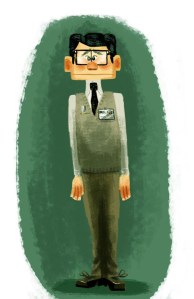 the encyclopedias he studied as a child, clear plastic pages holding the nervous system, circulatory system, etc of a man that could be overlaid on a body to see what fit where. Working at Disney as a storyboard artist, Leo along with many others, was invited to an open-pitch, where anyone could present their idea to John Lasseter and one would be chosen for production. Leo wrote his story with those encyclopedia images in mind. Spoiler alert: Leo won. Lurie mentioned that his deadpan pitched coupled with fanciful and humourous drawing really made his presentation stand out.
 Marnie has a little bit of money and an awful lot of time, so she packs up her New Jersey home and finds herself a condo in L.A. where her daughter Lori writes for television. Marnie’s California awakening is intoxicating. She loves all the things that most of us hate about L.A. But shopping at The Grove and volunteering only fill up so many hours. The rest are spent calling or visiting her daughter. Her daughter is not impressed.
 encouraged her to set boundaries with her mother, Marnie sees the therapist herself. And when that doesn’t go as expected, she finds other people to mother, like the ‘genius’ she overuses at the Apple store, and a friend of her daughter’s who’s more receptive to advice and well-intended intrusiveness.
